DataOps vs DevOps: Which Is Better for Modern Enterprises in 2025–2026?
Engineers analyzing systems and data pipelines while comparing DataOps vs DevOps for enterprise automation and infrastructure management. Choosing between DataOps vs DevOps depends on whether your enterprise prioritizes software delivery speed or data pipeline reliability.


Introduction: The Battle for Operational Excellence
The debate around DevOps vs DataOps is reshaping how modern enterprises think about technology operations. While DevOps has been the gold standard for software development and delivery for nearly two decades, DataOps has emerged as its data-centric counterpart — and the two are increasingly being evaluated side by side as organizations pursue AI readiness, cloud scalability, and faster time-to-value.
But framing this as a binary choice misrepresents the reality on the ground. For most enterprises, the real question is not which discipline to adopt — it is understanding how each one works, where it applies, and how the right talent and services can make both thrive. Whether you are looking to hire DevOps engineers, invest in DevOps managed services, or build a DataOps function from scratch, this guide breaks down everything you need to know.
According to Gartner’s 2025 Market Guide for DataOps Tools: “The DataOps market has evolved into a strategic data management foundational capability, driven by the increased need for optimized data pipelines to support AI initiatives and growing analytic use cases.”
Key Takeaways: DataOps vs DevOps (2025–2026)
- Complementary, Not Competitive: DevOps and DataOps are not mutually exclusive; DevOps powers the software applications, while DataOps powers the data-driven insights those applications rely on.
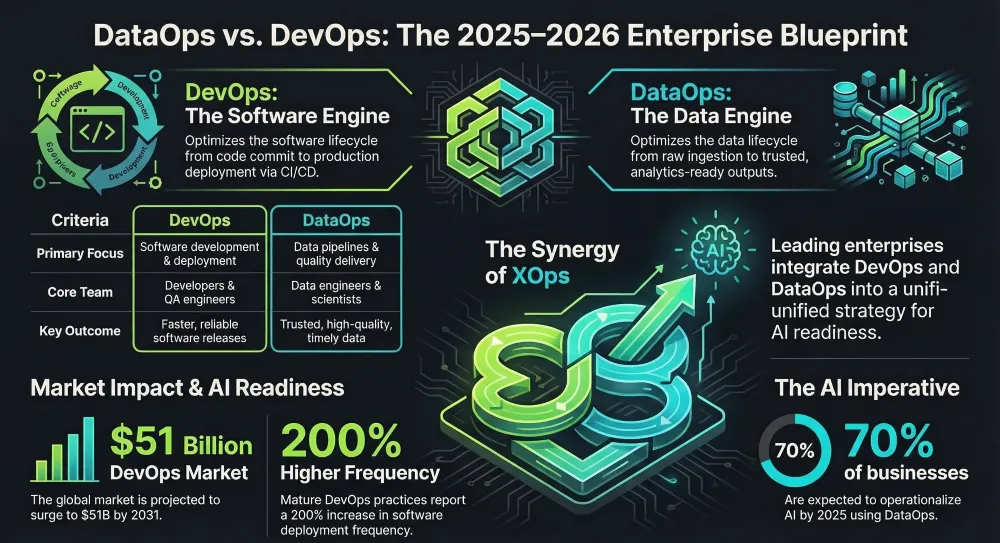
- The AI Imperative: DataOps is now recognized by Gartner as a “foundational enabler for AI readiness,” essential for the 70% of businesses expected to operationalize AI by 2025.
- Explosive Market Growth: The global DevOps market, valued at $16.1 billion in 2025, is projected to surge to over $51 billion by 2031 with a CAGR of 21.3%.
- Distinct Governance Needs: While DevOps focuses on deployment security and reliability, DataOps must navigate complex data privacy (GDPR/CCPA), lineage tracking, and data quality.
- The Rise of XOps: Leading enterprises are moving toward “XOps”—a framework that integrates DevOps, DataOps, MLOps, and DevSecOps into a unified operational strategy.
- Talent Crisis: DevOps Engineers remain a top-tier global career, but “DataOps Engineer” is rapidly following the same trajectory as demand for AI-ready data foundations grows.
What Are We Comparing?
Before diving into the technical weeds, let’s define the players. While they share a common suffix (“Ops”), their missions are distinct.
What Is DevOps?
DevOps is a cultural and technical philosophy that unifies software development (Dev) and IT operations (Ops) to shorten the software development lifecycle while delivering high-quality software continuously. At its core, DevOps relies on collaboration, automation, continuous integration and continuous delivery (CI/CD), and real-time monitoring.
Originating in the late 2000s as a response to the bottlenecks created by siloed development and operations teams, DevOps has now become standard enterprise practice. Key capabilities include:
- Continuous integration and continuous deployment (CI/CD) pipelines that automate code testing and release
- Infrastructure as Code (IaC) using tools like Terraform and Ansible to manage environments programmatically
- Containerization with Docker and orchestration with Kubernetes for scalable, portable deployments
- Real-time application monitoring, logging, and incident response
- Security integration through DevSecOps practices embedded across the development lifecycle
The global DevOps market was valued at approximately $16.1 billion in 2025 and is projected to reach over $51 billion by 2031, growing at a CAGR of more than 21% (Mordor Intelligence, 2026). Organizations using mature DevOps practices report a 200% increase in deployment frequency and a 50% reduction in time-to-market.
Many enterprises today rely on DevOps managed services to accelerate this transformation without building every capability in-house. Managed DevOps providers take on the operational complexity of toolchain management, pipeline configuration, and ongoing optimization — freeing internal teams to focus on business-critical software innovation.
What Is DataOps?
DataOps applies the same principles of DevOps — automation, collaboration, agile methodologies, and continuous delivery — but specifically to the world of data management and analytics. The goal is to accelerate the delivery of reliable, high-quality, and actionable data to those who need it across the organization.
Gartner defines DataOps as “a collaborative data management practice focused on improving the communication, integration, and automation of data flows between data managers and data consumers across an organization.” Forrester adds that DataOps is “the ability to enable solutions, develop data products, and activate data for business value across all technology tiers, from infrastructure to experience.”
DataOps encompasses a broad set of practices and capabilities:
- Automated data pipeline orchestration, from ingestion through transformation and delivery
- Continuous data quality monitoring, anomaly detection, and lineage tracking
- Data observability to understand the health and reliability of data assets
- Agile collaboration between data engineers, data scientists, business analysts, and stakeholders
- Environment management across development, staging, and production data infrastructure
The Gartner 2025 Market Guide for DataOps Tools identifies DataOps as a foundational enabler for AI readiness. As enterprises increasingly rely on AI and machine learning, the demand for clean, trusted, and readily available data has never been higher — and DataOps is the operational practice that delivers it.
Also Read: The Ultimate Guide to DevOps as a Service (DaaS) in 2026
DataOps vs DevOps: Head-to-Head Comparison
The following table captures the essential differences between the two disciplines across key dimensions that enterprise technology leaders need to evaluate:
| Criteria | DataOps | DevOps |
|---|---|---|
| Primary Focus | Data pipelines, quality & analytics delivery | Software development & deployment lifecycle |
| Core Team | Data engineers, data scientists, analysts | Developers, QA engineers, operations team |
| Key Outcome | Trusted, high-quality, timely data | Faster, reliable software releases |
| Automation Scope | Data ingestion, ETL, testing, monitoring | CI/CD pipelines, infrastructure, testing |
| Collaboration | Data + business + analytics stakeholders | Dev + Ops + Security (DevSecOps) |
| Maturity Level | Emerging — growing rapidly post-2020 | Established — mainstream enterprise adoption |
| AI Integration | MLOps, data observability, AI pipelines | AIOps, AI-assisted coding, testing |
| Governance | Data quality, lineage, compliance | Security, access control, change management |
| Tools (examples) | Apache Airflow, dbt, Atlan, DataKitchen | Jenkins, GitHub Actions, Docker, Kubernetes |
Key Differences: DevOps vs DataOps Explained
1. Purpose and Scope
The most fundamental distinction in the DevOps vs DataOps debate is what each methodology optimizes for. DevOps optimizes the software delivery pipeline — from code commit to production deployment. DataOps optimizes the data delivery pipeline — from raw data ingestion to trusted, analytics-ready outputs.
Think of DevOps as the engine that powers application delivery, while DataOps is the engine that powers data-driven decision-making. Both engines run on similar fuel (automation, collaboration, CI/CD principles) but serve fundamentally different machines.
2. Team Composition and Culture
DevOps unites software engineers, QA professionals, and IT operations staff under a shared culture of responsibility for the full software lifecycle. The hire DevOps engineer market reflects this: companies look for professionals who can bridge code writing, infrastructure management, security, and monitoring.
DataOps teams, in contrast, center on data engineers, data scientists, analytics engineers, and business analysts. These teams must collaborate closely not just with each other but with the business units that consume data products — a uniquely cross-functional challenge that DataOps is designed to address.
3. Automation Targets
In DevOps, automation targets the build, test, and deployment of application code. Pipelines in DevOps automate the journey from developer commit to live software.
In DataOps, automation targets the ingestion, transformation, quality validation, and delivery of data. The pipelines are not about software features — they are about ensuring that the right data, of the right quality, arrives at the right destination at the right time.
4. Governance and Compliance
While both disciplines care about quality and reliability, their governance concerns differ significantly. DataOps must handle data governance, privacy compliance (GDPR, CCPA), data lineage, access control for sensitive datasets, and audit trails for regulatory reporting — challenges that do not typically fall within the DevOps domain.
DevOps governance centers on change management, deployment approvals, security vulnerability management, and service reliability agreements. The rise of DevSecOps has blurred the line between security and operations, with 63.3% of security professionals reporting that AI is now helping write more secure code and automate application security testing (Global DevSecOps Report, 2025).
5. Toolchain Maturity
DevOps has a significantly more mature and standardized toolchain. Tools like Jenkins, GitHub Actions, GitLab CI, Docker, Kubernetes, and Terraform have achieved near-universal enterprise adoption. The DevOps tools ecosystem is vast, well-documented, and supported by major cloud providers (AWS, Azure, GCP).
DataOps tooling is evolving rapidly, but remains more fragmented. Gartner notes that the DataOps tools market lies at the intersection of data observability, data quality, data governance, data integration, and DevOps platforms. Tools like Apache Airflow, dbt, Monte Carlo, DataKitchen, and Atlan are prominent — but no single tool dominates the way Kubernetes does in container orchestration.
When to Use DevOps vs DataOps
Choose DevOps When:
- Your primary challenge is accelerating software delivery and reducing deployment friction
- You need to manage complex infrastructure across cloud-native or hybrid environments
- Security, reliability, and deployment consistency are top-of-mind concerns
- You are scaling engineering teams and need standardized CI/CD workflows
- Your organization wants to adopt platform engineering, SRE practices, or DevSecOps
Choose DataOps When:
- Your data pipelines are fragile, slow, or producing unreliable analytics outputs
- Business stakeholders are losing trust in the accuracy or timeliness of data
- You are building or scaling a data platform to support AI, ML, or real-time analytics
- Data governance, compliance, and lineage are regulatory requirements
- You are managing a complex multi-source data ecosystem with multiple teams consuming different data products
Consider Both When:
Modern enterprises building AI-first platforms almost certainly need both. The AI/ML model lifecycle spans both worlds — DevOps manages the code and deployment of AI applications, while DataOps manages the data that feeds those models. This is where MLOps sits at the intersection of both disciplines, and why Gartner has introduced the concept of XOps — a broader framework encompassing DevOps, DataOps, MLOps, ModelOps, and SecOps as interrelated disciplines.
Bridging the Gap: Full-Stack Techies for DevOps and DataOps Success
Whether you need to hire DevOps engineers, adopt DevOps managed services, or build out a DataOps capability, Full-Stack Techies has the expertise, talent, and proven frameworks to get you there — faster and with less risk.
Navigating the DataOps vs DevOps landscape requires more than understanding the theory. It demands the right people, the right processes, and an experienced partner who can translate operational best practices into business outcomes. That is exactly what Full-Stack Techies delivers.
Why Enterprises Choose Full-Stack Techies
- Deep Talent Pool: Full-Stack Techies connects enterprises with pre-vetted, senior-level DevOps engineers — specialists in CI/CD, Kubernetes, Terraform, cloud-native architecture, and DevSecOps.
- Specialized Data Talent: Access data engineers, analytics engineers, and DataOps specialists who can design, build, and manage modern data platforms at enterprise scale.
- End-to-End Managed Services: Don’t want to build it yourself? Full-Stack Techies offers fully managed DevOps services — from pipeline design and toolchain configuration to 24/7 monitoring, incident response, and continuous optimization.
- DataOps for AI: Our DataOps specialists help enterprises build the trusted, AI-ready data foundations that Gartner identifies as critical to AI operationalization — from data observability and pipeline automation to governance and MLOps integration.
- Scale Your Way: Whether you need a dedicated team, augmented staffing to fill critical gaps, or a project-based engagement to transform a specific process, Full-Stack Techies delivers the flexibility modern enterprises need.
Full-Stack Techies has helped organizations across financial services, healthcare, retail, and technology sectors modernize their operations using both DevOps and DataOps principles. Our approach goes beyond tooling — we embed cultural change, establish governance frameworks, and build internal capability so your teams can sustain the gains long after engagement ends.
Industry Updates: What the Analysts Are Saying
“The DataOps market has evolved into a strategic data management foundational capability, driven by the increased need for optimized data pipelines to support AI initiatives and growing analytic use cases.” — Gartner Market Guide for DataOps Tools, October 2025
The analyst community has been tracking both disciplines closely, and their findings paint a picture of rapid convergence and mutual reinforcement:
Gartner on DataOps & AI Readiness
Gartner’s 2025 Top Trends in Data and Analytics identifies DataOps as a key enabler of enterprise AI ambitions. Their research shows that insights and automations from data fabric architectures support orchestration demands, improve operational excellence through DataOps, and enable scalable data products. Gartner also notes that the DataOps tools market will continue growing as its own stand-alone category for the next two to three years, driven by escalating demands for efficient delivery of trusted and consumable data.
Critically, Gartner predicts that the proportion of businesses that have operationalized their AI initiatives will jump from 8% in 2020 to 70% by 2025 — and DataOps is a foundational enabler of that transition.
Forrester on Enterprise Data Catalogs & DataOps
In the Forrester Wave for Enterprise Data Catalogs (Q3 2024), Forrester evaluated leading platforms based on their ability to support DataOps and data product deployment. Forrester’s Michelle Goetze defines DataOps as “the ability to enable solutions, develop data products, and activate data for business value across all technology tiers” — underscoring the enterprise-wide, full-stack nature of true DataOps maturity.
DevOps Market Growth (Research & Markets, Mordor Intelligence)
The global DevOps market reached approximately $16.1 billion in 2025 and is forecast to hit $51.4 billion by 2031 at a CAGR of 21.3%. North America leads adoption with nearly 38% of global market share, while Asia-Pacific is the fastest-growing region. Organizations that integrate DevOps with agile programs report 29% faster releases and 20% higher customer satisfaction scores.
LinkedIn & DataKitchen on Talent Demand
LinkedIn consistently ranks DevOps Engineer as one of the most in-demand technology careers globally. DataKitchen’s research predicts that the DataOps Engineer role will follow the same trajectory — emerging as one of the most sought-after and well-compensated roles in the data analytics ecosystem. With over 950 DataOps-specific roles recently listed on LinkedIn alone, the talent market is heating up fast.
Common Misconceptions About DataOps vs DevOps
Myth 1: DataOps is just DevOps applied to data. While DataOps borrows heavily from DevOps principles, it addresses uniquely data-centric challenges: data quality, lineage, governance, and the management of complex multi-source pipelines. Treating DataOps as a simple extension underestimates its distinct requirements.
Myth 2: You need to choose one or the other. The reality is that most modern enterprises need both — often served by different teams with different toolchains that increasingly share common infrastructure and practices through platform engineering.
Myth 3: DevOps is mature and “done.” DevOps continues to evolve rapidly. DevSecOps, platform engineering, AI-assisted development, and the integration of SRE practices represent active frontiers. The DevOps market is expected to grow to $51B+ by 2031 — not the profile of a mature, static discipline.
Myth 4: DataOps is only for data teams. Effective DataOps requires business stakeholder involvement, executive sponsorship, and cross-functional collaboration. Treating it as purely a technical exercise leads to data products that are technically correct but operationally irrelevant.
Get scalable, fast, and user-friendly DevOps solutions tailored to your needs.
Get Free ConsultationReliable Alternatives to Consider
While DevOps and DataOps are the leaders, other “Ops” branches might be more specific to your needs:
- MLOps (Machine Learning Operations): A hybrid of DataOps and DevOps specifically for the lifecycle of ML models.
- FinOps (Cloud Financial Operations): Focuses solely on optimizing cloud spend—a major priority as AI costs spiral.
- GitOps: A subset of DevOps where everything (including infrastructure) is managed through Git repositories.
- CloudOps: Focused strictly on the health and performance of cloud-resident services.
Conclusion: DataOps vs DevOps — Two Sides of the Modern Enterprise Stack
The DataOps vs DevOps comparison ultimately reveals two disciplines that are more complementary than competitive. DevOps powers the software that runs modern enterprises. DataOps powers the data that informs them. Both are essential. Both are rapidly evolving. And both require skilled teams, proven practices, and the right technology foundation to deliver on their potential.
For enterprise technology leaders, the strategic imperative is clear: invest in DevOps capabilities to accelerate software delivery, adopt DataOps to build trusted data foundations for AI and analytics, and seek out experienced partners who can help you navigate both — without reinventing the wheel.
Ready to hire DevOps engineers, explore DevOps managed services, or build a DataOps capability that drives real business outcomes? Full-Stack Techies brings together the talent, expertise, and operational know-how to make it happen. Talk to our team today.
Why Trust This Comparison?
This guide was developed using the latest Q1/Q2 2025 data from Gartner, Forbes, and IDC. Our methodology focuses on:
- Technical Accuracy: Verified against current industry standards for CI/CD and Data Lifecycle Management.
- Impartiality: We look at both the strengths and weaknesses of each methodology.
- Recency: Incorporating 2026 predictions for AIOps and Data Mesh adoption.