DevOps Maintenance Checklist: Top 20 Tasks Your Managed DevOps Partner Should Handle
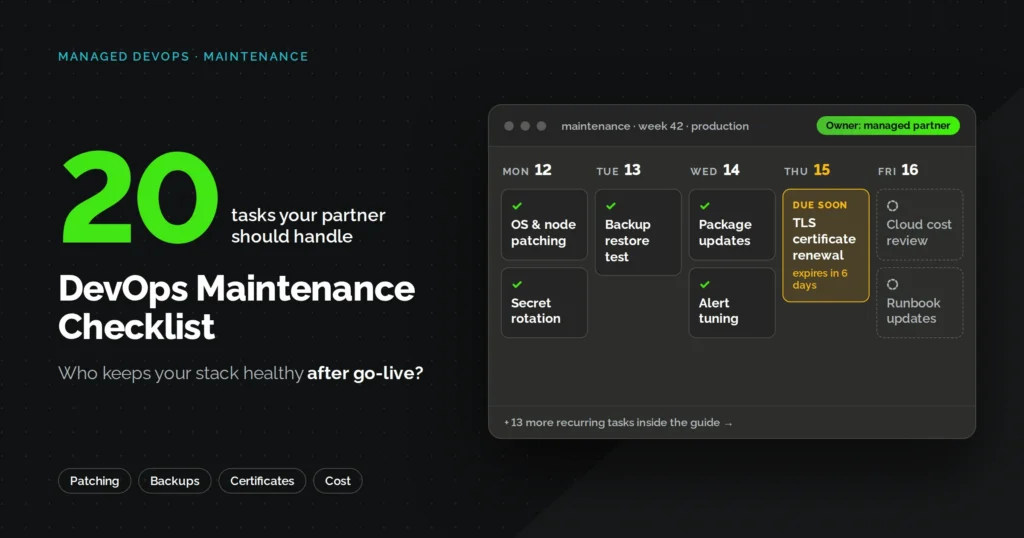

A devops maintenance checklist is simply the list of recurring jobs that keep a production environment healthy once the build or migration is finished. It covers monitoring, patching, pipeline upkeep, cost control and documentation, the unglamorous work that rarely shows up in a sales deck. Most of what follows is exactly what you’re already paying a managed DevOps partner to do, so use it to check their work rather than take their word for it.
What Does a DevOps Maintenance Checklist Cover at a Glance?
Twenty tasks, five categories. If a partner can’t immediately tell you who owns each one internally, that’s really the answer to whether the checklist gets followed at all.
| # | Task | Category |
|---|---|---|
| 1 | 24/7 infrastructure metric monitoring | Monitoring & Incident Response |
| 2 | Application performance monitoring with real thresholds | Monitoring & Incident Response |
| 3 | Defined on-call and escalation process | Monitoring & Incident Response |
| 4 | Postmortems after every incident | Monitoring & Incident Response |
| 5 | Scheduled OS and container patching | Security & Compliance |
| 6 | CVE triage before incidents happen | Security & Compliance |
| 7 | Secret rotation and access reviews | Security & Compliance |
| 8 | Audit-ready compliance documentation | Security & Compliance |
| 9 | Fast resolution of broken pipelines | CI/CD & Deployments |
| 10 | Pipeline performance tracking | CI/CD & Deployments |
| 11 | Tested rollback and deployment strategies | CI/CD & Deployments |
| 12 | Kubernetes cluster health checks | CI/CD & Deployments |
| 13 | IaC drift detection and correction | Infrastructure & Cost |
| 14 | Verified backups and tested disaster recovery | Infrastructure & Cost |
| 15 | Monthly cloud cost reviews | Infrastructure & Cost |
| 16 | Cleanup of unused resources | Infrastructure & Cost |
| 17 | Readable monthly reporting | Governance & Improvement |
| 18 | Current runbooks and documentation | Governance & Improvement |
| 19 | DORA metric tracking | Governance & Improvement |
| 20 | Quarterly priority reviews | Governance & Improvement |
How Should Your Partner Handle Monitoring and Incident Response?
A monitoring dashboard existing is not the same as someone actually watching it. This is the category buyers most often assume is covered, then discover it isn’t the night an alert fires and nobody answers.
1. Are they monitoring infrastructure metrics around the clock?
CPU, memory, disk, network and database connection pools are the baseline set. A partner should be watching these continuously, with thresholds tuned to your actual traffic rather than generic defaults.
- Alert fatigue, where notifications get muted because nobody has time to triage them, is the most common failure mode in-house teams run into
- Ask specifically who gets paged, not just what tool sends the page
2. Do they run application performance monitoring with real thresholds?
Infrastructure monitoring and application monitoring are two different disciplines, and buyers often assume one quietly covers the other. APM tracks latency and error rates at the code level, which is where most user-facing problems actually starts.
3. Is there a defined on-call and escalation process?
“We’ll get to it” is not an SLA. Ask for actual numbers, critical issues acknowledged within minutes rather than hours, with a named escalation path for when the first responder can’t resolve it alone.
4. Do they document postmortems after every incident?
A blameless postmortem after each incident turns a one-time fix into a permanent improvement instead of a repeat visit. Teams that skip this step tend to solve the same problem three or four times a year without noticing the pattern.
This exact tension shows up constantly in practitioner circles. A five-engineer platform team supporting close to a hundred internal engineers asked r/devops how other teams find out about pending maintenance, such as a new release or a security issue, and make sure that knowledge doesn’t sit with one single person. The honest answer from the replies was that this only works when it’s built into a process, not left to memory or good intentions.
How Should Your Partner Keep Security and Compliance Current?
Security maintenance is where “we’ll patch it next sprint” quietly turns into six months of exposure. None of the tasks below are glamorous, which is exactly why they get skipped first.
5. Are OS and container base images patched on a schedule?
OS-level patching and container base image updates need to happen on a defined cadence, not whenever there’s spare capacity. Left alone, dependencies drift further from current versions and each update gets riskier to apply.
6. Do they triage new CVEs before they become incidents?
Not every CVE deserves same-day urgency, and a mature partner should be able to explain that judgment call rather than just forward a scanner report. Triage is a skill separate from patching itself, deciding what’s genuinely critical versus what can wait for the next window.
7. Is secret rotation and access control reviewed regularly?
Automated secret rotation and periodic access reviews (who still has production access and why) belong on this checklist, not just in a security audit once a year. This is also a natural point to go deeper into secure-pipeline controls if you want implementation detail rather than a checklist item.
8. Do they maintain audit-ready compliance documentation?
The cost of getting this wrong keeps climbing. IBM’s 2025 Cost of a Data Breach Report puts the global average breach cost at $4.44 million, down from $4.88 million the year before, but still high enough to make “we’ll document it later” an expensive habit. Continuous audit trails, not a folder someone updates before the annual review, is what separates a maintained environment from a documented-once one.
How Should Your Partner Maintain CI/CD Pipelines and Deployments?
Pipelines don’t fail suddenly, they degrade slowly until one deployment fails spectacularly. This section covers the routine upkeep that prevents that slow slide.
9. Are broken pipelines and failed builds resolved quickly?
Troubleshooting broken pipelines and failed deployments should be routine maintenance, not emergency work that pulls a senior engineer off feature work. If every failed build turns into a fire drill, that’s a maintenance gap, not bad luck.
10. Is pipeline performance tracked and improved over time?
Build times creep upward quietly, a few extra minutes a month, until a five-minute build becomes a forty-five-minute one two years later and nobody noticed the trend. Build caching, parallelization and flaky-test cleanup are routine devops automation services work, not special projects billed separately.
11. Are rollback and deployment strategies tested regularly?
Blue-green, canary and rolling deployments only help if the rollback path has actually been exercised, not just documented. A rollback procedure nobody has run is a rollback procedure that probably doesn’t work.
12. Is Kubernetes cluster health part of the ongoing checklist?
Version upgrades, node scaling, certificate rotation and etcd backups need a defined cadence the same way patching does. This overlaps closely with dedicated Kubernetes consulting work, so keep this item on the checklist even if a deeper Kubernetes engagement covers the details.
How Should Your Partner Manage Infrastructure and Cloud Costs?
Cost drift is quiet by nature, nobody notices a Reserved Instance expiring the way they notice a production outage. That’s exactly why it needs a scheduled review rather than a reactive one.
13. Is Terraform or IaC drift detected and corrected?
Undetected infrastructure drift, where the real environment no longer matches the declared code, is a leading cause of “it worked yesterday” incidents. Daily reconciliation catches this before it becomes a production surprise.
14. Are backups verified and disaster recovery actually tested?
A backup nobody has restored from is a hypothesis, not a safety net. Ask when disaster recovery was last tested end to end, not just whether backups are scheduled.
15. Is cloud spend reviewed monthly for savings opportunities?
Gartner’s most recent forecasts show worldwide infrastructure-as-a-service spending continuing to climb through 2026 and 2027, driven largely by AI compute demand. As more spend sits under management, a monthly cost review becomes worth more, not less, since a modest percentage saved on a bigger number is real money.
One 20-year infrastructure veteran raised almost the same list on r/devops, asking for help building a holistic production environment review covering hosting, system components, access controls, observability, backup and restore processes, vendor contracts and documentation. The thread reads like a working draft of tasks 13 through 16 on its own, which is a fair sign that even engineers with two decades of experience are still refining this list rather than treating it as settled.
16. Are unused resources and expired reservations cleaned up?
Forgotten staging environments running around the clock, expired reservations quietly billed at on-demand rates, orphaned volumes nobody remembers creating, these are the easy wins a good devops service provider should catch monthly. Waiting for an annual budget scare to find them is waiting too long.
How Should Your Partner Support Governance and Continuous Improvement?
This last category is the one that decides whether the other 16 tasks stay consistent or slowly slip.
17. Is there a monthly report you can actually read and act on?
A good report covers work completed, incidents handled, cost changes and specific recommendations for next month. A dashboard screenshot with no narrative attached isn’t a report, it’s a data dump.
18. Are runbooks and documentation kept current, not just written once?
Documentation tied to actual operations, updated as things change, is a living artifact. Documentation written once during onboarding and never touched again is basically fiction by month six.
19. Do they track DORA metrics and act on the trends?
Deployment frequency, lead time for changes, change failure rate and mean time to recovery are the four DORA metrics, and the spread between performance tiers is stark. Elite teams run a change failure rate under 15 percent and deploy on demand, while low performers sit at 46 to 60 percent and ship every one to six months, and tracking these numbers only matters if someone is actually acting on the trend.
20. Is there a quarterly review that resets priorities?
A deeper architecture and cost review every quarter is where a partner earns their retainer, catching what monthly reporting misses and resetting priorities as the environment evolves. If tasks 1 through 19 never get revisited as a set, the checklist itself has quietly gone stale.
When Should You Move from Ad Hoc Support to a Maintenance Retainer?
Most teams start with project-based help, someone comes in, builds the thing, writes a bit of documentation, and leaves. That arrangement works fine until a few warning signs show up together:
- Incidents with no clear owner, and developers debugging infrastructure they didn’t build
- Security patches falling behind because nobody is explicitly responsible for tracking them
- Cloud costs creeping up without anyone investigating why
- Operational knowledge sitting in one engineer’s head, who could leave at any time
If two or more of these sound familiar, ad hoc support has probably already gotten more expensive than a retainer would be, you just haven’t seen the bill yet. A managed devops services provider like Fullstacktechies typically structures a retainer around a fixed monthly hours pool, a defined SLA and a set reporting cadence, so recognizing the need is usually the harder part, not the switch itself.
How Do You Vet a Managed DevOps Partner Against This Checklist?
Walk this exact list into your next vendor conversation and ask, task by task, which of the 20 are included by default and which get billed as extras. A partner who hesitates on the documentation items, tasks 4 and 18, is often the same partner who struggles when key project knowledge needs to move between people.
| Coverage area | In-house team | Ad hoc support | Maintenance retainer |
|---|---|---|---|
| Monitoring & incident response | Depends on headcount | Rarely included | SLA-backed, included |
| Security patching | Often deprioritized | One-time only | Scheduled and tracked |
| CI/CD upkeep | Shared with feature work | Not included | Ongoing |
| Cost optimization | Ad hoc, if it happens at all | Not included | Reviewed monthly |
| Documentation | Frequently goes stale | One-time deliverable | Living, updated |
If you’re evaluating vendors more formally, Fullstacktechies maintains a separate DevOps Vendor Evaluation Checklist that goes deeper into contract terms, SLAs and red flags to watch for. And if you’re still deciding whether managed DevOps services make sense for your stage of growth at all, the Ultimate Guide to DevOps as a Service is the better starting point.
Bottom Line
None of these 20 tasks are complicated on their own, monitoring, patching, backups, cost reviews, and documentation. What actually separates a well-maintained environment from a neglected one is consistency, doing every item on a schedule, month after month, without waiting for an incident to force the issue.
That’s the real test for a managed DevOps partner. Anyone can list these capabilities on a services page, but only a partner actually running the checklist can tell you, without hesitation, when each task was last done and what came out of it.
- If your current setup can answer that for all 20 items, you’re in good shape
- If it can’t, that gap is exactly where the next production incident or the next surprise cloud bill is going to come from
Frequently Asked Questions
Q1. What does a DevOps maintenance checklist include?
Five categories of recurring work, monitoring and incident response, security patching, CI/CD upkeep, infrastructure and cost management, and governance and reporting, spread across roughly 20 individual tasks.
Q2. How is DevOps maintenance different from managed DevOps services?
Maintenance is the actual list of tasks that need doing. Managed devops services is the delivery model, an external team performing those tasks under an SLA instead of internal engineers squeezing them in between feature work.
Q3. How often should a DevOps maintenance checklist be reviewed?
Monthly for the operational items like patching, monitoring and cost. Quarterly for the checklist and the retainer scope itself, since what needed attention a year ago isn't always what needs it now.
Q4. What happens if these tasks are ignored?
Security debt, cost creep and single-point-of-failure knowledge all compound quietly, and none of them announce themselves until an incident forces the issue, usually at the worst possible time.