

AIOps vs DevOps: Key Differences and When to Use Intelligent Automation
Explore AIOps vs DevOps to understand how intelligent automation is transforming IT operations. This guide breaks down key differences, benefits, and real-world use cases to help you choose the right approach for improving system performance, scalability, and reliability in 2026.


The software world is changing faster than most teams can keep up with. Enterprises are deploying thousands of microservices, managing multi-cloud environments, and shipping code multiple times a day. In this reality, two operating philosophies have become central to the conversation: DevOps and AIOps. On the surface, they sound similar. In practice, they solve very different problems — and the most forward-thinking organizations are learning how to use both together strategically. This article breaks down AIOps vs DevOps in plain terms, explores where they intersect, and helps you figure out which approach (or combination) your team actually needs right now.
Also Read: The Ultimate Guide to DevOps as a Service (DaaS) in 2026
Key Takeaways: AIOps vs DevOps
1. They Solve Different Problems
DevOps accelerates how software is built and delivered. AIOps intelligently manages what happens after deployment. Understanding this distinction is the starting point for making smart investment decisions in either direction.
2. DevOps Comes First
AIOps needs clean, structured operational data to function effectively. A reliable CI/CD pipeline, consistent infrastructure, and solid monitoring automation are prerequisites — not optional extras — before AI-driven intelligence delivers real value.
3. AIOps Is No Longer Optional at Scale
As Gartner states, there is no future of IT operations without AIOps. Organizations managing microservices, multi-cloud environments, and high deployment frequencies cannot rely on human attention alone to maintain stability and performance.
4. Predictive Beats Reactive
Traditional monitoring tells you something broke. Predictive monitoring powered by AIOps tells you something is about to break — often resolving it automatically through autonomous remediation before users ever notice an impact.
5. AI-Assisted CI/CD Is a Competitive Advantage
Teams adopting AI-driven CI/CD services are analyzing change risk before releases, reducing failed deployments, and optimizing pipeline performance using historical data — moving from guesswork to informed, intelligent delivery.
6. Autonomous Remediation Requires a Progressive Approach
Autonomous remediation is powerful but should be rolled out in stages — starting with AI recommendations, then supervised actions, then full autonomy for well-understood incident classes. Trust in the system is built incrementally, not assumed.
7. DevOps as a Service Accelerates the Journey
Not every organization needs to build DevOps and AIOps capabilities entirely in-house. DevOps as a Service providers like Full-Stack Techies offer a faster, more cost-effective path to operational maturity — with the expertise to integrate intelligence at every layer of the delivery and operations stack.
8. Data Quality Determines AIOps Outcomes
Garbage in, garbage out. The effectiveness of any AIOps platform — from alert correlation to predictive monitoring — depends entirely on the quality, completeness, and normalization of your telemetry data. Investing in observability hygiene is investing in AIOps success.
9. The Market Is Moving Fast
With the AIOps platform market projected to reach nearly $20 billion by 2028 and 73% of enterprises already implementing or planning adoption, organizations that delay building intelligent operations capabilities risk falling behind on reliability, speed, and cost efficiency.
10. The Future Is Both, Not Either/Or
The AIOps vs DevOps debate is ultimately a false choice. The highest-performing engineering organizations treat DevOps discipline and AIOps intelligence as two layers of the same modern operating model — and they build both with intention, in the right sequence, at the right pace.
What Is DevOps? The Foundation of Modern Software Delivery
DevOps is a cultural and technical philosophy that bridges the gap between software development and IT operations. The goal is simple: ship better software, faster, with fewer handoffs and less friction. DevOps does this by encouraging cross-functional collaboration, shared ownership, and end-to-end automation across the software delivery lifecycle.
The backbone of any DevOps practice is the CI/CD (Continuous Integration and Continuous Deployment) pipeline. Development teams push code changes, automated pipelines run tests, and successful builds are deployed to production — all without manual hand-holding at every stage. Infrastructure as Code (IaC), configuration management, containerization with Docker and Kubernetes, and version-controlled deployments are all hallmarks of a mature DevOps practice.
At its heart, DevOps is about people and process. It removes silos between developers and operations engineers and gives teams the tools and culture to take full ownership of what they build. This is why DevOps as a Service has become an increasingly popular model — organizations partner with specialized providers to implement and manage the entire DevOps toolchain without building an internal capability from scratch. Full-Stack Techies offers exactly this kind of end-to-end DevOps as a Service, from pipeline setup and containerization to infrastructure automation and continuous monitoring, so teams can focus on building products rather than managing tooling.
What Is AIOps? Bringing Intelligence to IT Operations
AIOps stands for Artificial Intelligence for IT Operations. The term was coined by Gartner in 2016 to describe the application of machine learning, advanced analytics, and big data to automate and enhance IT operations. Where DevOps focuses on how software is built and shipped, AIOps focuses on how complex IT environments are monitored, maintained, and healed.
AIOps refers to multi-layered, complex technology platforms that enhance and automate IT operations by using machine learning and analytics to analyze large amounts of data collected from various DevOps devices and tools, automatically identifying and responding to issues in real time.
The core capabilities of an AIOps platform typically include event correlation and noise reduction, anomaly detection, root cause analysis, predictive monitoring, and autonomous remediation. Rather than waiting for a human to notice that something is wrong, AIOps systems detect patterns in millions of log entries, metrics, and traces, surface the most relevant signals, and in many cases trigger fixes automatically.
As Gartner notes, “there is no future of IT Operations that does not include AIOps.” This isn’t marketing language. It reflects a genuine operational reality: the volume and velocity of data generated by modern distributed systems is simply beyond the capacity of human operators working with traditional tools.
AIOps vs DevOps: The Core Differences
Understanding AIOps vs DevOps starts with recognizing that they operate at different stages of the software and infrastructure lifecycle, and they address different types of problems.
Primary Focus
DevOps focuses on the software delivery pipeline — how code moves from a developer’s machine to production reliably and quickly. AIOps focuses on what happens after deployment — how production environments are monitored, how issues are detected, and how operations are kept stable at scale.
Automation Philosophy
DevOps automation is largely rule-based and deterministic. If this test passes, deploy. If this flag is set, rollback. The logic is scripted by engineers and executed predictably. AIOps automation is intelligent and probabilistic. ML models analyze patterns across massive datasets and make decisions — like suppressing a noisy alert or triggering a remediation script — without explicit human-authored rules for every scenario.
Speed of Response
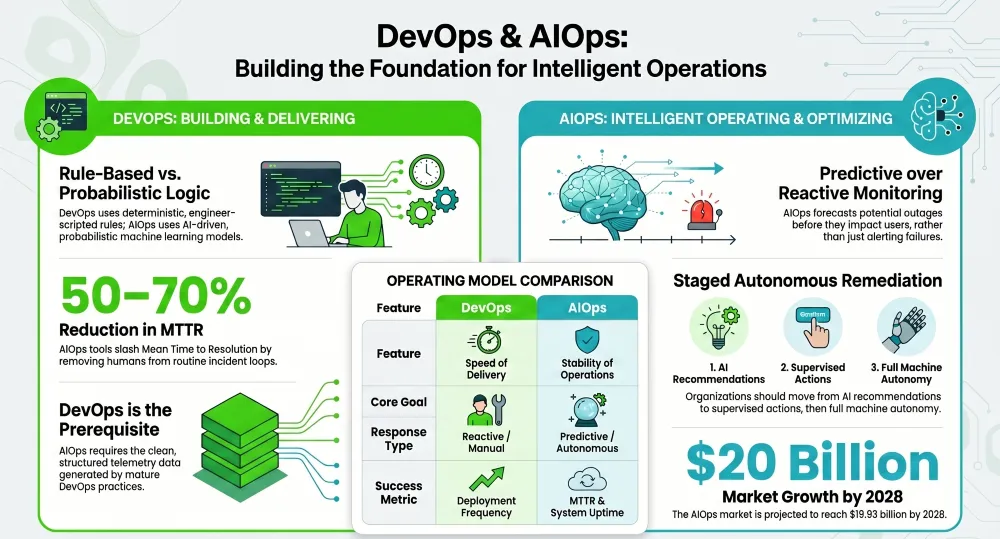
DevOps teams improve delivery speed through better processes and tooling. AIOps improves operational response speed by removing humans from the loop for routine incidents. Leading AIOps tools like Dynatrace, Splunk, Datadog, and ScienceLogic now embed advanced AI models, often slashing mean time to resolution (MTTR) by 50–70% and enabling proactive issue prevention.
Data Scope
DevOps primarily works with structured pipeline data — build logs, test results, deployment histories, and code repositories. AIOps ingests and correlates a much broader range of operational data: infrastructure metrics, application traces, network events, user experience data, security alerts, and ITSM tickets — often at petabyte scale.
Human Role
In DevOps, humans define the process. Engineers write pipeline scripts, configure deployment tools, and make architectural decisions. In AIOps, the system increasingly recommends or executes actions. Humans shift from operators reacting to incidents to strategists setting policy guardrails for autonomous systems.
Quick Comparison: DevOps vs. AIOps
| Feature | DevOps | AIOps |
|---|---|---|
| Core Goal | Speed of Delivery | Stability of Operations |
| Primary Data | Pipeline/Build Logs | Telemetry/Metrics/Traces |
| Logic Type | Rule-Based (Deterministic) | AI-Based (Probabilistic) |
| Response Type | Reactive/Manual | Predictive/Autonomous |
| Success Metric | Deployment Frequency | MTTR & System Uptime |
The Intersection: AI-Assisted CI/CD and Intelligent Pipelines
This is where the AIOps vs DevOps conversation gets genuinely exciting. The boundary between the two is blurring, and the most competitive engineering organizations are already operating in the overlap.
AI-assisted CI/CD refers to the application of machine learning directly within the software delivery pipeline. Rather than treating CI/CD as a dumb conveyor belt, AI-driven CI/CD services can intelligently predict failures before they happen, prioritize test runs, optimize resource allocation, and even recommend rollback decisions.
Gartner predicted that by 2024, 40% of product and platform teams would be using AIOps for automated change risk analysis in DevOps pipelines, cutting down unplanned downtime by 20%. This is exactly the kind of intelligence that AI-assisted CI/CD delivers: before a release goes out, the system evaluates whether it is likely to cause trouble based on historical patterns, code change velocity, and system state.
Predictive analytics has become increasingly important for DevOps teams as it helps in advancing the nature of CI/CD pipelines. Historical data and ML ensure that predictive analytics offer instances of bottlenecks, release cycles, and challenges that can affect the entire nature of release cycles. Companies like Netflix, Google, and Microsoft are already deep in this territory. Netflix uses ML-enabled chaos engineering to attain system reliability during deployments. Google uses AI to ensure its Kubernetes-based CI/CD pipelines achieve higher resource efficiency.
For teams looking to adopt AI-driven CI/CD services without building the capability in-house, Full-Stack Techies provides managed pipeline engineering with embedded intelligence — helping organizations move from reactive deployments to predictive, self-optimizing delivery workflows.
Predictive Monitoring vs Reactive Monitoring: A Paradigm Shift
One of the most tangible differences AIOps brings to the table is the shift from reactive to predictive operations. Traditional monitoring automation tools alert you when something breaks. Predictive monitoring powered by AIOps alerts you before it breaks — or fixes it automatically without alerting anyone at all.
Traditional monitoring tools would alert teams when something broke — a reactive approach that often meant scrambling to fix issues after they’d already impacted users. AIOps is no longer a futuristic concept but a present-day reality. The integration of AI and ML into DevOps workflows is enabling predictive monitoring, anomaly detection, and automation at an unprecedented scale.
AI optimizes IT operations in measurable ways: intelligent monitoring powered by AI helps identify potential issues before they cause outages, improving metrics like Mean Time to Detect (MTTD) by 15–20%.
Monitoring automation — even basic rule-based alerting — has been a standard part of DevOps for years. But what AIOps adds is correlation intelligence. Instead of receiving 500 alerts from different systems during an incident, an AIOps platform correlates those signals, identifies the probable root cause, and surfaces one actionable notification with context. This is the difference between alert fatigue and genuine operational clarity.
Predictive analytics in AIOps: forecasting potential outages or degrad
Autonomous Remediation: The Self-Healing Infrastructure Frontier
Autonomous remediation: executing predefined actions to resolve detected problems without human intervention.
Autonomous remediation is arguably the most disruptive capability that AIOps brings to modern IT operations. It represents the point at which systems stop just detecting problems and start fixing them — without human intervention.
Self-healing applications use AI to automatically detect and fix issues in real time. For example, if an application crashes, the AI can restart services, roll back updates, or reallocate resources without human intervention. In 2025, this trend is driving near-autonomous DevOps ecosystems capable of maintaining uptime 24/7.
The key to making autonomous remediation trustworthy is a staged approach. Most mature organizations begin with AI-generated recommendations that humans approve before execution. Over time, as confidence in the system grows, certain classes of incidents — restart loops, memory exhaustion, scaling events — are delegated entirely to the AIOps platform.
The strongest platforms combine event correlation, dynamic runbooks, and policy-based automation. They support auto-remediation for common incidents, integrate with ITSM tools, and let teams safely roll out automation in stages — starting with suggestions and approvals before moving to fully autonomous actions.
By 2026, leading platforms are expected to implement AI-driven architectural optimization that dynamically adjusts systems without human intervention — including automatic instance type switching, database migrations, and service mesh restructuring based on real-time cost and latency targets. The human role shifts from “operator” to “strategist.”
Full-Stack Techies helps organizations implement autonomous remediation frameworks responsibly — designing runbook automation, defining blast-radius controls, and progressively expanding machine autonomy as operational confidence grows.
Industry Numbers That Tell the Story
The data behind AIOps adoption paints a clear picture of where the market is heading:
According to Gartner, 70% of large enterprises will adopt AIOps platforms by 2025, underscoring its critical role in enabling agility, reliability, and scalability in IT systems.
73% of enterprises are implementing or planning AIOps adoption by end of 2026.
According to recent industry data, 67% of DevOps teams have increased their investment in AI for DevOps in the last year alone.
According to The Insight Partners, the AIOps platform market size is expected to expand from $2.83 billion in 2021 to $19.93 billion by 2028, growing at a compound annual growth rate of 32.2%.
The DevOps market has seen parallel expansion, reaching $14.95 billion in 2025, with a CAGR of 25.70% projected to reach $37.33 billion by 2029.
According to Forrester, organizations using AIOps for cybersecurity reported a 60% reduction in time to detect and mitigate threats.
Gartner research confirms that by 2025, most large organizations will adopt a platform team strategy to scale DevOps and SRE. Infrastructure and operations leaders must work with application leaders to build self-service platform infrastructure while developing key competencies, a product-oriented mindset, and AIOps capabilities in platform teams.
Get scalable, fast, and user-friendly DevOps solutions tailored to your needs.
Get Free ConsultationDevOps as a Service in the Age of Intelligent Automation
DevOps as a Service has evolved significantly. What started as managed CI/CD pipeline provisioning now encompasses intelligent toolchain integration, monitoring automation, security scanning, cloud cost optimization, and increasingly, AIOps-powered observability.
For organizations that don’t have the bandwidth to staff a dedicated platform engineering team, DevOps as a Service providers like Full-Stack Techies offer a practical path forward. Rather than hiring five specialized engineers, a team can partner with experts who already have experience integrating AI-driven CI/CD services, setting up predictive monitoring stacks, and building the observability foundations that AIOps platforms require to function well.
This matters because AIOps doesn’t work in isolation — it requires clean, normalized telemetry data to do its job. Organizations that invest in DevOps fundamentals first (structured logging, distributed tracing, reliable CI/CD pipelines) find that layering AIOps on top delivers dramatically better results than trying to implement intelligence on a chaotic operational foundation.
DevOps service providers are adopting AIOps to provide intelligent, data-driven solutions to customers. AI-driven predictive analytics software predicts system demand and auto-scales infrastructure, reducing idle resources and cloud expenditures.
Full-Stack Techies takes this integrated approach — treating DevOps discipline and AIOps intelligence as two parts of the same operational maturity journey, not competing philosophies.
When to Use DevOps, When to Use AIOps, and When to Use Both
The practical answer to AIOps vs DevOps is rarely either/or. Here’s a realistic framework:
Start with DevOps when your team is still building delivery fundamentals. If your deployments are manual, your environments are inconsistent, and you don’t have reliable CI/CD pipelines in place, AIOps is premature. The intelligence layer requires stable data foundations that DevOps provides. This is also the right time to engage a DevOps as a Service partner to accelerate maturity without reinventing the wheel.
Layer in monitoring automation once your pipelines are stable and you’re deploying regularly. Even basic automated alerting and log aggregation give your team the visibility needed to operate confidently and begin generating the data that future AIOps systems will learn from.
Add AIOps capabilities when your operational complexity exceeds what human attention can reliably cover. Signs you’re ready: your teams are suffering from alert fatigue, incident triage consumes significant engineering time, you’re running microservices across multiple cloud environments, or you’re struggling to identify root causes quickly during incidents.
Invest in AI-assisted CI/CD and predictive monitoring when deployment frequency is high, and the cost of production incidents is high. At this stage, AI-driven CI/CD services that analyze change risk before deployment and predictive monitoring that forecasts issues before they escalate provide measurable return on investment.
Pursue autonomous remediation progressively, starting with well-understood, low-risk incident classes and expanding as organizational confidence in automated decision-making grows.
Challenges and Honest Considerations
It would be intellectually dishonest to present AIOps as a plug-and-play solution. Enterprises often find that integrating an AIOps platform with existing monitoring and ITSM tools can be complex. There is also the hurdle of data — if your input data is garbage or siloed, the AI outcomes won’t be great.
AIOps also requires organizational change management. Operations teams need to trust the system enough to let it act autonomously on at least some incident classes. That trust is built incrementally, not declared by executive mandate.
On the DevOps side, the human element remains the hardest part. Tooling is relatively easy to implement. Getting development and operations teams to genuinely share ownership, communicate openly, and maintain a culture of blameless retrospectives is a long-term cultural commitment.
Monitoring automation AI is being used to power self-healing workflows, alert deduplication, and performance forecasting, which Gartner says will align observability with AIOps practices. Vendors that embrace open standards are better positioned to offer extensibility, avoid vendor lock-in, and enable broader ecosystem integration.
Vendor lock-in is a real risk in the AIOps space. Organizations should prioritize platforms that support OpenTelemetry and open standards, ensuring that their observability data isn’t trapped in a proprietary format.
Alternatives Section
If neither pure DevOps nor full-scale AIOps feels like a perfect fit, the technology landscape in 2025–2026 offers several alternative paths.
1. Platform Engineering
Instead of forcing every developer to learn how to manage cloud infrastructure, Platform Engineering creates an “Internal Developer Platform” (IDP). A dedicated team builds a highly automated, self-service portal. Developers just click a button to get the servers and databases they need.
- Unique Selling Point: Massively improves developer productivity by hiding the messy infrastructure details.
2. DevOps as a Service (DaaS)
If you do not want to build your own CI/CD pipelines or buy an AIOps tool, you can hire a specialized third-party company to handle your releases and infrastructure.
- Unique Selling Point: Great for non-tech businesses that need professional cloud management but do not want to hire expensive full-time engineers.
3. NoOps (No Operations)
This is the extreme end of the automation spectrum. The goal of NoOps is to build an environment so automated that a dedicated operations team is no longer needed. It relies heavily on serverless computing (like AWS Lambda).
- Unique Selling Point: You only pay for the exact milliseconds your code runs, and the cloud provider handles 100% of the scaling and server maintenance.
The Road Ahead: AIOps and DevOps Converging
By 2026, AIOps will change how IT teams work, boosting their efficiency, agility, and creativity. With smooth connections to current IT processes and better automation features, AIOps will drive a pivotal shift towards automated processes and self-managing IT systems leveraging artificial intelligence — hyperautomation that streamlines complex tasks by integrating advanced technologies like machine learning and predictive analytics.
The long-term trajectory is clear: DevOps provides the cultural and process foundation, while AIOps provides the intelligence layer that makes operating at scale sustainable. Together, they represent a complete approach to modern software delivery and operations — from the first code commit to the last production alert.
DevOps engineers will spend significantly less time writing scripts from scratch and more time training AI systems to handle the heavy lifting of routine operational tasks. Tools like GitHub Copilot and Datadog AI are already optimizing CI/CD pipelines and detecting anomalies automatically, reducing the cognitive load on human operators while improving reliability and speed.
For organizations navigating this shift, the key is starting with clear fundamentals — reliable pipelines, normalized observability data, and a culture of operational ownership — and then progressively introducing intelligence where the return is highest.
How Full-Stack Techies Helps Organizations Navigate This Shift
At Full-Stack Techies, we work with organizations across the AIOps vs DevOps spectrum. Whether you’re establishing your first CI/CD pipeline, integrating AI-driven CI/CD services into an existing workflow, deploying predictive monitoring at scale, or building the data foundation for AIOps adoption, our full-stack engineering team brings end-to-end expertise.
Our DevOps as a Service offering covers everything from containerization and infrastructure automation to observability architecture and monitoring automation — giving teams the operational backbone that intelligent automation requires to deliver real value.
We also help organizations evaluate and implement AIOps platforms that align with their existing toolchains, avoiding vendor lock-in while maximizing the return on their operational data.
The future of software operations isn’t just about shipping faster — it’s about operating smarter. AIOps and DevOps aren’t competing answers. They’re complementary layers of a modern, resilient, and intelligent operating model. Full-Stack Techies is here to help you build both — the right way, in the right sequence, at the right pace for your organization.
Ready to move from reactive operations to predictive, intelligent automation? Talk to the Full-Stack Techies team about building your DevOps foundation and AIOps roadmap today.
Also Read: 5 Top-Rated DevOps Outsourcing Companies You Should Know (2026–2027 Edition)
Trends & 2025–2026 Outlook
The world of software delivery is changing incredibly fast. As we move deeper into 2026, several major trends are reshaping the “AIOps vs DevOps” conversation.
1. The Rise of the “Agentic SDLC”
According to late 2025 insights from Forbes, we are moving toward an “Agentic Software Development Life Cycle (SDLC).” This means AI is no longer just a helpful autocomplete tool. It is becoming a virtual teammate. In 2026, companies are using multiple AI agents that talk to each other. One AI agent writes the code architecture, a second AI agent builds the testing suite, and a third AI agent monitors the security. The human engineer acts as a “director,” making sure all the agents work together properly.
2. CIOs Become “Chief Orchestration Officers”
As AI takes over routine coding and server maintenance, the role of IT leaders is changing. CIO Magazine notes that in 2026, tech leaders will focus less on running experiments and more on coordinating how digital AI workforces and human workforces collaborate. Governance, security, and accountability are the top priorities.
3. Smart Cloud Cost Reduction (FinOps + AIOps)
Cloud computing is expensive. In the past, companies bought too many servers just to be safe. Today, AIOps is being combined with financial operations (FinOps). AIOps models predict exactly how much server space you will need next week based on historical trends. They automatically scale down non-production environments on the weekends, saving companies up to 40% on their cloud bills without any human intervention.
4. AI Safety and Governance
You cannot just let AI run wild in a bank or a hospital. In 2026, the biggest priority for enterprise buyers is trust. Modern AIOps platforms now include strict audit trails. If an AI decides to restart a server, it must log exactly why it made that decision so compliance officers can review it.
5. Carbon-Aware AIOps
In 2026, AIOps is expanding into “GreenOps.” Intelligent systems now monitor the carbon footprint of cloud workloads in real-time, automatically shifting heavy processing tasks to data centers running on renewable energy or scaling down during peak grid-demand hours to meet corporate ESG goals.
Why Trust This Comparison?
This AIOps vs DevOps breakdown isn’t built on vendor brochures or theoretical frameworks. It draws on real-world implementation experience, analyst research from trusted sources like Gartner and Forrester, and publicly documented practices from engineering teams at organizations operating at scale.
The Full-Stack Techies team has hands-on experience designing and delivering DevOps as a Service engagements, building AI-assisted CI/CD pipelines, and architecting predictive monitoring and monitoring automation stacks across diverse industry environments — from fast-growing startups to large enterprises managing complex multi-cloud infrastructure.
We don’t have a stake in pushing one approach over the other. AIOps and DevOps solve different problems at different stages of operational maturity, and our goal here is straightforward: give you an honest, practical lens to evaluate where your team stands today and what your next move should be — whether that’s strengthening DevOps fundamentals, exploring AI-driven CI/CD services, or laying the groundwork for autonomous remediation.
If something in this article raises a question specific to your environment, our team is happy to dig into the details with you directly.



