

AI in DevOps: How Generative AI Is Transforming Developer Workflows in 2026
Discover how AI in DevOps is reshaping software development in 2026. This guide explores how generative AI enhances automation, accelerates workflows, and improves developer productivity, helping teams build, test, and deploy faster with greater efficiency.


Introduction: A Defining Inflection Point for Software Engineering
The software industry is at a crossroads. The tools, practices, and workflows that defined DevOps for the past decade are being fundamentally reimagined — not incrementally improved, but structurally rebuilt around artificial intelligence. In 2026, AI in DevOps is no longer a pilot program running in a sandbox, a vendor buzzword printed on a conference banner, or a future capability that forward-looking teams are preparing for. It is the operating reality for every competitive engineering organization on the planet.
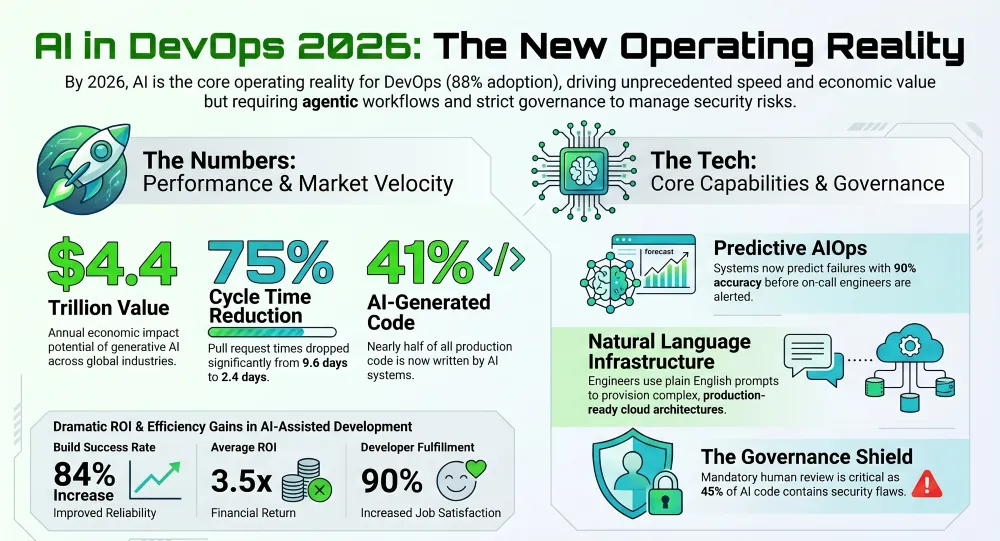
The evidence is everywhere. According to McKinsey’s State of AI report, 88% of organizations now use AI in at least one business function — a figure that has risen consistently year over year. McKinsey estimates that generative AI for DevOps and software engineering could unlock between $2.6 trillion and $4.4 trillion in economic value annually across industries. In software development specifically, McKinsey’s own internal lab research — involving more than 40 developers across the United States and Asia — found that developers completing tasks with AI assistance were dramatically faster across code generation, refactoring, and documentation than those working without it.
Gartner’s strategic predictions for 2026 make the trajectory even clearer: by 2029, 70% of enterprises will deploy agentic AI as part of IT infrastructure operations, up from less than 5% in 2025. Meanwhile, Gartner predicts that by 2026, 80% of software development companies will adopt Internal Developer Platforms (IDPs) to unify tooling, automate governance, and accelerate delivery at scale.
These are not speculative projections. These are near-term milestones in a transformation that is already underway — and for engineering teams, technology leaders, and the businesses they serve, the message is urgent: AI-driven DevOps is not something to plan for eventually. It is something to implement now.
At Full-Stack Techies, we have been designing, building, and optimizing AI-powered DevOps services for clients across industries for years. We have seen firsthand what separates organizations that capture real business value from AI from those that invest heavily and see marginal returns. In this article, we break down the full picture: what is driving the shift, what the data actually shows, how specific capabilities are transforming developer workflows, and what your organization needs to do to lead rather than follow.
Professional Presenting Ai In Devops Analytics Dashboard Showcasing Generative Ai Impact On Developer Workflows And Automation
Part 1: The State Of The Industry — What The Numbers Actually Say
Before examining specific capabilities and tools, it is worth establishing the quantitative foundation of this transformation. The scale, pace, and economic weight of AI in DevOps are not intuitive — they are staggering — and the data from the world’s most respected research institutions makes the case clearly.
1.1 Adoption Has Reached Critical Mass
Developer AI adoption is no longer an early-adopter story. According to data from multiple industry surveys compiled through early 2026:
- 84% of developers currently use or plan to use AI tools in their development workflows, up from 76% in 2024
- 51% of professional developers use AI tools every day
- 41% of all code written in the industry today is AI-generated
- 48% of organizations use two or more DevOps AI tools simultaneously, indicating that multi-tool AI strategies are becoming the norm
- 67% of engineering managers predict that developer velocity and productivity will increase by at least 25% in 2026 due to AI coding adoption
GitHub Copilot alone reached 20 million cumulative users by mid-2025, with 4.7 million paid subscribers as of January 2026 — representing 75% year-over-year paid subscriber growth. The tool is now used by approximately 90% of Fortune 100 companies and has been adopted by more than 50,000 organizations worldwide. This is not a niche technology. This is enterprise-scale infrastructure.
1.2 The Productivity Evidence Is Substantial — and Nuanced
The productivity case for AI-assisted development is well-documented and compelling. A controlled experiment published by GitHub in partnership with Accenture — involving 4,800 developers — found that developers using Copilot completed JavaScript HTTP server tasks 55% faster than those without AI assistance. Pull request time dropped from 9.6 days to 2.4 days in AI-assisted workflows, representing a 75% reduction in development cycle time. Successful builds increased by 84% among Copilot users, code review speed improved by 15%, and pull requests per developer increased by 8.69%.
McKinsey’s own research, tracking data across 600-plus organizations, found that more than 60% see at least a 25% productivity improvement from AI. And organizations with 80% to 100% developer adoption of AI tools — not partial, but near-complete adoption — saw productivity gains exceeding 110%, according to McKinsey’s research conducted in partnership with OpenAI.
In specific workflow areas:
- Developers save 30% to 60% of time on coding, testing, and documentation tasks when using AI tools consistently
- Large enterprises report a 33–36% reduction in time spent on code-related development activities
- Small and mid-sized companies see up to 50% faster unit test generation and debugging
- Microsoft’s ROI analysis found that AI investments are returning an average of 3.5x, with 5% of companies reporting returns as high as 8x
- Across Accenture’s study, 90% of developers reported feeling more fulfilled in their jobs with Copilot, and 91% said they enjoyed coding more with AI assistance
However, and this is critical to understand: the productivity picture is not without complexity. GitClear’s 2025 research found a 4x increase in code clones, suggesting that developers are copying AI-generated patterns without sufficient customization — raising long-term maintainability concerns. A significant portion of AI-generated code contains potential security weaknesses, particularly in languages like Python. And only about 30% of AI-suggested code gets accepted by developers without modification, highlighting that human review remains an essential control layer.
The message for engineering leaders is clear: generative AI for DevOps delivers real and significant productivity gains, but only when deployed with deliberate governance, proper review checkpoints, and ongoing quality measurement. Adoption without governance creates a different set of problems. This balance is what Full-Stack Techies helps organizations get right.
1.3 The Market Opportunity Is Growing Rapidly
The economic scale of the AI in the DevOps market reflects the breadth of this transformation:
- The global DevOps market, valued at approximately $14.95 billion in 2025, is projected to reach $37.33 billion by 2029 at a CAGR of 25.70%
- The AIOps market, valued at $2.67 billion in 2026, is projected to reach $11.8 billion by 2034 at a CAGR of 20.40%
- The AI coding tools market alone reached $7.37 billion in 2025, up from $4.91 billion in 2024, and is projected to reach $30.1 billion by 2032
- McKinsey’s extended analysis suggests that generative AI, when integrated broadly across software systems beyond specific use cases, could deliver up to $7.9 trillion in annual economic impact
- Private investment in AI globally reached approximately $252 billion in 2024, with $33.9 billion going specifically to generative AI
These numbers represent opportunity — but also competitive urgency. Every organization investing in AI-powered DevOps services today is building capability and a competitive distance that will compound over time. Those investing later will be catching up to organizations that already have two, three, or four years of AI-driven delivery advantage.
Part 2: Core Capabilities Transforming Developer Workflows
The transformation driven by AI-driven DevOps is not happening in one place. It is happening across every stage of the software delivery lifecycle simultaneously. Here is a detailed examination of the key capability areas where generative AI is delivering measurable impact in 2026.
2.1 AI-Assisted Code Generation, Completion, and Review
The most visible transformation in AI in DevOps has been in the code-writing process itself. The tools available to developers today bear almost no resemblance to the early autocomplete systems of 2022. Modern AI coding assistants understand full project context, infer developer intent from minimal prompts, generate production-ready code across dozens of languages and frameworks, and increasingly operate as autonomous agents capable of executing multi-step development tasks.
GitHub Copilot’s 2026 update introduced autonomous coding agents that generate complete pull requests from GitHub Issues, colorized code completions in Visual Studio, and context-aware suggestions based on live production environments. JetBrains AI Assistant provides next-edit suggestions and context-aware completions tightly integrated with the full JetBrains IDE ecosystem. Amazon Q Developer — AWS’s enterprise-focused AI coding tool — offers customization on proprietary codebases, enabling teams to train AI suggestions on internal architectural patterns, coding standards, and domain-specific logic.
Cursor, which captured 18% of the AI coding assistant market within just 18 months of launch, delivers the most aggressive AI-first developer experience currently available, with agentic workflows that allow developers to describe features in natural language and have the system implement them across multiple files simultaneously.
The data on these tools is compelling. GitHub Copilot generates an average of 46% of code written by users, with Java developers reaching 61%. Developers using Copilot report coding up to 51% faster for certain tasks. The code approval rate for AI-assisted code has risen 5% above manually written code, and code maintainability scores show measurable improvements. An impressive 84% of surveyed Copilot users say they would not go back to working without it.
For organizations operating at enterprise scale, the calculus is straightforward. A team of 50 developers saving even 25% of their time represents the equivalent of 12.5 additional full-time developers — without additional headcount, hiring costs, or onboarding time. This is the productivity leverage that AI-powered DevOps services unlock.
However, the quality risks are real and deserve serious attention. Up to 45% of AI-generated code has been found to contain security flaws in some studies. Code churn — the percentage of code discarded within two weeks of being written — is rising dramatically in teams that rely heavily on AI without sufficient review discipline. And 46% of developers in 2026 still report that they do not fully trust AI outputs, requiring mandatory human review at every merge point.
Full-Stack Techies addresses this through structured AI governance frameworks: defined review checkpoints, automated static analysis, security scanning, and quality metrics that allow teams to capture AI’s speed benefits without accumulating technical debt or security vulnerabilities.
2.2 Intelligent CI/CD Pipeline Automation
Continuous integration and continuous delivery pipelines are the heartbeat of modern software delivery. They are also where AI-driven DevOps delivers some of its most quantifiable — and often underappreciated — operational impact.
Traditional CI/CD pipelines are fundamentally rule-based systems. Engineers define conditions, thresholds, and triggers. The pipeline executes those rules mechanically. When conditions change — when deployment patterns shift, when new services are added, when load characteristics evolve — pipelines must be manually reconfigured. This creates both a maintenance burden and a reliability risk.
AI-powered DevOps services introduce adaptive intelligence into the pipeline layer. Machine learning models trained on historical build and deployment data learn what healthy system behavior looks like, identify which signals predict build failures before they occur, flag anomalous test results that pattern-match to past incidents, and dynamically adjust pipeline configurations based on observed outcomes. This is the difference between a pipeline that executes rules and a pipeline that learns.
The results are measurable. Organizations implementing AI-driven CI/CD automation report deployment speed improvements of up to 50%, with corresponding reductions in unplanned downtime and change failure rates. Predictive failure detection alone — catching builds that are likely to fail before they do — can save engineering teams hours of debugging time per week at scale.
Azure DevOps now integrates AI-generated code reviews, documentation suggestions, and the Azure SRE Agent — a system that monitors cloud applications, detects issues, and automatically generates fixes or initiates rollback procedures without waiting for human intervention. AWS CloudWatch uses AI anomaly detection in logs with natural language querying capabilities, allowing operations engineers to ask plain-English questions of their telemetry and receive intelligent, structured answers.
These capabilities represent a fundamental shift in how delivery pipelines operate. Rather than requiring constant manual attention, AI-native pipelines become self-monitoring, self-correcting, and increasingly self-optimizing systems. This is the operational model that Full-Stack Techies help organizations design and implement.
2.3 AIOps: From Reactive Firefighting to Predictive Intelligence
Of all the transformations underway in AI in DevOps, the evolution of IT operations through AIOps as a Service may be the most consequential for long-term organizational resilience.
The traditional model of IT operations was reactive by design. Systems would degrade or fail. Alerts would fire. Engineers would be paged. Investigations would begin. Root causes would eventually be identified and resolved. In small-scale environments running monolithic applications, this model was functional if painful. In modern cloud-native architectures — distributed microservices, Kubernetes clusters, multi-region deployments, serverless functions, event-driven systems — it is completely untenable.
Modern cloud-native systems generate telemetry at a scale that no human team can process manually. A single large Kubernetes cluster can produce millions of log entries, thousands of metrics data points, and hundreds of distributed traces every minute. The signal-to-noise ratio in production monitoring data is notoriously low. Finding a meaningful anomaly in this volume of data before it becomes a customer-impacting incident is not a human-scale problem. It is an AI-scale problem.
This is exactly what AIOps was designed to solve. AIOps platforms apply machine learning to the full telemetry stack — logs, metrics, traces, alerts, and events — to identify deviations from normal behavior, correlate signals across distributed services, determine probable root causes, and in many cases initiate automated remediation within seconds of an anomaly appearing.
The numbers support the investment decisively. According to Gartner’s AIOps Market Guide 2025, 73% of enterprises are already implementing or planning to adopt AIOps by the end of 2026. Research published on ResearchGate demonstrated that AI models trained on infrastructure data can predict system failures with over 90% accuracy and autonomously resolve up to 80% of incidents — before on-call engineers ever receive an alert. The 2025 State of Observability report by ManageEngine found that 81% of organizations reported over 100% ROI from their observability investments. Gartner itself has stated categorically: “There is no future of IT operations that does not include AIOps.”
In 2026, leading platforms have made these capabilities accessible to organizations at every scale:
- Datadog’s AI layer correlates signals across the entire observability stack and surfaces probable root causes with natural language explanations
- Dynatrace’s Davis AI engine performs automatic root cause analysis and anomaly detection across distributed cloud environments
- Sysdig Sage provides an integrated AI analyst that interprets security and performance data in plain English
- IBM’s Turbonomic continuously optimizes application resource management using AI-driven workload balancing
The operational impact is not just about speed of resolution. It is about shifting from a culture of reactive firefighting to one of proactive system engineering. When AI handles routine detection and remediation automatically, human engineers can focus their attention on system design, reliability architecture, and strategic improvements. This is a qualitative upgrade in how engineering talent is deployed — and it is one of the most powerful arguments for adopting AIOps as a Service today.
Full-Stack Techies offers AIOps as a Service engagements that cover the full instrumentation and integration process: establishing baseline telemetry, integrating AI-driven observability platforms, defining automated remediation playbooks, and building the governance structures necessary to act on AI-generated insights with confidence and accountability.
2.4 AI-Powered DevSecOps: Security That Accelerates Delivery
Security has historically been a bottleneck in software delivery. The traditional DevSecOps model attempted to shift security earlier in the pipeline — “shift left” in industry parlance — but in practice, security review still often happened downstream of development, creating friction, delays, and the perpetual tension between shipping fast and shipping safely.
Generative AI for DevOps is resolving this tension by making security both faster and more thorough — simultaneously. The Global DevSecOps Report 2025 found that 63.3% of security professionals now say that AI has become a helpful co-pilot for writing more secure code and automating application security testing. A further 27.27% of security engineers cited better integration of development workflows as their primary strategic priority heading into 2026.
AI-powered security tools operating in 2026 can:
- Scan every line of code for security vulnerabilities in real time during development, before a single commit reaches a pipeline
- Model threat behavior across production environments using machine learning trained on historical attack patterns
- Automatically enforce compliance policies without requiring manual review gates that slow deployment
- Generate natural language explanations of security findings that developers can act on immediately without needing to consult a security specialist
- Correlate security signals across the entire software supply chain, identifying vulnerable dependencies, misconfigured infrastructure, and anomalous runtime behavior simultaneously
The result is security that is embedded in the delivery workflow rather than appended to it — a continuous, automated process that makes every deployment inherently more secure without requiring slower releases. This is the DevSecOps model that AI-powered DevOps services enable, and it represents a meaningful operational and competitive advantage for organizations that implement it well.
Full-Stack Techies integrates AI-native security scanning, compliance automation, and threat detection into every DevOps engagement we deliver, ensuring that security is never a separate concern but an integral, automated part of the delivery pipeline from the first commit to the final deployment.
2.5 Natural Language Infrastructure and Platform Engineering
One of the most transformative and practically exciting developments in AI in DevOps in 2026 is the emergence of natural language-driven infrastructure management. The ability to describe what you want a system to do in plain English — and have AI translate that intent into valid, production-ready infrastructure code — is collapsing the traditional barrier between software developers and infrastructure engineering.
Platforms like Pulumi Neo now allow engineers to describe infrastructure requirements in plain English and receive complete, deployable infrastructure-as-code in response. AWS Bedrock AgentCore enables the same capability within the AWS ecosystem. The AWS Console itself has gained an AI assistant that can design architectures from conversational prompts — “I need to stream sensor data and analyze it in real time” — and provision the relevant services as a guided, automated workflow.
This capability sits within the broader trend of platform engineering, which Gartner predicts will see 80% of software development companies adopt Internal Developer Platforms by 2026. IDPs give development teams self-service access to production-ready environments, standardized deployment patterns, centralized governance, and pre-integrated toolchains — all without requiring deep infrastructure expertise from every developer who interacts with the system.
Platform engineering is the evolution of DevOps as a discipline. Rather than writing glue scripts and firefighting infrastructure issues, platform engineers build the internal products that other developers use to ship their own software efficiently. By 2026, industry analysts expect over 100,000 Platform Engineer job postings globally, with salaries matching or exceeding Site Reliability Engineer levels. This is a growing, high-value discipline — and AI tools are the primary force enabling it to scale.
Full-Stack Techies offers DevOps as a Service engagements built around this platform engineering model. We design and implement Internal Developer Platforms that are AI-native from the ground up — incorporating AI-assisted deployment, AI-powered observability, and natural language interfaces that allow your development teams to move faster without requiring them to become infrastructure experts.
2.6 AI-Powered Testing: From Manual Gates to Continuous Quality
Software testing is one of the most time-consuming, repetitive, and chronically underinvested areas of the delivery lifecycle. It is also one of the areas where devops ai tools are delivering the most dramatic efficiency improvements in 2026.
AI-powered testing tools can now generate comprehensive test suites from feature specifications, identify edge cases that human testers routinely miss, adapt test coverage dynamically as codebases evolve, and run entire regression suites in a fraction of the time that manual execution would require. Emerging no-code test automation platforms like Panto AI allow QA engineers and product teams to build automated tests through natural language descriptions and visual workflows — completely eliminating the need for test script engineering skills and dramatically accelerating test coverage expansion.
The quantitative impact is significant:
- Small and mid-sized teams using AI tools see up to 50% faster unit test generation
- AI-assisted testing shifts quality measurement from a downstream gate into a continuous, integrated loop — catching defects at the point of code generation rather than after deployment
- AI code assistance leads to a 21% productivity boost in complex knowledge work, including test design and quality assurance, according to Microsoft-backed research
Perhaps as importantly, AI-generated tests are consistent in a way that human-authored tests are not. They apply the same logic, the same coverage criteria, and the same edge case patterns every time — eliminating the variability that makes manual testing unreliable at scale.
Full-Stack Techies integrates AI-powered testing into every delivery pipeline we build, ensuring that quality is continuously measured and automated rather than manually checked at release gates.
2.7 AI-Generated Documentation and Knowledge Management
Documentation is universally acknowledged as critically important and chronically neglected. The reasons are predictable: it requires time that teams under delivery pressure do not have, it falls outside the direct path of feature delivery, and it degrades quickly as systems evolve faster than human writers can track. The result is teams operating in environments where institutional knowledge lives in individuals’ heads rather than in accessible systems — creating fragility, onboarding friction, and incident response delays.
Generative AI for DevOps is solving this problem structurally, not with willpower but with automation. In 2026, AI tools embedded in DevOps platforms can automatically generate:
- Incident postmortems from monitoring data, alert logs, and remediation actions — complete, structured, and ready for review within minutes of resolution
- API documentation from code and tests, kept in sync as the codebase evolves
- Runbooks and operational playbooks derived from historical incident patterns and remediation steps
- Architecture decision records capturing the rationale behind system design choices as they are made
- Deployment guides and change logs generated automatically from pipeline activity
Dataiku DSS 14.4.2’s Flow Assistant and SQL Assistant generate documentation and code explanations in real time within data and analytics workflows. Azure DevOps provides AI-generated documentation suggestions within the IDE. GitHub Copilot can document code functionality on demand from a simple prompt.
The organizational impact goes beyond individual document quality. When documentation is automated, it becomes consistent, current, and comprehensive by default — rather than incomplete, outdated, and sparse by habit. This is a cultural shift as much as a technical one, and it is one of the often-overlooked but highly valuable benefits of investing in AI-powered DevOps services.
Start Building With Full-Stack Techies Today
Part 3: Industry Intelligence — What The Research Leaders Say
The following synthesizes the most relevant recent findings from Gartner, McKinsey, and other authoritative research institutions on the state of AI in DevOps heading into 2026 and beyond.
3.1 Gartner’s Strategic Predictions for 2026 and Beyond
Gartner has consistently been the most precise forecaster of enterprise AI adoption trajectories, and its 2026 predictions are striking in their specificity and ambition.
Most significantly for AI-driven DevOps, Gartner’s December 2025 report “Predicts 2026: AI Agents Will Transform IT Infrastructure and Operations” concludes that AI will evolve “from tools that assist humans to platforms that replace manual effort for complex workflows.” By 2029, 70% of enterprises will deploy agentic AI as part of IT infrastructure operations — up from less than 5% in 2025. This represents one of the fastest adoption curves Gartner has ever projected for any enterprise technology category.
Gartner also predicts that 80% of software development companies will adopt Internal Developer Platforms by 2026. That 30% of enterprises will automate more than half of their network activities by 2026, up from under 10% in mid-2023. And that by 2028, one-third of all generative AI interactions will involve autonomous agents — systems capable of planning, deciding, and executing complex multi-step tasks without human direction at every step.
Gartner’s AIOps Market Guide 2025 puts the adoption trajectory in stark terms: 73% of enterprises are implementing or planning AIOps adoption by end of 2026. And Gartner’s bluntest statement on the subject remains: “There is no future of IT operations that does not include AIOps.” This is not a prediction. It is a verdict.
3.2 McKinsey: The Scale of the Opportunity and the Scaling Gap
McKinsey’s State of AI 2025 — based on 1,993 survey respondents across 105 countries — reveals both the enormous opportunity in AI in DevOps and the significant gap between adoption and genuine organizational scaling.
The headline finding: 88% of organizations now use AI in at least one business function. But only about one-third report genuinely scaling AI across their organization. Nearly two-thirds remain in experiment or pilot mode. And only about 5.5% of organizations report that AI contributes more than 5% of EBIT with significant measurable value.
This gap is not a technology problem. McKinsey’s research makes clear that the high performers — the 5.5% capturing the most value — have a distinct set of organizational characteristics that separate them from the majority. They have fundamentally redesigned their workflows around AI (not just added AI tools to existing processes). They set revenue and innovation goals for AI, not just efficiency targets. They treat AI adoption as an operating model change, not a tooling decision. And they have standardized their process steps, modernized their interfaces around legacy systems, and built governance frameworks that make AI-driven action observable and interruptible.
For software engineering specifically, McKinsey identifies this as one of the highest-value AI application areas, with organizations in software engineering reporting 10–20% cost reductions tied to AI, and significant shares seeing revenue uplift above 10% linked to AI initiatives in development functions. McKinsey’s own lab research found that developers complete tasks up to twice as fast with generative AI assistance — and that the gains are concentrated in the most time-consuming and highest-frequency tasks: documentation, refactoring, boilerplate code generation, and test writing.
The McKinsey conclusion for technology leaders is direct: “Winning doesn’t bolt on models; they rebuild processes and re-platform content and knowledge so AI can act reliably.” This is the strategic principle that Full-Stack Techies build every DevOps as a Service engagement around.
3.3 Gartner on the Skills Transformation
One of Gartner’s more provocative 2026 predictions addresses the human dimension of AI adoption directly. Gartner predicts that through 2026, atrophy of critical-thinking skills due to generative AI use will push 50% of global organizations to require “AI-free” skills assessments — tests designed to evaluate whether employees can still think independently when AI assistance is removed.
This prediction underscores a nuance that technology leaders need to hold simultaneously: AI is making development faster, but it is also changing which human skills matter most. The ability to write boilerplate code from memory matters less when AI can generate it in seconds. The ability to define clear intent, evaluate AI-generated outputs critically, design robust system architectures, govern AI behavior at scale, and connect technical decisions to business outcomes — these capabilities are becoming more valuable, not less.
McKinsey’s research reinforces this. As one executive in their study noted: “For decades, we thought coding was the hard part. It turns out describing what to build is harder. Generative tools will make writing code easy, so defining the right intent — the spec — will be the core human task. That shift changes who adds value in the development process. It rewards clarity, systems thinking, and the ability to guide AI toward the right outcomes.”
This is a paradigm shift, and it has profound implications for how engineering teams are organized, trained, and evaluated. Full-Stack Techies helps organizations navigate this transition — not just by implementing devops ai tools, but by building the governance frameworks, training programs, and evaluation practices that ensure AI adoption creates lasting organizational capability rather than hidden dependency.
Part 4: The Devops As A Service Model — Ai-native Delivery At Scale
For many organizations — particularly those without large in-house platform engineering teams, those operating in fast-growing markets, or those modernizing legacy delivery infrastructure — the most practical path to realizing the benefits of AI-driven DevOps is through a DevOps as a Service partnership.
DevOps as a Service is not simply outsourcing your operations team. It is engaging a specialized partner who designs, implements, optimizes, and — where appropriate — manages your entire delivery infrastructure as an AI-native system. Rather than assembling tooling stacks, hiring scarce platform engineering talent, and building internal expertise from scratch over years, organizations can leverage external teams who have already invested in developing the deep capability required to do this well.
The DevOps as a Service model has matured significantly in 2026. Leading providers now offer:
- AI-native delivery pipelines with built-in adaptive intelligence, predictive failure detection, and automated quality gates
- AIOps as a Service observability stacks that provide real-time anomaly detection, root cause analysis, and automated incident response
- Continuous security scanning and compliance automation integrated throughout the pipeline
- Internal Developer Platform design and implementation that gives development teams self-service access to production-ready environments
- AI-assisted code review, documentation generation, and testing infrastructure
- Ongoing optimization services that continuously tune AI systems based on delivery outcomes
Full-Stack Techies provides all of these capabilities — and more importantly, we provide the strategic framework and measurement discipline that ensures they deliver measurable business value, not just technical activity. Every engagement begins with establishing baselines across the four DORA metrics — deployment frequency, lead time for changes, change failure rate, and mean time to recovery — so that AI adoption can be evaluated against real outcomes. We measure what matters and optimize relentlessly against it.
Our clients span industries from fintech and healthcare to e-commerce and enterprise software. What they have in common is that they came to Full-Stack Techies with ambitious delivery goals and constraints — time, talent, or complexity — that made building everything in-house impractical. And they left with AI-native delivery systems that gave them a competitive edge they continue to compound over time.
Also Read: The Ultimate Guide to DevOps as a Service (DaaS) in 2026
Part 5: Agentic Ai — The Next Frontier Of Ai In Devops
If 2024 and 2025 were the years of AI-assisted DevOps — tools that help developers do their jobs faster — then 2026 and 2027 will be the years of agentic AI in DevOps: systems that can autonomously plan, execute, and verify complex delivery tasks without step-by-step human direction.
The distinction matters enormously. An AI assistant helps a developer write a function when asked. An AI agent can take a GitHub Issue description, determine what code changes are needed, implement them across multiple files, write the relevant tests, generate the pull request, and flag it for human review — all without anyone typing a prompt at each step. This is a categorical difference in capability.
In 2026, agentic DevOps systems are moving from experimentation to production deployment. GitHub Copilot already generates pull requests from Issues autonomously. Google’s Antigravity (powered by Gemini) enables AI agents to spin up testing environments, run QA suites, validate deployments, and generate browser recordings of their actions — with over 90% reliability in controlled benchmarks. Amazon Nova Act brings multi-step agent orchestration to AWS-native delivery workflows.
Gartner’s “Predicts 2026” report frames the infrastructure implication directly: AI agents are evolving “from tools that assist humans to platforms that replace manual effort for complex workflows.” The interaction model for infrastructure and operations teams is shifting from scripts and command-line interfaces to prompt engineering, policy definition, and workflow orchestration — a fundamentally different way of engaging with technology systems.
For AIOps as a Service specifically, this agentic evolution is transformative. Rather than AI that surfaces insights and waits for human action, agentic AIOps systems can diagnose issues, select remediation strategies, execute fixes, verify resolution, and document the incident — all within a governance framework that defines what agents can do autonomously versus what requires human approval. The human role shifts from operator to supervisor: setting guardrails, defining policies, approving edge cases, and focusing attention on the strategic design questions that AI cannot yet address.
Over half of IT teams now leverage AI in their observability stack, and almost half of those are using it to automate root-cause analysis and incident remediation, according to industry surveys. The trend toward agentic operations is accelerating, and organizations that establish the governance frameworks for AI agent deployment now will have a significant operational advantage as these systems become more capable.
Full-Stack Techies is actively designing and implementing agentic DevOps architectures for clients — building the policy frameworks, orchestration layers, and observability systems that allow AI agents to operate with increasing autonomy while maintaining the audit trails, override capabilities, and accountability structures that enterprise governance requires.
Part 6: Governance, Risk, And Responsible Ai In Devops
No discussion of AI in DevOps in 2026 is complete without addressing governance — the frameworks, policies, and accountability structures that determine whether AI deployment creates value or creates risk.
This is not a secondary concern. It is, as McKinsey has noted, one of the primary factors that separates organizations capturing real value from AI from those that invest heavily and see marginal or negative returns. Gartner’s 2026 strategic predictions include a striking warning: by the end of 2026, “death by AI” legal claims will exceed 2,000 due to insufficient AI risk guardrails — cases where black-box AI systems made consequential decisions that harmed users, triggered compliance violations, or caused operational failures that exposed organizations to legal liability.
In the DevOps context, governance concerns cluster around several specific risk areas:
Security vulnerabilities in AI-generated code are well-documented. Up to 45% of AI-generated code contains security flaws in some studies, and Java applications built with heavy AI assistance show security failure rates exceeding 70% in certain research. Organizations must implement mandatory security scanning of all AI-generated code and establish clear policies on what types of code can be AI-generated versus what requires human authorship.
Compliance and regulatory exposure is growing. Forrester forecasts that 60% of firms will face AI regulation by 2027, and the EU AI Act is already reshaping how enterprises must document and audit AI-driven decisions in production systems. AI-powered DevOps services that lack built-in compliance documentation and audit trails will become liabilities as regulatory pressure intensifies across industries.
Technical debt accumulation from AI-generated code is a real and growing concern. GitClear’s 2025 research projects that code churn — the rate at which recently written code is discarded or significantly reworked — will continue rising as teams over-rely on AI generation without sufficient design oversight. This translates directly into higher maintenance costs, longer debugging cycles, and reduced long-term system reliability.
Critical-thinking skill atrophy, as Gartner warned, is a genuine organizational risk that technology leaders must proactively manage through deliberate skills assessment, training programs, and “AI-free” competency evaluation.
Part 7: The Skills Transformation — Who Ai Creates Value For
One of the most practically important questions for engineering leaders in 2026 is not “which tools should we adopt?” but “how do we make sure our team can use these tools well?” The answer requires a clear-eyed understanding of how AI is changing the skills that create value in software delivery.
The shift is directional and accelerating. Skills that AI is progressively taking over include boilerplate code generation, standard function implementation, routine documentation, basic test script creation, log parsing, and known-pattern incident diagnosis. These are not low-value activities — they represent a significant portion of the average developer’s workday — but they are activities where AI operates at or above human-level performance.
The skills that are becoming more valuable as AI handles these tasks include:
- Systems thinking and architectural design — the ability to understand how complex systems behave holistically, not just how individual components function
- Prompt engineering and AI output evaluation — the ability to specify intent precisely, evaluate AI-generated results critically, and know when to trust and when to override AI suggestions
- Ethical oversight and governance — the ability to identify when AI behavior creates risk, define appropriate guardrails, and ensure accountability in AI-driven systems
- Cross-functional communication — the ability to translate between business requirements and technical implementation, a skill that becomes more valuable when AI handles more of the implementation layer
- Data interpretation and measurement — the ability to define meaningful metrics for AI-driven delivery, track them consistently, and use them to drive continuous improvement
McKinsey’s research across 600-plus organizations found that high performers nearly always fundamentally redesign their roles and incentives as part of AI adoption — not just their tools. Organizations that give developers AI tools without changing how work is structured, reviewed, and measured capture a fraction of the potential value. Full-Stack Techies builds skills transformation guidance into every DevOps as a Service engagement, ensuring that the human capability in your organization grows alongside the technical infrastructure.
Part 8: What To Watch — Emerging Trends Shaping Ai In Devops
The AI in DevOps landscape is evolving faster than any previous technology transition in the software industry’s history. These are the developments that engineering leaders should be monitoring closely as 2026 progresses:
8.1 Multi-Agent Systems and Orchestration
The next wave of AI-driven DevOps goes beyond single AI agents performing individual tasks to multi-agent systems where specialized agents collaborate, delegate, and verify each other’s work across complex delivery workflows. A planning agent breaks down a feature requirement. A coding agent implements it. A testing agent validates it. A security agent scans it. A documentation agent describes it. All coordinated through an orchestration layer that routes work, manages state, and escalates to humans only when necessary. This architecture is emerging in production environments in 2026 and will become standard delivery infrastructure over the next two to three years.
8.2 Multimodal AI in DevOps Workflows
The latest generation of AI models processes text, images, code, and video simultaneously. This is beginning to open new use cases in DevOps toolchains: visual regression testing that compares UI screenshots automatically, video-based incident documentation, architecture diagram generation from code analysis, and accessibility testing that combines visual analysis with code review. These capabilities are early but advancing rapidly.
8.3 FinOps Integration with AI
Cloud cost management is becoming a first-class concern in AI-powered DevOps services. AI systems that continuously optimize infrastructure resource allocation — dynamically adjusting instance types, scaling configurations, and service mesh parameters based on real-time cost and latency targets — are moving from demo to production. Platforms implementing AI-driven architectural optimization in 2026 are reporting meaningful reductions in cloud spend without performance degradation.
8.4 Unified Observability Across App, Data, and ML Pipelines
By late 2026, mature platform engineering environments are converging their CI/CD, observability, and governance toolchains to serve application developers, data engineers, and ML researchers through a single unified experience. The organizational benefit — cross-functional collaboration, standardized deployment patterns, consistent quality metrics — is significant. Full-Stack Techies is already designing these unified platform architectures for enterprise clients.
8.5 AI Regulation as Competitive Differentiator
As Forrester’s prediction of 60% of firms facing AI regulation by 2027 approaches reality, organizations that have invested in AI governance infrastructure — documentation, audit trails, explainability frameworks, risk assessment processes — will find that compliance becomes a competitive advantage rather than a compliance burden. Clients, partners, and regulators will increasingly prefer organizations that can demonstrate responsible AI deployment. Getting governance right now positions organizations for this regulatory environment.
How Full-stack Techies Helps Organizations Lead This Transformation
At Full-Stack Techies, we have built our entire practice around one insight: the value of AI in DevOps is not in the tools themselves, but in how they are designed, integrated, governed, and measured within your specific organizational context.
The tools are accessible. GitHub Copilot, Amazon Q Developer, Datadog AI, Dynatrace, Pulumi Neo, and dozens of other devops ai tools are available to any organization willing to pay the subscription fee. What is not universally available — and what genuinely separates organizations that transform their delivery capability from those that generate tool usage reports while delivery performance stagnates — is the strategic framework, engineering depth, and governance discipline to deploy these tools in ways that create compound organizational value.
Conclusion: The Time to Act is Now
AI in DevOps in 2026 is not a future capability. It is a present competitive reality. The organizations that implement AI-powered DevOps services with strategic clarity, proper governance, and the right expertise are already pulling ahead — shipping faster, operating more reliably, catching defects earlier, and deploying their engineering talent on higher-value work. The gap between these organizations and those still debating whether to invest is growing every quarter.
The data from Gartner, McKinsey, and the industry’s most rigorous research sources is unambiguous. AIOps as a Service is moving from experimentation to enterprise standard, with 73% of enterprises implementing or planning adoption by end of 2026. Generative AI for DevOps is delivering measurable productivity gains — 25% to 110% improvement depending on adoption depth — for organizations that implement it with discipline. The DevOps market is projected to reach $37.33 billion by 2029. And Gartner has stated the operating principle that every technology leader should internalize: there is no future of IT operations that does not include AIOps.
The question in 2026 is not whether to adopt AI in DevOps. It is how to adopt it well — with the right strategy, the right tools, the right governance, and the right partner to guide the transformation.
Full-Stack Techies is that partner. Whether your organization needs to modernize a legacy CI/CD environment, implement AIOps as a Service for the first time, build an AI-native Internal Developer Platform, or develop the governance frameworks that make AI adoption safe and scalable — we bring the expertise, the frameworks, and the commitment to measurable outcomes that turn AI investment into competitive advantage.
The future of software delivery is intelligent, adaptive, and continuously improving. It is built on AI in DevOps, powered by generative AI for DevOps, governed by deliberate human oversight, and measured against the outcomes that actually drive business success.
Let’s build that future together.
Also Read: 10 Top DevOps as a Service Providers in 2026 (Ranked & Reviewed)
Frequently Asked Questions (FAQs) AI in DevOps
FAQ 1: What is AI in DevOps and why does it matter in 2026?
AI in DevOps refers to the integration of artificial intelligence u2014 including machine learning and generative AI for DevOps u2014 into software delivery workflows such as coding, testing, deployment, monitoring, and incident response. In 2026, it matters because 88% of organizations now use AI in at least one business function, and teams leveraging AI-driven DevOps are shipping faster, catching defects earlier, and operating more reliably than those that are not. It is no longer optional u2014 it is a competitive baseline.
FAQ 2: How does generative AI improve developer productivity in DevOps workflows?
Generative AI for DevOps automates the most repetitive, time-consuming parts of the development cycle u2014 code generation, test writing, documentation, and pipeline configuration. Studies show developers complete tasks up to 55% faster with AI assistance, pull request cycle times drop by up to 75%, and teams with high AI adoption see productivity gains exceeding 110%. Devops ai tools like GitHub Copilot, Amazon Q Developer, and JetBrains AI Assistant are the primary drivers of these gains in 2026.
FAQ 3: What is AIOps as a Service and how is it different from traditional IT monitoring?
Traditional IT monitoring is rule-based and reactive u2014 alerts fire after something breaks. AIOps as a Service uses machine learning to continuously analyze logs, metrics, and traces across your entire infrastructure, detect anomalies before they cause outages, identify root causes automatically, and in many cases trigger self-healing remediation without human intervention. Research shows AI models can predict system failures with over 90% accuracy and autonomously resolve up to 80% of incidents u2014 a fundamental upgrade over conventional monitoring.
FAQ 4: What is DevOps as a Service and who should consider it?
DevOps as a Service is a managed model where a specialized partner designs, implements, and optimizes your entire AI-native delivery infrastructure u2014 CI/CD pipelines, observability, security scanning, and developer platforms u2014 so your team focuses on building product rather than maintaining tooling. It is ideal for organizations that lack in-house platform engineering expertise, are modernizing legacy delivery systems, or want to accelerate AI-powered DevOps services adoption without building capability from scratch. Full-Stack Techies delivers this model with a measurement-first, outcome-driven approach.
FAQ 5: How can organizations ensure AI in DevOps adoption is safe and governed properly?
Safe AI in DevOps adoption requires four things: mandatory human review of AI-generated code before merging, automated security scanning integrated throughout the pipeline, clear policies on what agents can act on autonomously versus what needs approval, and continuous measurement against DORA metrics to track real outcomes. Forrester forecasts that 60% of firms will face AI regulation by 2027, making governance infrastructure a business necessity u2014 not just a best practice. Full-Stack Techies builds these governance frameworks into every AI-driven DevOps engagement from day one.



