

10 Best CI/CD Tools for Managed DevOps Services in 2026
Explore the Best CI/CD Tools for Managed DevOps in 2026. This guide highlights top tools that help automate pipelines, accelerate software delivery, and improve scalability for modern engineering teams and managed DevOps service providers.


Introduction: Why the Right CI/CD Stack Defines Your Competitive Edge
Software delivery speed is no longer a technical metric — it is a business survival metric. In 2026, the companies shipping code faster, more securely, and with fewer failures are winning market share from those still wrestling with broken pipelines and manual deployment checklists. At the heart of this transformation sits a well-chosen set of Best CI/CD Tools for Managed DevOps — the engines that power automation, consistency, and velocity across every release cycle.
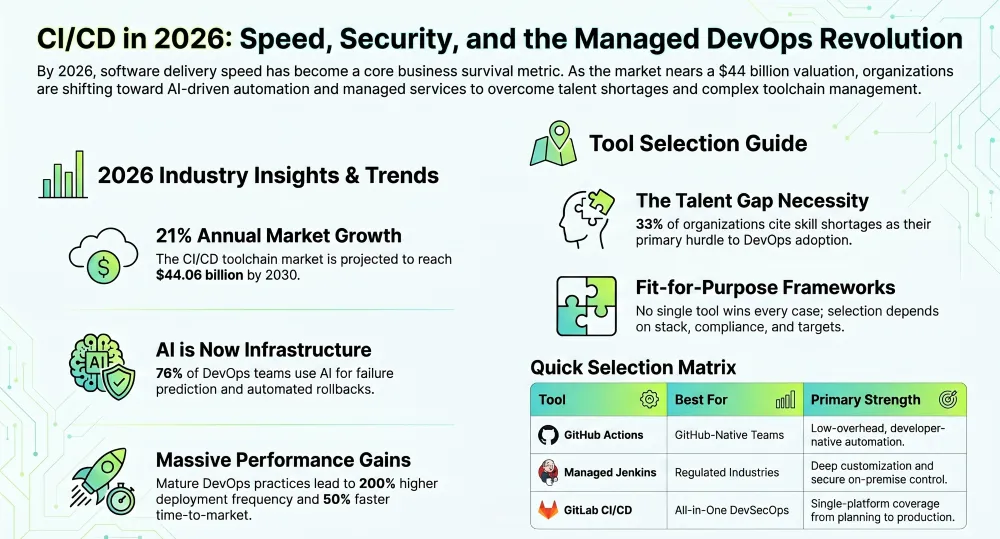
The numbers tell a compelling story. The CI/CD and DevOps Toolchain Platforms Market was valued at USD 16.97 billion in 2025 and is projected to reach USD 44.06 billion by the end of 2030, growing at a CAGR of 21%. Meanwhile, organizations using mature DevOps practices report a 200% rise in deployment frequency and a 50% fall in time-to-market. These are not incremental improvements — they represent an entirely different way of operating.
Yet selecting and managing the right toolchain is increasingly complex. The CI/CD tools market has become increasingly complex over the past few years. DevOps engineers now have to manage a wide range of tools, all with their own complex setups and features. Many businesses — especially those without a dedicated platform engineering team — are turning to CI/CD managed service providers like Full-Stack Techies to do the heavy lifting: architecting pipelines, managing upgrades, integrating security, and ensuring uptime so internal teams can focus on building product.
This guide covers the 10 Best CI/CD Tools for Managed DevOps in 2026, explaining how each works, where it excels, and how a trusted DevOps as a Service partner like Full-Stack Techies helps you unlock its full potential.
Key Takeaways
1. The CI/CD Market Is Growing at an Unprecedented Rate. The CI/CD and DevOps Toolchain Platforms Market is projected to reach USD 44.06 billion by 2030 at a 21% CAGR. Investing in the right best CI/CD tools for managed DevOps today is not optional — it is a strategic business decision that directly impacts your competitive position.
2. No Single Tool Wins Every Use Case. GitHub Actions dominates for GitHub-native teams, managed Jenkins pipelines remain king for complex enterprise builds, GitLab CI/CD as a Service leads for all-in-one DevSecOps, and Argo CD is the standard for Kubernetes GitOps. The right tool depends on your stack, compliance needs, and deployment target — not industry hype.
3. AI Is Now a Core Part of CI/CD — Not a Bonus Feature. In 2025, 76% of DevOps teams integrated AI into their pipelines. In 2026, AI-driven failure prediction, intelligent test selection, and automated rollback triggering are becoming baseline expectations — not differentiators. Choose tools and CI/CD managed service partners that treat AI as infrastructure, not a marketing add-on.
4. Security Must Be Built Into the Pipeline, Not Bolted On. DevSecOps is no longer a best practice reserved for large enterprises. Every modern CI/CD pipeline must include integrated SAST, DAST, container scanning, and secrets management from day one. Deployment tools in DevOps that do not support native security integration will become a compliance liability in 2026.
5. GitOps Is Rapidly Becoming the Operational Standard. Two-thirds of organizations had adopted GitOps by 2025, with over 80% reporting higher reliability and faster rollbacks. If your team is not treating Git as the single source of truth for both application code and infrastructure state, you are already behind the curve.
6. The Talent Shortage Makes Managed Services a Strategic Necessity. 33% of organizations cite skill shortage as their biggest DevOps challenge. Senior engineers who can architect and operate production-grade CI/CD infrastructure command salaries that most businesses cannot sustain at scale. DevOps as a Service providers like Full-Stack Techies turn that talent gap into a solved problem.
7. Pipeline Performance Is a Business Metric, Not Just a Technical One. Slow pipelines mean slow feedback, slow releases, and slow revenue. Organizations that adopted CI/CD reported a 50% reduction in software delivery costs and a 200% increase in deployment frequency. Every hour shaved off your pipeline directly accelerates your time-to-market.
8. Managed CI/CD Is Not Just About Tools — It Is About Ongoing Operations. Installing a CI/CD tool is the beginning, not the end. Pipelines require continuous maintenance, security patching, performance tuning, incident response, and optimization. Full-Stack Techies manages all of this under a predictable service model — so your engineering team ships features instead of fixing pipelines.
9. Compliance Automation Is the Next Frontier of CI/CD. Gartner’s 2026 Market Guide for DevOps Continuous Compliance Automation Tools signals that compliance-as-code is transitioning from an advanced capability to a market expectation. Organizations in financial services, healthcare, and government must embed compliance gates directly into their CI/CD managed service pipelines or face growing audit risk.
10. The Right CI/CD Partner Multiplies the Value of Every Tool. The best tools in the world underperform without expert implementation and disciplined operations. Full-Stack Techies brings cross-platform CI/CD expertise — covering GitHub Actions automation, managed Jenkins pipelines, GitLab CI/CD as a Service, and beyond — to help organizations extract maximum value from their DevOps investment in 2026 and beyond.
Quick Selection Guide: Which CI/CD Tool is Right for You?
- If you are a GitHub-native team looking for low overhead: GitHub Actions.
- If you are in a highly regulated industry needing on-premise control: Managed Jenkins.
- If you want a single “all-in-one” platform for the entire lifecycle, GitLab CI/CD.
- If build speed and developer UX are your primary KPIs, CircleCI.
- If you are running a Kubernetes-first GitOps environment, use Argo CD.
- If you need AI-driven governance and cloud cost visibility: Harness.
The State of CI/CD in 2026: Key Industry Insights
Before diving into the tools, it is worth grounding the conversation in where the industry actually stands.
In 2025, 76% of DevOps teams integrated AI into CI/CD pipelines, shifting from passive dashboards to predictive, automated responses in the delivery chain. AI is now embedded into pipeline failure prediction, intelligent test selection, and autonomous rollback triggering. The global AIOps market was valued at $16.42 billion in 2025 and is expected to reach $36.6 billion in 2030.
GitOps adoption reached roughly two-thirds of surveyed organizations by 2025, with over 80% of adopters reporting higher infrastructure reliability and faster rollbacks. This shift toward Git as the single source of truth for infrastructure is fundamentally changing how pipelines are structured and audited.
The DevOps service market is expected to register a CAGR of approximately 25.2% through 2030, as enterprises increasingly rely on external expertise to integrate and optimize automation tools across complex hybrid environments. That growth directly reflects the rising demand for CI/CD managed service and DevOps as a Service providers that bridge the expertise gap.
Jenkins dominates the CI/CD tools market with a share of 46.35%, while Atlassian Bitbucket holds 18.61% and CircleCI commands a 5.72% share.
Gartner’s position is equally clear: Gartner defines DevOps platforms as those that provide fully integrated and orchestrated capabilities to enable continuous delivery of software, spanning the development and delivery lifecycle built around the CI/CD pipeline, including planning, creation, artifact management, security, quality engineering, change management, compliance, environment management, deployment, and monitoring. Increasingly, organizations need a managed Jenkins pipeline or a GitLab CI/CD as a Service model to meet that definition without building an internal platform team from scratch.
What Makes a CI/CD Tool “Best” for Managed DevOps?
Not every CI/CD tool is suited for a managed services context. When Full-Stack Techies evaluates tools for clients, the criteria include:
- Pipeline configurability and maintainability — Can non-original engineers understand and extend the configuration without reverse-engineering undocumented decisions?
- Security and compliance integration — Does the tool support DevSecOps natively, or does it require bolted-on third-party plugins?
- Scalability across environments — Can pipelines run consistently across on-premise, hybrid, and multi-cloud setups?
- Ecosystem integration — How well does the tool connect with version control, monitoring, artifact registries, and ticketing systems?
- Total cost of ownership — Does the managed model reduce or increase operational overhead over time?
- AI-readiness — Does the platform support intelligent pipeline optimization as standard?
With those benchmarks in mind, here are the 10 best deployment tools in DevOps and CI/CD for managed services in 2026.
1. GitHub Actions — The Cloud-Native CI/CD Standard
Primary strength: Developer-native automation embedded directly in the repository
GitHub Actions automation has become the dominant choice for modern teams, and the data confirms it. 62% of respondents reported using GitHub Actions for personal projects, and 41% said they use the tool in organizations. It is the most popular CI/CD tool for personal projects — not surprising given that GitHub has over 100 million users and 420 million repositories.
The architecture of GitHub Actions automation is built around YAML-defined workflows that trigger on repository events: pushes, pull requests, releases, or scheduled crons. Every workflow runs inside ephemeral, containerized runners hosted on GitHub’s infrastructure — or your own self-hosted runners for private networking requirements.
What makes it exceptional for managed DevOps:
The reusable workflow and composite action system means Full-Stack Techies can build standardized pipeline templates for clients once, and apply them consistently across dozens of repositories. Secrets management integrates with GitHub’s native vault and supports OIDC federation with AWS, Azure, and GCP — eliminating long-lived credentials from pipelines entirely.
The GitHub Actions Marketplace now lists over 20,000 community actions, covering everything from Terraform plan approvals to Slack notifications to container vulnerability scanning. For teams already on GitHub, this means GitHub Actions automation delivers CI/CD without requiring a separate toolchain decision.
Ideal for: Teams on GitHub, open-source projects, organizations standardizing on a single platform, and businesses that need a CI/CD managed service with low infrastructure overhead.
Full-Stack Techies implementation note: We configure GitHub Actions automation with branch protection rules, required status checks, environment-scoped deployment gates, and integrated SAST/DAST scanning — turning a basic workflow file into an enterprise-grade, auditable delivery pipeline.
2. Jenkins — The Enterprise Workhorse, Modernized
Primary strength: Unmatched plugin ecosystem and on-premise control
Many respondents mentioned sticking to Jenkins and other older tools simply because critical systems depend on them. Whether it’s because the whole plugin infrastructure is built around these tools or simply a result of a general “if it’s not broken, don’t fix it” approach, fully migrating away from these tools is just too risky or expensive.
That inertia is not a weakness — it reflects genuine enterprise value. Managed Jenkins pipelines give organizations with complex, long-running build processes the customization depth that SaaS platforms often cannot match. Jenkins’ 1,800+ plugin library covers every conceivable integration: mainframe builds, COBOL testing, SAP deployment, and virtually every cloud and container orchestration platform.
The modern Jenkins story is the Jenkins X and Jenkins Configuration as Code (JCasC) story. JCasC eliminates the brittle, GUI-configured Jenkins instances of the past by expressing the entire controller configuration in declarative YAML. This is the foundation of how Full-Stack Techies delivers managed Jenkins pipelines — every configuration is version-controlled, peer-reviewed, and reproducible.
What makes it exceptional for managed DevOps:
Managed Jenkins pipelines with Kubernetes-based ephemeral agents give organizations cloud-like scalability with on-premise control. Agents spin up on demand inside a Kubernetes cluster, execute jobs, and terminate — eliminating idle compute costs and snowflake build environments.
Ideal for: Regulated industries (financial services, healthcare, defense) requiring on-premise deployment, enterprises with large legacy codebases, and organizations needing deep customization of build logic.
Full-Stack Techies implementation note: We migrate clients from click-configured Jenkins instances to fully JCasC-managed managed Jenkins pipelines, running ephemeral Kubernetes agents with templated Jenkinsfile libraries — reducing pipeline maintenance overhead by up to 60%.
3. GitLab CI/CD — The All-in-One DevSecOps Platform
Primary strength: Single-platform coverage from planning to production
GitLab was officially named a definitive Leader in the 2024 Gartner Magic Quadrant for DevOps Platforms, heavily praised for its aggressive rollout of “GitLab Duo,” a suite of advanced AI-powered DevSecOps features.
GitLab CI/CD as a Service represents the most complete single-vendor answer to the DevOps toolchain problem. Rather than stitching together a version control system, CI engine, container registry, dependency scanning tool, deployment orchestrator, and monitoring dashboard from different vendors, GitLab houses all of it under one roof — and one pricing model.
Auto DevOps automates CI/CD pipelines using GitLab’s predefined templates, ideal for rapid onboarding. Merge Trains ensure stable main branches by queuing and testing merge requests sequentially. Parent/Child Pipelines allow decomposition of complex workflows into smaller, reusable components.
The GitLab Duo AI suite now embeds code explanation, vulnerability remediation suggestions, and pipeline failure root-cause analysis directly into the developer workflow — reducing the cognitive load of operating complex pipelines without needing a separate AI tool.
A Forrester Total Economic Impact study showed enterprises using GitLab Ultimate reported an 80% reduction in pipeline build time post-adoption, with GitLab CI/CD allowing for the consolidation of toolchains, reducing costs and improving developer efficiency.
Ideal for: Organizations wanting a consolidated DevSecOps platform, compliance-heavy industries needing built-in audit trails, and teams running GitLab CI/CD as a Service on GitLab.com’s SaaS offering.
Full-Stack Techies implementation note: We implement GitLab CI/CD as a Service with compliance pipelines, security policy enforcement via GitLab’s Security Policy Editor, and environment-tiered deployments — making GitLab the single pane of glass for the entire software lifecycle.
4. CircleCI — Speed and Developer Experience First
Primary strength: Parallelism, caching, and pipeline performance optimization
CircleCI has carved out a durable niche among teams where build speed directly correlates to developer happiness and productivity. Its intelligent caching layer — which persists across jobs, branches, and pipelines — dramatically reduces repeated dependency installation and compilation time, often cutting build times by 40–70% compared to unconfigured alternatives.
The platform’s Test Insights feature uses historical run data to identify flaky tests and slow test suites, enabling targeted optimization without manual instrumentation. For organizations running test suites with thousands of cases, CircleCI’s automatic test splitting across parallel containers compresses feedback loops from 30 minutes to under 5.
What makes it exceptional for managed DevOps:
CircleCI’s orbs — reusable, versioned pipeline packages — function similarly to GitHub Actions’ Marketplace. Full-Stack Techies maintains a private orb registry for clients, publishing standardized deployment, notification, and security scanning steps that teams consume without needing to understand the underlying implementation.
The platform’s self-hosted runner capability supports macOS, Linux, and Windows, making it viable for mobile CI/CD pipelines, cross-platform desktop applications, and embedded systems builds.
Ideal for: Fast-moving product teams, SaaS companies with large test suites, and engineering organizations where pipeline performance is a top-tier KPI.
Full-Stack Techies implementation note: We configure CircleCI with dynamic configuration (pipeline parameters that conditionally include workflow stages), advanced caching strategies, and test splitting profiles — typically reducing total pipeline duration by 50%+ for new clients.
5. Azure DevOps — The Microsoft Ecosystem’s Native CI/CD
Primary strength: Deep integration with Microsoft and Azure services
For organizations running on Microsoft Azure, Azure DevOps is not merely a CI/CD tool — it is the central nervous system for software delivery. Azure Pipelines, one of five services within the Azure DevOps suite, connects natively to Azure Container Registry, Azure Kubernetes Service, Azure App Service, and every major Azure PaaS offering.
The YAML-based pipeline definition supports multi-stage pipelines with approval gates, deployment rings, and rollback policies — bringing enterprise release management discipline to the CI/CD layer. Integration with Microsoft Entra ID (formerly Azure Active Directory) means permissions, secrets, and service connections inherit from your organization’s identity infrastructure without any custom integration work.
What makes it exceptional for managed DevOps:
Azure DevOps Boards, Repos, Artifacts, Test Plans, and Pipelines create a closed-loop delivery system. Linking work items to commits, commits to pipeline runs, and pipeline runs to deployment environments gives organizations end-to-end traceability from business requirement to production release.
For deployment tools in DevOps targeting Azure, no platform matches the native depth of Azure DevOps — including zero-downtime slot swaps for App Services, canary deployments to AKS, and automated infrastructure provisioning via Bicep and Terraform tasks.
Ideal for: Microsoft-centric enterprises, regulated organizations needing Azure-native audit trails, and teams using the full Azure DevOps suite as their DevOps as a Service backbone.
Full-Stack Techies implementation note: We architect Azure DevOps environments with service principal federation (no client secrets), environment-gated multi-stage pipelines, and integrated Azure Policy compliance reporting — delivering a fully managed CI/CD experience on Microsoft’s infrastructure.
6. AWS CodePipeline + CodeBuild — Cloud-Native CI/CD on AWS
Primary strength: Serverless, auto-scaling CI/CD deeply integrated with AWS services
AWS’s native CI/CD offering — CodePipeline for orchestration, CodeBuild for compilation and testing, CodeDeploy for deployment, and CodeArtifact for artifact management — delivers a fully serverless pipeline model with zero infrastructure management overhead. There are no controllers to patch, no build agents to maintain, and no capacity planning required.
CodeBuild’s managed build environments support custom Docker images, enabling teams to define their exact toolchain without depending on a shared agent pool. Build projects scale automatically based on demand, and you pay only for the compute time consumed during builds — making it highly cost-efficient for variable workloads.
What makes it exceptional for managed DevOps:
The tight IAM integration makes security configuration straightforward in an AWS context. CodeBuild jobs assume IAM roles with least-privilege policies, and CodePipeline uses cross-account roles for multi-account deployment architectures — a critical pattern for enterprises running AWS Organizations with separate workload accounts.
With a 31% market share, AWS continues to dominate the cloud computing market, which means CodePipeline often becomes the default CI/CD choice simply because the rest of the infrastructure is already on AWS.
Ideal for: AWS-native organizations, serverless application teams, companies with variable build workloads, and businesses seeking a CI/CD managed service within the AWS ecosystem.
Full-Stack Techies implementation note: We implement AWS CodePipeline with cross-account deployment patterns, EventBridge-triggered pipeline executions, and integrated Amazon Inspector and ECR image scanning — creating a fully cloud-native, serverless CI/CD system with no infrastructure to manage.
7. Argo CD — The GitOps Continuous Delivery Engine
Primary strength: Declarative, Git-driven continuous delivery for Kubernetes
If GitHub Actions automation is the CI champion, Argo CD is the CD champion for Kubernetes-based workloads. Built natively on GitOps principles, Argo CD continuously monitors Git repositories for changes to Kubernetes manifests and automatically synchronizes the cluster state to make Git the single source of truth for what runs in production.
GitOps adoption reached roughly two-thirds of surveyed organizations by 2025, with over 80% of adopters reporting higher infrastructure reliability and faster rollbacks. Argo CD is the tool most responsible for that adoption curve.
What makes it exceptional for managed DevOps:
Argo CD’s ApplicationSet controller enables managing hundreds of applications across dozens of clusters from a single Git repository structure — the foundation of platform teams building DevOps as a Service capabilities internally or externally. Sync waves and hooks give precise control over deployment ordering, making Argo CD viable for complex stateful applications, not just stateless microservices.
The built-in rollback capability is Git-native: restoring a previous version is as simple as reverting a commit — no out-of-band tooling, no manual kubectl commands, no institutional knowledge required.
Ideal for: Kubernetes-first organizations, platform engineering teams, cloud-native application stacks, and any team implementing GitOps as their primary deployment tool in a DevOps strategy.
Full-Stack Techies implementation note: We pair Argo CD with Argo Rollouts for progressive delivery — canary releases, blue-green deployments, and automated analysis using Prometheus metrics — giving clients Kubernetes-native continuous delivery with zero-downtime guarantees.
8. Tekton — Cloud-Native CI/CD on Kubernetes
Primary strength: Kubernetes-native pipeline primitives with full portability
Tekton is an open-source framework from the Continuous Delivery Foundation that defines CI/CD pipelines as Kubernetes custom resources. Every step, task, and pipeline is a Kubernetes object — versioned, audited, and managed via standard Kubernetes tooling. This makes Tekton uniquely portable: a Tekton pipeline runs identically on any Kubernetes cluster, any cloud, or any on-premise environment.
For organizations that need to avoid vendor lock-in across their CI/CD managed service stack, Tekton provides the foundation. Platforms like Red Hat OpenShift Pipelines, Google Cloud Deploy, and IBM Cloud Continuous Delivery are built on top of Tekton — making pipeline expertise highly transferable.
What makes it exceptional for managed DevOps:
Tekton’s TaskRun isolation — each task runs in its own ephemeral container — means build environments are clean, reproducible, and auditable. Tekton Chains automatically signs task outputs, creating a cryptographic attestation chain that supports SLSA (Supply-chain Levels for Software Artifacts) compliance — increasingly important as software supply chain security requirements tighten in 2026.
Ideal for: Organizations with strong Kubernetes expertise, platform teams building internal developer platforms, and enterprises with strict supply chain security requirements.
Full-Stack Techies implementation note: We deploy Tekton with Tekton Chains for SLSA Level 3 provenance, integrating Cosign for container signing and Rekor for transparency log publishing — meeting the software supply chain security requirements increasingly mandated in financial services and government sectors.
9. Harness — AI-Native CI/CD for Enterprise Scale
Primary strength: AI-driven pipeline intelligence and cost governance
Harness has emerged as one of the most sophisticated deployment tools in DevOps for enterprises that need both CI/CD functionality and business-level visibility into software delivery. Its AIDA (AI Development Assistant) is embedded across the platform — explaining pipeline failures in plain language, suggesting remediation steps, and predicting deployment risk scores before a release goes to production.
The platform’s Cloud Cost Management module connects deployment activity to cloud spend in real time, giving organizations visibility into the cost implications of infrastructure scaling decisions within CI/CD pipelines — a critical capability as FinOps practices mature alongside DevOps.
What makes it exceptional for managed DevOps:
Harness Feature Flags integrates directly with the deployment pipeline, enabling feature-flag-driven progressive delivery without a separate tooling layer. Combined with Harness Chaos Engineering, organizations can run automated chaos experiments against canary deployments and gate promotion based on resilience thresholds — all within a single platform.
In 2026, managed DevOps teams are putting even more emphasis on serverless computing and cloud-native design, and Harness’s native serverless deployment support — covering AWS Lambda, Azure Functions, and Google Cloud Functions — makes it a strong choice for organizations on that trajectory.
Ideal for: Mid-to-large enterprises needing AI-driven pipeline governance, organizations adopting feature-flag-driven deployments, and teams seeking a premium CI/CD managed service experience with built-in cost visibility.
Full-Stack Techies implementation note: We implement Harness for clients requiring Board-level visibility into deployment risk, cost, and velocity — configuring OPA (Open Policy Agent) governance policies that enforce compliance gates automatically before any production release.
10. TeamCity — The Professional-Grade Build Automation Platform
Primary strength: Deep build intelligence, flexibility, and enterprise reliability
JetBrains’ TeamCity has long been a favorite in enterprises where build logic is complex, build times are long, and pipeline reliability is non-negotiable. Its build chain visualization — showing the full dependency graph of interconnected pipelines across projects — is unmatched in clarity among competing tools.
TeamCity’s smart rebuilding logic detects when upstream changes actually affect a downstream build, skipping unnecessary recompilation and testing. For organizations with monorepo structures or deeply interconnected microservice dependencies, this translates to meaningful compute savings and faster feedback.
What makes it exceptional for managed DevOps:
GitHub Actions is free and fast for lightweight tasks, while Jenkins or TeamCity may be preferred for heavier lifting. In some cases, on-premises solutions are simply cheaper to maintain for large workloads. TeamCity occupies that “heavier lifting” tier — it handles .NET, Java, Python, Go, and C++ builds with equal facility, making it the right choice for polyglot organizations running diverse technology stacks.
TeamCity Cloud, JetBrains’ hosted offering, removes the controller management burden while preserving the full feature set — bridging the gap between self-hosted control and SaaS convenience.
Ideal for: JetBrains-ecosystem organizations, polyglot engineering teams, enterprises with complex build dependency graphs, and teams migrating away from legacy build servers.
Full-Stack Techies implementation note: We configure TeamCity with Kotlin DSL for version-controlled pipeline definitions, build chains for microservice dependency management, and integrated SonarQube analysis — delivering enterprise build automation as a fully managed service.
Get scalable, fast, and user-friendly DevOps solutions tailored to your needs.
Get Free ConsultationComparison Summary: Choosing the Right Tool for Your Context
| Tool | Best For | Hosted Option | AI Features | GitOps Native |
|---|---|---|---|---|
| GitHub Actions | GitHub-native teams | Yes | Copilot integration | Via Actions |
| Jenkins | Enterprise, on-premise | No (self-hosted) | Plugin-based | Via plugins |
| GitLab CI/CD | All-in-one DevSecOps | Yes (GitLab.com) | GitLab Duo | Yes |
| CircleCI | Speed, developer UX | Yes | Test Insights | Via orbs |
| Azure DevOps | Microsoft ecosystem | Yes | Copilot integration | Via pipelines |
| AWS CodePipeline | AWS-native workloads | Yes (serverless) | Amazon Q | Via EventBridge |
| Argo CD | Kubernetes GitOps | No (self-hosted) | Limited | Yes (native) |
| Tekton | Portable Kubernetes CI/CD | No (self-hosted) | Limited | Via Tekton Chains |
| Harness | AI-governed enterprise CD | Yes | AIDA (native) | Yes |
| TeamCity | Complex builds, polyglot | Yes (TeamCity Cloud) | Limited | Via plugins |
The Case for Managed CI/CD Services in 2026
Selecting a tool is the easy part. Operating it reliably — maintaining agents, patching controllers, tuning caching strategies, managing secrets rotation, integrating security scanning, onboarding new repositories, and responding to pipeline failures at 2 AM — is where most organizations struggle.
The services segment of the DevOps market is forecast to record a 23.1% CAGR to 2031. Enterprises rely on consulting, training, and managed offerings to bridge skills gaps and handle complex toolchains. Demand spikes for managed DevSecOps platforms that combine advisory and execution.
A Puppet survey found the top DevOps challenge is skill shortage, with 33% of respondents citing it as the biggest challenge they faced in adopting DevOps. The talent scarcity problem is not resolving — it is intensifying. Senior DevOps engineers who can architect and operate production-grade CI/CD infrastructure at scale command premium salaries that most organizations cannot sustain.
This is the gap Full-Stack Techies was built to fill.
How Full-Stack Techies Delivers CI/CD as a Managed Service
Full-Stack Techies is a dedicated DevOps as a Service provider that helps businesses across industries design, implement, and operate enterprise-grade CI/CD pipelines — without the overhead of hiring, training, and retaining a specialist platform engineering team.
What Full-Stack Techies manage for you:
- Pipeline architecture and design — We do not just install tools. We architect delivery systems tailored to your technology stack, team structure, compliance requirements, and cloud strategy. Whether you need a managed Jenkins pipeline for a legacy Java monolith or GitHub Actions automation for a cloud-native microservices platform, we design for your context.
- Security and compliance integration — Every pipeline we build includes integrated SAST, DAST, SCA (Software Composition Analysis), container image scanning, and secrets management. We implement DevSecOps practices that shift security left without slowing delivery down — essential as software supply chain attacks continue to rise in 2026.
- GitLab CI/CD as a Service — For clients on GitLab, Full-Stack Techies operates the full lifecycle: runner infrastructure management, pipeline template maintenance, compliance pipeline configuration, and security policy enforcement — all under a predictable managed service model.
- Monitoring, alerting, and SLA management — We instrument pipelines with observability tooling that tracks pipeline success rates, build durations, deployment frequencies, and DORA metrics. Our team responds to pipeline failures, investigates root causes, and implements preventive fixes — so your engineers wake up to green pipelines, not incident pages.
- Continuous optimization — CI/CD pipelines degrade over time without active maintenance. Full-Stack Techies conducts monthly pipeline health reviews, identifies bottlenecks, implements caching improvements, prunes unnecessary steps, and ensures toolchain versions stay current — keeping your pipelines fast, secure, and cost-efficient.
- Multi-tool expertise — Most organizations run more than one CI/CD tool. Full-Stack Techies has hands-on expertise across every platform in this list, enabling us to manage heterogeneous toolchains without forcing a disruptive consolidation that the business is not ready for.
Emerging Trends Shaping CI/CD in 2026 and Beyond
AI-powered pipeline intelligence is becoming standard. AI in CI/CD is moving beyond anomaly detection dashboards toward preventive and autonomous actions, with use cases including intelligent test selection, risk-based change scoring, and automated remediation flows that trigger rollbacks or config changes before users experience impact.
Platform engineering is redefining how CI/CD is consumed. Platform engineering is one of the key DevOps trends in 2026 and beyond, as organizations increasingly build Internal Developer Platforms to streamline delivery pipelines. Managed service providers like Full-Stack Techies effectively function as an external platform engineering team for organizations that cannot justify building one internally.
DevSecOps integration is no longer optional. Integration of security and DevOps is expected to deepen in 2026, with 27.27% of security engineers citing better integration of development workflows as a primary focus. Every Best CI/CD Tools for Managed DevOps deployment in 2026 must have security controls embedded in the pipeline, not bolted on afterward.
Compliance automation is creating new tool requirements. Gartner’s March 2026 publication of its Market Guide for DevOps Continuous Compliance Automation Tools signals that compliance-as-code is transitioning from an advanced practice to a market expectation — particularly in financial services, healthcare, and government sectors.
GitOps is maturing from a pattern to an operational standard. The market is being heavily shaped by the rapid standardization of GitOps, a framework where Git repositories act as the single source of truth for declarative infrastructure and applications, allowing for completely automated cluster synchronization.
Also Read: 10 Top DevOps Managed Service Providers for Enterprises (2026)
Conclusion: Choose the Tools. Partner for the Operations.
The Best CI/CD Tools for Managed DevOps in 2026 — GitHub Actions automation, managed Jenkins pipelines, GitLab CI/CD as a Service, CircleCI, Azure DevOps, AWS CodePipeline, Argo CD, Tekton, Harness, and TeamCity — collectively represent the most powerful software delivery infrastructure in the history of software engineering. They are faster, more intelligent, more secure, and more integrated than any previous generation of deployment tools in DevOps.
But tools do not manage themselves. Pipelines require ongoing architecture, security hardening, performance tuning, incident response, and continuous improvement. The market faces formidable restraints, most notably the severe global shortage of highly skilled DevOps and platform engineering professionals capable of architecting these complex systems.
Full-Stack Techies closes that gap. As a specialized DevOps as a Service and CI/CD managed service provider, we bring senior engineering expertise, proven implementation frameworks, and round-the-clock operational support to businesses that need enterprise-grade pipelines without enterprise-sized platform teams.
Whether you are migrating from a legacy CI/CD setup, scaling an existing pipeline to handle ten times the throughput, or building a DevSecOps-compliant delivery system from scratch, Full-Stack Techies is the partner that makes it happen — reliably, securely, and on schedule.
Frequently Asked Questions About the Best CI/CD Tools for Managed DevOps
Q1: What are the best CI/CD tools for managed DevOps services in 2026?
The 10 best CI/CD tools for managed DevOps in 2026 are GitHub Actions, Jenkins, GitLab CI/CD, CircleCI, Azure DevOps, AWS CodePipeline, Argo CD, Tekton, Harness, and TeamCity. Each serves different use cases u2014 from cloud-native pipelines to enterprise on-premise deployments.
Q2: What is a CI/CD managed service?
A CI/CD managed service is when a third-party provider like Full-Stack Techies designs, operates, and optimizes your CI/CD pipelines on your behalf u2014 handling infrastructure, security, monitoring, and maintenance so your internal team can focus on building product instead of managing tooling.
Q3: How is GitHub Actions automation different from other CI/CD tools?
GitHub Actions automation is embedded directly inside GitHub repositories, triggering workflows on code events like pushes and pull requests. Unlike standalone CI/CD platforms, it requires no separate integration u2014 making it the fastest way to get a pipeline running for teams already on GitHub.
Q4: When should a business choose managed Jenkins pipelines over a SaaS CI/CD tool?
Managed Jenkins pipelines are the right choice when your organization needs on-premise deployment, has complex legacy build logic, operates in a regulated industry with strict data residency requirements, or relies on Jenkinsu2019 deep plugin ecosystem for specialized integrations that SaaS tools cannot replicate.
Q5: What is GitLab CI/CD as a Service and who is it best for?
GitLab CI/CD as a Service is a fully managed delivery model where providers like Full-Stack Techies operate your GitLab pipelines u2014 including runner management, security policy enforcement, and compliance configuration. It is best for organizations that want a single platform covering source control, CI/CD, and DevSecOps under one roof.
Q6: What are deployment tools in DevOps and why do they matter?
Deployment tools in DevOps are platforms that automate the process of moving tested code from a pipeline into staging or production environments. They matter because manual deployments are slow, error-prone, and unauditable. The right deployment tools in DevOps eliminate human error, enforce release gates, and make rollback instant.
Q7: What is DevOps as a Service and how does Full-Stack Techies deliver it?
DevOps as a Service is the outsourcing of your entire DevOps function u2014 including CI/CD pipeline management, infrastructure automation, monitoring, and security u2014 to a dedicated provider. Full-Stack Techies delivers it through tailored pipeline architecture, 24/7 operational support, DORA metric tracking, and continuous pipeline optimization under a predictable managed service model.
Q8: Which CI/CD tool is best for Kubernetes-based workloads?
Argo CD is the top choice for Kubernetes-native continuous delivery, operating on GitOps principles where Git is the single source of truth for cluster state. Tekton is the best option when you need fully portable, Kubernetes-native CI as well. Both are available as part of Full-Stack Techiesu2019 managed DevOps offerings.
Q9: How fast is the CI/CD and DevOps tools market growing?
The CI/CD and DevOps Toolchain Platforms Market was valued at USD 16.97 billion in 2025 and is projected to reach USD 44.06 billion by 2030 at a 21% CAGR. The DevOps as a Service segment is growing even faster at approximately 25.2% CAGR u2014 driven by talent shortages and the rising complexity of modern delivery pipelines.
Q10: How do I choose between these CI/CD tools for my organization?
The right choice depends on four factors: your existing tech stack (GitHub, GitLab, AWS, Azure), your deployment target (Kubernetes, serverless, on-premise), your compliance requirements, and your teamu2019s DevOps maturity. If evaluating tools feels overwhelming, Full-Stack Techies offers a free pipeline assessment to match your organization with the right best CI/CD tools for managed DevOps strategy from day one.



