Best DevOps Tools Compared: CI/CD, Automation, Monitoring & Infrastructure
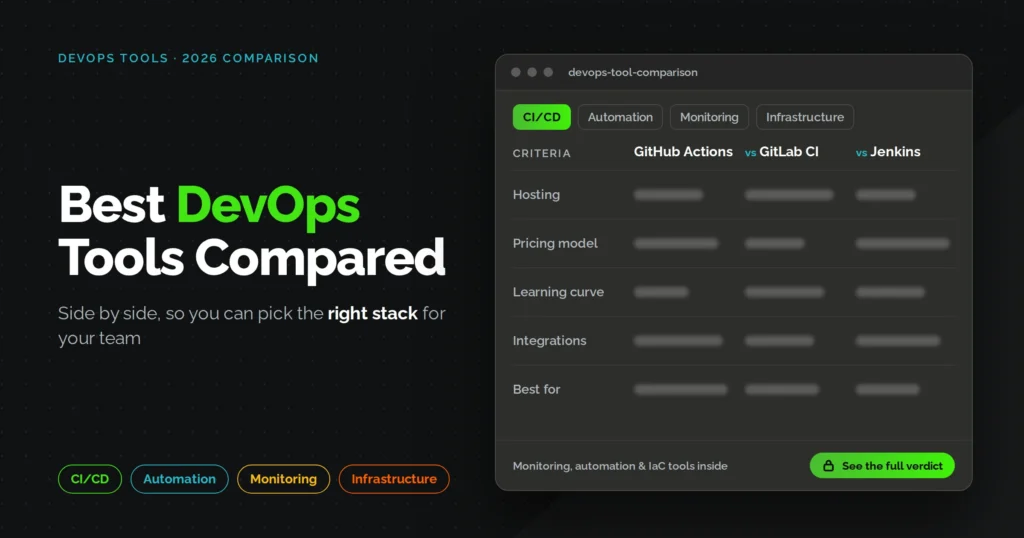

Picking a DevOps tool used to mean picking one platform and living with it. That’s not how teams operate anymore.
Most engineering organizations now run four or five tools side by side, one for pipelines, one for provisioning, one for watching production, and one for keeping the whole thing secure. This guide compares the best DevOps tools across those four pillars so you can see what actually fits your stack instead of guessing from a marketing page.
Best DevOps Tools
- Jenkins — best open source CI/CD automation server
- GitHub Actions — best CI/CD tool for GitHub native teams
- GitLab CI/CD — best all in one DevOps platform
- Terraform — best infrastructure as code tool for multi cloud
- Spacelift — best tool for policy driven IaC orchestration
- Ansible — best agentless configuration management tool
- Docker — best containerization tool
- Kubernetes — best container orchestration platform
- Prometheus — best open source monitoring tool
- Grafana — best observability and dashboard tool
- Datadog — best full stack cloud monitoring platform
- Argo CD — best GitOps continuous delivery tool
Which CI/CD Tools Actually Speed Up Your Releases?
CI/CD is still the backbone of any DevOps practice, its the part that turns a code commit into something running in production without someone babysitting the process. The right choice usually comes down to how much control your team wants versus how much setup time you’re willing to spend.
Jenkins vs GitHub Actions: Which One Fits Your Team
Jenkins has been around since 2011 and it’s still the most customizable CI server on the market, largely because of a plugin ecosystem that covers almost anything you’d want to automate. The tradeoff is that you own it. You manage the server, the plugin upgrades, and the security patching, which is fine for teams with dedicated platform engineers but a real burden for smaller ones.
GitHub Actions skips most of that setup by living directly inside your repository. Workflows are defined in YAML, triggered by pull requests or pushes, and there’s a large marketplace of prebuilt actions. If your codebase already lives on GitHub, this is usually the faster path to a working pipeline.
GitLab CI/CD for Teams That Want One Platform
GitLab bundles source control, CI/CD, and basic project management into a single product, which removes the need to stitch together separate tools for version control and pipelines. Teams that want fewer vendor relationships tend to gravitate here. The tradeoff is less flexibility than Jenkins if your pipeline logic gets genuinely complex.
CircleCI and Argo CD for Cloud Native Delivery
CircleCI is a managed CI platform built for speed, with parallel job execution and Docker layer caching that shortens build times for larger codebases. Argo CD sits a level below that, it’s a GitOps continuous delivery tool purpose built for Kubernetes, syncing your cluster state to whatever’s declared in Git. Many teams run CircleCI or GitHub Actions for the build stage and hand off to Argo CD for the actual deployment into Kubernetes.
How Do Infrastructure Automation Tools Cut Manual Provisioning Work?
Manually clicking through a cloud console to spin up servers doesn’t scale past a handful of environments. Infrastructure automation tools turn that process into version controlled code, so provisioning becomes repeatable and auditable instead of tribal knowledge.
Terraform vs Pulumi for Infrastructure as Code
Terraform remains the default choice for most teams, using its own declarative language (HCL) to define cloud resources across AWS, Azure, GCP, and dozens of other providers. Pulumi takes a different approach entirely, letting you write infrastructure code in Python, TypeScript, Go, or a handful of other general purpose languages instead of a domain specific one. If your infra team already codes daily in one of those languages, Pulumi cuts the context switching. If you’d rather keep infrastructure code separate from application code, Terraform is the safer default.
Spacelift for Policy Driven IaC at Scale
Spacelift doesn’t replace Terraform or Pulumi, it orchestrates them. It adds policy as code using Open Policy Agent, so a plan that violates your infrastructure standards can be blocked before it ever reaches production. For platform teams managing IaC across dozens of repositories and multiple clouds, that guardrail layer matters more than the provisioning tool itself.
Ansible and Chef for Configuration Management
Ansible is agentless, uses YAML playbooks, and doesn’t require installing anything on the servers it manages, which makes it the lower friction option for most teams. Chef uses Ruby based cookbooks and a client-server model, and tends to suit organizations that already have deep Ruby expertise or a larger legacy footprint. Both solve the same core problem: keeping server configuration consistent instead of drifting server by server.
Which DevOps Monitoring Tools Give You Real Time Visibility?
Deploying faster is only half the job, you also need to know the moment something breaks in production. Monitoring tools exist to close that gap between deployment and detection.
Prometheus and Grafana for Open Source Observability
Prometheus pulls metrics from your services on a schedule and stores them as time series data, which makes it a strong fit for Kubernetes environments where services and pods are constantly changing. Grafana doesn’t collect data itself, it visualizes whatever Prometheus (or several other sources) feeds into it through customizable dashboards. Together they’re the most common open source monitoring pairing in cloud native shops today.
Datadog and New Relic for Full Stack Monitoring
Datadog and New Relic both offer a single platform that covers infrastructure, application performance, logs, and user experience monitoring in one place. That consolidation saves engineering time compared to stitching open source tools together, but it comes at a real cost once you’re monitoring hundreds of hosts or high volumes of custom metrics. These are usually the right pick for teams that would rather pay for convenience than manage their own observability stack.
PagerDuty for Incident Response and Alerting
PagerDuty isn’t a monitoring tool itself, it’s the layer that sits on top of Prometheus, Datadog, or whatever you’re using to detect problems. Its job is escalation: deciding who gets paged, when, and what happens if they don’t respond. Teams that skip this layer usually end up with alerts that either everyone ignores or nobody sees in time.
What are the Best Container and Kubernetes Tools for DevOps Teams?
Containers changed how software ships, and Kubernetes changed how those containers get managed at scale. Most modern DevOps stacks assume both are already in place.
Docker for Containerization
Docker packages an application with everything it needs to run into a single portable image, which solves the “it worked on my machine” problem for good. Build once, run the same image locally, in staging, and in production. It’s still the default containerization format even where the runtime underneath has changed.
Kubernetes for Container Orchestration at Scale
Kubernetes automates deployment, scaling, and recovery of containerized applications across a cluster of machines, self healing failed containers and redistributing workloads without manual intervention. It’s a CNCF graduated project at this point, which says a lot about how mainstream it’s become across enterprises of every size. The learning curve is real, but for teams running more than a handful of services, it’s hard to justify not using it.
How Do DevSecOps Tools Keep Your Pipeline Secure?
Security bolted onto the end of a release cycle catches problems too late to fix cheaply. DevSecOps tools push those checks earlier, into the same pipeline that builds and deploys your code.
Snyk and Trivy for Vulnerability Scanning
Snyk scans your open source dependencies, container images, and infrastructure as code for known vulnerabilities directly inside your CI pipeline, flagging issues before a build ever ships. Trivy does something similar as a free, open source scanner, and it’s become a common choice for teams that want vulnerability scanning without a per seat license. Running either one as a required pipeline step, rather than an optional audit, is what actually catches problems before release.
HashiCorp Vault for Secrets Management
Hardcoded API keys and database passwords in a config file are still one of the most common ways teams get breached. Vault issues short lived, dynamically generated credentials instead, so secrets rotate automatically and nothing sensitive sits in plain text in your repo. It’s become close to a standard for teams serious about least privilege access.
Best DevOps Tools Comparison Table: CI/CD, Automation, Monitoring, Infrastructure
| Tool | Category | Best For | License | Learning Curve |
|---|---|---|---|---|
| Jenkins | CI/CD | Full pipeline control | Open source | Steep |
| GitHub Actions | CI/CD | GitHub native teams | Free / paid tiers | Low |
| GitLab CI/CD | CI/CD | Single platform teams | Free / paid tiers | Moderate |
| Terraform | Infrastructure | Multi cloud provisioning | Open source / paid | Moderate |
| Pulumi | Infrastructure | Code first IaC | Free / paid tiers | Moderate |
| Spacelift | Infrastructure | Policy driven IaC orchestration | Paid | Moderate |
| Ansible | Automation | Config management | Open source | Low |
| Docker | Containers | Containerization | Free / paid tiers | Low |
| Kubernetes | Containers | Orchestration at scale | Open source | Steep |
| Prometheus | Monitoring | Metrics collection | Open source | Moderate |
| Grafana | Monitoring | Dashboards and visualization | Open source / paid | Low |
| Datadog | Monitoring | Full stack SaaS monitoring | Paid | Low |
| Snyk | Security | Dependency and container scanning | Free / paid tiers | Low |
| HashiCorp Vault | Security | Secrets management | Open source / paid | Moderate |
How Should You Choose the Right DevOps Tool Stack for Your Team?
There’s no single stack that works for every team, the right combination depends on where you are right now, not where a vendor’s homepage says you should be.
Start with these four questions:
Team size and skill set: A five person startup and a 200 person platform org need different tools even if they’re solving the same problem.
Cloud footprint: Single cloud teams can lean into provider native tools; multi cloud teams need vendor neutral options like Terraform.
Existing maturity: If you don’t have CI/CD in place yet, get that working before layering on advanced observability or policy engines.
Budget model: Per seat pricing scales differently than consumption based pricing once your team doubles in size.
Gartner projects that by 2026, 80% of large software engineering organizations will have established platform engineering teams as internal providers of reusable services and tools for application delivery, up from just 45% in 2022. That shift matters because it changes who owns tool selection, moving it from individual teams to a centralized platform function.
If your team doesn’t have the bandwidth to own and maintain this stack internally, that’s exactly the gap a managed DevOps as a Service provider like Fullstacktechies is built to close, handling the pipeline, the infrastructure, and the monitoring so your engineers can focus on product work instead of tool maintenance.
How is AI Changing DevOps Tooling Right Now?
AI has moved from an experimental feature to a default expectation in DevOps tooling faster than most other categories of software. Google’s 2025 DORA report found that 90% of respondents now use AI in their daily software development work, with 65% describing themselves as heavily reliant on AI tools. That’s not a niche trend anymore, its close to universal.
The catch is that the same report found AI’s impact isn’t uniformly positive. Teams with strong existing engineering practices see real throughput gains from AI assisted coding and pipeline automation, while teams without solid foundations see AI amplify existing problems like rework and change failures rather than fix them.
In practice, this shows up as AI assisted anomaly detection inside monitoring platforms, AI generated first drafts of Terraform configurations, and predictive alerting that flags likely incidents before they fully happen. None of it replaces the fundamentals covered above, it just makes a well built pipeline faster and a poorly built one riskier.
What’s the Bottom Line on Choosing These DevOps Tools?
There’s no single winner across CI/CD, automation, monitoring, and infrastructure, and any list that claims otherwise is selling you something. What actually works is picking one solid tool per pillar, based on your team’s size, cloud footprint, and how much maintenance you’re willing to own, then adding to that stack as your pipeline matures.
Most teams land somewhere close to GitHub Actions or GitLab CI/CD for pipelines, Terraform for infrastructure, Prometheus and Grafana or Datadog for monitoring, and Snyk or Vault for security. Jenkins, Ansible, and Pulumi still earn their place in plenty of stacks, just usually for teams with specific legacy or language requirements rather than as a default first pick.
If you’re rebuilding this stack from scratch or trying to consolidate a messy one, that’s exactly the kind of work Fullstacktechies handles day to day as a DevOps as a Service partner, so you’re not the one debugging Jenkins plugins at midnight.
Frequently Asked Questions
Q1. What is the best DevOps tool for a small team?
GitHub Actions or GitLab CI/CD are usually the fastest starting points for small teams. Both skip the server management overhead that comes with self hosted options like Jenkins.
Q2. Is Jenkins still relevant in 2026?
Yes, particularly for on premise, air gapped, or highly customized pipelines. For simpler, cloud native projects, newer managed tools usually get you running faster.
Q3. What is the difference between CI/CD tools and infrastructure automation tools?
CI/CD tools build, test, and deploy your application code. Infrastructure automation tools like Terraform provision the servers and cloud resources that application actually runs on.
Q4. Which DevOps monitoring tool is best for startups?
Prometheus and Grafana are the common starting point since they're open source and free to run. Datadog becomes worth the cost once manual dashboard maintenance starts eating real engineering time.
Q5. Do I need a separate DevSecOps tool if I already use CI/CD security scanning?
It depends on coverage. Many CI/CD platforms only scan code, so you still need something like Snyk or Trivy for container images and dependencies, and Vault for runtime secrets.