

How Much Does DevOps as a Service Cost in 2026?
DevOps as a Service Cost in 2026 varies based on team size, cloud infrastructure, and service scope. Businesses can expect flexible pricing models ranging from subscription-based plans to usage-based billing. This guide breaks down cost factors, average pricing benchmarks, and strategies to optimize DevOps investments for maximum ROI.


If you’ve been shopping around for DevOps support, you’ve probably noticed that pricing varies wildly — from a few thousand dollars a month to well over six figures annually. So what’s the real DevOps as a Service cost in 2026, and what are you actually paying for?
This guide cuts through the noise. Whether you’re a startup trying to scale fast or an enterprise looking to outsource your DevOps operations, you’ll walk away with a clear picture of what to expect, what drives the price up (or down), and how to find the right partner to maximize your ROI.
Also Read: The Ultimate Guide to DevOps as a Service (DaaS) in 2026
Key Takeaways: How Much Does DevOps as a Service Cost in 2026?
1. DevOps as a Service Pricing Is Not One-Size-Fits-All. The DevOps as a Service cost in 2026 ranges from $2,500/month for small startups to $60,000+/month for enterprise-grade engagements. Your final price depends on infrastructure complexity, team size, compliance requirements, and the level of support you need — not just a generic package rate.
2. The Global DevOps Market Is Growing Fast — and So Is Demand for Managed Services. With the DevOps market projected to grow from $13.16 billion in 2024 to $81.14 billion by 2033 (IMARC Group), demand for skilled DevOps professionals is far outpacing supply. Managed DevOps services are filling that gap for businesses that can’t afford the time or cost of building in-house teams.
3. Monthly Retainers Offer the Best Balance of Cost and Predictability. Of all the DevOps as a Service pricing models available — hourly, project-based, retainer, and outcome-based — monthly managed retainers are the most popular in 2026. They deliver budget predictability, proactive support, and clearly defined SLAs that one-off or hourly engagements simply can’t match.
4. Outsourcing DevOps Is Almost Always Cheaper Than Hiring In-House. A single senior DevOps engineer in the US costs $200,000+/year when you factor in salary, benefits, and tooling. A fully managed DevOps outsourcing engagement covering the same scope typically runs $60,000–$180,000/year — with broader expertise, zero recruitment overhead, and no coverage gaps.
5. Geography Affects DevOps Outsourcing Pricing — But Quality Matters More. Offshore teams in India and Eastern Europe offer rates as low as $35–$75/hour, while onshore US providers charge $120–$220+/hour. Regional pricing differences are real, but the right provider at any tier should offer clear SLAs, documented processes, and accountable delivery — not just a low hourly rate.
6. Compliance and Security Requirements Can Add 20–40% to Your Base Cost. If your business operates in fintech, healthcare, or e-commerce, DevSecOps isn’t optional. SOC 2, HIPAA, PCI-DSS, and ISO 27001 requirements add meaningful cost to any DevOps as a Service engagement — but they also protect your business from risks that far outweigh the investment.
7. AI-Powered DevOps Is Now a Standard Expectation. With the AIOps market hitting $16.42 billion in 2025 and growing rapidly, AI-driven automation, intelligent monitoring, and predictive incident response are no longer premium add-ons — they’re baseline expectations in 2026. Providers who bundle AIOps capabilities may charge more, but they deliver faster resolution times and fewer production incidents.
8. The Right Provider Competes on Outcomes, Not Just Price. The best DevOps as a Service providers — like Full-Stack Techies — don’t just set up tools and walk away. They commit to measurable outcomes: improved deployment frequency, reduced MTTR, lower cloud spend, and engineering teams freed up to focus on product. If a provider can’t articulate what results you should expect, that’s a red flag.
9. Watch for Hidden Costs and Vague Scopes. Unclear scope definitions, no SLA commitments, and one-size-fits-all packages are common pitfalls in DevOps as a Service pricing. Always confirm what’s explicitly included, what triggers out-of-scope billing, and what escalation paths exist before signing any managed services agreement.
10. Start With an Infrastructure Assessment Before Committing to a Tier. The most cost-effective path to managed DevOps starts with understanding your current state — deployment frequency, automation maturity, incident patterns, and cloud spend. Providers like Full-Stack Techies offer tailored assessments that ensure you’re buying the right scope of service from day one, not paying for capabilities you don’t need yet.
The DevOps Market in 2026: Why Pricing Has Shifted
Before diving into numbers, let’s set the context. DevOps is no longer a “nice-to-have” — it’s core infrastructure for competitive businesses.
According to market research from IMARC Group, the global DevOps market was valued at $13.16 billion in 2024 and is projected to reach $81.14 billion by 2033, growing at a CAGR of nearly 20%. North America continues to dominate with over 37% of global market share. Meanwhile, Gartner has noted that over 85% of organizations are now adopting cloud-first strategies, with 95% of new digital workloads running on cloud platforms — a 30% jump from just a few years ago.
The practical takeaway? Demand for DevOps talent and managed services is surging, and that pressure is reshaping DevOps as a Service pricing across the board.
In 2026, a few major forces are directly influencing what you’ll pay:
- AI-driven DevOps (AIOps) is becoming standard. The AIOps market alone hit $16.42 billion in 2025 and is expected to reach $36.6 billion by 2030. Providers that bundle AI-powered monitoring and automation naturally charge more.
- Talent scarcity is real. A Puppet report found that 33% of organizations cite skills shortage as their top DevOps challenge — and 37% of IT leaders say DevOps and DevSecOps represent the biggest technical skills gap on their teams. Outsourcing fills that gap, but the talent premium is priced in.
- Security and compliance demands have grown. With DevSecOps adoption rising to 36% of organizations (up from 27% in 2020), providers that offer security-integrated DevOps pipelines command higher rates.
The 2026 AIOps Baseline
In 2026, a “standard” DaaS engagement should include these AI capabilities as a baseline:
- Self-Healing Infrastructure: AI agents that automatically restart services or clear logs based on predictive patterns.
- Automated Root Cause Analysis (RCA): Reducing incident investigation time from hours to seconds.
- Predictive Cost Governance: AI models that forecast cloud spend spikes before they happen.
What Is DevOps as a Service, Exactly?
DevOps as a Service (DaaS) is the outsourcing of your DevOps functions — including CI/CD pipeline setup, infrastructure automation, cloud management, monitoring, and security — to a specialized third-party provider. Instead of hiring and maintaining an in-house team, you pay for an outcome-focused service with defined SLAs.
The scope of what’s included varies by provider, but a solid managed DevOps engagement typically covers:
- CI/CD pipeline design, implementation, and management
- Infrastructure as Code (IaC) using tools like Terraform or Pulumi
- Container orchestration (Kubernetes, Docker)
- Cloud infrastructure management (AWS, Azure, GCP)
- 24/7 monitoring and incident response
- Security scanning, compliance automation, and DevSecOps practices
- Performance optimization and cloud cost governance
Get scalable, fast, and user-friendly DevOps solutions tailored to your needs.
Get Free Consultation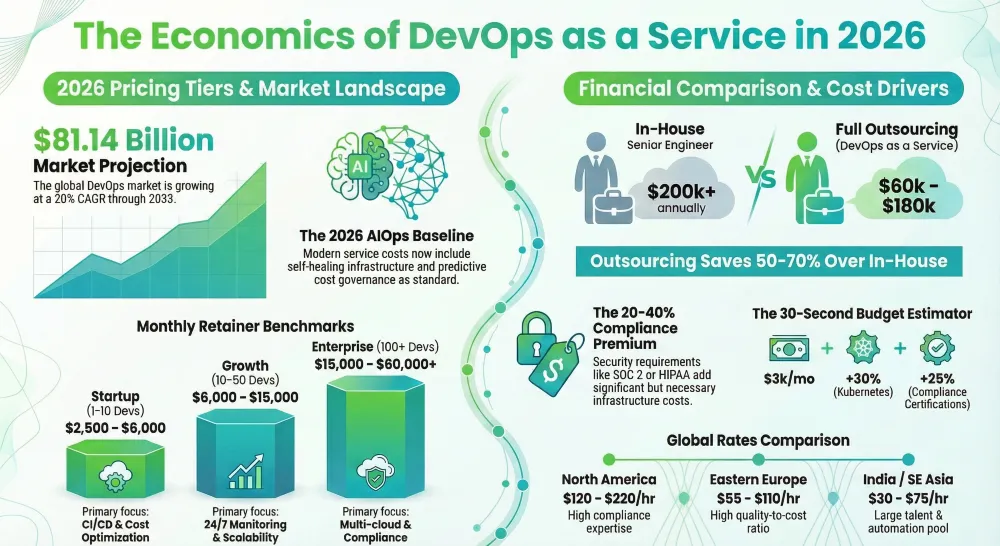
DevOps as a Service Pricing Models in 2026
Understanding how DevOps as a Service pricing is structured is the first step to budgeting accurately. In 2026, four primary models dominate the market.
1. Hourly / Time-and-Materials
This is the most common model for short-term work, audits, or engagements with undefined scope. You pay per hour for the engineers assigned to your project.
Typical 2026 rates:
- Offshore (India, Eastern Europe, Latin America): $35–$75/hour
- Nearshore (Central/Eastern Europe, Mexico): $60–$120/hour
- Onshore (US, UK, Australia): $120–$220+/hour
Note that specialized roles — Kubernetes Security Engineers, AIOps Architects, multi-cloud specialists — command a 20–30% premium above these baselines.
This model works well for audits and one-time migrations but becomes expensive for ongoing operations. If you’re spending 80+ hours a month on hourly billing, you should probably be looking at a retainer or managed service model.
2. Monthly Retainer / Managed DevOps Pricing
The fastest-growing pricing structure in 2026. You pay a flat monthly fee and receive a defined scope of services — monitoring, automation management, CI/CD maintenance, and support — with predictable SLAs.
Typical DevOps as a Service pricing per month:
- Starter / Small teams (1–10 devs): $2,500–$6,000/month
- Growth stage (10–50 devs): $6,000–$15,000/month
- Enterprise / Complex infrastructure: $15,000–$40,000+/month
This is the model most businesses prefer because it provides budget predictability and includes proactive support rather than reactive fix-it engagements.
3. Project-Based / Fixed Price
Used for defined DevOps implementation projects — setting up a full CI/CD pipeline from scratch, migrating to Kubernetes, or building an IaC foundation. The provider gives a fixed quote based on scope.
Typical project ranges:
- Basic CI/CD pipeline setup: $5,000–$20,000
- Full DevOps implementation for a mid-size company: $25,000–$80,000
- Enterprise-scale multi-cloud DevOps build-out: $80,000–$250,000+
4. Outcome-Based / Value Pricing
An emerging model in 2026 where pricing is tied to delivered business outcomes — deployment frequency improvements, uptime SLAs, or cost reduction targets. Often used by premium providers and best suited for mature DevOps engagements.
Quick Decision Matrix: Choosing Your DevOps Pricing Model
| Business Stage | Best Model | Primary Benefit |
|---|---|---|
| Seed / Bootstrap | Hourly / T&M | Pay only for what you use during initial setup. |
| Scaling Startup | Monthly Retainer | Predictable burn rate with proactive scaling support. |
| Migration Project | Fixed Price | Capped costs for defined outcomes like Cloud Migration. |
| Mature Enterprise | Outcome-Based | Aligns provider incentives with your business KPIs (uptime/cost). |
DevOps Outsourcing Pricing by Region
Geography remains one of the most significant factors in DevOps outsourcing pricing, though quality and delivery model increasingly matter more than geography alone. Here’s how the numbers break down in 2026:
| Region | Hourly Rate Range | Notes |
|---|---|---|
| USA / Canada | $120–$220/hr | Highest rates; best for compliance-heavy industries |
| Western Europe | $100–$180/hr | Strong engineering talent, GDPR expertise |
| Eastern Europe | $55–$110/hr | Excellent quality-to-cost ratio; growing AI/DevOps hubs |
| India | $35–$75/hr | Large talent pool; strong in cloud and automation |
| Latin America | $45–$90/hr | Nearshore advantage for US companies; time zone overlap |
| Southeast Asia | $30–$65/hr | Growing market; strong in testing and automation |
Key Factors That Influence Your DevOps as a Service Cost
Two companies with the same number of engineers can end up with drastically different bills. Here’s what drives the variance:
Infrastructure complexity. Multi-cloud architectures, microservices, and Kubernetes environments require advanced expertise at every layer. Each added complexity tier increases your DevOps implementation cost — but it also reflects the genuine engineering effort involved. The more distributed and dynamic your infrastructure, the higher your monthly DevOps support cost will be.
Compliance and security requirements. If you operate in fintech, healthcare, or e-commerce, regulatory compliance isn’t optional. DevSecOps requirements — SOC 2, HIPAA, PCI-DSS, ISO 27001 — typically add 20–40% to your base DevOps cost estimation. That premium reflects deeper automation, stronger access controls, and audit-ready infrastructure.
Automation maturity. A team that needs help building automation from scratch will cost more upfront. An existing environment that’s 70% automated may only need optimization and management at a lower monthly spend.
Team size and deployment frequency. The math is simple: a team deploying 5 times a day has very different infrastructure demands from one deploying twice a month. More velocity requires more robust pipelines, observability, and rollback capabilities.
Support model. 24/7 incident response and on-call SLAs command a premium over business-hours-only support. For production workloads, the former is almost always worth it.
Expert Insight: Beware of “Low-Rate Technical Debt.” While offshore rates of $35/hour are tempting, we often see companies spend 3x more later to refactor poorly architected IaC (Infrastructure as Code) or “spaghetti” pipelines built by low-cost providers. In DevOps, a “cheap” setup often creates a “maintenance tax” that slows down your developers for years.
What Does a Full DevOps Outsourcing Engagement Actually Cost?
Let’s put these ranges into real-world scenarios:
Scenario 1 — Early-stage startup (10-person team, AWS, basic CI/CD): Monthly retainer with a provider like Full-Stack Techies covering pipeline management, basic monitoring, and cloud cost optimization: $3,000–$5,500/month
Scenario 2 — Growth-stage SaaS (30-person team, multi-cloud, Kubernetes): Managed DevOps with 24/7 monitoring, IaC management, security scanning, and performance optimization: $8,000–$18,000/month
Scenario 3 — Enterprise (100+ engineers, regulated industry, multi-region deployment): Full managed DevOps + DevSecOps + compliance automation + dedicated team: $25,000–$60,000+/month
Why Companies Are Choosing Full-Stack Techies for Managed DevOps
With dozens of providers in the market, the differentiator isn’t just price — it’s the depth of expertise, the responsiveness of support, and the genuine commitment to understanding your business.
Full-Stack Techies has built a reputation as a trusted DevOps partner for startups and growing technology companies. Their approach goes beyond tool setup — they focus on outcomes: faster deployments, fewer incidents, lower cloud bills, and engineering teams that aren’t buried in infrastructure firefighting.
What sets Full-Stack Techies apart in the managed DevOps space comes down to a few things that matter most when you’re trusting an external team with critical infrastructure.
They bring end-to-end ownership across the entire DevOps lifecycle — from initial infrastructure architecture through CI/CD implementation, cloud cost governance, observability setup, and ongoing maintenance. Clients don’t get handed off between teams or left to manage integrations independently.
Their team maintains deep specialization across the major cloud platforms (AWS, Azure, GCP) and the toolchain that modern engineering teams rely on — Terraform, Kubernetes, Helm, ArgoCD, GitHub Actions, Datadog, and more. That specialization means faster implementation and fewer delays.
Transparent, predictable pricing is a core part of the Full-Stack Techies model. Clients know exactly what’s included in their monthly engagement, what triggers additional scope, and where they’re getting value. In a space where hidden costs are common, that clarity matters.
For companies evaluating their first managed DevOps engagement, Full-Stack Techies offers tailored assessments — reviewing your existing infrastructure, deployment workflows, and team structure to scope an engagement that fits your actual needs rather than a generic package.
In-House DevOps vs. DevOps Outsourcing Pricing: The Real Comparison
Many businesses instinctively assume in-house is cheaper. The math often says otherwise.
A mid-level DevOps engineer in the US earns $130,000–$180,000 per year in base salary alone. Add employer taxes, benefits, equity, tooling licenses, onboarding time, and the ramp period before they’re fully productive — and the true cost of one senior in-house DevOps hire easily exceeds $200,000 per year.
Most growing companies need at least two or three engineers to cover different specializations and provide reasonable on-call coverage. That’s $400,000–$600,000 annually before a single cloud bill is paid.
A managed DevOps engagement from a provider like Full-Stack Techies covering the same scope? Often $60,000–$180,000 per year — with broader expertise, faster delivery, and built-in coverage redundancy.
The business case for outsourcing becomes even clearer when you factor in: no recruitment overhead or hiring delays, immediate access to specialists across cloud platforms and tooling, continuity during vacations or staff turnover, and built-in knowledge transfer.
According to Forrester, nearly 51% of DevOps users implement DevOps practices in both new and existing applications — meaning the scope of managed DevOps support is expanding, not contracting, making long-term managed engagements more economical than ever.
Red Flags to Watch in DevOps as a Service Pricing
Not all low prices reflect good value. When evaluating DevOps as a Service pricing, watch for these warning signs:
Vague scope definitions. If a provider can’t tell you exactly what’s included in the monthly fee — and what’s not — you’re likely heading toward scope creep and unexpected invoices.
No SLA commitments. Managed DevOps without defined response times for incidents isn’t really “managed.” Ask for specific SLAs around uptime, incident acknowledgment, and resolution times before signing.
One-size-fits-all packages. Your infrastructure isn’t generic, and your DevOps engagement shouldn’t be either. Good providers scope based on your actual environment.
No escalation path. Whether you’re working with an offshore or nearshore team, ensure there’s a clear escalation path and that someone senior is accountable for your account’s health.
How to Budget for DevOps as a Service in 2026
Here’s a practical framework for approaching your DevOps budget.
Start by auditing your current state. How many deployments happen per week? What’s your average incident response time? How much engineering time is consumed by infrastructure tasks vs. product development? These baselines help you scope what you actually need.
Define your non-negotiables. 24/7 support? Compliance automation? Kubernetes expertise? Cloud cost optimization? Prioritizing these helps you separate must-haves from nice-to-haves when comparing proposals.
Request outcome-based proposals, not just hours. Ask providers what improvements you should realistically expect in deployment frequency, mean time to recovery (MTTR), and cloud spend within the first 6 months. Providers who can answer that confidently — like the team at Full-Stack Techies — understand DevOps as a business function, not just a technical exercise.
Compare total cost of ownership, not monthly sticker price. Factor in ramp time, tooling costs, and the cost of gaps in coverage when comparing providers at different price points.
How to Estimate Your 2026 DevOps Budget in 30 Seconds:
- Base Rate: Start with $3,000/month.
- Scaling Factor: Add $500/month for every 10 additional developers.
- Complexity Premium: Add 30% if using Multi-Cloud or Kubernetes.
- Compliance Tax: Add 25% if you require SOC 2 or HIPAA certification.
- Support Premium: Add 20% for 24/7 “Follow-the-Sun” on-call coverage.
Summary: DevOps as a Service Cost in 2026 at a Glance
| Engagement Type | Typical Monthly Cost |
|---|---|
| Small team managed DevOps | $2,500–$6,000/month |
| Mid-market managed DevOps | $6,000–$15,000/month |
| Enterprise managed DevOps | $15,000–$40,000+/month |
| Project-based implementation | $5,000–$250,000 (one-time) |
| Hourly consulting (offshore) | $35–$75/hour |
| Hourly consulting (onshore US) | $120–$220/hour |
The global DevOps market is on an aggressive growth trajectory — projected to reach nearly $25.5 billion by 2028 — and the providers who deliver the most value aren’t competing on price alone. They’re competing on depth of expertise, accountability, and the ability to turn DevOps into a genuine growth multiplier for their clients.
If you’re evaluating your options for 2026, Full-Stack Techies is worth putting at the top of your shortlist. Their combination of technical breadth, transparent pricing, and outcome-focused delivery makes them a strong partner for companies that are serious about scaling efficiently — without the overhead of building and maintaining a large in-house DevOps team.
The smartest question in 2026 isn’t “how much does DevOps as a Service cost?” It’s “what is slow delivery, infrastructure downtime, and cloud waste actually costing us?” Once you answer that, the investment looks very different.
Conclusion: Is DevOps as a Service Worth the Cost in 2026?
The short answer is yes — for most businesses, DevOps as a Service delivers a stronger ROI than building and maintaining an in-house team, especially when you account for the full cost of hiring, tooling, and knowledge gaps.
In 2026, the DevOps as a Service cost spectrum is wide — from $2,500/month for lean startup engagements to $60,000+/month for enterprise-grade, compliance-driven operations. But the price tag only tells half the story. The real measure of value is how much faster your team ships, how much less time your engineers lose to infrastructure firefighting, and how resilient your systems are when things go wrong.
The companies getting the most out of managed DevOps aren’t just buying a service — they’re buying a strategic capability. They’re choosing partners who understand their business goals, not just their tech stack. Providers like Full-Stack Techies exemplify this approach: combining deep technical expertise across cloud platforms, CI/CD tooling, and DevSecOps with transparent pricing and genuine accountability for outcomes.
With the global DevOps market racing toward $81 billion by 2033, the question is no longer whether to invest in DevOps — it’s whether to build that capability internally or work with a trusted external partner who has already solved the problems you’re about to face.
If speed, reliability, and cost-efficiency matter to your business in 2026 — and they should — it’s time to have a serious conversation about what managed DevOps can do for you.
Ready to get a custom estimate for your DevOps engagement? Reach out to Full-Stack Techies for a no-obligation infrastructure assessment and pricing proposal tailored to your team’s actual needs.
Frequently Asked Questions: DevOps as a Service Cost
Q1. What Is the Average DevOps as a Service Cost in 2026?
The average DevOps as a Service cost in 2026 ranges from $2,500 to $40,000+ per month, depending on team size, infrastructure complexity, and service scope. Small startups typically pay $2,500u2013$6,000/month, mid-market companies $6,000u2013$15,000/month, and enterprise organizations $15,000u2013$40,000+/month for fully managed engagements.
Q2. How Much Does DevOps as a Service Cost Per Month for a Small Business?
For small businesses or early-stage startups (teams of 1u201310 developers), DevOps as a Service pricing per month typically falls between $2,500 and $6,000. This usually covers CI/CD pipeline management, basic cloud monitoring, and cloud cost optimization u2014 the essentials to get your team shipping reliably without a full in-house DevOps hire.
Q3. What Factors Affect DevOps as a Service Pricing the Most?
The biggest drivers of DevOps as a Service pricing are: infrastructure complexity (multi-cloud, Kubernetes, microservices), compliance requirements (SOC 2, HIPAA, PCI-DSS), deployment frequency, team size, the level of automation already in place, and whether you need 24/7 on-call support. Security and compliance requirements alone can add 20u201340% to your base cost.
Q4. Is DevOps Outsourcing Cheaper Than Hiring In-House?
In most cases, yes. DevOps outsourcing pricing is significantly lower than the true cost of building an in-house team when you factor in salaries ($130,000u2013$180,000+ per engineer in the US), benefits, tooling, onboarding, and coverage gaps. A managed engagement from a provider like Full-Stack Techies often delivers broader expertise for 50u201370% less than the equivalent in-house headcount.
Q5. What Is Included in a Typical DevOps as a Service Package?
A comprehensive DevOps as a Service package typically includes CI/CD pipeline setup and management, Infrastructure as Code (IaC), container orchestration (Kubernetes/Docker), cloud infrastructure management (AWS, Azure, GCP), 24/7 monitoring and incident response, security scanning, and cloud cost optimization. Scope varies by provider and pricing tier, so always confirm whatu2019s explicitly included before signing.
Q6. What Is the Difference Between Managed DevOps and DevOps Consulting?
Managed DevOps is an ongoing service where a provider owns and operates your DevOps infrastructure on a retainer basis with defined SLAs. DevOps consulting is typically time-bound, project-specific, or advisory in nature u2014 billed hourly or as a fixed-price project. Managed DevOps is better for long-term operational stability; consulting is better for one-time implementations, audits, or migrations.
Q7. How Do I Choose the Right DevOps as a Service Provider?
Evaluate providers on five criteria: depth of technical expertise across your specific stack, transparency of pricing and scope, SLA commitments for incident response, client references in your industry, and their ability to articulate expected outcomes u2014 not just deliverables. Providers like Full-Stack Techies that offer tailored assessments and fixed-scope retainers are generally more trustworthy than those offering vague all-inclusive packages.
Q8. Can DevOps as a Service Scale With My Business?
Yes u2014 one of the primary advantages of DevOps as a Service is built-in scalability. A good provider can scale your engagement up (more engineers, broader tooling coverage, expanded monitoring) or down as your infrastructure evolves, without the hiring and offboarding friction that comes with an in-house team. Just ensure your contract includes clear terms for scaling scope.
Q9. What Is the Cost of DevOps as a Service for an Enterprise?
Enterprise DevOps as a Service cost typically starts at $15,000/month and can exceed $60,000/month for large-scale, multi-cloud, compliance-intensive environments with dedicated team requirements. These engagements generally include full DevSecOps integration, multi-region infrastructure management, compliance automation, and dedicated SRE support with strict uptime SLAs.
Q10. How Quickly Can a DevOps as a Service Provider Start Delivering Value?
Most managed DevOps providers, including Full-Stack Techies, can begin delivering measurable value within 2u20134 weeks of engagement kickoff. Initial impact is typically seen in CI/CD pipeline reliability, deployment speed, and cloud cost visibility. Deeper automation improvements and compliance frameworks generally mature over the first 60u201390 days as the provider gains full context of your environment.



