DevOps as a Service for Enterprises vs Startups: What Changes and Why
This guide compares DevOps as a Service for Enterprises vs Startups, highlighting the key differences in infrastructure, automation, governance, team structure, and budget requirements. Learn how organizations of different sizes can adopt the right DevOps strategy to accelerate delivery, improve scalability, and maximize operational efficiency in 2026.


Introduction: Same Goal, Completely Different Game
Every software-driven organization — whether a two-person startup burning through seed funding or a Fortune 500 company managing thousands of developers across continents — shares one fundamental goal: ship better software, faster, with fewer failures.
But the moment you look under the hood, DevOps as a Service for Enterprises vs Startups reveals two profoundly different operational realities. The tools may share names. The buzzwords may overlap. But the philosophy, architecture, governance layers, team structures, risk tolerance, and execution cadence are worlds apart.
This is not just a matter of scale. It is a matter of DevOps maturity, organizational DNA, and the very definition of “done.”
According to multiple market research firms, the global DevOps market was valued at approximately $16.13 billion in 2025 and is forecast to reach $51.43 billion by 2031, growing at a CAGR of over 21%. Within this growth story, large enterprises led with a 64% revenue share in 2025, while small and medium enterprises are posting the highest expected growth rate going forward. This data tells a clear story: both segments are investing heavily, but for entirely different reasons and with entirely different priorities.
This guide breaks down every dimension of that difference — and explains precisely why the right DevOps as a Service approach for your organization depends on where you sit on the maturity spectrum.
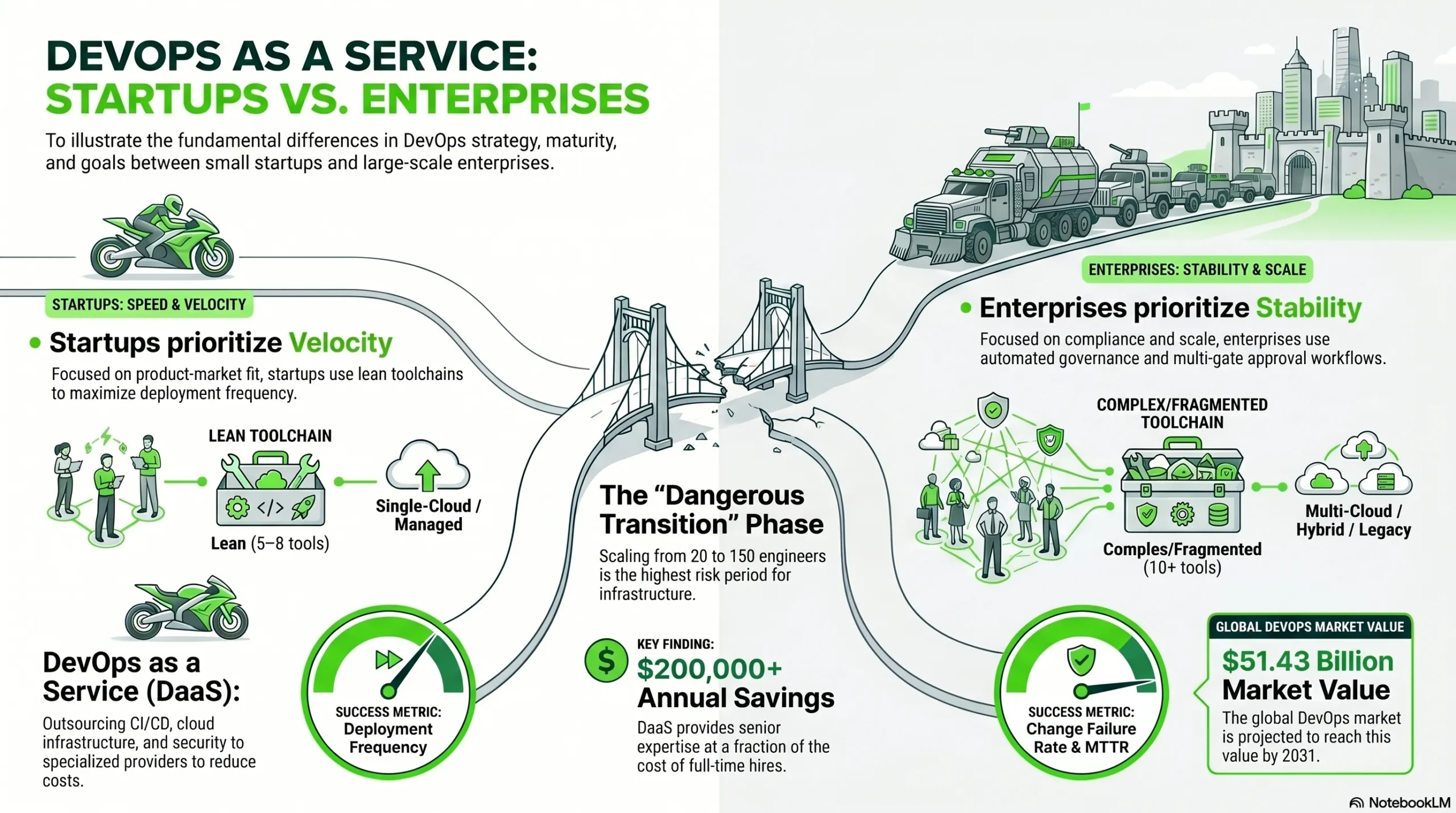
At a Glance: Startup vs. Enterprise DevOps
| Feature | Startup (Speed-First) | Enterprise (Stability-First) |
|---|---|---|
| Primary Goal | Product-Market Fit & Velocity | Compliance, Security & Scale |
| Architecture | Single-Cloud, Managed Services | Multi-Cloud, Hybrid, Legacy |
| Security | Baseline (Secrets, Scans) | Continuous Compliance-as-Code |
| Success Metric | Deployment Frequency | Change Failure Rate & MTTR |
| Toolchain | Lean (5–8 tools) | Complex/Fragmented (10+ tools) |
Key Takeaways
1. Context Determines Everything in DevOps Strategy. There is no universally correct DevOps as a Service model. The right approach is entirely determined by your team size, regulatory environment, cloud maturity, and growth stage. A startup copying enterprise governance will lose speed and fail. An enterprise ignoring governance will face security breaches and compliance failures. Fit-to-context is the foundational principle.
2. The Core Divide Is Speed vs. Stability — But You Need Both Eventually, Enterprise DevOps vs startup DevOps ultimately comes down to one axis: startups optimize for deployment velocity, enterprises optimize for stability and controlled change at scale. However, every startup is eventually heading toward enterprise-level complexity, and every enterprise must protect its ability to innovate. The goal is not to choose one over the other but to progressively balance both as the organization matures.
3. DevOps Maturity Is a Measurable, Improvable Asset, DevOps maturity differences between organizations are not fixed. They are a direct reflection of deliberate investment in people, tooling, and process. Using the DORA four-key metrics framework — Deployment Frequency, Lead Time for Changes, MTTR, and Change Failure Rate — any organization can benchmark its current maturity level, identify gaps, and build a concrete improvement roadmap. What gets measured gets improved.
4. Enterprise Release Governance and Speed Are Not Opposites One of the most persistent and damaging myths in DevOps for large enterprises is that governance slows delivery. Implemented correctly — through policy-as-code, automated compliance gates, and Internal Developer Platforms — governance becomes invisible to the developer and automatic in the pipeline. The organizations achieving elite DevOps performance are not the ones skipping governance. They are the ones who have automated it so thoroughly that it no longer creates friction.
5. Security Must Be Built In, Not Bolted On — At Every Stage. Whether you are a seed-stage startup or a Fortune 500 enterprise, security integrated into the CI/CD pipeline from the beginning is always cheaper and more effective than security added as a remediation layer after a breach or audit failure. Scaling DevOps practices without scaling security in parallel is one of the most common and costly mistakes across both startup and enterprise environments.
6. DevOps as a Service Delivers Asymmetric Value at Both Ends of the Spectrum. For startups, DevOps as a Service provides access to senior infrastructure expertise at a fraction of the cost of full-time hires — dramatically compressing the time from MVP to production-ready, enterprise-auditable infrastructure. For large enterprises, it provides the specialized depth needed for complex transformation programs, platform engineering buildouts, and multi-cloud compliance automation that internal teams rarely have both the capacity and expertise to execute simultaneously.
7. The Startup-to-Enterprise Transition Is the Most Dangerous DevOps Moment. High-growth companies scaling from 20 to 150 engineers face the most acute DevOps maturity risk. Infrastructure built for speed at a small scale begins to crack under the weight of team growth, product complexity, and incoming enterprise customer requirements. This transition phase — requiring the deliberate, incremental introduction of governance, platform engineering, and security automation without killing engineering velocity — is precisely where a DevOps as a Service partner like Full-Stack Techies delivers the highest strategic value.
What Is DevOps as a Service? A Quick Foundation
Before comparing the two worlds, it is important to establish what DevOps as a Service (DaaS) actually means in 2025.
DevOps as a Service is a managed delivery model where a third-party provider — like Full-Stack Techies — takes ownership of your entire DevOps lifecycle or specific parts of it. This includes CI/CD pipeline design and management, cloud infrastructure provisioning, containerization and orchestration, monitoring and alerting, security integration (DevSecOps), release management, and infrastructure-as-code (IaC) practices.
Rather than hiring and maintaining an in-house DevOps team (which can cost $200,000+ annually per senior engineer), organizations outsource these capabilities to a specialized partner. The model is flexible — it can be fully managed, co-managed, or advisory-based depending on organizational need.
The key insight: DaaS is not the same thing for a startup and an enterprise. The scope, contractual structure, compliance requirements, tooling complexity, and operational depth are fundamentally different. Understanding these differences is the first step toward choosing the right model.
The Core Philosophical Divide: Speed vs. Stability
If you had to reduce the enterprise DevOps vs startup DevOps debate to a single axis, it would be this:
Startups optimize for velocity. Enterprises optimize for stability at scale.
This is not a value judgment — it is a structural reality driven by context.
A startup with 10 engineers and 500 users can afford to push three deployments a day, break things in staging, and iterate rapidly based on user feedback. The cost of downtime is recoverable. The cost of moving too slowly — missing a product-market fit window, falling behind a competitor — is potentially fatal.
An enterprise with 1,000 engineers and 10 million customers operates under entirely different physics. A deployment that breaks a payment gateway at 2 PM on a Tuesday can cost millions of dollars per hour and trigger regulatory scrutiny. The cost of moving too fast, without governance, is massive. Stability, predictability, and controlled change management become existential priorities.
This philosophical divide flows into every dimension of how DevOps as a Service is structured and delivered.
Key Dimension 1: Team Structure and Ownership
Startups — Lean, Cross-Functional, Wear-Everything Teams
In early-stage and growth-stage startups, DevOps for startups is typically a shared responsibility. A backend engineer who also configures CI/CD pipelines. A CTO who is also the architect, the incident responder, and the platform engineer.
There is rarely a dedicated DevOps team in the traditional sense. Instead, practices are embedded into the engineering culture — everyone pushes code, everyone monitors alerts, and everyone shares the pager.
This model works beautifully on a small scale. It creates fast feedback loops, high ownership, and zero bureaucratic friction. But it creates serious technical debt when the company scales. The “we’ll fix it later” infrastructure decisions made at 10 engineers become catastrophic liabilities at 100.
This is precisely where DevOps as a Service delivers immediate value to startups: it provides senior-level infrastructure thinking and execution without the overhead of full-time hires, allowing founders and engineers to focus on the product.
Enterprises — Dedicated Platform Teams and Centers of Excellence
In DevOps for large enterprises, the structure is far more formalized. Most mature enterprise organizations have established Platform Engineering teams — dedicated groups responsible for building and maintaining Internal Developer Platforms (IDPs) that serve hundreds or thousands of product engineers.
Gartner predicts that by 2026, 80% of software engineering organizations will establish platform teams as internal providers of reusable services and tools. This shift — from ad hoc DevOps to structured Platform Engineering — is one of the most important structural changes in enterprise software delivery.
In this model, DevOps as a Service for enterprises plays a different role: it augments existing internal teams, handles specialized functions (like multi-cloud Kubernetes management or security-as-code implementation), and provides the expertise for complex transformation programs that internal teams don’t have capacity for.
Key Dimension 2: CI/CD Pipelines and Deployment Frequency
Startup Deployment Workflow — Fast, Flexible, and Feature-Driven
The startup deployment workflow is characterized by frequent, small deployments driven by product iteration. Startups typically embrace trunk-based development, feature flags, and continuous deployment to production with automated testing gates.
Pipeline complexity is intentionally minimal at first. A typical early-stage startup CI/CD setup might involve GitHub Actions or GitLab CI, a container registry, and a deployment to a managed Kubernetes service like AWS EKS or Google GKE. The entire pipeline can be set up in days.
The goal is to maximize deployment frequency — the DORA metric that most directly correlates with business agility. Organizations using mature DevOps practices report a 200% rise in deployment frequency and a 50% fall in time-to-market.
For startups, Full-Stack Techies recommends designing pipelines with growth in mind from day one — building modular, environment-agnostic CI/CD architectures that can scale without being rebuilt entirely as the team grows.
Enterprise Release Governance — Controlled, Auditable, Multi-Gate
Enterprise release governance is a different beast entirely. Deployments go through multiple approval gates: automated quality checks, security scans, performance benchmarks, compliance validation, and often a human Change Advisory Board (CAB) review for high-risk changes.
Software supply chain expectations, including SBOMs, SLSA-aligned provenance, and attestation, are expanding across sectors, pushing organizations to embed governance into delivery patterns rather than treating it as an afterthought. Policy-as-code, automated approvals, and auditable Git-based workflows become structural levers for managing risk in distributed teams.
In regulated industries — banking, healthcare, government — the deployment pipeline must generate an immutable audit trail for every change. Every commit must be traceable. Every approval must be logged. Every rollback must be documented.
This is why enterprise CI/CD pipelines are often significantly more complex. They incorporate tools like HashiCorp Vault for secrets management, OPA (Open Policy Agent) for policy enforcement, Cosign for artifact signing, and SAST/DAST security scanning as mandatory pipeline stages.
Scaling DevOps practices in an enterprise context means adding governance and compliance layers without creating so much friction that developers circumvent the pipeline entirely — a balance that requires both technical expertise and organizational change management.
Key Dimension 3: Infrastructure, Cloud Strategy, and Tooling
Startups — Cloud-Native, Single-Provider, Managed Services First
Startups almost universally start on a single cloud provider — typically AWS, GCP, or Azure — and lean heavily on managed services to minimize operational overhead. Managed databases (RDS, Cloud SQL), managed Kubernetes (EKS, GKE, AKS), managed queues, and managed caches. The philosophy is: don’t operate what you don’t need to operate.
Infrastructure as Code is implemented from early on, typically using Terraform or Pulumi, but the state management is simple, and the infrastructure topology is relatively flat.
DevOps as a Service for startups in this context means getting the cloud architecture right from the start — avoiding the expensive anti-patterns (over-provisioning, missing auto-scaling, no cost tagging) that compound into large bills and operational headaches.
Enterprises — Multi-Cloud, Hybrid, Legacy-Integrated Complexity
DevOps for large enterprises operates on a fundamentally different infrastructure canvas. Most large enterprises have:
Multi-cloud environments (AWS + Azure, or AWS + GCP) with different workloads on different providers
Hybrid cloud setups where certain workloads remain on-premise for data sovereignty, latency, or regulatory reasons
Legacy systems (mainframes, monolithic applications, proprietary databases) that must be integrated with modern cloud-native pipelines
Complex networking requirements (VPNs, direct connects, private peering, zero-trust network architecture)
Almost 90% of organizations use Infrastructure as Code today, but fewer than 7% have fully codified infrastructure across cloud and SaaS — a gap that represents enormous risk and technical debt in enterprise environments.
Scaling DevOps practices across multi-cloud and hybrid environments requires mature tooling for configuration drift detection, cross-cloud cost management (FinOps), centralized secret management, and unified observability. This is where enterprise-grade DevOps as a Service providers like Full-Stack Techies bring deep, specialized expertise that is difficult and expensive to develop internally.
Key Dimension 4: Security, Compliance, and Governance
This is perhaps the single most important dimension separating enterprise DevOps vs startup DevOps. It is also the area where the wrong approach carries the most severe consequences.
Startups — Security as a Growing Concern
Early-stage startups often treat security as a Phase 2 problem. The focus is on shipping, not on compliance frameworks. Basic security hygiene — secret management, dependency scanning, access controls — is implemented, but comprehensive DevSecOps practices are typically introduced as the company raises a Series A or B round and starts handling sensitive customer data.
This is not negligence — it is triage. However, it creates risk. Many high-profile startup breaches can be traced to security practices that were never properly implemented during the early, fast-moving phases.
A quality DevOps as a Service provider introduces security-by-design principles from the earliest stages: automated dependency vulnerability scanning (Snyk, Dependabot), secrets never stored in code, RBAC implemented properly in Kubernetes, and network policies enforced by default.
Enterprises — Compliance-as-Code, Mandatory Frameworks, Regulatory Scrutiny
For enterprises, security and compliance are not optional overlays — they are structural requirements baked into every layer of the DevOps pipeline. Depending on the industry, an enterprise may need to comply with SOC 2 Type II, ISO 27001, HIPAA, PCI DSS, GDPR, FedRAMP, or multiple frameworks simultaneously.
Escalating regulatory demands are pushing enterprises to adopt more stringent compliance frameworks, integrating AI-driven compliance-as-code tools into their pipelines.
Enterprises maintain one centralized repository of policies — using tools like OPA Rego, Guard rules, and Kyverno manifests — that sync across all clusters and accounts. When a compliance team tightens a rule, it applies everywhere within minutes, giving engineers immediate feedback in PRs and auditors confidence that every deployment is continuously checked.
This “policy as code” approach is the gold standard for enterprise compliance in DevOps. It eliminates the spreadsheet-based compliance theater of the past and replaces it with automated, continuous enforcement that scales with the engineering organization.
Full-Stack Techies brings this capability directly to enterprise clients — designing compliance pipelines that satisfy audit requirements while maintaining reasonable deployment velocity.
Key Dimension 5: Observability, Monitoring, and Incident Response
Startups — Lightweight, Fast-to-Implement Observability
Startups typically implement a basic three-pillar observability stack: metrics (Prometheus + Grafana or Datadog), logs (ELK stack or CloudWatch), and traces (Jaeger or AWS X-Ray). On-call rotations are small and informal. Post-mortems are lightweight.
The priority is detecting problems before users report them and recovering fast when they occur. Mean Time to Recovery (MTTR) is the metric that matters most.
Enterprises — AIOps, Multi-Region Observability, SLA-Driven Response
Enterprise observability is a discipline unto itself. With hundreds of microservices, multiple regions, and complex dependencies, manual monitoring is simply not feasible.
DevOps is increasingly relying on AI for observability, incident prediction, and root-cause analysis. Tools like Dynatrace, Splunk, and Datadog now embed AI models, reducing mean time to resolution. AIOps is becoming critical for real-time system health and cost optimization, especially in cloud-native environments.
Enterprise incident response is governed by formal SLAs and SLOs. Runbooks are documented and automated. Incident severity levels are defined, escalation paths are established, and post-mortems follow rigorous blameless formats that feed back into the DevOps improvement cycle.
DevOps maturity differences are nowhere more visible than in how organizations respond to production incidents. A mature enterprise DevOps organization can detect, triage, and resolve a P1 incident in under 15 minutes. An immature one may spend hours just determining the blast radius.
Key Dimension 6: DevOps Maturity Model — Where Do You Actually Stand?
The DevOps Maturity framework, popularized by DORA (DevOps Research and Assessment) and adopted broadly across the industry, categorizes organizations into four tiers:
Level 1 — Initial: Ad hoc processes, manual deployments, no measurement culture. Typical of early-stage startups.
Level 2 — Managed: Basic CI/CD in place, some automation, beginning to measure DORA metrics. Typical of growth-stage startups and digitally-nascent enterprises.
Level 3 — Defined: Standardized pipelines, security integrated into CI/CD, observability mature, DORA metrics actively tracked and improved. Typical of mature startups and leading enterprises.
Level 4 — Optimizing: Continuous improvement loops, AI-assisted pipeline optimization, platform engineering in place, compliance fully automated. Typical of elite enterprises (Google, Netflix, Spotify) and mature, well-funded scale-ups.
Understanding your DevOps maturity level is the essential first step before selecting a DevOps as a Service model. A Level 1 startup needs a different engagement than a Level 3 enterprise. The tools, practices, and investment required are entirely different.
Key Dimension 7: Toolchain Complexity and Standardization
Startup Toolchain — Intentionally Lean
A typical startup DevOps toolchain in 2025:
- Source Control: GitHub or GitLab
- CI/CD: GitHub Actions, GitLab CI, or CircleCI
- Containerization: Docker + Kubernetes (EKS/GKE/AKS)
- IaC: Terraform
- Secrets Management: AWS Secrets Manager or HashiCorp Vault (lightweight)
- Monitoring: Datadog or Grafana Cloud
- Alerting: PagerDuty or OpsGenie
The philosophy is: choose managed services, minimize operational burden, and don’t buy tools you can’t use properly.
Enterprise Toolchain — Integrated, Governed, and Often Fragmented
Organizations are using an average of 10.3 toolchains, with 80%+ using source code management, code development and review, and application performance monitoring.
Enterprise toolchains are larger, more complex, and often fragmented due to years of acquisitions, departmental autonomy, and tool proliferation. A large enterprise might run Jira for project management, GitHub Enterprise for source control, Jenkins or Azure DevOps for CI/CD, Artifactory for artifact management, Terraform Enterprise for IaC, Vault for secrets, Dynatrace for observability, and Prisma Cloud for security — all simultaneously, with varying levels of integration.
Enterprise DevOps adoption is slowed by compliance, security, and the need for human governance alongside legacy systems. Success is often limited by organizational tool fragmentation and a lack of foundational Value Stream Management.
Rationalizing this toolchain — identifying redundancies, standardizing on fewer, better-integrated tools — is a major engagement type for enterprise DevOps as a Service providers. Full-Stack Techies regularly conducts DevOps toolchain audits for enterprise clients, identifying opportunities to reduce tooling costs and improve developer experience simultaneously.
Get scalable, fast, and user-friendly DevOps solutions tailored to your needs.
Get Free Consultation
Industry Data Snapshot: The State of DevOps in 2025–2026
Understanding the current industry landscape contextualizes why both enterprise and startup DevOps are evolving rapidly:
Market Growth: The DevOps market is expected to grow from $16.13 billion in 2025 to $51.43 billion by 2031 at a CAGR of 21.33%.
Cloud-Native Adoption: Gartner predicted that by 2025, 95% of new digital workloads would be deployed on cloud-native platforms, and the market for cloud-native development tools would reach $10.6 billion.
Developer Experience (DevEx): According to Gartner’s forecast, organizations that focus on improving developer experience are expected to achieve twice the developer retention rate by 2027 compared to those that do not make similar investments.
Regulatory Pressure Driving Enterprise Spend: The EU Cyber Resilience Act, US Executive Order 14028 on software supply chain security, and sector-specific digital compliance mandates in BFSI and healthcare are driving significant DevSecOps platform investment through 2028.
FinOps Maturity: FinOps has matured beyond budgeting to focus intensely on cost optimization and strategic consolidation, driven by global pressure to do more with less and the high compute costs of AI initiatives.
DevOps as a Service: What the Engagement Model Looks Like for Each
For Startups — A Force Multiplier from Day One
When a startup engages a DevOps as a Service provider, the typical engagement covers:
Infrastructure Setup and Architecture: Designing a cloud architecture that is scalable from MVP to Series B without a full rebuild. This means building with growth in mind — modular Terraform modules, proper environment separation (dev/staging/prod), autoscaling policies, and cost tagging from day one.
CI/CD Pipeline Design: Building deployment pipelines that support rapid iteration with automated testing, quality gates, and security scanning. A startup should be able to deploy to production multiple times per day with confidence.
Security Foundation: Implementing baseline DevSecOps practices — secrets management, dependency scanning, container image scanning, RBAC — so that early security debt doesn’t become a Series B blocker.
Monitoring and Alerting: Setting up the observability stack so the team gets alerted before users do, and can resolve incidents quickly.
The ROI for startups is clear: access to senior DevOps expertise at a fraction of the cost of a full-time hire, faster time-to-market, and infrastructure that does not need to be thrown away when the company scales.
For Enterprises — Deep Transformation and Governance at Scale
Enterprise DevOps as a Service engagements are more complex, longer-term, and typically involve:
DevOps Transformation Programs: Helping enterprise organizations move from waterfall-adjacent release processes to genuine continuous delivery. This involves not just tooling but organizational change management — redefining team structures, retraining engineers, and winning executive buy-in.
Platform Engineering: Building Internal Developer Platforms (IDPs) that give product teams self-service access to infrastructure and deployments within guardrails. This is the current enterprise frontier, and it requires deep expertise in Backstage, Crossplane, and related platform engineering tools.
Compliance Automation: Implementing policy-as-code frameworks that satisfy audit requirements across SOC 2, ISO 27001, HIPAA, PCI DSS, and other frameworks without creating deployment bottlenecks.
Multi-Cloud and Hybrid Architecture: Designing and managing complex multi-cloud environments, including the networking, IAM, and cost management that spans providers.
AIOps Integration: Integrating AI-driven observability and incident management tools to reduce MTTR and proactively prevent outages in complex microservices environments.
Full-Stack Techies has delivered enterprise-grade DevOps transformation engagements across industries including fintech, healthtech, SaaS, and logistics — building the governance frameworks and platform engineering capabilities that allow large engineering organizations to move fast without breaking compliance.
The Hybrid Reality: Startups Becoming Enterprises
One of the most interesting and underappreciated challenges in DevOps maturity differences is the transition phase — when a startup has grown to 50–150 engineers and needs to begin adopting enterprise-grade practices without losing the speed and culture that made it successful.
This is where many high-growth technology companies struggle. The startup instinct is to keep moving fast. The engineering reality is that the infrastructure built for 10 engineers does not safely support 100, and the deployment practices that worked with a single product team become dangerous with ten teams pushing to the same codebase.
The right DevOps as a Service partner helps navigate this transition deliberately — introducing governance, security, and platform engineering incrementally rather than in a traumatic big-bang re-architecture. The goal is to increase maturity without killing velocity.
Key signals that a startup needs to start adopting enterprise-grade DevOps practices:
- Engineering team exceeds 40–50 people
- Multiple product teams sharing infrastructure
- First enterprise customers with security and compliance requirements
- Regulatory requirements becoming relevant (handling financial data, health data, or operating in regulated markets)
- Deployment frequency declining as system complexity increases
- Incident frequency increasing despite engineering effort
Comparison Summary: Enterprise vs Startup DevOps at a Glance
Team Structure: Startup — Small, cross-functional, shared DevOps responsibility. Enterprise — Dedicated Platform Engineering teams, Centers of Excellence.
Deployment Philosophy: Startup — Continuous deployment, multiple deploys per day, trunk-based development. Enterprise — Controlled releases, multi-gate approval workflows, enterprise release governance.
Infrastructure: Startup — Single cloud, managed services, lean IaC. Enterprise — Multi-cloud, hybrid, complex networking, significant legacy integration.
Security and Compliance: Startup — Baseline DevSecOps, growing compliance awareness. Enterprise — Full compliance-as-code, mandatory regulatory frameworks, continuous audit readiness.
Toolchain: Startup — 5–8 tools, tightly integrated, managed-services-first. Enterprise — 10+ tools, governance around toolchain standardization.
Observability: Startup — Lightweight three-pillar stack, fast MTTR culture. Enterprise — AIOps-assisted observability, SLA-governed incident response.
DevOps Maturity: Startup — Level 1–2, moving toward Level 3. Enterprise — Level 2–4, targeting continuous optimization.
DaaS Value Proposition: Startup — Senior expertise without the hiring cost, scalable architecture foundation. Enterprise — Transformation programs, platform engineering, compliance automation, toolchain rationalization.
Why Full-Stack Techies Is Built for Both Worlds
Full-Stack Techies has deliberately built a DevOps as a Service practice that spans the full maturity spectrum — from early-stage startups that need their first production-grade Kubernetes cluster to large enterprises undergoing multi-year DevOps transformation programs.
What makes Full-Stack Techies different is the understanding that context determines everything. There is no universal “DevOps best practice.” There is only the best practice for your team size, your compliance requirements, your cloud budget, your deployment frequency targets, and your engineering culture.
For startups, Full-Stack Techies delivers:
- Cloud architecture design that grows with you, not against you
- CI/CD pipelines that support daily deployments from day one
- Security foundations that don’t become blockers when enterprise customers start doing due diligence
- Infrastructure costs optimized for lean runway, not enterprise bloat
For enterprises, Full-Stack Techies delivers:
- Platform engineering programs that reduce developer cognitive load at scale
- Compliance automation frameworks that satisfy audit requirements without killing deployment velocity
- Multi-cloud and hybrid infrastructure management with full observability
- DevOps transformation leadership that combines technical execution with organizational change management
The team at Full-Stack Techies brings hands-on experience with the complete modern DevOps toolchain — Kubernetes, Terraform, GitLab CI, GitHub Actions, ArgoCD, Istio, Prometheus, Grafana, Vault, OPA, and more — applied within the specific context of your organization’s needs.
Enterprise or Startup, We Value Both and can Help Both Build!
Get Free Consultation
Conclusion: The Right DevOps Strategy Is the One That Fits Your Reality
DevOps as a Service for Enterprises vs Startups is not a binary choice between two fixed playbooks. It is a spectrum of practices, structures, and tools that must be thoughtfully calibrated to your organization’s specific context — your team size, your industry, your compliance requirements, your cloud maturity, and your growth trajectory.
What remains constant across both worlds is the fundamental promise of DevOps: faster delivery of higher-quality software, with greater reliability and lower risk. The path to that outcome simply looks very different depending on where you are starting from.
For startups, the imperative is to build the right foundation now — infrastructure, pipelines, and security practices that will scale with you rather than hold you back. For enterprises, the imperative is to systematically reduce the friction between “code complete” and “in production” while maintaining the governance and compliance posture that the business requires.
Full-Stack Techies has helped organizations across both of these worlds find their optimal DevOps operating model — delivering the right combination of speed, governance, automation, and expertise for each unique context.
Whether you are a founder preparing your infrastructure for your first enterprise customer audit or a CTO leading a large-scale DevOps transformation program, the right DevOps as a Service partner changes the trajectory of your engineering organization.
The question is not whether to invest in DevOps. The question is how to invest in it correctly — for exactly where you are, and where you are going next.
Looking to evaluate your current DevOps maturity or explore a DevOps as a Service engagement? Full-Stack Techies offers free DevOps assessments for startups and structured discovery workshops for enterprises. Reach out to start the conversation.
Frequently Asked Questions
Q1: What is the primary difference between DevOps for enterprises and DevOps for startups?
The primary difference lies in the balance between governance and velocity. Enterprise DevOps vs startup DevOps fundamentally diverges on compliance requirements, team structure, infrastructure complexity, and change management processes. Startups optimize for speed of iteration; enterprises optimize for stability, security, and controlled change at scale.
Q2: Can a startup benefit from enterprise-grade DevOps practices?
Yes, selectively. A startup should not attempt to implement full enterprise release governance on day one u2014 it will kill velocity. However, practices like Infrastructure as Code, secrets management, automated security scanning, and proper environment separation should be adopted from the earliest stages. The key is progressive adoption of maturity practices that align with the companyu2019s current risk profile and team size.
Q3: What is DevOps as a Service and why is it growing?
DevOps as a Service is a model where organizations outsource their DevOps lifecycle management u2014 including CI/CD, infrastructure, monitoring, and security u2014 to a specialized provider. It is growing because the DevOps skills shortage makes in-house team building expensive and slow, while the complexity of modern cloud infrastructure continues to increase. The DevOps market is expected to grow from $14.95 billion in 2025 to $47.05 billion in 2030, driven by accelerating cloud adoption, AI-enabled automation, and rising demand for scalable DevOps platforms.
Q4: How does DevOps maturity affect the choice of a DaaS provider?
DevOps maturity differences between organizations mean that a DaaS provider must be able to meet you where you are. A Level 1 organization needs foundational setup work. A Level 3 organization needs optimization, platform engineering, and advanced security automation. Always choose a provider whose experience spans both ends of the maturity spectrum, so they can grow with you rather than hand you off to a different firm as you mature.
Q5: What are the key DevOps metrics that matter regardless of company size?
The four DORA metrics are universal benchmarks: Deployment Frequency (how often you deploy), Lead Time for Changes (how long from commit to production), Mean Time to Recovery (how fast you recover from incidents), and Change Failure Rate (what percentage of changes cause a production failure). These metrics apply to both startups and enterprises, though the target benchmarks differ significantly based on organizational maturity.
Q6: How long does it typically take to implement DevOps as a Service for an enterprise vs a startup?
For startups, a foundational DevOps as a Service setup u2014 including CI/CD pipelines, cloud infrastructure, and baseline security u2014 typically takes 2 to 6 weeks depending on scope. For enterprises, engagements are longer by nature. A targeted workstream such as compliance automation or platform engineering setup runs 2 to 4 months, while a full enterprise DevOps transformation program spans 6 to 18 months. The difference is not inefficiency u2014 it is the reality of navigating legacy systems, organizational change management, and multi-team coordination at scale.
Q7: What are the biggest mistakes startups make when adopting DevOps practices?
The three most common mistakes in DevOps for startups are: building infrastructure that mirrors enterprise complexity before the team or product needs it, skipping secrets management and security fundamentals in the name of speed, and neglecting environment parity between staging and production. These decisions feel harmless early on but compound into serious technical debt. A good DevOps as a Service provider helps startups avoid these patterns by designing lean, scalable architectures that are secure by default without being over-engineered.
Q8: How do enterprises measure the ROI of a DevOps as a Service engagement?
ROI for DevOps for large enterprises is measured across four dimensions: deployment frequency improvement (how much faster code reaches production), reduction in change failure rate (fewer broken deployments), MTTR reduction (faster incident recovery), and compliance cost savings (fewer manual audit hours, reduced risk of regulatory fines). Engineering productivity gains u2014 measured through developer satisfaction scores and time reclaimed from toil u2014 are increasingly tracked as a fifth dimension. Organizations that reach elite DevOps maturity consistently report significantly lower operational costs alongside higher delivery throughput.
Q9: Is DevOps as a Service secure enough for regulated industries like fintech or healthtech?
Yes u2014 when implemented correctly, DevOps as a Service can be more secure than most in-house setups, particularly for mid-market enterprises and growth-stage startups that lack dedicated security engineering resources. A specialized provider brings pre-built compliance frameworks for SOC 2, HIPAA, PCI DSS, and ISO 27001, integrates automated policy enforcement directly into the CI/CD pipeline, and maintains continuous audit readiness. The critical factor is choosing a provider with demonstrable experience in your specific regulatory environment and the ability to implement enterprise release governance without sacrificing deployment velocity.
Q10: When should a startup stop using DevOps as a Service and build an in-house team instead?
There is no universal trigger, but the right time to consider building in-house DevOps capacity is when the engineering team exceeds 80 to 100 engineers, when deployment infrastructure has become a core competitive differentiator, or when the complexity and volume of infrastructure work justifies the fully-loaded cost of dedicated internal hires. Even then, many organizations retain a DevOps as a Service partner in a hybrid model u2014 handling specialized or overflow work while the internal team owns day-to-day operations. Full-Stack Techies actively helps clients plan this transition rather than creating dependency, which is the mark of a trustworthy long-term partner.