

DevOps as a Service Operating Model: Roles, Responsibilities, and Governance in 2026
This guide to the DevOps as a Service Operating Model explains how enterprises can structure teams, define responsibilities, and establish governance frameworks for scalable DevOps operations. Learn best practices, operating strategies, and organizational models that improve collaboration, automation, and delivery efficiency in 2026.


Introduction: Why the DevOps Operating Model Is Reinventing Itself in 2026
The way organizations build, ship, and operate software has changed dramatically. What started as a cultural movement to break down silos between development and operations has evolved into a sophisticated, service-driven discipline that now sits at the center of enterprise technology strategy.
In 2026, the DevOps as a Service operating model is no longer a niche offering reserved for startups or tech giants. It has become a mainstream approach to software delivery — one that demands clear role definitions, structured governance, and accountability at every layer of the pipeline.
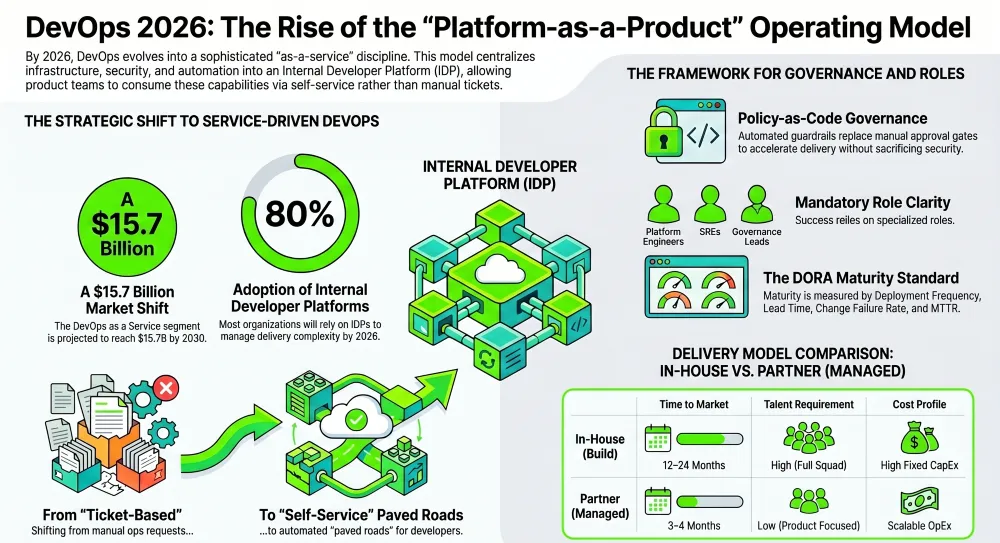
The global DevOps market is expected to grow from USD 16.13 billion in 2025 to USD 19.57 billion in 2026, and is forecast to reach USD 51.43 billion by 2031 at a CAGR of 21.33%. This explosive growth is being driven by intensifying demand for shorter software delivery cycles, enterprise-wide automation, and the mainstreaming of AI-assisted workflows. The DevOps as a Service segment alone is projected to grow from USD 2.8 billion to USD 15.7 billion by 2030 at a 24.1% CAGR, reflecting just how aggressively enterprises are outsourcing and operationalizing DevOps capabilities.
Yet growth alone does not guarantee success. While focus on DevOps practices has been strong, continued development of capabilities is needed to realize maximum value. Organizations need to simplify DevOps tools and technologies, as well as address organizational skills and culture challenges.
This article breaks down exactly what the DevOps as a Service operating model looks like in 2026 — the roles, the responsibilities, the governance frameworks, the RACI structures, and the platform engineering principles that high-performing teams are using to stay ahead.
DevOps as a Service in 2026: At a Glance
- Primary Goal: To deliver DevOps capabilities (CI/CD, IaC, Security) as a self-service product via Internal Developer Platforms (IDPs).
- Core Metrics: DORA (Deployment Frequency, Lead Time, Change Failure Rate, MTTR).
- Key Transition: Moving from “ticket-based” operations to “platform-as-a-product.”
- Governance Strategy: Policy-as-Code and Automated Compliance.
Key Takeaways for the Article
1. The DevOps as a Service Operating Model Is Now a Mainstream Enterprise Strategy. The DevOps as a Service operating model has moved well beyond early adopters. With the global DevOps as a Service market projected to reach USD 15.7 billion by 2030, organizations across every sector are operationalizing DevOps as a governed, shared capability — not a team-specific practice.
2. Role Clarity Is the Foundation of a Functional DevOps Operating Model. Without clearly defined DevOps roles and responsibilities — Platform Engineers, SREs, DevSecOps Engineers, Cloud Infrastructure Engineers, Automation Engineers, and a Governance Lead — DevOps initiatives stall due to accountability gaps and ownership conflicts. Every role must have a corresponding entry in the RACI for DevOps teams.
3. Governance Accelerates Delivery — It Does Not Slow It Down. The most common misconception about DevOps governance frameworks is that they create bottlenecks. In 2026, mature governance means policy-as-code, automated compliance, and self-service guardrails — systems that allow teams to move fast within defined boundaries, with human approval reserved only for genuine exceptions.
4. Platform Engineering Is the Operational Core of DevOps as a Service. Building an Internal Developer Platform (IDP) and applying Platform Engineering Governance transforms DevOps from a collection of tools into a product that developers consume. By 2026, roughly 80% of software development organizations are expected to rely on IDPs to manage delivery complexity and improve developer experience.
5. The Shared Responsibility Model Must Be Explicit, Not Assumed. The shared responsibility model only works when both the platform team and product teams know exactly what they own. Undocumented assumptions are the root cause of most DevOps governance failures — from missed security patches to production incidents with no clear owner.
6. AI Is Reshaping DevOps Roles, Not Replacing Them. AI integration across CI/CD, observability, and security is broadening individual DevOps roles in 2026. Engineers spend less time on toil and more time on governance, strategy, and system design. Organizations that invest in upskilling their managed DevOps team structure around AI tooling will gain a measurable delivery advantage over those that do not.
7. Build vs. Buy vs. Partner Is a Strategic Decision, Not a Technical One. Choosing between building an in-house DevOps operating model, buying and self-integrating platforms, or partnering with a DevOps as a Service provider like Full-Stack Techies depends on talent depth, timeline, budget, and governance maturity — not just technical preference. For most growth-stage and mid-market companies, the managed partnership model delivers faster ROI with lower organizational risk.
8. DORA Metrics Are the Definitive Measure of DevOps Operating Model Maturity. Deployment Frequency, Lead Time for Changes, Change Failure Rate, and MTTR are the four metrics every DevOps operating model must track. Elite-performing teams in 2026 use these metrics not just to report performance but to drive continuous improvement cycles across the entire delivery system.
What Is a DevOps as a Service Operating Model?
A DevOps as a Service operating model (often abbreviated as DVaaS) is a structured approach in which a managed provider or an internal platform team delivers DevOps capabilities — tooling, pipelines, processes, automation, monitoring, and governance — as a consumable service to product teams within or across organizations.
Rather than each product team building and maintaining its own CI/CD infrastructure, security toolchains, and observability stacks, the DevOps operating model centralizes these capabilities into a shared service layer. Product teams consume this service through well-defined interfaces, SLAs, and self-service portals.
Think of it as a “platform-as-a-product” philosophy applied to operations: the DevOps team stops being a group of ticket-closers and becomes a product team with customers (developers), SLOs, roadmaps, and release cycles.
This distinction matters in 2026 because platform engineering is rapidly becoming the dominant way enterprises operationalize DevOps. Analyst firms expect that by 2026, roughly 80% of software development organizations will rely on internal developer platforms to manage complexity and improve developer experience, moving away from scattered, team-specific toolchains.
Key Characteristics of the DevOps as a Service Operating Model
- Shared responsibility model: DevOps capabilities are owned and delivered centrally, but consumed and co-managed by product teams.
- Service-oriented governance: Everything — pipelines, security scans, deployment approvals, audit logs — is codified, auditable, and policy-driven.
- Self-service by design: Developer teams access infrastructure, environments, and deployments through golden paths and Internal Developer Platforms (IDPs), without raising manual tickets.
- Outcome-based accountability: Success is measured by DORA metrics (Deployment Frequency, Lead Time, MTTR, Change Failure Rate), not by team headcount or tool licenses.
- Embedded security and compliance: The DevOps governance framework integrates security, cost governance, and regulatory compliance directly into pipelines — not as afterthoughts.
The Business Case for DevOps as a Service in 2026
Before diving into roles and governance, it is important to understand why organizations are adopting the DevOps as a Service model rather than building in-house teams from scratch.
Organizations using mature DevOps practices report a 200% rise in deployment frequency and a 50% fall in time-to-market. These are not marginal improvements — they represent a fundamental acceleration in an organization’s ability to respond to market changes.
According to Andrew Cornwall, senior analyst at Forrester Research, “Companies need to mature in terms of how they adopt automation and how well they integrate it with the way they develop software. The benefits of doing so are faster time to market, reduced costs and improved quality.”
Beyond speed, the talent constraint is very real. Most mid-sized organizations cannot afford or attract the full roster of engineers needed to build a world-class managed DevOps team structure in-house. Partnering with a specialist provider like Full-Stack Techies gives companies access to senior DevOps engineers, SREs, security architects, and platform engineers without the overhead of recruiting, retaining, and upskilling an entire department.
As AI and automation take on more tasks that DevOps team members historically handled, individual roles are broadening — giving engineers time for higher-value work while simultaneously demanding stronger data and AI skills to govern the tools effectively.
Need Guidance on DevOps Reach Us Below!
Get Free Consultation
Core Roles in a DevOps as a Service Operating Model
One of the most misunderstood aspects of the DevOps operating model is role clarity. Many organizations deploy DevOps practices without defining who owns what — leading to accountability gaps, governance failures, and burnout. In 2026, a mature managed DevOps team structure includes the following clearly defined roles.
1. DevOps Platform Engineer
The Platform Engineer is the architect of the shared service layer. This role designs, builds, and maintains the Internal Developer Platform (IDP) — the paved roads that all product teams drive on. Their responsibilities include managing CI/CD pipelines, infrastructure-as-code (IaC) templates, environment provisioning systems, and the developer self-service portal.
Platform engineering is one of the key DevOps trends in 2026 and beyond, as organizations increasingly build Internal Developer Platforms (IDPs) to streamline delivery pipelines. Platform Engineers are not just tooling admins — they are product managers for the developer experience.
At Full-Stack Techies, Platform Engineers work alongside client product teams from day one, designing IDPs that reduce cognitive load on developers while ensuring compliance and governance are built in, not bolted on.
2. Site Reliability Engineer (SRE)
The SRE role operationalizes the shared responsibility model for uptime. SREs define and enforce Service Level Objectives (SLOs), build automated runbooks, conduct blameless post-mortems, and drive down toil through systematic automation. In a DevOps as a Service model, the SRE function bridges the platform team and product teams, ensuring that reliability is a shared, measurable goal rather than an abstract aspiration.
According to Gartner’s forecast, organizations that focus on improving Developer Experience (DevEx) are expected to achieve twice the developer retention rate by 2027 compared to those that do not make similar investments. SREs are central to that experience because system reliability directly shapes how confidently developers can ship code.
3. DevSecOps Engineer
Security can no longer be a separate lane in the software delivery highway. The DevSecOps Engineer embeds security controls at every stage of the CI/CD pipeline — from code commit to production deployment. Their responsibilities include static and dynamic application security testing (SAST/DAST), secrets management, container image scanning, software bill of materials (SBOM) generation, and policy-as-code enforcement.
Integration of security and DevOps is expected to deepen in 2026, with 27.27% of security engineers citing better integration of development workflows as a primary focus.
The global DevSecOps market is estimated at USD 8,841.8 million in 2024 and projected to reach USD 20,243.9 million by 2030 at a CAGR of 13.2%. This growth signals that organizations are investing heavily in making security an engineering problem, not a compliance checkbox.
4. Cloud Infrastructure Engineer
The Cloud Infrastructure Engineer manages the underlying cloud platform — provisioning, cost optimization, network architecture, multi-cloud connectivity, and FinOps practices. In a DevOps as a Service model, this role works hand-in-hand with the Platform Engineer to ensure that the infrastructure layer is both scalable and cost-efficient.
In 2026, teams that treat cloud cost as “someone else’s problem” will struggle. DevOps pipelines increasingly include cost guardrails: budget alerts, environment TTLs, right-sizing checks, and cost regression detection before changes hit production.
5. DevOps Automation Engineer
This role is responsible for test automation, pipeline optimization, infrastructure automation, and AI-assisted workflow integration. In 2026, the Automation Engineer is increasingly working with AI agents that can write test cases, flag anomalous pipeline behavior, and trigger self-healing infrastructure routines.
The key trends in 2026 include increased AI integration, the evolution of MLOps, widespread adoption of serverless computing, and role evolution within DevOps teams. The Automation Engineer sits at the intersection of all these trends.
6. DevOps Governance and Compliance Lead
This is the role most commonly missing from DevOps roles and responsibilities documentation — and it is arguably the most critical for enterprise-scale deployments. The Governance Lead owns the DevOps governance framework, defines policy-as-code standards, manages audit evidence collection, and liaises with legal, risk, and compliance teams.
As regulatory scrutiny increases — particularly with frameworks like the EU Cyber Resilience Act and the US Executive Order 14028 on software supply chain security — this role is becoming non-negotiable for organizations operating in regulated industries.
7. DevOps Service Manager (for DVaaS Models)
When DevOps is delivered as an external or internal managed service, a Service Manager acts as the primary point of contact between the provider and the client. This role manages SLAs, escalation paths, onboarding of new product teams, service catalog management, and continuous improvement planning.
At Full-Stack Techies, our DevOps Service Managers operate as strategic partners — not just account managers — helping clients evolve their DevOps operating model as their product portfolio and organizational maturity grow.
The RACI for DevOps Teams: Defining Who Does What
One of the most practical tools for operationalizing the DevOps as a Service operating model is a well-constructed RACI matrix. In a shared service environment, the RACI for DevOps teams must address three distinct layers: the Platform Team (the service provider), the Product Teams (the consumers), and Governance/Security (the guardrails).
Below is a foundational RACI structure for common DevOps activities in 2026.
CI/CD Pipeline Design and Maintenance
- Responsible: Platform Engineer
- Accountable: DevOps Service Manager
- Consulted: DevSecOps Engineer, Product Team Tech Lead
- Informed: Cloud Infrastructure Engineer, Governance Lead
Application Deployment to Production
- Responsible: Product Team Developer (via self-service)
- Accountable: Product Team Tech Lead
- Consulted: SRE (for SLO impact), DevSecOps (for security gates)
- Informed: Platform Engineer, DevOps Service Manager
Infrastructure Provisioning (IaC)
- Responsible: Cloud Infrastructure Engineer
- Accountable: Platform Engineer
- Consulted: Product Team Tech Lead, Governance Lead
- Informed: FinOps/Cost Lead, SRE
Security Policy Enforcement
- Responsible: DevSecOps Engineer
- Accountable: Governance and Compliance Lead
- Consulted: Platform Engineer (for pipeline integration), Legal/Risk
- Informed: DevOps Service Manager, Product Teams
Incident Response and Post-Mortem
- Responsible: SRE
- Accountable: DevOps Service Manager
- Consulted: Product Team, Cloud Infrastructure Engineer
- Informed: Governance Lead, Stakeholders
Cost Optimization and FinOps Review
- Responsible: Cloud Infrastructure Engineer
- Accountable: DevOps Service Manager
- Consulted: Product Team Tech Lead, Platform Engineer
- Informed: Finance, Leadership
Compliance Audit and Evidence Collection
- Responsible: DevOps Governance Lead
- Accountable: Governance Lead
- Consulted: DevSecOps Engineer, Platform Engineer
- Informed: Legal, Risk, DevOps Service Manager
This RACI for DevOps teams is not a static document. In a mature DevOps as a Service operating model, the RACI is reviewed quarterly as the service catalog evolves, new product teams onboard, and regulatory requirements shift.
The DevOps Governance Framework: From Policy to Practice
Governance is the backbone of any sustainable DevOps as a Service operating model. Without it, speed becomes reckless, and automation becomes automated by chaos. In 2026, the DevOps governance framework is built on four pillars.
Pillar 1: Policy-as-Code
Rather than maintaining governance through spreadsheets, email approvals, and manual reviews, forward-looking organizations encode their policies directly into the CI/CD pipeline using tools like Open Policy Agent (OPA), Kyverno, or Sentinel. This means that compliance rules — who can deploy to production, what container base images are approved, what secrets management standards must be met — are automatically enforced at every pipeline run.
GitOps adoption reached 64% in 2025, with 81% of adopters reporting higher infrastructure reliability and faster rollback, signaling a decisive move toward declarative, auditable change control. Policy-as-code is the logical extension of this trend — making governance as auditable and version-controlled as the code it governs.
In 2026, Policy-as-Code is the mechanism that allows for “Guardrails, not Gates.” For example, a policy might automatically block a deployment if the associated CloudFormation template lacks a CostCenter tag or if a container image contains a CVE with a score higher than 7.0. This shifts the Governance Lead’s role from a manual reviewer to a policy architect.
Pillar 2: The Shared Responsibility Model
A well-defined shared responsibility model makes explicit what the DevOps platform team owns, what product teams own, and what is jointly managed. This is borrowed from the cloud provider model (where, for instance, AWS owns physical security but the customer owns data security) and applied to the internal DevOps layer.
In a DevOps as a Service context, a typical shared responsibility model looks like this:
- Platform Team owns: Pipeline infrastructure, base container images, IaC templates, IDP uptime, security tooling integration, and observability platform.
- Product Teams own: Application code quality, application-level security, test coverage, deployment timing, production runbooks.
- Jointly owned: Incident response, SLO definition and review, onboarding to new platform capabilities, and cost accountability.
Making this model explicit prevents the most common failure mode in DevOps transformations: the assumption that “someone else” is responsible for security, reliability, or cost — right up until something breaks.
Pillar 3: Platform Engineering Governance
Platform Engineering Governance refers to the set of standards, processes, and controls that govern how the Internal Developer Platform (IDP) itself is built, maintained, and evolved. This includes golden path documentation (the approved, opinionated way to build and deploy services), deprecation policies for legacy tooling, onboarding standards for new product teams, and SLA commitments from the platform team to its internal customers.
Gartner highlights the strategic shift toward platform engineering and embedded intelligence as a key trend for software teams, with Internal Developer Platforms increasingly positioned as the backbone of scalable DevOps practices.
Full-Stack Techies has developed a proprietary Platform Engineering Governance framework that helps clients move from ad-hoc DevOps practices to a fully governed, product-centric platform model — typically within 90 to 120 days of engagement kickoff.
Pillar 4: Continuous Compliance and Audit Readiness
In regulated industries — financial services, healthcare, government — audit readiness is not an annual event. It is a continuous operational state. The DevOps governance framework in 2026 uses automated evidence collection (pipeline logs, deployment records, approval gates, scan results) to generate compliance artifacts in real time, dramatically reducing the cost and disruption of formal audits.
Governance gaps raise vulnerability exposure as 73% of enterprises struggle with policy consistency across clouds. Zero-trust frameworks are gaining traction, and DevSecOps spending is projected to reach USD 41.66 billion by 2030.
Platform Engineering Governance: The Maturity Stages
Not every organization arrives at the DevOps as a Service operating model overnight. Platform Engineering Governance matures through recognizable stages, and knowing where you are helps you plan where to go next.
Stage 1 — Ad Hoc: Each team builds its own pipelines, tooling, and deployment processes. There is no shared platform, no common standards, and governance is entirely manual. This stage is characterized by tool sprawl, inconsistent security posture, and high toil.
Stage 2 — Standardized: A central team introduces common tooling standards and shared pipeline templates. Some self-service exists, but most requests still flow through tickets. Governance is partially documented but inconsistently enforced.
Stage 3 — Managed: A dedicated Platform Engineering team operates an Internal Developer Platform with a defined service catalog, SLAs, and golden paths. Policy-as-code is in use. The shared responsibility model is documented and understood. This is where most organizations should target in 2026.
Stage 4 — Optimized: The platform team operates like a product team with a public roadmap, developer NPS scores, and continuous feedback loops. FinOps, security, and observability are fully integrated. Governance is automated, auditable, and continuous. AI agents handle routine operational tasks.
A typical enterprise DevOps operating model evolution roadmap spans 12 to 36 months, moving through Assess, Pilot, Expand, and Institutionalize phases — aligning funding, governance, and org structure around value streams and platform-as-a-product principles.
AI’s Impact on DevOps Roles and Responsibilities in 2026
No discussion of the DevOps operating model in 2026 is complete without acknowledging the profound impact of AI on DevOps roles and responsibilities.
According to Seth Robinson, Vice President of Industry Research at CompTIA, “The big umbrella trend is more AI, more AI agents, more automation in the software development lifecycle.”
In 2025, 76% of DevOps teams integrated AI into CI/CD, shifting from passive dashboards to predictive, automated responses in the delivery chain.
What does this mean for roles in practice? AI is not eliminating DevOps jobs — it is reshaping them. Automation Engineers now spend less time writing boilerplate scripts and more time designing the guardrails that govern AI agents. SREs use AI-powered anomaly detection to predict incidents before they occur. Platform Engineers use AI to generate IaC from natural language descriptions, accelerating environment provisioning.
Individual team members can expect their responsibilities to broaden as AI takes on more of the tasks they historically handled, giving them time for higher-value work. DevOps teams will need stronger data skills to ensure the AI used in their practice is properly trained and performs as needed.
At Full-Stack Techies, we have embedded AI-assisted workflows into our DevOps as a Service delivery model — from AI-powered code review gates to predictive pipeline failure detection. This is not experimentation; it is production-grade delivery that our clients depend on every day.
Managed DevOps Team Structure: Build, Buy, or Partner?
One of the most consequential decisions organizations face in 2026 is whether to build their DevOps capabilities in-house, buy platforms and integrate them independently, or partner with a managed DevOps provider.
There is no universal answer, but there is a clear decision framework.
Build makes sense when: You have a large, stable engineering organization with dedicated DevOps budget, deep talent pipelines, and long-term platform investment appetite. Think global financial institutions or enterprise software companies.
Buy-and-integrate makes sense when: You have a mid-sized engineering team with specific, well-understood DevOps needs and the technical capacity to operate commercial platforms independently.
Partner (DevOps as a Service) makes sense when: You need DevOps capabilities quickly, your internal team lacks depth in platform engineering, SRE, or DevSecOps, or you want to scale delivery without scaling headcount. This is increasingly the dominant model for fast-growing companies, digital-native businesses, and enterprises undergoing transformation.
The Global DevOps as a Service Market was valued at USD 2.8 billion and is projected to reach USD 15.7 billion by 2030 at a CAGR of 24.1% — a growth rate that reflects the accelerating preference for the partnership model.
Full-Stack Techies specializes in this third category. Our managed DevOps team structure embeds senior engineers directly into client workflows, acting as an extension of internal teams rather than an external vendor. Clients get the depth of a mature DevOps organization without the timeline and cost of building one from scratch.
| Feature | In-House (Build) | Buy & Integrate | Managed (Partner) |
|---|---|---|---|
| Time to Market | 12–24 Months | 6–12 Months | 3–4 Months |
| Talent Req. | High (Full Squad) | Medium (Ops heavy) | Low (Product focused) |
| Cost Profile | High Fixed CapEx | Subscription + OpEx | Scalable OpEx |
| Governance | Custom/Manual | Platform-dependent | Automated/Embedded |
Industry Insights: What Top Analysts Are Saying
It is worth pausing to ground this conversation in what the most credible voices in the industry are observing in 2026.
According to an analysis of 2026 DevOps trends, the AIOps market was valued at $16.42 billion in 2025 and is expected to reach $36.6 billion by 2030, with AI and ML augmenting every stage of the DevOps lifecycle and automating processes across a wide range of tools and technologies.
DevOps trends in 2026 are best viewed as a portfolio of reinforcing capabilities, not a set of disconnected initiatives. The strategic question for executives is not “which trend is best,” but “which combination fits our risk profile, talent model, and regulatory constraints over the next 12 to 36 months.”
The regulatory environment — particularly the EU Cyber Resilience Act, US Executive Order 14028 on software supply chain security, and sector-specific digital compliance mandates in BFSI and healthcare — will drive significant DevSecOps platform investment through 2028.
These analyst insights reinforce a core principle of the DevOps as a Service operating model: governance and delivery are not in tension. Done well, governance accelerates delivery by removing ambiguity, preventing rework, and building the institutional trust that enables teams to move fast with confidence.
Common Anti-Patterns in DevOps Operating Models
Understanding what not to do is as important as knowing best practice. Here are the most common failure modes in DevOps operating model implementations that Full-Stack Techies helps clients avoid.
- The Tooling Trap: Organizations invest heavily in DevOps tools (Jenkins, GitHub Actions, Terraform, Kubernetes, Datadog) without defining the operating model that governs them. Tools without process create expensive, well-instrumented chaos.
- The Hero Engineer Problem: Centralized DevOps knowledge concentrated in one or two individuals creates fragility. The DevOps as a Service operating model distributes knowledge through documentation, automation, and platform design — so the system, not the person, holds the institutional knowledge.
- Governance as a Bottleneck: Some organizations interpret governance as a gate — a series of approvals that slow down delivery. Mature governance is the opposite: it is a set of automated guardrails that allow teams to move fast within defined boundaries, with human review reserved for genuine exceptions.
- RACI Without Accountability: Defining a RACI for DevOps teams is only useful if the accountabilities are operationally enforced. A RACI that lives in a Confluence page and is never referenced in incident reviews or sprint planning is just documentation theater.
- Platform Engineering Without a Product Mindset: Building an IDP without treating it as a product — with users, feedback loops, and a roadmap — leads to a platform that nobody uses. The IDP must earn adoption from developers, just like any other product earns its customers.
How Full-Stack Techies Delivers the DevOps as a Service Operating Model
Full-Stack Techies is a technology services firm specializing in end-to-end DevOps as a Service delivery. Our approach is built around the conviction that DevOps is not a tool implementation project — it is an operating model transformation that requires strategy, governance, engineering excellence, and continuous evolution.
Our DevOps as a Service offering includes:
- Platform Engineering: We design, build, and manage Internal Developer Platforms tailored to your technology stack, team structure, and compliance requirements. Our Platform Engineers become embedded members of your delivery organization, not remote ticket-closers.
- Managed DevOps Team Structure: We provide fully staffed DevOps squads — Platform Engineers, SREs, DevSecOps Engineers, Cloud Infrastructure Engineers, and Automation Engineers — operating under a structured shared responsibility model with your product teams.
- DevOps Governance Framework Design: We help organizations design and operationalize a DevOps governance framework that is audit-ready from day one — with policy-as-code, automated evidence collection, and clear RACI for DevOps teams that removes ambiguity and accelerates decision-making.
- Platform Engineering Governance: Our proprietary governance methodology for IDPs ensures that your platform evolves safely — with deprecation policies, onboarding standards, SLA commitments, and developer NPS tracking built into the operating rhythm.
- AI-Augmented DevOps: We integrate AI-powered tools across CI/CD, observability, and security — from predictive pipeline failure detection to AI-assisted code review — giving your teams the productivity benefits of AI without the governance risk.
Whether you are a startup needing to establish DevOps foundations quickly, a mid-market company scaling your engineering organization, or an enterprise modernizing a legacy operating model, Full-Stack Techies has the expertise, methodology, and engineering depth to meet you where you are and take you where you need to go.
Get scalable, fast, and user-friendly DevOps Solutions tailored to your needs.
Get Free ConsultationConclusion: Building the Operating Model That Scales
The DevOps as a Service operating model in 2026 is not simply about deploying Kubernetes or automating a CI/CD pipeline. It is about designing an organizational system — one with clear devops roles and responsibilities, a robust DevOps governance framework, a practical RACI for DevOps teams, and a shared responsibility model that enables every team to move fast without breaking things (or each other’s trust).
The organizations winning in software delivery today are those that have moved beyond DevOps as a practice and embraced it as a managed, governed, continuously improving operating model. They treat their platform as a product, their governance as code, and their developers as customers.
That transition is hard. It requires the right methodology, the right talent, and a provider that has done it before.
Full-Stack Techies brings all three. If you are ready to transform your DevOps operating model — from ad-hoc to enterprise-grade, from reactive to predictive, from tool-heavy to outcome-driven — our team is ready to start that conversation.
Also Read: 10 Types of DevOps as a Service Models Explained
Also Read: 5 Top-Rated DevOps Outsourcing Companies You Should Know (2026–2027 Edition)
Frequently Asked Questions
Q1. What is a DevOps as a Service operating model?
A DevOps as a Service operating model is a structured approach where DevOps capabilities u2014 including CI/CD pipelines, infrastructure automation, security tooling, and observability u2014 are delivered as a managed service by a central platform team or external provider. Product teams consume these capabilities through self-service interfaces, SLAs, and defined devops roles and responsibilities, rather than each team building its own infrastructure independently.
Q2. What is the difference between DevOps as a Service and a DevOps operating model?
A DevOps operating model is the broader organizational framework u2014 including culture, processes, tooling, governance, and team structure u2014 that defines how DevOps is practiced within an organization. DevOps as a Service is a specific delivery pattern within that model, where DevOps capabilities are packaged and consumed as a service with defined SLAs, a service catalog, and a shared responsibility model.
Q3. What roles are needed in a managed DevOps team structure?
A mature managed DevOps team structure typically includes Platform Engineers, Site Reliability Engineers (SREs), DevSecOps Engineers, Cloud Infrastructure Engineers, Automation Engineers, a Governance and Compliance Lead, and a DevOps Service Manager. Each role has distinct responsibilities defined in a RACI for DevOps teams.
Q4. What is a DevOps governance framework?
A DevOps governance framework is the set of policies, standards, controls, and processes that ensure DevOps practices are consistent, compliant, secure, and auditable across an organization. In 2026, a mature governance framework includes policy-as-code enforcement, a shared responsibility model, continuous compliance automation, and Platform Engineering Governance standards for the Internal Developer Platform.
Q5. What is RACI in DevOps?
RACI for DevOps teams is a responsibility assignment matrix that defines who is Responsible, Accountable, Consulted, and Informed for each DevOps activity u2014 from pipeline design to production deployment to incident response. A well-defined RACI prevents accountability gaps and ensures that both the platform team and product teams understand their obligations under the shared responsibility model.
Q6. How does platform engineering relate to DevOps as a Service?
Platform Engineering is the discipline of building and maintaining the Internal Developer Platform (IDP) that powers DevOps as a Service. Platform Engineers design the self-service infrastructure, CI/CD golden paths, and security integrations that allow product teams to deploy autonomously within governed boundaries. Platform Engineering Governance ensures that the platform itself evolves safely, with SLAs, deprecation policies, and developer feedback loops.
Q7. What is the shared responsibility model in DevOps?
The shared responsibility model in DevOps divides ownership between the platform team and product teams. The platform team owns pipeline infrastructure, base images, security tooling, and IDP uptime. Product teams own application code, test coverage, and deployment decisions. Governance, incident response, and SLO definitions are jointly managed by both.
Q8. How is DevOps as a Service different from traditional managed IT services
DevOps as a Service is fundamentally different from traditional managed IT because it is outcome-driven, not ticket-driven. Instead of reactive support, a DevOps as a Service provider embeds engineers into delivery workflows, automates governance through policy-as-code, and measures success using DORA metrics like deployment frequency and mean time to recovery u2014 not SLA uptime percentages alone.
Q9. What DORA metrics should a DevOps operating model track in 2026?
A mature DevOps operating model should track all four core DORA metrics: Deployment Frequency (how often code ships to production), Lead Time for Changes (time from commit to production), Change Failure Rate (percentage of deployments causing incidents), and Mean Time to Recovery or MTTR (how quickly the team restores service after a failure). Elite teams in 2026 deploy multiple times per day with lead times under one hour.
Q10. When should a company adopt a DevOps as a Service model instead of building in-house?
A company should adopt the DevOps as a Service model when it lacks deep in-house expertise in platform engineering, SRE, or DevSecOps; when it needs to scale delivery faster than hiring allows; or when governance and compliance requirements exceed internal capability. It is the right model for fast-growing companies, digital transformation programs, and organizations that want enterprise-grade DevOps governance frameworks without the multi-year cost of building one from scratch.



