

DevOps for Ecommerce: How to Handle Scale, Speed & Zero Downtime Deployments
Discover how DevOps for Ecommerce helps businesses scale efficiently, deliver faster updates, and achieve zero downtime deployments. This guide covers best practices, tools, and strategies to ensure high availability and seamless user experiences in 2026.


Introduction: Why Ecommerce Can No Longer Afford to Ignore DevOps
Picture this: It’s Black Friday. Your ecommerce store is flooded with traffic. Carts are filling up. Revenue is rolling in. Then — the site goes down. Checkout stops working. Customers leave. Competitors win.
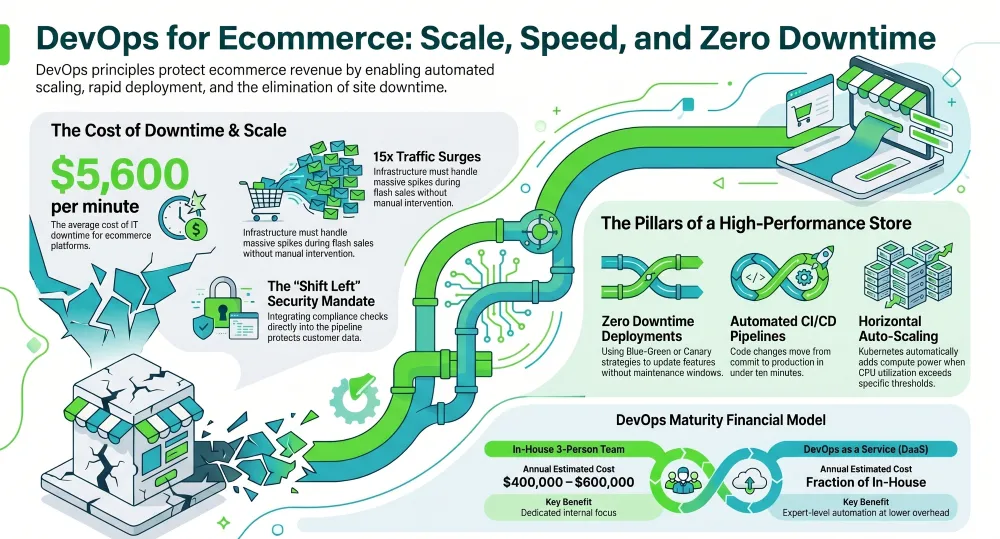
This is not a hypothetical. It is the reality for thousands of e-commerce businesses every year that operate without a mature DevOps for E-commerce strategy. According to Gartner, the average cost of IT downtime is approximately $5,600 per minute — and for a high-traffic ecommerce platform, that number can be significantly higher during peak sales periods.
The good news? Modern DevOps as a service practices, combined with cloud-native tooling and intelligent automation, have made it possible for e-commerce teams to scale on demand, deploy continuously, and recover from failures before customers even notice. Whether you run a Shopify-based storefront, a headless WooCommerce setup, or a fully custom-built platform, the principles of scalable DevOps solutions apply to your business.
This guide breaks down everything you need to know — from CI/CD pipelines and container orchestration to monitoring, zero-downtime deployments, and how a dedicated DevOps partner like Full-Stack Techies can make the difference between a sale and a lost customer.
Key Takeaways From The Article
1. The Financial and Operational Mandate
- High Cost of Failure: IT downtime costs an average of $5,600 per minute, a figure that spikes significantly for high-traffic platforms during peak sales.
- Retail-Specific Pressures: Ecommerce DevOps must handle unique challenges like flash sale traffic surges, complex third-party API integrations (payments, logistics), and the need for constant feature updates without disrupting checkout.
- Cultural Shift: Mature DevOps breaks down the traditional silos between development and operations, fostering a unified workflow that prioritizes both speed and stability.
2. Core Technical Foundations
- CI/CD Pipelines: Automated pipelines allow code changes to move from commit to production in under ten minutes, ensuring that every release is built, tested, and scanned for vulnerabilities automatically.
- Containerization and Kubernetes: Using Docker and Kubernetes ensures environment consistency (“it works on my machine”) and enables automatic horizontal scaling to handle traffic spikes.
- Zero Downtime Deployments: Strategies such as Blue-Green (switching between two identical environments) and Canary deployments (gradually rolling out changes to a small percentage of users) eliminate the need for maintenance windows.
3. Advanced Infrastructure Management
- Infrastructure as Code (IaC): By defining servers, databases, and firewalls in version-controlled configuration files (e.g., Terraform), businesses can recover from disasters in minutes and maintain a full audit trail for security compliance.
- Comprehensive Observability: A modern stack must include metrics for quantitative data, logs for event details, and distributed tracing to pinpoint exactly which service is causing a slow checkout experience.
- Multi-Layer Scaling: Effective scaling combines Kubernetes autoscaling with CDN caching, database read replicas, and rate limiting to protect against both legitimate traffic surges and bot attacks.
4. Security and Strategic Growth
- DevSecOps: Security is “shifted left” by integrating PCI-DSS and GDPR compliance checks directly into the CI/CD pipeline rather than treating them as an afterthought.
- DevOps as a Service (DaaS): For many businesses, outsourcing DevOps is more economical than hiring in-house; a three-person team can cost $400,000–$600,000 annually, whereas a managed service provides the same expertise at a fraction of the cost.
- Future Trends: Emerging practices include AIOps for predictive failure detection, FinOps for cloud cost optimization, and Edge computing to move application logic closer to the user for faster performance.
5. Implementation Roadmap
The article suggests a phased approach to DevOps maturity:
- Phase 1 (Foundation): Establish Git discipline, containerize applications, and set up basic CI and monitoring.
- Phase 2 (Automation): Implement full CD pipelines, IaC, and feature flags.
- Phase 3 (Scale): Migrate to Kubernetes, adopt zero-downtime releases, and integrate DevSecOps.
- Phase 4 (Optimization): Utilize GitOps workflows, AI-assisted operations, and FinOps tooling.
What Is DevOps for Ecommerce?
DevOps for Ecommerce is the application of DevOps principles — collaboration, automation, continuous delivery, and monitoring — to the specific technical, operational, and commercial demands of online retail environments.
Traditional DevOps emerged from enterprise software development. Ecommerce DevOps inherits those foundations but layers on requirements unique to retail: flash sale traffic spikes, payment gateway integrations, third-party logistics APIs, inventory sync pipelines, and the constant pressure to ship new features without breaking the checkout experience.
In a mature DevOps for E-commerce setup, development and operations teams work together in a unified workflow. Code changes move automatically through build, test, staging, and production pipelines. Infrastructure scales up during peak demand and scales back down to control costs. Deployments happen without taking the store offline. And when something goes wrong, alerts fire in seconds — not hours.
The shift is cultural as much as it is technical. DevOps breaks down the wall between “we write code” and “we keep the lights on” — a wall that has historically been responsible for slow releases, untested hotfixes, and catastrophic outages.
Also Read: DevOps for Fintech: How Financial Teams Ship Faster Without Breaking Compliance
The Unique Challenges of Ecommerce Infrastructure
Before diving into solutions, it’s worth understanding what makes ecommerce infrastructure genuinely hard to manage.
- Unpredictable traffic patterns are perhaps the most defining challenge. A viral social media post, a flash sale announcement, or a Prime-style deals event can multiply your traffic tenfold within minutes. Infrastructure that handles 5,000 concurrent users on a Wednesday afternoon needs to handle 80,000 on Black Friday morning.
- Deployment frequency pressure is another constant tension. Ecommerce product teams ship fast — new promotions, A/B tests, UI tweaks, pricing changes, feature rollouts. Every deployment is a risk event. Without a continuous deployment management system in place, releasing code manually is a bottleneck that creates both delays and errors.
- Third-party dependency complexity means your uptime isn’t entirely in your hands. Payment processors, shipping calculators, inventory management systems, review platforms, and analytics scripts all introduce external failure points. DevOps practices around circuit breakers, fallbacks, and dependency health monitoring become essential.
- Security and compliance requirements add another dimension. PCI-DSS compliance for payment data, GDPR obligations for customer information, and platform-specific security standards must be baked into the pipeline — not bolted on after deployment.
- Multi-environment consistency is a practical headache that DevOps solves elegantly. Bugs that only appear in production — because staging was configured differently — are a common and avoidable problem. Infrastructure-as-code and containerization ensure that what works in development works in production, consistently.
Start Building With Full-Stack Techies Today
Core DevOps Practices That Every Ecommerce Platform Needs
1. CI/CD Pipelines: The Foundation of Fast, Safe Releases
Continuous deployment management through CI/CD (Continuous Integration and Continuous Deployment) pipelines is the backbone of any mature DevOps for e-commerce strategy.
Every time a developer pushes code, an automated pipeline kicks in: it builds the application, runs unit and integration tests, checks for security vulnerabilities, validates against staging, and — if all gates pass — deploys to production. The entire process, from commit to live, can take under ten minutes in a well-tuned e-commerce environment.
The business impact is significant. Teams that ship code in small, frequent increments catch bugs early, reduce rollback complexity, and deliver new customer-facing features faster. According to the 2024 State of DevOps Report by DORA (DevOps Research and Assessment), elite performing teams deploy multiple times per day with change failure rates below 5%. This level of reliability is achievable — but only with proper pipeline architecture.
For e-commerce specifically, CI/CD pipelines should include:
Automated functional testing that covers critical purchase flows — add to cart, checkout, payment confirmation, and order confirmation emails. If any of these break, the pipeline stops before the bug reaches production.
Performance regression testing, because a new feature that adds 300ms to your page load time can measurably reduce conversion rates. Tools like Lighthouse CI or k6 can be baked directly into the pipeline.
Feature flags that allow code to be deployed to production without being activated. This separates deployment from release — your team can ship at any time, and turn features on for specific user segments when ready.
At Full-Stack Techies, we build CI/CD pipelines tailored to e-commerce workflows, incorporating platform-specific checks for Shopify, Magento, WooCommerce, and custom-built storefronts. Our DevOps as a service for e-commerce approach means your team gets enterprise-grade automation without the overhead of hiring and managing a dedicated DevOps team in-house.
2. Containerization and Kubernetes: Scaling Without the Headaches
Docker containers and Kubernetes orchestration have become the standard infrastructure for scalable DevOps solutions in e-commerce. The reason is simple: they make scaling both automatic and predictable.
Containers package your application and its dependencies into a portable, isolated unit. Every container runs identically regardless of where it is deployed — your developer’s laptop, staging, or a cloud data center on the other side of the world. This eliminates the “works on my machine” problem that plagues teams without containerization.
Kubernetes takes it further. It manages clusters of containers, automatically scheduling workloads across available compute resources, restarting failed containers, and — critically — scaling horizontally when traffic increases. You define a policy: “When CPU utilization exceeds 70%, add more pods.” Kubernetes handles the rest.
For an e-commerce business preparing for a sales event, this means:
You can pre-scale your infrastructure hours before a campaign launches. Kubernetes Horizontal Pod Autoscalers will then continue to adjust in real time based on actual traffic. When the event ends, compute scales back down, and you stop paying for idle resources.
SaaS DevOps platforms like Google Kubernetes Engine (GKE), Amazon EKS, and Azure AKS abstract much of the cluster management complexity, making Kubernetes accessible even to teams that are new to container orchestration.
Full-Stack Techies specializes in containerizing e-commerce applications and migrating them to managed Kubernetes environments. Our scalable DevOps solutions include complete infrastructure-as-code setups using Terraform and Helm charts, so your entire cluster configuration is version-controlled and reproducible.
3. Zero Downtime Deployments: The Art of Shipping Without Stopping
Zero downtime deployment is the gold standard for e-commerce, and modern DevOps for e-commerce makes it entirely achievable. There are several deployment strategies that eliminate the “maintenance window” entirely:
Blue-Green Deployments maintain two identical production environments — “blue” (current live) and “green” (new version). The new version is deployed to green, tested, and then traffic is switched instantly from blue to green. If anything goes wrong, rolling back is a single traffic switch away.
Canary Deployments send a small percentage of traffic — say, 5% — to the new version. Monitoring dashboards watch for error spikes or performance regressions. If the canary looks healthy after a defined window, traffic shifts to the new version gradually: 10%, 25%, 50%, 100%. If problems emerge at any point, traffic rolls back to the stable version.
Rolling Updates replace instances of the old version with the new version one at a time, ensuring the application remains live throughout. Kubernetes handles this natively.
Each of these strategies depends on a mature continuous deployment management system and real-time observability. You need to know, within seconds of a deployment, whether error rates are rising, response times are climbing, or conversion metrics are dropping.
Forbes has highlighted that e-commerce businesses that invest in deployment automation and observability reduce their mean time to recovery (MTTR) by up to 70%, translating directly into fewer lost sales and stronger customer trust.
Full-Stack Techies implements blue-green and canary deployment pipelines for ecommerce clients, paired with automated rollback triggers that fire when pre-defined thresholds are breached — no manual intervention required.
4. Infrastructure as Code (IaC): Reproducible, Auditable Environments
Infrastructure as Code means every server, database, load balancer, CDN rule, and firewall policy is defined in version-controlled configuration files — not clicked together in a cloud console by a single engineer whose context is the only documentation.
Terraform, Pulumi, and AWS CloudFormation are the primary tools in this space. For e-commerce platforms, IaC delivers several critical benefits:
Disaster recovery becomes fast and reliable. If your primary region goes down, you can spin up an identical environment in a secondary region in minutes — not days.
Security audits become tractable. Because every infrastructure change is a code commit, you have a complete audit trail of who changed what and when.
New environments — for staging, QA, load testing, or regional expansion — can be spun up in minutes by running a single command.
Compliance requirements are easier to demonstrate because your infrastructure configuration is documented, version-controlled, and testable.
At Full-Stack Techies, we deliver IaC-based environment management as part of our DevOps as a service for e-commerce offerings, ensuring that our clients’ infrastructure is always documented, auditable, and recoverable.
5. Observability: Monitoring, Logging, and Alerting at Scale
The 2024 Gartner report on digital commerce infrastructure notes that observability — the ability to understand system state from its external outputs — has become a board-level concern for e-commerce businesses, not just an operational nicety. For high-traffic stores, the difference between a five-minute outage and a five-second alert is pure observability maturity.
A complete observability stack for DevOps for e-commerce includes three pillars:
Metrics track quantitative data over time: request rates, error rates, latency percentiles, CPU usage, memory consumption, database query durations, and business KPIs like orders per minute and cart abandonment rates. Prometheus and Grafana are the open-source standards; commercial options include Datadog, New Relic, and Dynatrace.
Logs capture structured event data from every service. Centralized log aggregation via tools like the ELK Stack (Elasticsearch, Logstash, Kibana) or Loki makes it possible to search across millions of log lines in seconds when debugging a production incident.
Traces follow a single user request as it travels through your microservices: from the edge CDN, through the API gateway, to the product service, inventory service, pricing engine, and back. Distributed tracing (OpenTelemetry, Jaeger, Zipkin) makes it possible to pinpoint exactly which service is responsible for a slow checkout experience.
The SaaS DevOps platforms available today — Datadog, New Relic, Honeycomb — combine all three pillars in a single interface, with AI-powered anomaly detection that can surface problems before they affect customers.
Full-Stack Techies designs and implements full observability stacks for ecommerce clients, including custom dashboards that surface both technical and business metrics on a single screen — so your team always knows when something is wrong and why.
6. Auto-Scaling and Load Management
When traffic spikes arrive, the question is not whether your infrastructure will be tested — it is how quickly it can respond.
Horizontal scaling adds more compute instances to handle load. Modern cloud providers — AWS, GCP, Azure — all offer auto-scaling groups that can provision new instances within 90 seconds of a scaling trigger. Combined with Kubernetes Horizontal Pod Autoscalers, most ecommerce platforms can respond to a 10x traffic spike within two to three minutes.
Vertical scaling increases the resources on existing instances — more CPU, more RAM. This is slower and has limits, but it is useful for database tiers and stateful services that are harder to scale horizontally.
Caching strategies reduce the load that reaches your origin servers in the first place. A properly configured CDN (Cloudflare, Fastly, AWS CloudFront) can serve 80–90% of your product catalog, category pages, and static assets from edge nodes close to the user — at millisecond latency. Redis or Memcached caching layers in front of your databases dramatically reduce query load during peak periods.
Database read replicas distribute read traffic across multiple database nodes, ensuring your product database doesn’t become the bottleneck when thousands of users are browsing simultaneously.
Rate limiting and bot protection matter more than most teams realize. Aggressive bot traffic and credential-stuffing attacks can account for 30–40% of traffic during major sales events. Tools like Cloudflare WAF, AWS Shield, and NGINX rate limiting keep illegitimate traffic from consuming your scaling headroom.
Full-Stack Techies architects multi-layer scaling solutions for e-commerce platforms, combining CDN optimization, Kubernetes autoscaling, and database tiering to ensure consistent performance from 100 concurrent users to 100,000.
DevOps as a Service for Ecommerce: Why In-House Isn’t Always the Answer
Building a world-class DevOps for Ecommerce practice in-house is genuinely difficult. Senior DevOps engineers are among the most in-demand and expensive engineers on the market. Building a team capable of covering CI/CD, Kubernetes, security, observability, and incident response requires multiple senior hires, significant onboarding time, and ongoing investment in training and tooling.
This is where DevOps as a service for e-commerce becomes a compelling option. Rather than building from scratch, you partner with a specialist team that brings battle-tested practices, tooling, and expertise to your specific platform.
Full-Stack Techies delivers end-to-end DevOps as a service for ecommerce businesses of all sizes — from scaling D2C brands to enterprise multi-vendor marketplaces. Our team has deep experience with Shopify Plus, Magento, WooCommerce, BigCommerce, and fully custom-built platforms built on Node.js, Python, and PHP backends.
What does our DevOps as a service model include?
We start with a thorough infrastructure audit — understanding your current deployment process, pain points, and scalability gaps. From there, we design and implement CI/CD pipelines, containerize your application stack, set up managed Kubernetes environments, and deploy a complete observability stack. We then provide ongoing management, monitoring, and on-call incident response, so your engineering team can focus on building product rather than keeping the lights on.
The economics of DevOps as a service for e-commerce are compelling. A mid-market ecommerce business that would need to spend $400,000–$600,000 per year on salaries for a three-person DevOps team can access equivalent capability through a managed service model at a fraction of the cost, with the added benefit of a team that has already solved the exact problems your platform faces.
SaaS DevOps Tools: The Ecommerce Technology Stack
The ecosystem of SaaS DevOps tooling available to ecommerce teams has matured enormously over the past few years. Here is a breakdown of the key tools across each category:
- Source Control and Collaboration: GitHub, GitLab, Bitbucket. All three offer native CI/CD capabilities (GitHub Actions, GitLab CI, Bitbucket Pipelines) that integrate directly with your repository workflow.
- CI/CD Pipelines: CircleCI, Jenkins, GitHub Actions, GitLab CI. For e-commerce-specific workflows, GitHub Actions has emerged as the dominant choice due to its deep integration with the GitHub ecosystem and extensive marketplace of pre-built actions.
- Container Orchestration: Kubernetes (self-managed or via GKE, EKS, AKS). Docker Swarm for smaller teams. Helm for managing Kubernetes application packages.
- Infrastructure as Code: Terraform for multi-cloud infrastructure provisioning. Ansible for configuration management. Pulumi for teams that prefer writing IaC in general-purpose programming languages.
- Observability: Datadog, New Relic, Prometheus + Grafana, Sentry, Honeycomb. For e-commerce specifically, Datadog’s APM and Real User Monitoring (RUM) capabilities are particularly valuable.
- Incident Management: PagerDuty, OpsGenie, Rootly. These integrate with your monitoring stack to route alerts to the right on-call engineer and manage incident communication.
- Security (DevSecOps): Snyk for dependency vulnerability scanning, HashiCorp Vault for secrets management, OWASP ZAP for dynamic application security testing, Trivy for container image scanning.
- Performance Testing: k6, Locust, Gatling for load testing before major sales events.
Full-Stack Techies is tool-agnostic and works with your existing stack or recommends the optimal combination for your platform, scale, and team capabilities. Our SaaS DevOps partnerships mean we can often provide preferred pricing on key tools as part of our managed service offering.
Real-World Use Cases: DevOps for Ecommerce in Action
Flash Sale Preparation
A fashion ecommerce brand running a 24-hour clearance sale expected 15x normal traffic. Working with Full-Stack Techies, the team implemented Kubernetes autoscaling with pre-configured scaling policies, warmed up CDN caches 48 hours before the event, ran load tests simulating 50,000 concurrent users, and set up a war room dashboard combining technical metrics with real-time order volume. The sale executed without a single downtime incident, and the team scaled back infrastructure the morning after — resulting in zero overspend on idle compute.
Rapid Feature Deployment During Peak Season
A home goods retailer needed to deploy a new bundle builder feature during the holiday season but was terrified of breaking checkout. Using Full-Stack Techies‘ blue-green deployment setup and feature flag system, the feature was deployed to production two weeks before launch, hidden behind a flag. It was tested extensively in production with internal users, then gradually rolled out to 10%, 25%, and 100% of customers over 72 hours with zero customer-impacting incidents.
Incident Response and Recovery
An electronics marketplace experienced a database connection pool exhaustion event during a major promotion. Without continuous deployment management and observability in place, the engineering team would have needed 30–45 minutes to diagnose and resolve the issue. With Full-Stack Techies’ observability stack and runbook automation in place, automated alerts fired within 45 seconds of the first error spike, the on-call engineer was notified via PagerDuty, and the issue was mitigated through a configuration change in under eight minutes — while the store remained live throughout.
DevSecOps: Baking Security Into the Ecommerce Pipeline
Security in ecommerce is not optional — it is a regulatory and commercial necessity. PCI-DSS compliance governs how payment card data is handled. GDPR and CCPA govern customer data. Platform-specific requirements govern integrations with Shopify, Amazon, and others.
DevSecOps integrates security checks directly into the continuous deployment management pipeline, rather than treating security as a separate gate at the end of development.
In practice, this means:
Static Application Security Testing (SAST) scans your code for vulnerabilities at every commit. Dynamic Application Security Testing (DAST) runs against a live staging environment before every production deployment. Software Composition Analysis (SCA) checks every third-party library and npm package for known CVEs. Container image scanning ensures no vulnerable base images make it into production. Secrets scanning prevents API keys, database credentials, and payment tokens from being accidentally committed to source control.
Gartner predicts that by 2026, more than 70% of organizations will use security tooling embedded in CI/CD pipelines — up from under 30% in 2022. For ecommerce businesses handling payment and customer data, this transition is not optional: it is a path-to-compliance requirement.
Full-Stack Techies implements complete DevSecOps pipelines for ecommerce clients, including automated compliance checks, vulnerability dashboards, and remediation workflows that integrate with your existing engineering processes.
Industry Trends: What’s Shaping DevOps for Ecommerce in 2025 and Beyond
The DevOps for Ecommerce landscape is evolving rapidly. Here are the trends shaping the next generation of ecommerce infrastructure:
- AI-Assisted Operations (AIOps) is moving from buzzword to practical reality. Tools like Dynatrace Davis, Datadog Watchdog, and New Relic’s AI engine use machine learning to detect anomalies, predict infrastructure failures before they occur, and automate root cause analysis. Forbes has reported that AIOps is on track to become a standard feature of enterprise DevOps platforms by the end of 2025.
- Platform Engineering is emerging as the next evolution beyond traditional DevOps. Rather than requiring every developer to understand Kubernetes, Terraform, and CI/CD configuration, platform engineering teams build internal developer platforms (IDPs) that abstract infrastructure complexity behind simple, self-service interfaces. Backstage (open-sourced by Spotify) is the leading framework in this space.
- GitOps is becoming the dominant operational model for Kubernetes-based ecommerce deployments. In a GitOps workflow, the desired state of your entire infrastructure and application configuration is stored in Git. Tools like ArgoCD and Flux continuously reconcile the actual cluster state with the desired state defined in Git, making drift detection and recovery automatic.
- FinOps integration is pushing scalable DevOps solutions to account for cloud cost optimization as a first-class concern. Real-time cost dashboards, spot instance utilization, and automatic rightsizing of over-provisioned resources are becoming standard parts of the DevOps toolkit for ecommerce businesses facing pressure to improve infrastructure ROI.
- Edge computing is changing how ecommerce applications handle personalization, A/B testing, and geo-targeted content. Cloudflare Workers, AWS Lambda@Edge, and Vercel Edge Functions allow application logic to execute at CDN edge nodes — milliseconds from the user — opening up new possibilities for fast, personalized storefronts.
Full-Stack Techies stays at the forefront of these trends, continuously updating our DevOps as a service for ecommerce methodologies to incorporate the latest tools, patterns, and best practices as they mature.
How to Get Started: A Practical DevOps Maturity Roadmap for Ecommerce
If you are early in your DevOps for Ecommerce journey, here is a practical maturity roadmap:
Level 1 — Foundation (0–3 months): Establish source control discipline (Git branching strategy), implement a basic CI pipeline with automated testing, containerize your application with Docker, and set up centralized logging and basic uptime monitoring.
Level 2 — Automation (3–6 months): Build out full CD pipelines with staging environment promotion, implement infrastructure as code for all cloud resources, deploy a metrics and tracing stack, and introduce feature flags for safer releases.
Level 3 — Scale (6–12 months): Migrate to Kubernetes with autoscaling, implement blue-green or canary deployments, build out full DevSecOps pipeline integrations, conduct regular load testing and chaos engineering exercises, and establish on-call runbooks.
Level 4 — Optimization (12+ months): Adopt GitOps workflows, implement AIOps tooling, build an internal developer platform, integrate FinOps tooling, and pursue continuous improvement through DORA metric tracking.
Full-Stack Techies can accelerate every stage of this roadmap. Whether you are starting from scratch or optimizing a mature setup, our DevOps as a service model is designed to meet you where you are and move you rapidly toward the capabilities your business needs.
Why Full-Stack Techies Is the Right DevOps Partner for Your Ecommerce Business
There is no shortage of DevOps consultancies in the market. What makes Full-Stack Techies different is the combination of deep ecommerce domain expertise and genuine DevOps engineering capability.
We do not simply apply generic DevOps frameworks to ecommerce platforms — we understand the specific architectural, compliance, and operational realities of running an online store. We know what happens to a Magento database connection pool under Black Friday load. We know how Shopify Plus deployment limitations affect CI/CD pipeline design. We know how to instrument a headless commerce frontend for performance observability. This domain depth translates into faster implementation, fewer false starts, and better outcomes.
Our scalable DevOps solutions are designed to grow with your business. We work with early-stage brands running on shared infrastructure and enterprise retailers processing millions of transactions per day — and we know how to right-size the solution for where you are now while building toward where you are going.
Our DevOps as a service for ecommerce model means you get a dedicated team, not a revolving door of consultants. We embed with your engineering team, participate in sprint planning, and take ownership of the infrastructure outcomes — not just the deliverables.
If you want to stop losing revenue to downtime, deploy faster without breaking things, and build an infrastructure that scales with your growth, we would love to talk. Reach out to Full-Stack Techies to schedule a free infrastructure review and find out how we can help.
Start Building With Full-Stack Techies Today
Conclusion: DevOps Is Not Optional for Ecommerce Anymore
The ecommerce market is too competitive, customer expectations are too high, and the cost of downtime is too great for online retailers to treat infrastructure as an afterthought.
DevOps for Ecommerce is no longer a practice reserved for Amazon, ASOS, or Zalando. The tooling, expertise, and SaaS DevOps platforms available today make enterprise-grade deployment automation, scalable DevOps solutions, zero downtime releases, and proactive observability accessible to businesses at every scale.
Whether you choose to build these capabilities in-house or partner with a specialist like Full-Stack Techies through a DevOps as a service model, the imperative is the same: build the foundation now, before the next traffic spike, the next security incident, or the next competitor launch forces the issue.
Your customers expect your store to be fast, reliable, and available every time they visit. Continuous deployment management, intelligent scaling, and zero downtime practices are how you deliver on that expectation — consistently.
About Full-Stack Techies: We are a specialist technology partner delivering DevOps as a service, cloud infrastructure engineering, and full-stack development for e-commerce businesses. From CI/CD pipeline setup to full Kubernetes migration and managed observability, we help online retailers build and operate infrastructure that scales with their ambitions. Contact us to learn more.
Frequently Asked Questions (FAQs)
Q1. What is DevOps for Ecommerce?
DevOps for Ecommerce is the practice of applying automation, continuous delivery, and collaborative workflows to the specific infrastructure and operational demands of online retail u2014 helping stores deploy faster, scale reliably, and eliminate downtime.
Q2. Why do ecommerce businesses need DevOps?
Ecommerce platforms face unpredictable traffic spikes, frequent deployments, and zero tolerance for downtime. DevOps for Ecommerce solves these challenges through automated pipelines, auto-scaling infrastructure, and proactive monitoring u2014 directly protecting revenue and customer experience.
Q3. What is DevOps as a Service for Ecommerce?
DevOps as a service for ecommerce is a managed model where a specialist partner handles your entire DevOps function u2014 CI/CD pipelines, infrastructure management, monitoring, and incident response u2014 so your team focuses on building product rather than managing infrastructure.
Q4. How does DevOps help prevent ecommerce downtime?
DevOps prevents downtime through zero downtime deployment strategies like blue-green and canary releases, real-time observability that catches issues in seconds, automated rollbacks, and Kubernetes-based infrastructure that self-heals when services fail.
Q5. What are scalable DevOps solutions for ecommerce?
Scalable DevOps solutions for ecommerce combine Kubernetes auto-scaling, CDN caching, database read replicas, and cloud auto-scaling groups to handle traffic surges u2014 from normal daily load to 10x spikes during flash sales u2014 without manual intervention.
Q6. What is continuous deployment management in ecommerce?
Continuous deployment management is the automated process of moving code from development through testing, staging, and into production via CI/CD pipelines u2014 ensuring every release is tested, consistent, and deployed without human error or store disruption.
Q7. What DevOps tools are commonly used in ecommerce?
The most widely used SaaS DevOps tools in ecommerce include GitHub Actions or GitLab CI for pipelines, Kubernetes for container orchestration, Terraform for infrastructure as code, Datadog or Prometheus for monitoring, and PagerDuty for incident management.
Q8. How does DevOps improve ecommerce site speed?
DevOps for Ecommerce improves site speed by enforcing performance testing in CI/CD pipelines, optimizing CDN configurations, enabling edge computing for faster content delivery, and using observability tools to identify and eliminate latency bottlenecks before they impact customers.
Q9. Is DevOps suitable for small and mid-sized ecommerce businesses?
Yes. With DevOps as a service models and managed SaaS DevOps platforms, small and mid-sized ecommerce businesses can access enterprise-grade automation and scalability without the cost of building an in-house DevOps team u2014 making it viable at almost any scale.
Q10. How do I get started with DevOps for my ecommerce store?
Start by containerizing your application, setting up a basic CI/CD pipeline with automated testing, and implementing centralized monitoring. For faster results, partnering with a specialist like Full-Stack Techies through a DevOps as a service for ecommerce model accelerates the entire process with proven frameworks and ecommerce-specific expertise.



