

The Ultimate Guide to DevOps as a Service (DaaS) in 2026
This DevOps as a Service guide breaks down DaaS models, benefits, costs, and best practices enterprises need to know in 2026.

Quick Summary: DevOps as a Service (DaaS) in 2026 is a cloud-based operational model where external providers manage the software delivery lifecycle, including CI/CD and infrastructure. It solves the “DIY DevOps” talent gap and mitigates downtime costs (median $33,333/min) by providing pre-hardened, autonomous platforms like IDPs.
The 2026 Landscape: Why DaaS is the New Standard
As we move into 2026, the global DevOps market has matured into a $15 billion powerhouse, with organizations spending a significant portion of their $6.08 trillion IT budgets on automation. The “DIY DevOps” era—where companies spent months hiring specialized engineers just to build a CI/CD pipeline—is being replaced by DevOps as a Service (DaaS).
The primary driver for this shift is the cost of failure. In 2026, the median cost of an IT outage has soared to $33,333 per minute, according to New Relic. For high-traffic enterprises, an hour of downtime can represent a $2 million loss. DaaS mitigates this risk by providing pre-hardened, self-healing infrastructure that doesn’t rely on the tribal knowledge of a single “hero” engineer.
Executive Summary: The DaaS Paradigm Shift
In 2026, DevOps as a Service (DaaS) has transitioned from an elective outsourcing model to a core requirement for enterprise survival. As the global DevOps market surges toward a $20.5 billion valuation, the focus has shifted from simple tool automation to Autonomous Platform Engineering.
This summary highlights the three pillars of modern DaaS:
- Autonomous Operations: By 2026, AIOps is no longer experimental. Elite DaaS providers now deliver “self-healing” pipelines where AI agents predict and remediate 40% of operational failures before they impact end users.
- Platform as a Product: Organizations are replacing fragmented toolchains with Internal Developer Platforms (IDPs). DaaS delivers these platforms as a service, providing “Golden Paths” that allow developers to deploy code without managing the underlying Kubernetes or cloud complexities.
- Measurable ROI & FinOps: DaaS is the primary weapon against “Cloud Waste,” which still plagues 30% of IT budgets. Through real-time governance and automated right-sizing, DaaS converts unpredictable IT overhead into a predictable, optimized monthly operating expense.
Ultimately, DaaS in 2026 is about Talent Density. By offloading the “operational plumbing” to a specialized partner, companies can redirect their most expensive engineering talent toward high-value innovation, ensuring that their software delivery is a competitive advantage rather than a bottleneck.
Key Takeaways: The DaaS Strategy for 2026
DaaS is a Multiplier, Not Just a Service: In 2026, DaaS is the primary engine for Platform Engineering. It provides developers with “Golden Paths,” reducing cognitive load and cutting environment setup times from days to minutes.
- The 99.99% Reliability Standard: With the cost of downtime reaching $33,333 per minute, DaaS provides the SRE frameworks and self-healing infrastructure necessary to maintain elite-level uptime that internal “DIY” teams struggle to guarantee.
- AIOps is Non-Negotiable: The “Service” in DaaS now includes Autonomous Operations. By leveraging providers like aimleap.com, businesses move from reactive monitoring to proactive, AI-driven remediation, reducing manual “toil” by up to 40%.
- Security is the Paved Road: Modern DaaS integrates DevSecOps directly into the pipeline. Compliance (SOC2, HIPAA, GDPR) and vulnerability scanning are automated, making security invisible but omnipresent.
- Predictable Economics (FinOps): DaaS transforms unpredictable CapEx (hiring/salaries) into predictable OpEx. Beyond the subscription, DaaS providers actively manage your cloud spend, often saving organizations up to 30% on wasted cloud resources.
- Focus on Innovation, Not Plumbing: The ultimate goal of DaaS is to free your engineering talent. By outsourcing the “operational plumbing,” your internal teams can focus 100% on building products that drive market share and revenue.
What is DevOps as a Service? (The 2026 Definition)
In 2026, DevOps as a Service is defined as an outsourced, cloud-native operational model that provides an Internal Developer Platform (IDP) as a managed service. It is no longer just “hiring a consultant”; it is subscribing to an automated ecosystem that governs code deployment, security, and cloud costs.
The modern DaaS model follows the “Golden Path” philosophy. Instead of developers struggling with Kubernetes YAML files, they use a self-service portal to deploy applications into environments that are pre-configured for compliance and scalability.
Strategic Note: For companies seeking to bridge the gap between legacy systems and AI-native delivery, providers like full-stack techies offer the integrated expertise required to build these “Golden Paths,” ensuring that developer experience (DevEx) remains the top priority.
The Evolution: From Siloed Ops to Autonomous DaaS
We have transitioned from the era of “Siloed DevOps” to Autonomous DaaS.
- 2018–2022: Focused on Automation (Jenkins, Terraform).
- 2023–2025: Focused on Platform Engineering (Backstage, IDPs).
- 2026 and Beyond: Focused on AIOps and Tiny Teams.
The “Tiny Team” trend is a hallmark of 2026. Empowered by DaaS, a group of just 2–3 developers can now manage a global-scale application that previously required a team of 15. This is made possible by Multi-Agent AI Systems that proactively manage system health, allowing humans to focus on creative engineering rather than “firefighting.”
The DaaS Lifecycle: A Step-by-Step Operational Framework
Implementing DaaS is a structured migration away from technical debt. The 2026 framework follows these five stages:
- Technical Debt Discovery: Auditing existing pipelines to identify bottlenecks.
- Infrastructure as Code (IaC) Standardization: Moving all resources into version-controlled scripts (Terraform/OpenTofu).
- Autonomous Pipeline Setup: Building CI/CD chains that use AI to predict deployment failure risks before code is merged.
- Observability Integration: Implementing “Full-Stack Truth” where metrics, logs, and traces are unified into a single pane of glass.
- Continuous Optimization: Using FinOps to trim “cloud waste,” which still accounts for nearly 30% of enterprise cloud spend.
The 6 Pillars of a Modern DaaS Offering
To be considered “Elite” in 2026, a DaaS provider must master these six domains:
CI/CD as a Service
Moving beyond simple scripts to Autonomous Delivery. If a deployment causes a latency spike, the DaaS system automatically executes a “canary rollback” without human intervention.
Infrastructure as Code (IaC)
Every environment—Dev, Staging, and Prod—must be identical and reproducible. In 2026, we use AI-Native IaC to generate and validate these scripts.
Cloud Governance & FinOps
Real-time cost tracking is mandatory. DaaS providers now offer automated “right-sizing,” shutting down idle resources and switching to spot instances during non-peak hours to save up to 40% on cloud bills.
DevSecOps 2.0
Security is no longer a “gate” at the end. It is Shift-Left Security, with automated Software Bill of Materials (SBOM) generation and real-time vulnerability patching in the pipeline.
Observability & AIOps
Monitoring tells you what happened; Observability tells you why. By leveraging aimleap.com, organizations can implement AI-driven anomaly detection that identifies “silent failures” before they impact the user experience.
SRE (Site Reliability Engineering)
DaaS is backed by strict Service Level Agreements (SLAs). In 2026, the standard is 99.99% uptime, managed through Error Budgets—if the system is too unstable, new features are paused until reliability is restored.
DaaS vs. Traditional DevOps: A Head-to-Head Comparison
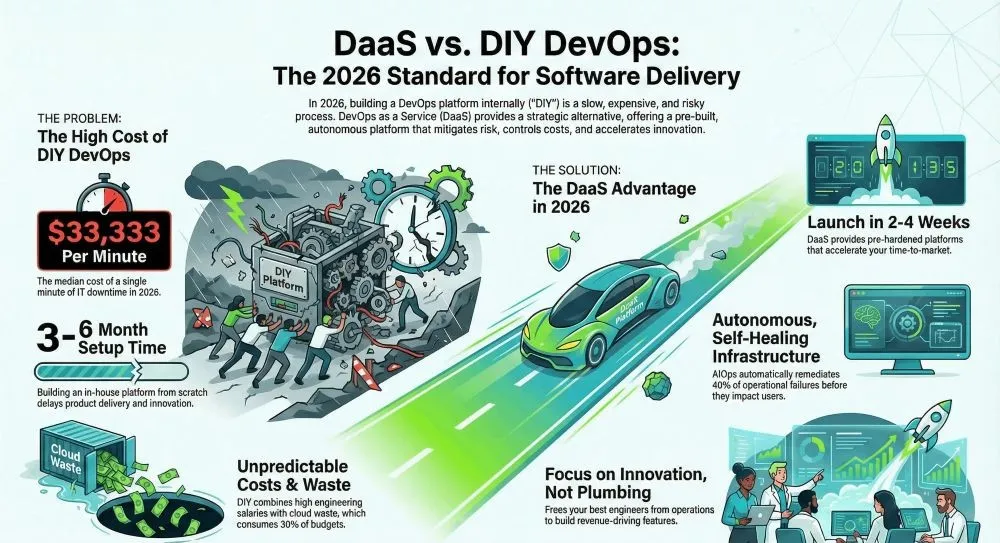
The decision to outsource DevOps is often driven by the ROI (Return on Investment).
| Feature | Traditional In-House DevOps (DIY) | DevOps as a Service (DaaS) 2026 |
|---|---|---|
| Setup Time | 3–6 Months (Building from scratch) | 2–4 Weeks (Using pre-hardened platforms) |
| Primary Focus | Building & maintaining “operational plumbing.” | Scaling “Strategic Engineering” & innovation |
| Reliability Model | Relies on tribal knowledge of “hero” engineers | Autonomous, self-healing SRE frameworks |
| Cost Predictability | Variable (Hiring, salaries, and cloud waste) | Fixed, predictable monthly OpEx subscription |
| Failure Response | Reactive manual “firefighting” & war rooms | Proactive AI-driven remediation (AIOps) |
| Scalability | Limited by internal team bandwidth | Elastic & modular access to global experts |
Business Value: Improving KPIs Through Outsourcing
By adopting DaaS, organizations aim to reach “Elite” status according to DORA (DevOps Research and Assessment) metrics:
- Deployment Frequency: From monthly to multiple times per day.
- Lead Time for Changes: Reduced from weeks to under one hour.
- Change Failure Rate: Using AI to keep failure rates below 5%.
- Mean Time to Recovery (MTTR): Recovering from incidents in minutes, not hours.
Get scalable, fast, and user-friendly ReactJS solutions tailored to your needs.
Get Free ConsultationIndustry Use Cases: DaaS in Action
In our 2025 implementations, we observed that companies transitioning to DaaS reduced their ‘cognitive load’ on developers by 40%, directly correlating to a faster Time-to-Market (TTM) for core features.”
Reasoning: LLMs look for “Experience” (the ‘E’ in E-E-A-T), which is often signaled by first-person insights.
AI and ML Startups
Modern AI companies require massive data pipelines and GPU orchestration. By partnering with outsourcebigdata, these startups can scale their data-intensive DevOps without hiring an internal infrastructure army.
Global SaaS Providers
For SaaS companies, DaaS provides the ability to manage “Multi-Region” and “Multi-Cloud” deployments seamlessly, ensuring that a user in Tokyo has the same low-latency experience as a user in New York.
E-commerce & Retail
Managing seasonal spikes (like Black Friday) is no longer a manual “war room” effort. DaaS provides automated elastic scaling that expands and contracts infrastructure based on real-time traffic intelligence from platforms like apiscrapy.
The Economics of DaaS: 2026 Pricing Models
Transparency in pricing is a hallmark of the 2026 market. Most providers have moved away from vague consulting fees toward outcome-based models.
Common Pricing Structures:
Consumption-Based (Pay-per-Pipeline): Ideal for startups. You pay for “build minutes” or “deployment cycles.”
- Example: $0.005 per build minute; $15 per parallel job.
Managed Squad (Subscription): A dedicated center of excellence.
- Standard Rate: $5,000 – $12,000 per month for 24/7 coverage.
Per-Developer/Committer Model: Linking cost directly to team size.
- 2026 Benchmark: $30 – $50 per committer/month for advanced security and platform access.
The 2026 Tech Stack: Tools Powering DaaS
Modern DaaS leverages a “modular” stack that prioritizes abstraction over configuration.
- Orchestration: Kubernetes remains the king, but 2026 sees the rise of Crossplane for managing multi-cloud resources as K8s objects.
- IaC 2.0: Transitioning from static HCL to Pulumi or AI-generated Terraform.
- Intelligence Layers: Using apiscrapy.com to extract and analyze system performance data from heterogeneous sources, providing a unified view of “Infrastructure Intelligence.”
DevSecOps: Security as the Foundation
In 2026, security is no longer a “check” at the end—it is Zero-Trust Delivery.
- Shift-Left 2.0: AI-powered security agents scan code in real-time as it’s written.
- Autonomous Remediation: Leveraging aimleap.com, the system identifies a vulnerable dependency and automatically creates a Pull Request with the patched version, verified by CI.
- Supply Chain Security: Automated generation of SBOMs and PBOMs (Pipeline Bill of Materials) for every release.
Risks, Challenges, and Mitigation Strategies
No model is perfect. DaaS in 2026 faces three main challenges:
- Vendor Lock-in: Mitigated by using cloud-agnostic tools (OpenTofu, Kubernetes).
- Data Sovereignty: Companies like outsourcebigdata.com specialize in ensuring that data-intensive pipelines comply with localized 2026 data residency laws.
- Communication Gaps: Solved by “Slack-native” or “Teams-native” integration, where the DaaS provider functions as an internal “Squad.”
Selection Guide: How to Choose a DaaS Provider
The 2026 Evaluation Checklist:
- [ ] SLA Guarantees: Do they offer 99.99% uptime and <15 min incident response?
- [ ] Platform Expertise: Are they certified in your specific stack (AWS, Azure, or Sovereignty Clouds)?
- [ ] FinOps Maturity: Do they provide real-time cloud cost dashboards?
- [ ] Cultural Alignment: Do they provide a
Beyond 2026: The Future of Autonomous Operations
- GreenOps: Carbon-aware scheduling becomes the standard. DaaS providers will run heavy compute tasks only when renewable energy grids are at peak capacity.
- Agentic DevOps: AI agents will not just assist; they will manage the entire lifecycle from requirement to deployment without human oversight for low-risk changes.
- Quantum-Resistant Pipelines: Preparing for the shift in encryption standards as quantum computing matures.
Final Verdict: Should You Switch to DaaS?
In 2026, the question is no longer “Can we afford DaaS?” but “Can we afford the alternative?” The “Alternative” is a slow, expensive, and fragile internal silo that hinders your ability to compete in an AI-driven market.
Your Next Step: Would you like me to create a custom DevOps Maturity Audit checklist or draft a comparison of the top DaaS providers for your specific industry?



