

The Ultimate Guide to DevOps Consulting: From Assessment to Transformation
This comprehensive Guide to DevOps Consulting explains how organizations can move from initial DevOps assessment to full-scale transformation. Learn proven strategies, automation best practices, and consulting frameworks that help enterprises improve scalability, accelerate delivery, and optimize software operations in 2026.


Introduction: Why Businesses Can No Longer Afford to Delay DevOps Consulting
Software delivery is no longer a back-office function. It is a competitive weapon. Organizations that ship faster, recover from failures quicker, and deploy with greater reliability are the ones capturing market share. Those that don’t are losing it — quietly but consistently.
Yet for most enterprises, the path to meaningful DevOps transformation is littered with stalled pilot projects, siloed teams, tool sprawl, and cultural friction. Leadership buys into the idea of DevOps but underestimates its scope. Engineers adopt new tools without changing processes. The result is a hybrid of old dysfunction and new complexity.
This is precisely where DevOps consulting services become not just valuable, but essential.
The global DevOps market reached USD 15.80 billion in 2025 and is projected to reach USD 83.60 billion by 2034, growing at a CAGR of 19.74% during 2026–2034 — driven by accelerating digital transformation, widespread cloud adoption, and growing enterprise demand for faster, more reliable software delivery.
According to Gartner, the next wave of DevOps maturity will blend security, automation, and engineering culture into a single discipline — it’s not about shipping faster, but about building a delivery system that’s reliable, auditable, and scalable by design.
This guide covers everything you need to know about DevOps consulting — what it is, how a structured DevOps assessment works, what a real DevOps transformation looks like, how to select the right partner, and what the smartest organizations are doing differently in 2026 and beyond.
Whether you are a CTO evaluating your first consulting engagement or a transformation leader trying to scale what’s already working, this guide to DevOps consulting will give you the frameworks, benchmarks, and clarity to move forward.
Executive Summary
The Ultimate Guide to DevOps Consulting: From Assessment to Transformation is a comprehensive resource for technology leaders, CTOs, and engineering managers who need a clear, actionable roadmap to modernize software delivery through structured DevOps consulting.
What this guide covers:
DevOps consulting is the practice of engaging specialized external experts to assess, redesign, and implement DevOps practices — aligning people, processes, and technology to deliver software faster, more reliably, and more securely. It is fundamentally different from managed services or staff augmentation. Its goal is to build lasting internal capability, not create dependency.
The guide walks through the five core phases of a successful DevOps consulting engagement: DevOps assessment, strategy and roadmap design, technical implementation (CI/CD, IaC, cloud-native transformation, DevSecOps), organizational and process improvement, and ongoing delivery optimization. Each phase is mapped to concrete business outcomes — not just technical deliverables.
Key data points from 2026 industry research anchor the business case: the global DevOps market is projected to grow from $24.30 billion in 2026 to $125.07 billion by 2034. Elite DORA performers deploy 182 times more frequently than low performers. Enterprises that invest in DevOps transformation through structured consulting report up to 230% ROI over three years. And 73% of enterprises are already implementing or planning AIOps adoption by end of 2026.
The guide also addresses the major trends reshaping enterprise DevOps consulting in 2026 — including platform engineering, AIOps, the AI productivity paradox, DevSecOps as a regulatory requirement, and FinOps-driven delivery optimization. It covers how to choose the right consulting partner, what metrics to track, and the most common mistakes that cause DevOps transformation efforts to stall.
Throughout, Full-Stack Techies is positioned as a full-lifecycle DevOps consulting services partner — from initial DevOps assessment through cloud-native transformation, DevOps as a service, and ongoing optimization — with a philosophy grounded in outcomes over outputs and knowledge transfer over consulting dependency.
Who this guide is for: CTOs, VPs of Engineering, IT directors, and business leaders evaluating their first DevOps consulting engagement or looking to accelerate a transformation already underway.
The bottom line: In 2026, DevOps transformation is not a technical project. It is a strategic business imperative — and the organizations that treat it that way, with the right partner and the right framework, are the ones widening the performance gap on everyone else.
What Is DevOps Consulting? A Clear, Business-First Definition
DevOps consulting is the practice of engaging external experts to assess, design, implement, and optimize DevOps practices within an organization. It goes far beyond tool selection or pipeline configuration. At its core, it is the alignment of people, processes, and technology to enable faster, more reliable, and more secure software delivery.
A DevOps consultant brings three things that internal teams typically lack:
1. Objective diagnosis. Internal teams are too close to their own problems. Consultants can identify root causes — cultural, architectural, or process-based — that are invisible from the inside.
2. Proven playbooks. Experienced DevOps consulting services providers have seen patterns across dozens of organizations and industries. They know what works, what doesn’t, and in what order changes should happen.
3. Acceleration without disruption. Rather than learning by trial and error, consulting engagements compress the timeline of transformation by transferring knowledge, establishing standards, and avoiding common mistakes.
It is important to distinguish DevOps consulting from managed services or staff augmentation. Consulting is outcome-oriented and advisory. It delivers a capability uplift within the client organization rather than simply providing headcount or keeping the lights on.
Quick Comparison: DevOps Consulting vs. Alternatives
| Feature | DevOps Consulting | Managed Services (DaaS) | Staff Augmentation |
|---|---|---|---|
| Primary Goal | Capability building & Transformation | Ongoing operational management | Filling immediate headcount gaps |
| Outcome | Internal team independence | Stable, outsourced operations | Task completion |
| Duration | Phased/Project-based | Long-term subscription | Temporary/Contractual |
| Best For | Strategic pivots & Modernization | Mid-market efficiency | Short-term technical needs |
The Business Case for DevOps Consulting in 2026
Before investing in a DevOps consulting engagement, leadership needs to understand the financial and operational case. The numbers in 2026 are compelling.
Elite DORA performers deploy 182 times more frequently than low performers. And in 2026, only 19% of engineering teams qualify as elite performers, while the low-performance tier has grown from 17% to 25% year on year.
That widening gap is not just a technical metric. It is a business risk. Organizations in the bottom performance tier are delivering slower, failing more often, and recovering more slowly — and they are competing directly against elite performers.
The four DORA (DevOps Research and Assessment) metrics — deployment frequency, lead time for changes, change failure rate, and mean time to recovery (MTTR) — remain the gold standard for measuring delivery performance and quality. In 2026, these are no longer just “IT goals” but are seen as operational resilience benchmarks that directly affect customer trust and brand reputation.
The financial translation is direct. Reducing MTTR from four hours to one hour represents three hours of avoided revenue loss — and if your platform generates $50,000 per hour, that single metric improvement is worth $150,000 in risk mitigation value.
A Forrester Total Economic Impact study for enterprises reports a 230% ROI over three years (risk-adjusted), with a payback period of under six months from DevOps platform investment.
For organizations weighing the cost of enterprise DevOps consulting, these numbers reframe the conversation. The question is not “can we afford to invest in DevOps consulting?” — it is “can we afford not to?”
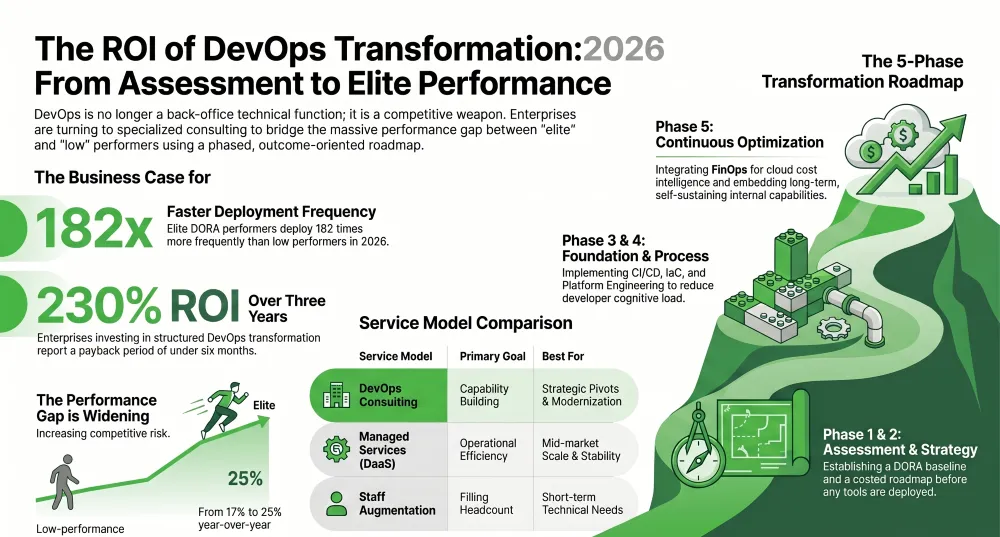
The 5 Core Phases of a DevOps Consulting Engagement
A well-structured DevOps consulting engagement is not a one-size-fits-all service. It is a phased journey that begins with understanding and ends with self-sustaining capability. Here is how that journey looks when done right.
Phase 1: DevOps Assessment — Understanding Where You Are
Every effective DevOps transformation starts with an honest look at where an organization currently stands. The DevOps assessment is the foundation of everything that follows.
The first step in the DevOps transformation process is to assess your organization’s current DevOps maturity level. This helps identify the areas where improvements are needed and determines the right approach for the transformation.
A comprehensive DevOps assessment evaluates five domains:
- People and culture. How are development and operations teams structured? Is there genuine collaboration or are there walls between them? How does the organization respond to failure — with blame or with learning?
- Processes and workflows. How does code flow from idea to production? What are the bottlenecks in the delivery pipeline? How are incidents managed? How are changes reviewed and approved?
- Tools and technology. What does the current toolchain look like? Is there duplication? Are tools integrated or siloed? Is the infrastructure cloud-ready or legacy-constrained?
- Security posture. Where does security enter the development lifecycle? Is there automated vulnerability scanning? Are compliance requirements baked into pipelines or bolted on at the end?
- DORA performance baseline. What are the current deployment frequency, lead time, change failure rate, and MTTR numbers? These establish the quantitative benchmark that all future progress will be measured against.
The output of a DevOps assessment is not a list of problems — it is a prioritized roadmap with clear recommendations, quick wins, and a phased transformation plan that aligns with the organization’s business goals.
At Full-Stack Techies, our DevOps assessment engagements typically take two to three weeks and combine stakeholder interviews, pipeline audits, architecture reviews, and toolchain analysis into a single, actionable deliverable. We do not deliver a generic report — we deliver a specific, costed roadmap that executives can act on.
Phase 2: Strategy and Roadmap Design
Once the assessment is complete, the next phase is translating findings into a strategic plan. Before embarking on a DevOps transformation journey, it’s crucial to define your DevOps mission statement, vision, and goals — ensuring that you and your stakeholders are on the same page about the direction of travel.
The DevOps transformation roadmap must answer three questions:
What are we trying to achieve? Not in technical terms, but in business terms. Faster time to market, greater system reliability, reduced operational cost, improved developer experience, or regulatory compliance — the goals must be concrete and measurable.
What is the sequence of change? Not all improvements can happen simultaneously. The roadmap should identify quick wins (usually in CI/CD automation or environment management), medium-term structural changes (team restructuring, IaC adoption), and long-term cultural shifts (psychological safety, learning culture, blameless postmortems).
How will we measure success? Every milestone in the roadmap should have associated DORA metrics, business KPIs, or team satisfaction indicators that tell you whether the transformation is working.
A strong roadmap is also realistic about organizational capacity. Transformation fatigue is real. Attempting to change too much too fast creates resistance that can derail even technically sound initiatives.
Phase 3: Implementation — Building the DevOps Foundation
This is where strategy becomes reality. Implementation is the most technically intensive phase of the DevOps consulting engagement, and it encompasses several parallel workstreams.
CI/CD Pipeline Build-Out. Continuous Integration and Continuous Delivery are the technical backbone of DevOps modernization. Consultants establish standardized pipelines that automate build, test, security scan, and deployment stages. Tools like GitHub Actions, GitLab CI/CD, Jenkins, and Azure DevOps are configured and integrated into the organization’s broader toolchain. The goal is to make deploying software as safe and repeatable as possible — so that deployment becomes a non-event rather than a high-risk ceremony.
Infrastructure as Code (IaC). Manual infrastructure provisioning is one of the biggest sources of inconsistency, delay, and security risk in traditional IT environments. DevOps consulting services establish IaC practices using tools like Terraform, Pulumi, or AWS CloudFormation — enabling infrastructure to be versioned, reviewed, and deployed with the same rigor as application code.
Cloud-Native Transformation. According to Gartner, over 85% of organizations are adopting a cloud computing strategy, and 95% of new digital workloads will take place on cloud platforms. Cloud-native transformation — including containerization (Docker, Kubernetes), microservices architecture, and serverless computing — is a central pillar of modern DevOps modernization. Full-Stack Techies specializes in guiding organizations through this journey, from lift-and-shift cloud migration to fully cloud-native architectures, with a particular focus on Kubernetes orchestration, service mesh implementation, and cloud cost optimization.
DevSecOps Integration. Security is no longer a phase at the end of the development cycle. DevSecOps embeds security controls, automated scanning, and compliance checks directly into CI/CD pipelines. Consulting firms specialize in shifting security left — building security into the earliest stages of development, including GDPR and SOC 2 compliance directly into the code, and implementing Zero Trust architectures with automated vulnerability scanning running 24/7.
Observability and Monitoring. In 2026, observability has moved to the next level with observability 2.0 — powered by AI and ML, DevOps engineers can now analyze massive streams of data, surface hidden patterns, and predict potential failures, with intelligent tools integrating directly into CI/CD pipelines to provide actionable insights on system health and performance. Implementation of tools like Prometheus, Grafana, Datadog, or the ELK Stack gives teams the visibility they need to maintain reliability and catch issues before they become outages.
Phase 4: Process Improvement and Organizational Change
Technical implementation without organizational change is one of the most common reasons DevOps transformation efforts fail. This phase focuses on the people and process dimensions that determine whether new technical capabilities are actually adopted and sustained.
Team Structure and Operating Model. The old way of running DevOps — separate teams for development, operations, and security — simply can’t keep up with today’s delivery pace. Handovers slow things down, miscommunication multiplies risk, and by the time an issue reaches the right person, the sprint is already behind schedule. Enterprise DevOps consulting helps organizations design new operating models — whether that means full-stack product teams, platform engineering teams, or site reliability engineering (SRE) functions — that are structured for modern delivery velocity. Gartner predicts that by 2026, 80% of software development companies will adopt internal development platforms (IDPs) to unify tools, automate governance, and accelerate delivery.
Platform Engineering. Platform engineering will be one of the key DevOps trends in 2026 and beyond, as organizations increasingly build Internal Developer Platforms (IDPs) to streamline delivery pipelines. A well-designed IDP reduces the cognitive load on individual teams, standardizes golden paths for common development tasks, and enables self-service provisioning of environments, tools, and pipelines.
Delivery Optimization and Process Improvement. Process improvement in a DevOps context means systematically identifying and eliminating waste from the software delivery value stream. This includes reducing approval bottlenecks, eliminating redundant testing gates, streamlining incident response workflows, and establishing feedback loops that continuously improve pipeline performance. Value stream mapping is a common tool in this phase — helping teams visualize exactly where time is being lost and where automation can deliver the greatest impact.
Cultural Change Management. Culture is where most DevOps transformations succeed or fail. Consultants facilitate workshops, establish blameless postmortem practices, introduce psychological safety frameworks, and coach leadership on how to model the behaviors that DevOps culture requires — experimentation, transparency, and continuous learning. At Full-Stack Techies, we treat cultural transformation as a first-class deliverable, not an afterthought. Our change management practitioners work alongside technical consultants to ensure that new tools and processes are genuinely adopted, not just installed.
Phase 5: Optimization and Continuous Improvement
DevOps transformation is not a project with a defined end date. The final phase of a consulting engagement focuses on embedding the mechanisms for continuous improvement so the organization can keep getting better without ongoing dependence on external consultants.
This phase includes:
- DORA metrics dashboards. Making performance data visible to all levels of the organization, from individual engineers to executive leadership, creates the accountability and shared language that drives ongoing improvement.
- FinOps integration. Around 50% of cloud decision-makers believe they wasted more than a quarter of their cloud spend, with approximately 31% estimating waste exceeds 50%. Delivery optimization through FinOps practices — rightsizing resources, automating idle environment shutdown, and tracking unit cost per transaction — turns cloud spending from a runaway cost center into a managed, transparent line item.
- Developer Experience (DevEx) programs. According to Gartner, organizations that focus on improving Developer Experience are expected to achieve twice the developer retention rate by 2027 compared to those that do not make similar investments. Developer satisfaction is not a soft metric — it is directly correlated with productivity, retention, and the quality of software delivered.
- Knowledge transfer and capability building. The goal of a great consulting engagement is to make itself unnecessary. Full-Stack Techies structures all engagements with a knowledge transfer plan that leaves internal teams fully capable of sustaining and evolving their DevOps practice independently.
DevOps as a Service: An Alternative Model
Not every organization is ready for or wants a full transformation engagement. For some, DevOps as a service (DaaS) is a better-fit model — particularly for startups, scale-ups, and mid-market companies that need DevOps capability without the overhead of building it in-house.
In the DaaS model, a partner like Full-Stack Techies takes ongoing responsibility for DevOps operations — managing CI/CD pipelines, infrastructure automation, monitoring, and cloud cost optimization — as a managed service. This gives organizations access to elite DevOps engineering capability at a fraction of the cost of hiring and retaining a full internal team.
DaaS is also a common entry point for organizations that want to experience the benefits of DevOps modernization before committing to a full internal transformation. The skills and processes developed through a DaaS engagement naturally transfer to internal teams over time.
Get scalable, fast, and user-friendly DevOps Solutions tailored to your needs.
Get Free ConsultationEnterprise DevOps Consulting: What’s Different at Scale
Enterprise DevOps consulting operates at a different level of complexity than consulting for smaller organizations. The challenges are not just technical — they are organizational, political, and regulatory.
Large enterprises typically face:
- Legacy architecture and technical debt. Monolithic applications, on-premise infrastructure, and outdated toolchains require careful migration strategies that minimize risk to production systems.
- Regulatory and compliance requirements. Industries like financial services, healthcare, and government have strict compliance frameworks (SOC 2, HIPAA, FedRAMP, PCI-DSS) that must be built into the DevOps architecture from the start.
- Multi-team coordination. With hundreds or thousands of engineers across multiple business units, establishing consistent standards, shared platforms, and governance frameworks is a major undertaking.
- Toolchain sprawl. Organizations are using an average of 10.3 toolchains, and 24.7% of teams are consolidating DevOps tools into a single platform to simplify operations and reduce complexity. Enterprise consulting engagements often include significant toolchain rationalization work.
- Change management at scale. Cultural transformation is harder when the organization is larger. Enterprise engagements require structured change management programs, executive sponsorship strategies, and community of practice frameworks.
Full-Stack Techies has deep experience delivering enterprise DevOps consulting across financial services, healthcare, retail, and technology sectors. Our enterprise engagements are structured around program-level governance, executive stakeholder management, and delivery architectures designed for scale.
Choosing the Right DevOps Consulting Partner: 8 Criteria That Matter
Selecting a DevOps consulting services provider is a high-stakes decision. The wrong partner can waste months and millions of dollars. Here are the criteria that separate great consulting partners from mediocre ones.
1. Technical breadth and depth. Does the partner have proven expertise across the full DevOps stack — CI/CD, IaC, cloud platforms, containers, security, observability? Ask for specific case studies and technical references.
2. Business-outcome orientation. Great consultants speak in business metrics, not just technical ones. They should be able to articulate how their work will impact deployment frequency, MTTR, developer productivity, and business revenue.
3. Assessment-first approach. Be wary of any partner who wants to start building before they have finished understanding. A rigorous DevOps assessment at the start of every engagement is non-negotiable.
4. Change management capability. Technical skills are necessary but not sufficient. Your partner should have practitioners who specialize in organizational change, training, and adoption — not just engineers who build pipelines.
5. Multi-cloud and cloud-native expertise. In 2026, most enterprises operate across AWS, Azure, and GCP simultaneously. Your partner needs native expertise on all major platforms, not just one.
6. Security-first mindset. DevSecOps integration should be a standard component of every engagement, not an optional add-on. Ask specifically how security is embedded in the pipelines and architecture they design.
7. Transparent metrics and reporting. Success of a DevOps transformation must be measured not only by operational improvements but also by how these translate into tangible business outcomes — aligning DevOps KPIs with business performance indicators such as increased market share, revenue growth, or faster product delivery cycles. Your partner should commit to measuring and reporting against agreed KPIs.
8. Knowledge transfer commitment. The goal is your team’s independence, not indefinite consulting dependency. Choose a partner with a formal knowledge transfer plan built into every engagement.
Read About the Right Partner in Depth: How to Choose the Right DevOps Consulting Services Providers in 2026
Reach Out to Us below!
Get Free ConsultationWhat Does a DevOps Transformation Actually Look Like? A Real-World Framework
Abstract descriptions of DevOps transformation can make the journey seem impossibly complex. Breaking it down into concrete, sequential deliverables makes it manageable.
Month 1–2: Assessment and Strategy
- Stakeholder interviews and team surveys
- Pipeline and toolchain audit
- DORA baseline measurement
- Architecture and security review
- Transformation roadmap and business case
Month 2–4: Foundation Building
- CI/CD pipeline standardization
- Source control governance (branching strategies, code review processes)
- Infrastructure as Code implementation for key environments
- Automated testing frameworks established
- Container platform setup (Kubernetes, Docker)
Month 4–8: Cloud-Native Transformation
- Cloud migration or modernization of key workloads
- Microservices decomposition (where appropriate)
- Service mesh implementation
- Observability platform deployment
- DevSecOps pipeline integration
Month 6–12: Organizational Transformation
- Platform engineering team formation or IDP build-out
- Value stream mapping and process improvement workshops
- Blameless postmortem practices established
- Developer experience program launched
- Governance frameworks and standards documented
Month 10–12+: Optimization and Handover
- FinOps implementation and cloud cost dashboards
- DORA metrics dashboards live for all levels
- Capability transfer to internal teams
- Long-term improvement backlog established
- Ongoing advisory retainer (optional)
The specific timeline varies by organization size, complexity, and scope. Full-Stack Techies uses this phased framework as a starting point and customizes it to each client’s context — because no two transformations are identical.
The 2026 DevOps Landscape: Trends Every Organization Must Understand
A guide to DevOps consulting would be incomplete without addressing the forces reshaping the landscape in 2026 and beyond. These trends are not hypothetical — they are actively influencing how leading organizations structure their DevOps engagements today.
AIOps: The Rise of Intelligent Operations
According to Gartner’s AIOps Market Guide 2025, 73% of enterprises are already implementing or planning to adopt AIOps by the end of 2026 — a clear sign that predictive, self-healing operations are moving from experimentation to enterprise standard. A recent ResearchGate study showed that AI models can predict failures with over 90% accuracy and autonomously resolve up to 80% of incidents.
AIOps integrates machine learning into monitoring, alerting, and incident response workflows. For organizations undergoing DevOps transformation, AIOps represents a significant multiplier on operational efficiency — but only when the underlying delivery foundation is already working well.
Platform Engineering as the New DevOps Standard
In 2026, the organizations thriving in DevOps are treating their platform as a living product, built to evolve, scale, and serve every engineer who touches it. Internal Developer Platforms have moved from a leading-edge practice to a mainstream expectation for large engineering organizations.
Enterprise DevOps consulting engagements increasingly include IDP design and build as a core deliverable — because standardized golden paths and self-service infrastructure are the most effective ways to scale DevOps practices across large, distributed engineering teams.
The AI Productivity Paradox
DORA’s research across 2025 confirmed the amplifier effects of adopting AI throughout the software lifecycle, finding that AI improves throughput but often at the cost of stability if the foundational delivery system is not already solid.
This is a critical insight for organizations considering AI coding tools in 2026: AI amplifies whatever is already there — good practices become better, but weak foundations become more fragile. DevOps consulting is increasingly being sought as a prerequisite to AI tool adoption, not a parallel activity.
DevSecOps as a Regulatory Imperative
The regulatory environment — particularly the EU Cyber Resilience Act, US Executive Order 14028 on software supply chain security, and sector-specific digital compliance mandates in BFSI and healthcare — will drive significant DevSecOps platform investment through 2028.
Security is no longer a best practice — it is a compliance requirement with legal consequences. Organizations that have not embedded security into their delivery pipelines are accumulating regulatory risk that is increasingly difficult to quantify or manage.
FinOps and Cloud Cost Intelligence
Cloud bills are eating into innovation budgets, with teams overextended and costs creating barriers to new investment. Delivery optimization in 2026 includes a strong FinOps dimension — real-time cost visibility, automated rightsizing, and unit economics tracking that connects infrastructure spend to business value delivered.
Full-Stack Techies integrates FinOps practices into all cloud-native engagements, giving organizations the transparency to make intelligent tradeoffs between performance, reliability, and cost.
Common DevOps Consulting Mistakes and How to Avoid Them
Understanding what can go wrong is as important as understanding what to do right. These are the most frequent failure modes in DevOps transformation engagements.
Mistake 1: Starting with tools instead of assessment. Deploying Kubernetes or adopting a new CI/CD platform without understanding the organizational context is a recipe for expensive technical debt. The DevOps assessment is not an optional step — it is the foundation of everything else.
Mistake 2: Underestimating the cultural dimension. Technical implementations that ignore culture fail more often than they succeed. Continued development of capabilities is needed to realize maximum value from DevOps — and heads of Infrastructure and Operations need to address organizational skills and culture challenges, not just simplify DevOps tools and technologies.
Mistake 3: Measuring activity instead of outcomes. Tracking the number of pipelines built or tools deployed is not the same as measuring DevOps transformation success. DORA metrics and business KPIs are the right measurement framework.
Mistake 4: Trying to transform everything at once. Prioritization is a discipline. Attempting to change team structures, toolchains, architecture, and culture simultaneously creates confusion and exhaustion. Phased roadmaps with clear milestones are essential.
Mistake 5: Neglecting developer experience. 60% of DevOps practitioners report better system reliability, 59% report higher productivity and efficiency, and 57% report improved workflow standards as key benefits of DevOps. These benefits are only realized when developers genuinely embrace the new ways of working — which requires that those ways of working actually make their jobs better, not harder.
Mistake 6: No knowledge transfer plan. A consulting engagement that ends with the organization as dependent on external support as it was at the start has failed, regardless of what was built. Knowledge transfer must be a designed component of every engagement, not an afterthought.
How Full-Stack Techies Deliver DevOps Transformation
Full-Stack Techies is a technology consulting firm specializing in DevOps consulting services, cloud-native transformation, and enterprise DevOps consulting for organizations across industries. Our approach is grounded in three principles: assess before you build, measure outcomes not outputs, and leave your team stronger than we found it.
Our DevOps consulting practice covers the full transformation lifecycle:
- DevOps Assessment and Strategy. We conduct comprehensive maturity assessments that establish your DORA baseline, identify organizational and technical gaps, and produce a prioritized transformation roadmap with a clear business case.
- CI/CD and Pipeline Engineering. We design, build, and optimize CI/CD pipelines across GitHub Actions, GitLab CI/CD, Jenkins, Azure DevOps, and other platforms — with a focus on speed, reliability, and developer experience.
- Cloud-Native Transformation. From containerization and Kubernetes orchestration to microservices architecture and serverless implementation, we guide organizations through every stage of cloud-native transformation on AWS, Azure, and Google Cloud.
- DevSecOps Implementation. We embed security into every layer of the delivery pipeline — automated vulnerability scanning, secrets management, compliance-as-code, and Zero Trust architecture — so security becomes a continuous capability rather than a periodic audit.
- Platform Engineering. We design and build Internal Developer Platforms that give engineering teams self-service access to standardized environments, pipelines, and tooling — dramatically reducing cognitive load and accelerating delivery.
- DevOps as a Service. For organizations that want elite DevOps capability without building a large internal team, our DevOps as a service offering provides ongoing pipeline management, infrastructure automation, observability, and cloud optimization as a managed service.
- FinOps and Delivery Optimization. We implement real-time cloud cost visibility, rightsizing automation, and FinOps governance frameworks that turn cloud spending into a strategic lever rather than a runaway expense.
If you are evaluating your first DevOps consulting engagement or looking to accelerate a transformation already underway, Full-Stack Techies offers a no-obligation initial assessment conversation. We will tell you honestly what we see, what we recommend, and what realistic outcomes look like for your organization.
Key DevOps Metrics Every Organization Should Track in 2026
Measurement is the backbone of any successful DevOps transformation. These are the metrics your organization should be tracking — and what they mean for your business.
Deployment Frequency. How often does your team successfully release to production? Elite performers deploy multiple times per day. Low performers deploy once per month or less. Higher deployment frequency means faster delivery of value and faster validation of business assumptions.
Lead Time for Changes. How long does it take for a code commit to reach production? Shorter lead times indicate a healthy, automated pipeline with minimal manual gates or approval bottlenecks.
Change Failure Rate. What percentage of deployments cause a production incident? Elite teams maintain rates below 5%. High failure rates indicate insufficient automated testing or inadequate staging environments.
Mean Time to Recovery (MTTR). How quickly does your team recover from a production incident? In 2026, DORA metrics are seen as operational resilience benchmarks that directly affect customer trust and brand reputation. Elite performers restore service in under an hour; low performers take days.
Reliability (the fifth DORA metric). DORA’s evolving framework now includes reliability as a fifth metric, recognizing that availability and performance are as important as delivery speed.
Developer Experience Index (DevEx). Team satisfaction, perceived productivity, and developer retention — increasingly recognized as leading indicators of technical performance, not just lagging outcomes.
Cloud Cost Efficiency. Cost per active user, infrastructure utilization rates, and cloud waste percentage — connecting technical operations to financial accountability.
Security Vulnerability Lead Time. How quickly are identified vulnerabilities patched and deployed? In a DevSecOps environment, this should be days, not weeks or months.
Conclusion: The Transformation Starts With an Honest Assessment
The distance between where most organizations are and where they need to be on DevOps transformation is significant. But it is navigable — with the right partner, the right sequence, and the right measurement framework.
2026 marks the shift from more automation to measurable outcomes. Instead of chasing deployment speed, forward-thinking leaders are asking tougher questions: What is the business impact of every sprint? How do we measure value, not just velocity?
That is the right question. And a structured DevOps consulting engagement is how you get the right answer — specific to your architecture, your team, your competitive context, and your business goals.
Full-Stack Techies brings the experience, the methodology, and the business-outcome orientation that DevOps transformation demands. Whether you are at the beginning of the journey or working to accelerate one already underway, we are ready to help you close the gap between where you are and where your business needs you to be.
The first step is an honest conversation. And for us, that conversation always starts with an assessment — because transformation built on assumptions is transformation built on sand.
Ready to begin your DevOps transformation? Contact Full-Stack Techies today to schedule your DevOps assessment and discover exactly what your organization needs to accelerate software delivery, improve reliability, and build the engineering capability your business depends on.
Also Read: 10 Reasons You Need DevOps Automation Consulting in 2026 (Ranked & Reviewed)
Also Read: 10 Leading DevOps as a Service Providers for Startups & SMBs in 2026 (Ranked)
Frequently Asked Questions About DevOps Consulting
Q1. What is the difference between DevOps consulting and managed DevOps services?
DevOps consulting is advisory and outcome-focused u2014 consultants help you build internal capability. DevOps as a service (managed DevOps) is operational u2014 the provider runs your DevOps function on an ongoing basis. Many organizations begin with consulting and transition to a blended model.
Q2. How long does a DevOps transformation take?
Timeline varies significantly by organization size and complexity. Focused engagements for mid-market companies can show meaningful DORA metric improvement in three to six months. Full enterprise DevOps consulting transformations typically run 12 to 24 months, with phased milestones along the way.
Q3. What is the ROI of DevOps consulting?
The business value translates into dollar amounts across multiple dimensions u2014 from reduced downtime and avoided revenue loss to faster feature delivery that accelerates revenue recognition and market share capture. Organizations that commit to transformation consistently see DORA metric improvements within the first two to three months, with business ROI becoming measurable within six months.
Q4. How do we know if we are ready for DevOps consulting?
If your organization is experiencing any of the following, you are likely ready: long release cycles, frequent production incidents, high developer turnover, inability to respond quickly to market changes, or growing cloud costs without corresponding business value. A DevOps assessment will tell you exactly where you stand.
Q5. Can small and mid-sized companies benefit from DevOps consulting?
Absolutely. In fact, smaller organizations often see ROI faster than large enterprises because they have less bureaucracy and fewer legacy constraints. DevOps as a service models are particularly well-suited for SMBs that want elite DevOps capability without the overhead of building a large internal team.
Q6. What industries benefit most from enterprise DevOps consulting?
Any industry that relies on software to deliver value u2014 which in 2026 is essentially every industry. DevOps consulting services deliver particularly strong ROI in financial services, healthcare, retail and e-commerce, telecommunications, and government technology.
Q7. What is the difference between a DevOps maturity assessment and a DevOps readiness assessment?
A DevOps maturity assessment evaluates how advanced your existing DevOps practices are u2014 measuring current performance across CI/CD, automation, culture, and DORA metrics to identify where you are on the maturity curve. A DevOps readiness assessment evaluates whether your organization is prepared to begin a DevOps transformation at all u2014 examining team structure, toolchain state, leadership buy-in, and cultural readiness. Maturity assessments are for organizations already practicing DevOps who want to level up. Readiness assessments are the right starting point for organizations early in their DevOps transformation journey.
Q8. How does DevOps consulting support regulatory compliance in industries like healthcare or finance?
DevOps consulting embeds compliance directly into the delivery pipeline through DevSecOps practices u2014 automating security scans, enforcing policy-as-code, generating Software Bill of Materials (SBOM), and maintaining audit trails at every stage of the CI/CD process. For regulated industries, this means frameworks like HIPAA, SOC 2, PCI-DSS, and FedRAMP are built into the architecture from day one rather than retrofitted after deployment. This approach is significantly less expensive and more reliable than manual compliance auditing and reduces the risk of costly regulatory penalties.
Q9. Can DevOps consulting help if we already have DevOps tools in place but delivery is still slow?
Yes u2014 and this is one of the most common scenarios DevOps consulting services address. Having tools in place does not mean having a functioning DevOps practice. In real-world systems, DevOps failures rarely stem from dramatic u201cautomation gone wrongu201d scenarios u2014 they come from structural gaps like toolchain fragmentation, where teams adopt different CI/CD platforms and monitoring solutions, and years later the organization has multiple different ways to deploy code with no one able to answer basic questions about overall system health. A proper DevOps assessment will diagnose whether the bottleneck is in the toolchain, the team structure, the process, or the culture u2014 and the consulting roadmap will target the actual root cause, not just the surface symptoms.
Q10. What is the first thing a DevOps consultant should do when engaged by a new client?
The very first step is always a structured DevOps assessment u2014 not tool selection, not pipeline building, and not team restructuring. A consultant must understand the organizationu2019s current DORA metric baseline, existing toolchain and architecture, team structure, delivery bottlenecks, cultural dynamics, and business goals before recommending anything. DevOps transformations succeed when communication is open and iterative, and the right consulting approach starts with understanding business and engineering maturity before recommending tools or architectures. Any partner who wants to start building before they finish understanding is a partner worth reconsidering



