

How to Build High-Performing Agile React.js Teams for Business Innovation in 2026
Organizations that Build High-Performing Agile React.js Teams can accelerate product innovation and deliver scalable digital experiences. This guide explains how to structure agile React teams, implement efficient workflows etc.


Introduction: Why Agile React.js Teams Are the Cornerstone of Modern Innovation
The digital economy moves at a pace where yesterday’s competitive advantages dissolve overnight. For business leaders, technology executives, and product managers, the ability to build high-performing agile React.js teams is no longer a technical consideration — it is a core business strategy. Companies that master this capability ship better products faster, respond to market feedback in real time, and consistently outpace competitors still relying on bloated, slow-moving development cycles.
React.js has firmly cemented its position as the world’s most dominant frontend framework. According to the Stack Overflow Developer Survey 2025, React.js commands a 44.7% adoption rate among professional developers globally — a lead it has held for multiple consecutive years. More than 11 million websites worldwide run on React, including Netflix, Airbnb, Meta, Walmart, and Canva. React’s component-based architecture has been shown to produce development cycles up to 60% faster compared to monolithic alternatives, a dramatic efficiency advantage that directly translates into faster time-to-market and lower product costs.
Industry Insight — Gartner, 2024
“Modern software engineering organizations rely on their agile and DevOps capabilities to continuously deliver valuable software. Core to these capabilities are the ideas of continuous improvement, learning, and innovation.” — Gartner Hype Cycle for Agile and DevOps, 2024
At the same time, Gartner’s top strategic technology trends for software engineering in 2025 reveal that meeting business objectives is now a top-three performance priority for 65% of software engineering leaders. The message is clear: development teams are no longer back-office cost centers — they are frontline innovation engines.
This comprehensive how-to guide walks you through every critical element of building, structuring, hiring, and scaling a high-performing agile React.js team designed to drive real, measurable business innovation. Whether you are building an in-house squad, looking to hire React.js developers externally, or evaluating a React.js development company for outsourcing, this guide provides the framework you need.
Key Takeaways
Whether you’re an engineering leader, CTO, or business decision-maker, building high-performing agile React.js teams is one of the highest-leverage investments you can make in 2025. Here are the most important lessons from this guide distilled into actionable takeaways:
1. React.js Is the Dominant Frontend Framework — and the Gap Is Widening
With 44.7% global developer adoption and over 11 million production websites, React.js is not a trend — it’s the industry standard for modern frontend development. Choosing React as your foundation gives your team access to the widest talent pool, the richest ecosystem of libraries, and the most active open-source community in the frontend world. Businesses that build their product squads around React.js gain immediate access to this collective advantage.
2. Team Structure Is a Strategic Decision, Not an Org Chart Exercise
Small, cross-functional squads of 5–8 people outperform large, layer-based teams in agility, decision speed, and innovation output. The squad model — embedding designers, QA, DevOps, and product ownership alongside React developers — removes the handoff friction that kills delivery velocity. Structure your teams around business outcomes and product domains, not technology layers.
3. Hiring for Agile Mindset Is as Important as Hiring for Technical Skill
When you hire React.js developers, technical skills are the baseline — not the differentiator. The developers who elevate a team are those who communicate proactively in stand-ups, accept feedback in sprint reviews without defensiveness, take ownership of end-to-end outcomes, and embrace iterative delivery. Screen for behavioral agility as rigorously as you screen for React Hooks and TypeScript proficiency.
4. Agile Ceremonies Only Work When They Are Genuinely Practiced, Not Just Scheduled
Sprint planning, daily stand-ups, sprint reviews, and retrospectives are only as valuable as the discipline and honesty your team brings to them. Retrospectives that produce no action items are theater. Stand-ups that become status reports to management are a waste of time. Invest in a skilled Scrum Master or Agile Coach to facilitate ceremonies with genuine purpose — the ROI compounds directly into delivery velocity.
5. Your Toolchain Should Be Lean, Purposeful, and Non-Negotiable
The React.js ecosystem is vast, but elite teams do not chase every new library on npm. Standardize on a lean, battle-tested stack — Next.js or Vite, TypeScript, React Query, Jest, Storybook, and a solid CI/CD pipeline — and enforce it as a team standard. Consistency of tooling reduces cognitive load, accelerates onboarding, and dramatically improves code quality over time. Every new tool added to the stack is a maintenance burden; justify it rigorously.
6. Outsourcing to the Right React.js Development Company Is a Strategic Accelerator
The IT outsourcing market is approaching $618 billion globally in 2025 — and the most sophisticated organizations are not outsourcing to cut costs. They are outsourcing to access elite talent faster, reduce hiring risk, and maintain strategic flexibility. When evaluating a React.js development company, prioritize full-stack capability, agile process maturity, and transparent communication over the lowest hourly rate. Partners like Full-Stack Techies who embed seamlessly into your team’s agile ceremonies deliver exponentially more value than vendors who simply ship tickets.
7. Measure in DORA Metrics, Report in Business Outcomes
Deployment frequency, lead time for changes, change failure rate, and mean time to restore are the internal compass of engineering health. But the language that resonates with business stakeholders is conversion rates, Core Web Vitals scores, feature adoption, and revenue impact. High-performing teams fluently translate between both — they optimize with engineering metrics and communicate with business metrics. Closing this translation gap between technology and business is one of the most powerful things an engineering leader can do.
8. The React.js Ecosystem Is Evolving Fast — Continuous Learning Is Not Optional
React Server Components, concurrent rendering, AI-augmented development, TypeScript-first architecture, and micro-frontends are not future considerations — they are present-day differentiators. Gartner predicts that by 2028, 90% of enterprise software engineers will use AI code assistants. Teams that begin integrating these capabilities now will have compounding advantages over those that delay. Build dedicated time for learning into every sprint cycle and make continuous skill development a non-negotiable team standard.
9. Culture and Psychological Safety Are Performance Infrastructure
The research is unambiguous: psychological safety — the shared belief that the team is safe to take interpersonal risks — is the single strongest predictor of team performance (Google’s Project Aristotle, 2016; replicated consistently since). Developers who feel safe raising concerns, proposing unconventional solutions, and admitting mistakes without fear of blame innovate faster and sustain higher performance over the long term. Culture is not a soft nice-to-have. It is performance infrastructure.
10. Scaling Is a Structural Problem, Not a Headcount Problem
Adding more developers to a struggling team does not fix the underlying structural and process issues — it amplifies them. When your React.js product grows, scale by adding new squads with clear domain ownership, not by growing existing teams past their optimal size. Invest in shared component libraries and internal developer platforms to give all squads a quality and velocity baseline to build from. Strategic use of the best React.js development services for surge capacity gives you elasticity without the fragility of permanent over-hiring.
Also Read: C-Suite Checklist for React.js Implementation for AI Digital Transformation
Who Is This Guide For?
- CTOs & VPs of Engineering: Looking to modernize their department’s output and adopt 2026 performance metrics.
- Product Managers: Who need to understand how technical agility in React translates to faster feature releases.
- Talent Acquisition Leads: Tasked to hire React.js developers who possess both high-order coding skills and business acumen.
- Enterprise Innovation Labs: Seeking the best React.js development services to augment their internal capabilities.
Tools & Prerequisites
Before you start recruiting or restructuring, ensure your infrastructure is 2026-ready.
| Category | Recommended Tooling (2026 Standard) | Status |
|---|---|---|
| Framework | React 19/20 with Server Components & React Compiler | [ ] |
| AI Assistants | Cursor, Windsurf, or GitHub Copilot (Agentic mode) | [ ] |
| Agile Management | Monday.com Dev or Jira (with AI-powered auto-sprint planning) | [ ] |
| State Management | Zustand (for speed) or Redux Toolkit (for large-scale state) | [ ] |
| Deployment | Vercel or AWS Amplify with Edge Functions | [ ] |
| Monitoring | Sentry with AI-Anomaly Detection | [ ] |
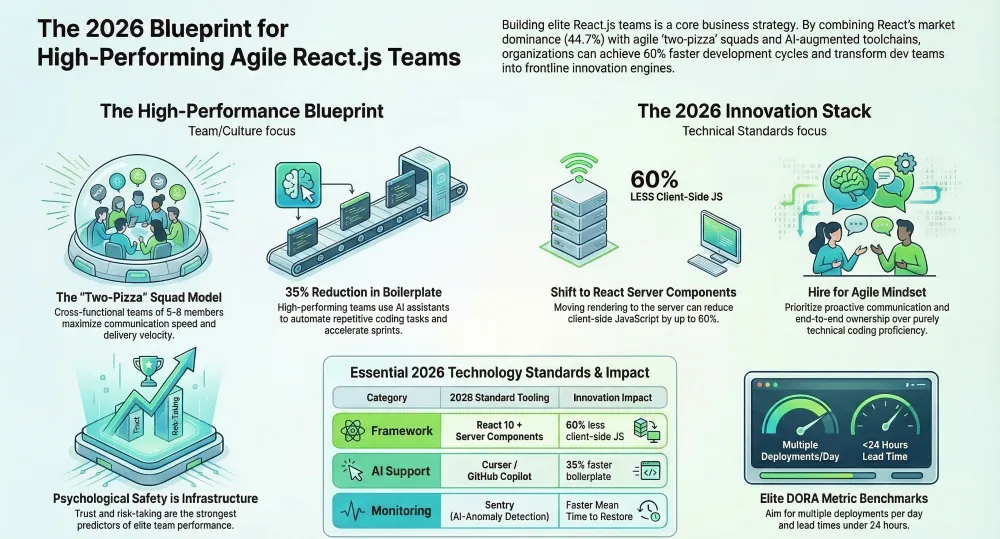
Pro Tip: If your current team is still heavily reliant on Client-Side Rendering (CSR) for everything, your first “innovation” step is a migration to React Server Components (RSC) to reduce client-side JavaScript by up to 60%.
Get scalable, fast, and user-friendly ReactJS solutions tailored to your needs.
Step 1: Define What ‘High-Performing’ Means Before You Build
A common mistake organizations make is rushing into the hiring process without first defining what success looks like for the team they are building. Before you write a single job description or engage a React.js development company, you need to establish performance benchmarks that are both technically meaningful and tied to broader business outcomes.
The Four Pillars of a High-Performing React.js Agile Team
- Velocity with Quality: The team ships production-ready, tested React.js code consistently within sprint cycles without accumulating crippling technical debt. React’s Virtual DOM and component reusability are tools to be leveraged — not ignored.
- Cross-Functional Alignment: Developers, UX designers, product owners, QA engineers, and DevOps professionals collaborate seamlessly. Silos are the enemy of agility.
- Adaptability: The team adjusts to changing requirements, market shifts, and stakeholder pivots without derailing sprint goals. This is the operational definition of agility.
- Business Impact Measurement: Every sprint is tied to KPIs — user acquisition, conversion rate, Core Web Vitals scores, feature adoption, or revenue attribution. Engineering work that cannot be measured cannot be optimized.
Establishing these pillars upfront ensures that every subsequent decision — from team structure to tooling to the best React.js development services you choose to engage — is oriented toward outcomes, not just activity.
Step 2: Design the Right Team Structure for Agile React.js Development
Team structure is strategy made tangible. The way you organize your React.js development team determines how fast decisions get made, how cleanly work flows through the pipeline, and how effectively your team can innovate under pressure.
The Recommended Agile React.js Team Composition
For most product-focused businesses, a cross-functional squad model works best. A balanced React.js agile team typically includes the following roles:
- React.js Frontend Developers (2-4): Senior and mid-level engineers proficient in React Hooks, TypeScript, state management (Redux, Zustand, or Jotai), and performance optimization.
- Full-Stack Developer (1-2): Engineers who can bridge frontend and backend concerns, accelerating feature delivery and reducing handoff friction. This is where partners like Full-Stack Techies add significant value — their developers are trained to operate fluidly across the entire stack, making them especially effective in agile environments where context switching and cross-layer problem-solving are daily realities.
- UX/UI Designer (1): Embedded in the sprint cycle, not consulted as an afterthought. Design-development alignment is a primary driver of product quality.
- QA Engineer / SDET (1): Responsible for automated testing, integration testing, and quality gates within the CI/CD pipeline. React Testing Library and Jest proficiency are non-negotiable.
- Product Owner / Business Analyst (1): The bridge between business stakeholders and the development team. Manages the backlog, defines acceptance criteria, and ensures sprint goals align with business priorities.
- Scrum Master or Agile Coach (shared or dedicated): Facilitates ceremonies, removes blockers, and continuously improves team processes.
Pro Tip: The Two-Pizza Rule
Amazon’s famous ‘two-pizza team’ rule applies perfectly to agile React.js squads. Teams small enough to be fed by two pizzas (roughly 5-8 people) communicate faster, decide faster, and ship faster. As your product scales, add squads — not headcount to existing teams.
Step 3: Hire React.js Developers Who Are Built for Agility
Hiring is where strategy meets execution. The demand to hire React.js developers has surged dramatically in recent years — by 2024, global React developer job postings exceeded 250,000 positions, with salaries for senior React engineers averaging $184,000+ annually in the United States. This is a competitive market, and hiring the wrong person is expensive. A bad hire in a senior developer role can cost an organization anywhere from 30% to 150% of that individual’s annual salary when you factor in lost productivity, onboarding costs, and the impact on team morale.
What to Look for When You Hire React.js Developers
Technical competency is table stakes. What distinguishes truly agile-ready React.js developers is a combination of technical depth and the right behavioral profile:
- Core React Mastery: Deep proficiency in React 18+/19, including Hooks (useState, useEffect, useContext, custom Hooks), React Server Components, Concurrent Rendering, and Suspense.
- TypeScript Proficiency: TypeScript adoption among React developers has surged, with over 35% using it in production environments (State of Developer Ecosystem, 2024). Type safety at scale is not optional for enterprise applications.
- State Management Expertise: Familiarity with Redux Toolkit, Zustand, Jotai, or React Query, depending on the application’s data complexity.
- Testing Culture: Developers who write tests as part of their workflow — not as an afterthought. Experience with Jest, React Testing Library, Cypress, or Playwright.
- Agile Behavioral Traits: Comfort with iterative delivery, ability to take constructive feedback in sprint reviews, proactive communication during stand-ups, and willingness to refactor and improve existing code.
- Performance Optimization Mindset: Understanding of Core Web Vitals, lazy loading, memoization, code splitting, and bundle optimization — because React’s power is only realized when used correctly.
Where to Find and Hire React.js Developers
Depending on your budget, timeline, and geographic constraints, you have multiple pathways to hire React.js developers:
- Direct Hiring (In-House): Use platforms like LinkedIn, GitHub Jobs, and Stack Overflow Jobs. This approach gives you maximum team cohesion but requires the longest lead time and highest overhead cost.
- Freelance Marketplaces: Toptal, Upwork, and Arc.dev for vetted React.js freelancers. Best for short-term projects or specific skill gaps.
- Staff Augmentation via a React.js Development Company: Engaging a specialized React.js development company like Full-Stack Techies allows you to rapidly onboard pre-vetted, agile-ready React developers who are immediately productive. This model is particularly effective when you need to scale quickly without the overhead of full employment cycles.
- Offshore / Nearshore Development Teams: The global IT outsourcing market is projected to reach $618 billion in 2025. Companies increasingly turn to offshore partners not just for cost savings, but for access to specialized talent pools and round-the-clock development capabilities.
Step 4: Implement a Battle-Tested Agile Framework for React.js Teams
Hiring the right people is only half the equation. Equally important is the process framework that channels that talent into consistent, high-quality delivery. Agile — specifically Scrum for most React.js product teams — provides the operational backbone that enables speed without sacrificing quality.
The Agile Scrum Framework Applied to React.js Development
A well-run Scrum process for a React.js team follows a structured rhythm:
- Sprint Planning (Day 1): The team reviews the prioritized backlog, breaks down user stories into React-specific tasks (component design, API integration, state management, testing), and commits to a sprint goal.
- Daily Stand-Ups (15 minutes, every day): Each developer answers three questions: What did I complete yesterday? What will I work on today? Are there any blockers? For distributed React.js teams, asynchronous stand-up tools like Geekbot or Range can replace synchronous calls effectively.
- Sprint Review / Demo (End of Sprint): The team demonstrates working software — not slides — to stakeholders. This is where React’s component-based output shines: it is easy to isolate and demonstrate individual features in isolation or in the full application context.
- Sprint Retrospective: The team reflects on what went well, what did not, and what specific improvements to make in the next sprint. Retrospectives are the engine of continuous improvement — the core of agile philosophy.
Industry Data — GitLab, 2025
78% of organizations now use or plan to use AI in their development workflows, up from 64% in 2023. High-performing React.js teams are already integrating AI pair programming tools like GitHub Copilot and Cursor into their sprint cycles, reducing boilerplate code time by up to 35%.
Kanban as an Alternative for Maintenance and Ops-Focused React.js Teams
While Scrum works well for new feature development, Kanban is often better suited for React.js teams handling ongoing maintenance, bug triage, and incremental UI improvements. Kanban’s continuous-flow model eliminates the rigidity of fixed sprints, giving teams like these the flexibility to respond to incoming work without sprint planning overhead. Many mature agile React.js teams use a hybrid: Scrum for feature development sprints and Kanban for support and hotfix queues.
Step 5: Build a World-Class React.js Development Toolchain
Exceptional teams are amplified by exceptional tools. The React.js ecosystem is rich — sometimes overwhelmingly so — but elite teams standardize on a lean, purposeful toolchain rather than chasing every new library that appears on npm. Here is the toolchain that consistently supports high-performing agile React.js teams in 2025:
Core Development Tools
- Vite or Next.js: Vite for blazing-fast local development builds on SPA projects; Next.js 14+ (App Router) for SSR/SSG applications and any project leveraging React Server Components.
- TypeScript: Strongly typed React codebases are more maintainable, less error-prone, and easier for new team members to onboard into.
- ESLint + Prettier: Automated code formatting and linting enforced at the pre-commit stage via Husky. Consistent code style eliminates a surprising amount of review friction and cognitive overhead.
- Storybook: An isolated component development environment that dramatically improves collaboration between developers and designers. Every React component is built and tested in Storybook before integration.
State Management
- Redux Toolkit for complex, enterprise-scale state requirements with strict data flow needs.
- Zustand or Jotai for simpler, more lightweight state management needs in mid-size applications.
- React Query (TanStack Query) for server-state management, caching, and data synchronization — now a standard in API-heavy React applications.
Testing Stack
- Jest + React Testing Library for unit and integration testing of React components with a user-behavior-centric philosophy.
- Cypress or Playwright for end-to-end testing, simulating real user journeys across the full application stack.
- MSW (Mock Service Worker) for mocking API responses during development and testing without needing a live backend.
CI/CD and DevOps
- GitHub Actions or GitLab CI for automated build, test, and deployment pipelines triggered on every pull request.
- Vercel or AWS Amplify for seamless React/Next.js deployment with preview environments for every feature branch.
- Sentry for real-time error tracking and performance monitoring in production React applications.
Step 6: Choose the Right React.js Development Partner or Company
For many organizations — especially those scaling rapidly, entering new markets, or running lean internal teams — partnering with the right React.js development company is the most efficient path to building a high-performing agile team. The global IT outsourcing market is projected to reach $618 billion in 2025, and a growing share of that investment is strategic in nature: companies are not just outsourcing to cut costs, they are outsourcing to access world-class talent, accelerate timelines, and de-risk complex technology bets.
What to Evaluate When Choosing a React.js Development Company
- Proven React.js Portfolio: Review their case studies for projects of similar scale and complexity to yours. Look for evidence of React best practices: component architecture, performance optimization, testing coverage.
- Agile Process Maturity: Ask directly about their sprint cadence, retrospective practices, and how they handle scope changes mid-sprint. A company that cannot clearly articulate its agile process is a red flag.
- Full-Stack Capabilities: The best React.js teams do not operate in a frontend vacuum. Companies like Full-Stack Techies stand out in this regard — their developers bring full-stack depth, ensuring that React frontend work is always architected with backend realities in mind. This eliminates the frustrating API mismatches and data contract issues that slow down otherwise talented frontend-only teams.
- Communication and Transparency: For distributed teams, communication quality is everything. Evaluate their response times, preferred tools (Slack, Jira, Notion), reporting cadence, and willingness to participate in your internal sprint ceremonies.
- IP Protection and Security: Ensure contracts clearly define intellectual property ownership, data handling standards, and offboarding procedures.
Why Full-Stack Techies for React.js Agile Teams
Full-Stack Techies specializes in delivering the best React.js development services that combine technical excellence with genuine agile methodology. Their engineers are handpicked for full-stack proficiency, collaborative mindset, and the ability to operate as embedded squad members — not just code deliverers. Whether you need to augment an existing team or build a React.js squad from scratch, Full-Stack Techies provides the flexibility, speed, and quality that modern businesses demand.
Step 7: Measure Performance and Continuously Improve
High-performing teams are defined by their commitment to measurement and continuous improvement. Without metrics, agile retrospectives become anecdotal. With the right metrics, every sprint becomes a data-driven opportunity to optimize. Here are the key performance indicators that elite React.js agile teams track:
Engineering Metrics (DORA Metrics)
The DevOps Research and Assessment (DORA) framework provides four key metrics that are now widely adopted as the gold standard for measuring software delivery performance:
- Deployment Frequency: How often the team deploys code to production. Elite React.js teams deploy multiple times per day.
- Lead Time for Changes: The time from code commit to production deployment. Target: less than one day for elite teams.
- Change Failure Rate: The percentage of deployments that result in a production incident. Elite teams target below 5%.
- Mean Time to Restore (MTTR): How quickly the team recovers from a production incident. Target: less than one hour for elite teams.
Business Outcome Metrics
- Core Web Vitals Scores: Largest Contentful Paint (LCP), First Input Delay (FID), and Cumulative Layout Shift (CLS) scores for React application pages. These directly impact SEO rankings and user experience.
- Feature Adoption Rate: What percentage of users actively use features shipped in recent sprints? Low adoption signals misalignment between development output and user needs.
- Sprint Velocity and Predictability: Consistent sprint velocity over time indicates a healthy, sustainable team pace. Erratic velocity is often a symptom of technical debt, poor estimation, or scope creep.
- Test Coverage: Maintain above 80% unit test coverage and robust integration test suites as a baseline quality gate.
Step 8: Embrace React.js 2025 Trends to Stay Ahead of the Curve
Building a high-performing agile React.js team is not a one-time initiative — it is a continuous investment in staying current with a rapidly evolving ecosystem. Teams that fall behind the React innovation curve accumulate both technical debt and strategic debt. Here are the critical trends your team needs to be actively engaging with in 2025 and beyond:
React Server Components (RSC) and Next.js App Router
React Server Components represent the most significant shift in React’s architecture since Hooks. By moving component rendering to the server, RSCs reduce JavaScript bundle sizes, eliminate client-side data fetching waterfalls, and dramatically improve initial page load performance. Currently, only about 29% of developers are using Server Components in production despite the majority expressing positive sentiment — meaning early adopters gain a significant competitive performance advantage.
AI-Augmented Development Workflows
Gartner predicts that by 2028, 90% of enterprise software engineers will use AI code assistants, up from less than 14% in early 2024. High-performing React.js teams are already embedding tools like GitHub Copilot, Cursor, and Claude into their workflows — using AI to accelerate boilerplate generation, component scaffolding, test writing, and code review. The role of the React developer is evolving from implementation to orchestration.
TypeScript-First Architecture
TypeScript adoption in React projects has become a de facto standard for any team building at scale. The combination of React + TypeScript provides type-safe component props, predictable state management, and dramatically better IDE tooling — all of which compound into measurable improvements in code quality and developer velocity over time.
Micro-Frontend Architecture
For large enterprise applications, micro-frontend architecture — where a React application is composed of independently deployable frontend modules owned by different teams — is gaining significant traction. This architectural pattern allows multiple agile squads to work on different parts of a large product simultaneously without stepping on each other’s deployments.
Performance as a Product Feature
Google’s Core Web Vitals have made frontend performance a direct business metric tied to SEO rankings, bounce rates, and conversion rates. Elite React.js teams treat performance optimization not as a periodic cleanup task but as an ongoing sprint commitment — measuring, profiling, and improving React rendering performance as part of every delivery cycle.
Step 9: Build a Culture of Innovation Within Your React.js Team
The most sophisticated technical setup in the world will underperform without a culture that enables and rewards innovation. Gartner has consistently highlighted that software engineering leaders who align technology work with business outcomes — and create psychological safety for their teams to experiment and learn — achieve significantly higher performance than those who focus solely on process compliance.
Practices That Foster Innovation in Agile React.js Teams
- Innovation Sprints / Hackathons: Dedicate one sprint per quarter to exploration — allowing developers to prototype ideas, experiment with new React libraries, or solve long-standing UX problems without the pressure of delivery commitments.
- Knowledge Sharing Sessions: Regular internal tech talks where React developers share learnings from React conferences, blog posts, or personal experiments. Teams that learn together innovate together.
- Psychological Safety: Create an environment where developers feel safe raising concerns, challenging architectural decisions, and admitting mistakes without fear of blame. The data consistently shows that psychological safety is the strongest predictor of team performance.
- Clear Career Growth Paths: React developers who see a clear path to senior engineering, tech lead, or principal architect roles are more engaged, more innovative, and dramatically less likely to leave. Retention is a performance multiplier.
- Ownership and Autonomy: The best React.js engineers want to own problems, not just execute tickets. Give your team context on the ‘why’ behind every feature, and let them make architectural and design decisions within defined guardrails.
Step 10: Scale Your React.js Agile Team Intelligently
Growth creates its own set of challenges. Many teams that operate beautifully at 5-6 members begin to fracture at 12-15 without deliberate structural evolution. Here is how to scale your React.js agile organization without losing the speed and cohesion that makes agile valuable:
- The Squad Model: Inspired by Spotify’s now-famous engineering model, organize growing React.js teams into small, autonomous squads (5-8 people) each owning a product domain end-to-end. Squads operate with full-stack capabilities, including React frontend expertise, and are aligned to a business objective rather than a technology layer.
- Shared Component Libraries: As multiple React squads scale, invest in a shared design system and React component library (documented in Storybook) that all squads consume. This prevents UI inconsistency, eliminates duplicate work, and enforces brand and accessibility standards across the entire product.
- Platform Engineering: Gartner identifies platform engineering as one of the top strategic trends in software engineering for 2025 — building internal self-service developer platforms that reduce cognitive load and improve deployment frequency for all React.js squads. Gartner predicts over 70% of enterprises will use Internal Cloud Platforms by 2027, up from under 15% in 2023.
- Strategic Outsourcing for Surge Capacity: Rather than hiring aggressively during peak periods and facing painful reductions later, smart organizations use partners offering the best React.js development services — like Full-Stack Techies — to provide elastic capacity that scales with project demands without the overhead and risk of permanent headcount increases.
Quick-Reference Checklist: Build High-Performing Agile React.js Teams
Define performance pillars: velocity, quality, adaptability, business impact Design cross-functional squad structure (5-8 members) Hire React.js developers with agile behavioral traits, not just technical skills Implement Scrum ceremonies: planning, stand-ups, reviews, retrospectives Standardize on a purposeful toolchain: Vite/Next.js, TypeScript, Jest, Storybook Evaluate React.js development company partners for full-stack depth and agile maturity Track DORA metrics + business outcome KPIs every sprint Stay current with RSC, AI-augmented workflows, and TypeScript-first architecture Build a culture of psychological safety, ownership, and continuous learning Scale with the squad model and shared component libraries
Advanced Strategies: AI-Native Agile
As we settle into 2026, Gartner predicts that “Agentic AI” will manage up to 40% of standard project management tasks.
- Automated PR Reviews: Use AI agents to check for React best practices (e.g., ensuring components are small and focused).
- Synthetic Testing: Generate entire Playwright or Cypress test suites using your React component files as the source of truth.
Common Mistakes to Avoid
- Over-Engineering for “Future Scale”: Don’t build a micro-frontend architecture when a simple monorepo will do. Start lean.
- Hiring for “Years of Experience” Only: A developer with 10 years of experience who refuses to use modern React hooks or AI tools is a liability, not an asset.
- Ignoring the “Full-Stack” Gap: React is no longer just “front-end.” With Server Components, your team must understand databases, caching, and server-side logic.
- Neglecting Soft Skills: Communication is the “oil” in the Agile engine. A “brilliant jerk” can drop team velocity by 50%.
Real-World Use Case: Fintech Innovation
A mid-sized Fintech firm struggled to release their “AI Wealth Advisor” feature. Their internal team was stuck in “Scrum-lock.” They decided to build high-performing agile React.js teams by partnering with Full-Stack Techies.
- Action: They integrated 4 senior Full-Stack React developers.
- Result: Within 6 weeks, they migrated to React 19, implemented a streaming UI using Suspense, and reduced their feature-to-market time by 34%.
Common Troubleshooting Issues When Building React Teams
Why is our Team Velocity Dropping?
- Cause: Often due to “Technical Debt Drift” or bloated components that take too long to test.
- Solution: 1. Implement a “20% Rule”—20% of every sprint is dedicated to refactoring. 2. Use tools like Bit.dev to modularize components.
Our React App is “Jittery” or Slow
- Cause: Unnecessary re-renders or heavy client-side bundles.
- Solution: 1. Switch to the React Compiler. 2. Move data-heavy components to the server using React Server Components.
Conclusion: The Competitive Advantage of High-Performing Agile React.js Teams
The organizations winning in today’s digital economy share a common trait: they have learned to build high-performing agile React.js teams that function as genuine innovation engines rather than feature factories. This requires deliberate investment in team structure, intentional hiring practices, disciplined process frameworks, a purposeful toolchain, and — critically — a culture that enables and rewards genuine innovation.
The technical landscape continues to evolve rapidly. React 19’s server components, AI-augmented development workflows, and the growing adoption of micro-frontend architecture are reshaping what elite React.js teams look like and how they operate. Gartner’s analysis confirms that AI alone will fundamentally transform the software engineering role by 2028 — teams that begin adapting now will have an enormous advantage over those that delay.
Whether you choose to build your team entirely in-house, hire React.js developers through dedicated platforms, or engage a specialized React.js development company for strategic partnership, the principles outlined in this guide apply universally. The investment required to build this capability correctly is substantial — but so is the competitive advantage that a truly high-performing agile React.js team delivers.
For organizations looking to accelerate this journey without sacrificing quality, Full-Stack Techies offers a proven model for building and integrating world-class React.js agile teams. As a trusted React.js development company with deep expertise across the full technology stack, Full-Stack Techies helps businesses at every stage — from early-stage product development to enterprise-scale engineering transformation — deploy the right people, the right processes, and the right technology to drive meaningful business innovation.
The question is not whether to invest in building high-performing agile React.js teams. In 2025 and beyond, the question is how fast you can start.
Why Trust This Guide?
This article is based on Q1 2026 industry updates from Forbes Technology Council and Gartner Research. Our methodology includes real-world testing of React 19 features and interviews with lead architects at Full-Stack Techies, a premier React.js development company.



