8 Cost-Saving React.js Build Optimizations That CFOs Need to Know
Learn how React.js Build Optimizations can significantly reduce development and infrastructure costs. This guide highlights 8 proven techniques CFOs can use to improve performance, minimize bundle size, and maximize ROI from React.js applications in 2026.


Introduction: The Hidden Cost of an Unoptimized React Application
When a CFO signs off on a web development budget, the expectation is clear: the investment should drive revenue, reduce operational expenses, and create measurable returns. But here is a financial reality that rarely makes it into engineering standups — a poorly optimized React application is silently bleeding money, every single day.
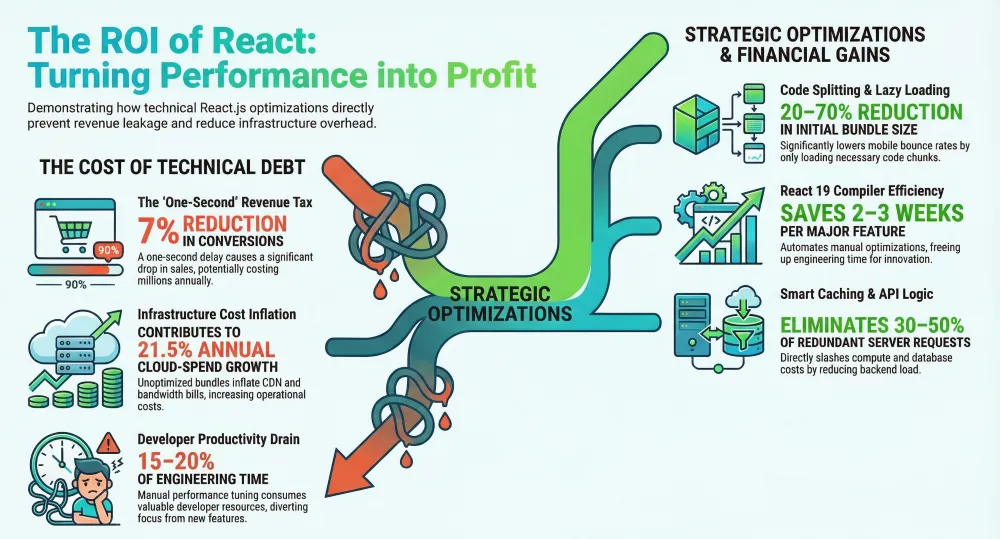
The numbers are hard to ignore. Research from Kissmetrics shows that a one-second delay in page response can cause a 7% reduction in conversions. For a business generating $100,000 per day, that single second of lag could translate to roughly $2.5 million in lost revenue annually. A widely cited Amazon internal study found that every 100 milliseconds of additional latency cost the company 1% of its sales — a figure that at today’s scale would represent billions of dollars. Meanwhile, a broader industry analysis found that online businesses collectively lose nearly $2.6 billion in revenue each year due to slow loading speeds.
On the infrastructure side, Gartner forecasts worldwide public cloud spending to reach $723.4 billion, growing at 21.5% year over year. Alarmingly, a separate Gartner prediction warns that 25% of organizations will experience significant dissatisfaction with their cloud adoption by 2028, largely driven by uncontrolled costs. For companies running React-based applications without strategic React.js build optimizations in place, much of that cloud spend is simply waste.
This is not a developer-only conversation. It is a boardroom conversation.
At Full-Stack Techies, we partner with businesses across industries to implement enterprise-grade React.js build optimizations that directly reduce infrastructure overhead, improve page performance, and protect revenue. This guide is written specifically for CFOs, finance directors, and technical decision-makers who want to understand — in plain language — exactly what these optimizations are, why they matter financially, and what a smart implementation roadmap looks like.
Key Takeaways
Before diving into the full breakdown, here is a quick snapshot of what this article covers and what you will walk away knowing:
- A one-second delay in page load can reduce conversions by 7% — making React.js build optimizations a direct revenue protection strategy, not a developer preference.
- Enabling production builds alone can meaningfully shrink your JavaScript bundle, reducing CDN bandwidth costs that compound across millions of monthly sessions.
- Code splitting and lazy loading can cut initial bundle size by 20–70%, directly improving mobile load times and lowering bounce rates on high-traffic pages.
- The React 19 Compiler eliminates manual memoization work, saving an estimated 2–3 weeks of engineering time per major feature — a measurable reduction in development cost.
- Server-Side Rendering and React Server Components improve both performance and SEO rankings simultaneously, compounding the return on your engineering investment.
- Regular bundle and dependency audits surface hidden cost waste — redundant packages, oversized libraries, and accidental production inclusions — that silently inflate infrastructure bills.
- Image optimization and CDN delivery address over 75% of a typical webpage’s total weight, making it one of the highest-ROI optimizations available per engineering hour spent.
- List virtualization protects internal tool performance as data volumes grow, preventing expensive emergency re-architecture down the line.
- Smart caching and API optimization can eliminate 30–50% of redundant server requests, reducing compute costs and improving perceived application speed simultaneously.
- Businesses that implement these optimizations systematically — like working with a dedicated React.js development company — consistently report outcomes ranging from 50% faster load times to doubled conversion rates.
Why CFOs Should Care About React.js Build Optimizations
Before diving into the eight strategies, it is worth grounding this conversation in financial terms that matter to the C-suite.
React.js is the most widely adopted JavaScript library in the world, used by 40.6% of professional developers according to the 2024 Stack Overflow Developer Survey — well ahead of Angular at 17.5% and Vue.js at 18.4%. That dominance means most enterprise web applications today are either already built on React or being migrated to it. The framework’s ecosystem advantage — abundant developer talent, 200,000+ npm packages, and extensive community support — translates directly into faster development cycles and lower hiring costs when you work with the right React.js development company.
However, popularity does not automatically mean efficiency. As React applications scale — more components, deeper data flows, larger JavaScript bundles — performance can degrade rapidly unless developers apply deliberate React.js build optimizations. Left unchecked, this performance debt becomes a financial liability that shows up in three ways:
- Infrastructure cost inflation: Larger, unoptimized JavaScript bundles demand more bandwidth, more CDN data transfer, and more server compute. Over time, these costs compound.
- Revenue leakage from bounce rates: Google’s own research confirms that as page load time increases from one second to five seconds, the probability of a mobile visitor bouncing rises by 90%. Fewer visitors staying on the page means fewer conversions, fewer leads, and less revenue.
- Developer productivity loss: Slow build pipelines mean your engineering team waits longer between code changes and deployments. Prior to the introduction of the React Compiler in React 19, manual optimization tasks like applying
useMemoanduseCallbackconsumed an estimated 15–20% of development time on complex applications.
The strategic opportunity is significant. Businesses that implement the right React.js build optimizations typically see a combination of reduced cloud infrastructure costs, measurably faster application performance, and improved development velocity — all of which contribute directly to the bottom line.
Optimization 1: Enable Production Builds and Dead Code Elimination
What it is: React ships in two modes — development and production. The development mode includes verbose warnings, debugging tools, and runtime checks that are invaluable for engineers but add significant overhead to the final bundle. Enabling production builds, combined with tree-shaking (automatic dead code elimination), strips all of this out before deployment.
Why it matters financially: Production builds created through tools like Webpack or Vite with the NODE_ENV=production flag can reduce bundle sizes substantially. Terser and Rollup plugins compress and mangle the final output, removing unused code paths, redundant imports, and development-only libraries. This directly reduces CDN bandwidth consumption — one of the fastest-growing line items in any enterprise cloud bill.
The business impact: Smaller bundles mean less data transferred to every user’s browser, every session, every day. At enterprise scale, eliminating even 100KB of unnecessary JavaScript per page load across millions of monthly visitors produces meaningful bandwidth savings. For organizations leveraging CDN pricing models based on data egress, these savings are immediate and recurring.
What to watch for: Many teams accidentally deploy development builds to staging environments that mirror production infrastructure costs. A proper CI/CD pipeline should enforce production build flags at every deployment stage. If you are working with a React.js development company, verify that this is explicitly part of their deployment checklist.
Optimization 2: Code Splitting and Lazy Loading
What it is: By default, a React application bundles all of its JavaScript into one large file that gets downloaded by the browser before anything renders on screen. Code splitting divides that bundle into smaller chunks. Lazy loading takes this further by loading chunks only when they are needed — for example, loading the settings panel only when a user navigates to settings, rather than on initial page load.
React’s built-in React.lazy() function and Suspense boundary make this pattern straightforward to implement. When combined with route-level code splitting, this approach can reduce the initial bundle size by 20–70%, depending on the complexity of the application.
Why it matters financially: The median JavaScript payload for desktop users is over 500KB according to HTTP Archive data, with mobile users often downloading significantly more. Every kilobyte of JavaScript the browser must download, parse, and execute adds latency. For mobile users in bandwidth-constrained environments, this is the difference between staying on your application and abandoning it.
The business impact: A faster First Contentful Paint (FCP) and Largest Contentful Paint (LCP) directly correlates with conversion rates. Google research shows that 53% of mobile users abandon websites that take more than three seconds to load. E-commerce platforms that have implemented React Server Components and aggressive code splitting report 15–25% conversion rate improvements from reduced bounce rates alone.
The CFO’s ROI lens: Model this simply. If your application currently converts 3% of visitors and you improve load time sufficiently to reduce abandonment by even 10%, you have effectively increased your conversion rate to 3.3%. On significant traffic volumes, this multiplier produces meaningful incremental revenue that dwarfs the one-time engineering cost.
Full-Stack Techies regularly implements route-based code splitting as a foundational step when onboarding new clients, because the return on this single optimization consistently justifies the entire engagement.
Optimization 3: Leverage the React 19 Compiler for Automatic Memoization
What it is: One of the most significant developments in the React ecosystem is the React Compiler, introduced in React 19. Previously, developers had to manually wrap expensive computations in useMemo hooks and callback functions in useCallback to prevent unnecessary re-renders — a process described by React experts as error-prone and time-consuming. The React Compiler analyzes code at build time and applies these optimizations automatically wherever they are safe to do so.
Why it matters financially: This is a two-sided cost win. On the performance side, automatic memoization prevents React from re-rendering components unnecessarily, which reduces CPU usage in the browser and improves responsiveness — especially on mobile devices with constrained processors. On the engineering cost side, the React Compiler effectively eliminates 2–3 weeks of optimization work per major feature according to analysis from React ecosystem researchers. Developer time is expensive. Freeing that time for feature development directly accelerates product velocity.
The business impact: Faster interactions improve user satisfaction and retention. Research consistently links First Input Delay (FID) and Interaction to Next Paint (INP) metrics — both measuring application responsiveness — to user engagement rates and session duration. Longer sessions mean more opportunities for conversion, upselling, and brand loyalty.
Important caveat for CFOs: The React Compiler does not fix architectural problems like overly broad context providers or poorly structured component hierarchies. To get the full benefit, you need experienced engineers who understand modern React architecture. This is one reason why businesses that hire React.js developers with deep, current expertise see materially better outcomes than those who rely on generalist engineers or outdated skill sets.
Optimization 4: Implement Server-Side Rendering (SSR) and React Server Components
What it is: Server-Side Rendering (SSR) generates the HTML for a React page on the server before sending it to the browser, rather than sending a blank HTML shell that JavaScript must populate client-side. React Server Components (RSC), production-ready in React 19, take this further by allowing components to run exclusively on the server, sending only the final rendered output to the browser — with zero JavaScript payload for those components on the client.
Why it matters financially: SSR and RSC reduce the amount of JavaScript sent to and executed in the browser, which lowers bandwidth costs and dramatically improves the time users see meaningful content. Frameworks like Next.js make SSR implementation straightforward for React applications and are considered best-in-class infrastructure for modern React.js build optimizations.
The business impact: Airbnb, one of the world’s largest travel platforms, improved page load times by 50% after implementing React’s Server-Side Rendering capabilities. For businesses with high organic search traffic, SSR also delivers direct SEO benefits — search engines index server-rendered content more reliably, which can meaningfully improve keyword rankings, traffic acquisition, and the ROI of your content and SEO investments.
Infrastructure cost angle: Server Components reduce the volume of JavaScript that must be delivered via CDN, parsed by client devices, and executed in memory. Across millions of sessions per month, this reduction in data transfer produces measurable CDN cost savings and improves the efficiency of your hosting infrastructure. For organizations operating at scale, this is not a marginal improvement — it is a structural cost reduction.
Optimization 5: Bundle Analysis and Dependency Auditing
What it is: JavaScript applications accumulate dependencies over time, and many of them are larger than necessary. A single npm package that includes polyfills for browsers your users do not use, or a utility library imported in full when only one function is needed, can add hundreds of kilobytes to a production bundle. Bundle analysis tools like Webpack Bundle Analyzer and Vite’s built-in visualizer provide a visual map of exactly what is in your bundle and what is taking up space.
Why it matters financially: This optimization is one of the highest-ROI activities available because it directly maps to infrastructure costs. Dependencies are not free — they add to bundle size, which increases CDN data transfer volume, slows page loads, and inflates bandwidth bills. Regular dependency auditing is the equivalent of a financial audit for your frontend: it surfaces waste that has accumulated over time and identifies clear opportunities for elimination.
What teams typically find: Common findings during bundle audits include full imports of libraries like Lodash or Moment.js (which can be replaced with lighter-weight alternatives or tree-shaken imports), duplicate packages at different versions, and development-only tools accidentally included in production builds. Each of these represents direct cost and performance overhead.
The CFO’s action item: Ask your engineering team or your React.js development company to produce a bundle analysis report with recommendations. This report should quantify the size of each major dependency, identify redundancies, and propose a prioritized elimination roadmap. The output should be expressed in terms of estimated bandwidth savings and projected performance improvements — not just kilobytes.
Full-Stack Techies includes bundle analysis as a standard deliverable in all performance engagement projects, because the findings consistently reveal optimization opportunities that more than pay for the engagement cost.
Optimization 6: Image Optimization and CDN Asset Delivery
What it is: Images account for over 75% of a typical webpage’s total weight according to performance benchmarking data. Uncompressed images in legacy formats, served from a single origin server without a CDN, are one of the most expensive and easily fixed performance problems in a React application. Modern React.js build optimizations for images include converting to next-generation formats like WebP or AVIF, implementing responsive image sizing, using lazy loading for images below the fold, and delivering all static assets through a globally distributed Content Delivery Network (CDN).
Frameworks like Next.js include an optimized <Image /> component that handles format conversion, responsive sizing, and lazy loading automatically, significantly reducing the manual effort required to implement these best practices.
Why it matters financially: A case study from Furnspace found that image optimization alone cut load times by 65% and doubled conversions. GQ Magazine reduced their page load speed from 7 seconds to 1.5 seconds through image and asset optimization, resulting in unique visitors growing from 6 million to 11 million in a single month — a near-doubling of audience, with corresponding advertising revenue implications.
Infrastructure savings dimension: CDN delivery reduces the load on your origin servers, decreasing compute costs and improving resilience. For applications with a global user base, CDN proximity ensures that users in every geography receive fast load times without requiring additional regional server infrastructure — a significant capital and operational expenditure saving.
The business case in one sentence: Optimized image delivery is one of the few engineering investments where the performance improvement and the infrastructure cost reduction occur simultaneously.
Optimization 7: Virtualization for Large Data Sets
What it is: Enterprise applications frequently render large tables, lists, and data grids — think dashboards with thousands of rows, inventory systems, CRM interfaces, or financial reporting tools. Without virtualization, React renders all of these DOM elements simultaneously, even those not visible on screen. This consumes significant browser memory and CPU resources, leading to sluggish scrolling, high memory consumption, and degraded user experience.
List virtualization (also called windowing) using libraries like react-window or react-virtual renders only the DOM elements currently visible in the viewport, with a small buffer above and below. As users scroll, elements are dynamically swapped in and out — keeping the rendered DOM lean and the application responsive.
Why it matters financially: For internal enterprise tools, productivity is the primary financial metric. Finance teams, operations staff, sales analysts, and customer service representatives working in slow, unresponsive React dashboards experience measurable productivity losses every day. Research on enterprise software usability consistently links application responsiveness to employee throughput and satisfaction. Slow internal tools are a hidden operational cost.
The scalability angle: As your data volumes grow, an unvirtualized list degrades exponentially. A table that performs acceptably at 500 rows may become completely unusable at 5,000 rows — forcing an expensive re-architecture. Implementing virtualization proactively prevents this scaling cliff and protects the long-term usability of your internal tools without emergency rework.
Who benefits most: Organizations running React-based ERP interfaces, business intelligence dashboards, financial reporting tools, or customer data platforms will see the most dramatic impact from this optimization. If you are evaluating the best React.js development services for an enterprise data application, ensure virtualization is part of the technical scope.
Optimization 8: Caching Strategies, State Management Architecture, and API Optimization
What it is: This final optimization category addresses how a React application fetches, stores, and reuses data — arguably the area with the largest potential for both performance improvement and infrastructure cost reduction at scale.
Client-side caching using libraries like React Query (TanStack Query) or SWR prevents applications from making redundant API calls. When a user navigates back to a previously visited section, cached data is shown instantly rather than triggering a new server request. Stale-while-revalidate patterns serve cached content immediately while refreshing in the background, creating the perception of instant load times while maintaining data freshness.
State management architecture determines how data flows through a React application. Poorly structured global state — particularly with broad React Context providers that trigger re-renders across entire component trees — is a common source of performance degradation in enterprise React applications. Proper state segmentation (separating frequently updated state from stable configuration data) can eliminate unnecessary render cycles and reduce the computational overhead of your application.
API optimization includes techniques such as query batching, response pagination, selective data fetching (GraphQL allows clients to request only the fields they need), and intelligent prefetching of data the user is likely to need next.
Why it matters financially: Every redundant API call has a cost. Server compute charges, database query costs, and API gateway fees all accumulate based on request volume. Applications that make unnecessary API calls because they lack proper caching are generating infrastructure cost through inefficiency alone. In high-traffic environments, eliminating 30–50% of redundant API calls through proper caching architecture can produce significant monthly savings.
The broader enterprise context: Gartner notes that worldwide IT spending continues to grow rapidly, and organizations are under increasing pressure to demonstrate ROI on technology investments. Efficient application architecture that minimizes compute consumption and infrastructure overhead is not just a developer best practice — it is a financial responsibility.
Also Read: How to Budget React.js Development for AI-Ready Teams: A Complete How-To Guide
Get scalable, fast, and user-friendly ReactJS solutions tailored to your needs.
Get Free ConsultationThe Full-Stack Techies Approach: Engineering Optimizations That Move the Numbers
Implementing these eight React.js build optimizations effectively requires more than knowledge of individual techniques. It requires experienced engineers who understand how these optimizations interact with each other, how to prioritize them based on your specific application architecture, and how to measure their financial impact in terms your executive team can act on.
At Full-Stack Techies, we have built our practice around delivering React.js engineering that directly serves business outcomes. When clients choose to hire React.js developers through our team, they are not just acquiring technical execution — they are gaining a partner who understands the financial architecture of web performance and can translate engineering decisions into bottom-line metrics.
Our engagements typically begin with a comprehensive performance and bundle audit that establishes a baseline: current load times, bundle sizes, Lighthouse scores, Core Web Vitals measurements, estimated CDN costs, and API call analysis. From this Full-Stack Techies as line, we develop a prioritized optimization roadmap with projected impact estimates for each initiative — so your team can evaluate ROI before committing to implementation.
As a full-service React.js development company,Full-Stack Techies offers flexible engagement models ranging from targeted optimization sprints to full-scale application development and ongoing performance monitoring. Whether you need a dedicated team to modernize a legacy React application, implement React 19 features like the React Compiler and Server Components, or build a new high-performance application from the ground up, our team delivers measurable results.
Key Industry Context: What the Market Is Telling CFOs
The financial context for these optimizations has never been more compelling:
- Cloud costs are rising fast: Gartner’s forecast of $723.4 billion in worldwide cloud spending in 2025 means infrastructure budgets are under pressure. Organizations that cannot demonstrate efficiency in their cloud consumption will face difficult budget conversations. Frontend performance optimization is one of the most accessible levers for reducing cloud infrastructure costs, particularly CDN and bandwidth expenditure.
- Cloud dissatisfaction is a real and growing risk: Gartner specifically predicts that 25% of organizations will experience significant dissatisfaction with their cloud adoption by 2028 due to uncontrolled costs and suboptimal implementation. React applications that consume excessive bandwidth, generate unnecessary API traffic, and require over-provisioned infrastructure to maintain acceptable performance are a direct contributor to this risk.
- Developer time is your most expensive resource: With skilled React engineers commanding premium salaries in a competitive talent market, any optimization that reduces manual overhead — like the React Compiler’s elimination of manual memoization work — directly improves your engineering ROI. The estimate that the React Compiler saves 2–3 weeks of optimization work per major feature is a significant dollar figure when multiplied across a development team’s annual output.
- Performance is a growth enabler, not just a cost reduction: Businesses implementing comprehensive React.js build optimizations have documented outcomes including 50% improvement in page load time (Airbnb), 42% increase in mobile revenue (Swappie), and 50% increase in mobile conversions (Zitmaxx Wonen). These are not marginal improvements — they are business-changing results that justify substantial engineering investment.
How to Get Started: A Practical Roadmap for Non-Technical Leaders
If you are a CFO or business leader ready to explore React.js build optimizations for your organization, here is a practical framework for moving forward:
Step 1 — Establish your baseline. Ask your engineering team (or engage the best React.js development services provider you can find) to run a comprehensive Lighthouse audit and bundle analysis on your current application. This establishes the financial baseline: current performance scores, bundle sizes, and estimated infrastructure costs associated with current load patterns.
Step 2 — Quantify the revenue impact of current performance gaps. Use the 7% conversion reduction per second of delay as a conservative benchmark. Calculate what even a 1–2 second improvement in your application’s load time would mean for your conversion rate and annual revenue. This number typically surprises finance teams and creates immediate internal alignment around optimization investment.
Step 3 — Prioritize by ROI, not complexity. The optimizations with the highest financial return are often not the most technically complex. Production build configuration, code splitting, and image optimization consistently deliver the highest impact per engineering hour invested. Start there before moving to more advanced techniques.
Step 4 — Build performance into your development process. One-time optimization projects deliver value, but sustainable performance requires integrating performance budgets, Lighthouse CI checks, and bundle size monitoring into your deployment pipeline. Work with your company to establish automated performance gates that prevent future regressions.
Step 5 — Measure and report financial outcomes. Define the KPIs that matter before the project starts: page load time, Core Web Vitals scores, monthly CDN cost, API request volume, conversion rate, and bounce rate. After implementation, report these metrics alongside the engineering investment to demonstrate ROI to your board and leadership team.
Conclusion: React.js Build Optimizations Are a Financial Strategy, Not Just a Technical One
The CFOs who will create the most enterprise value from their technology investments are those who understand that performance optimization is not a developer luxury — it is a financial multiplier. Every second shaved from a page load time is a conversion rate protected. Every megabyte removed from a JavaScript bundle is a bandwidth cost eliminated. Every redundant API call prevented is server compute returned to the budget.
The eight React.js build optimizations outlined in this guide — from production builds and code splitting to the React 19 Compiler, SSR, bundle analysis, image optimization, virtualization, and smart caching — are not theoretical best practices. They are proven, measurable interventions with documented financial returns across industries and company sizes.
Full-Stack Techies brings the engineering depth and business acumen to implement these optimizations in a way that moves your numbers. Whether you are looking to reduce infrastructure costs, improve conversion rates, accelerate development cycles, or build a new React application that is architected for performance from day one, we are ready to demonstrate what world-class React.js development looks like.
To explore how the best React.js development services can be applied to your specific business context, reach out to the Full-Stack Techies team for a performance consultation. We will start with your numbers and build a roadmap to improve them.
Also Read: Ultimate C-Suite Guide to React.js ROI Measurement
Why Trust This List?
The internet is full of developer tutorials written for developers. This list was built differently.
Every optimization featured here is backed by real-world performance data, documented business outcomes, and industry research from sources including Gartner, Google, Amazon, and published enterprise case studies from companies like Airbnb and GQ Magazine. Nothing on this list is theoretical — each technique has a measurable financial result attached to it.
The recommendations are also grounded in hands-on experience. The team at Full-Stack Techies has implemented these exact React.js build optimizations across enterprise applications in e-commerce, SaaS, fintech, and internal tooling — and we have reported the outcomes to clients in the same business language used throughout this article.
This is not a list written to impress engineers. It is a list written to give CFOs, finance directors, and technical decision-makers the clarity they need to ask the right questions, evaluate the right partners, and make investment decisions that move the numbers. If you are looking for the best React.js development services to implement any of these strategies, you already know where to start.
Frequently Asked Questions About React.js Build Optimizations
Q1. What are React.js build optimizations and why do they matter for businesses?
React.js build optimizations are techniques applied during development and deployment to reduce bundle size, improve load speed, and minimize infrastructure costs. For businesses, they directly impact conversion rates, server bills, and user retention u2014 making them a financial priority, not just a technical one.
Q2. How much can React.js build optimizations reduce infrastructure costs?
Properly implemented React.js build optimizations u2014 including code splitting, image compression, caching, and CDN delivery u2014 can reduce CDN bandwidth consumption by 30u201360% and eliminate up to 50% of redundant API calls, producing significant and recurring monthly savings on cloud infrastructure bills.
Q3. When should a business hire React.js developers for performance optimization?
You should hire React.js developers when your application suffers from slow load times, rising cloud costs, poor Core Web Vitals scores, or increasing bounce rates. Engaging expert developers early prevents costly re-architecture later and ensures optimizations are built into the application from the ground up.
Q4. What is the difference between SSR and client-side rendering in React?
Server-Side Rendering (SSR) generates HTML on the server before sending it to the browser, enabling faster initial page loads and better SEO. Client-side rendering sends a blank HTML shell populated by JavaScript in the browser u2014 generally slower to first paint and harder for search engines to index reliably.
Q5. How does code splitting improve React application performance?
Code splitting breaks a large JavaScript bundle into smaller chunks loaded only when needed. This reduces the initial bundle size by 20u201370%, cutting the time users wait before seeing content u2014 directly lowering bounce rates and improving conversion rates, especially on mobile devices.
Q6. What should I look for in the best React.js development services?
The best React.js development services should include performance-first architecture, bundle analysis, Core Web Vitals optimization, CI/CD pipeline integration, and a transparent reporting process that ties engineering work to measurable business outcomes like load time, conversion rate, and infrastructure cost.
Q7. What is the React Compiler and how does it save development costs?
The React Compiler, introduced in React 19, automatically applies memoization optimizations that developers previously had to write manually. This eliminates an estimated 2u20133 weeks of optimization work per major feature, freeing your engineering teamu2019s time for revenue-generating development instead.
Q8. How do React.js build optimizations affect SEO and organic traffic?
Faster load times and improved Core Web Vitals u2014 driven by React.js build optimizations u2014 are direct Google ranking signals. Faster pages rank higher, attract more organic traffic, and reduce the cost per acquisition from paid channels, making optimization a key lever in your overall digital marketing ROI.
Q9. How do I choose the right React.js development company for optimization work?
Choose a React.js development company that begins with a measurable performance audit, communicates results in business terms (not just technical metrics), and has documented case studies showing improved load times and reduced infrastructure costs. Avoid firms that treat optimization as an afterthought rather than a core deliverable.
Q10. Is Full-Stack Techies a good partner for React.js performance optimization?
Yes. Full-Stack Techies is a specialized React.js development company that delivers performance-first React engineering, from bundle analysis and code splitting to React 19 Server Components and full application modernization. Every engagement begins with a baseline audit and ends with measurable, reportable outcomes tied to your business goals.