

How to Budget React.js Development for AI-Ready Teams: A Complete How-To Guide
Budget React.js Development effectively by understanding team costs, infrastructure needs, and AI integration requirements. This guide provides a step-by-step framework to estimate budgets, reduce waste, and align development investments with business goals for AI-ready applications in 2026.


Why Every AI-Ready Team Needs a Smarter React.js Development Budget
The intersection of artificial intelligence and frontend engineering is no longer a future concept — it is the defining challenge for technology teams right now. According to Gartner, worldwide AI spending is projected to reach $2.52 trillion in 2026, a 44% increase year-over-year. For businesses building modern, scalable web applications, that number is not just a headline — it is a mandate to build smarter, more adaptive software from the ground up.
React.js sits right at the center of this transformation. According to Statista data, React.js is the most in-demand web framework in 2025, with 40.41% of software developers globally indicating they use it to develop web applications. From AI-powered dashboards and real-time data visualization to intelligent UI workflows, React has proven to be the foundation of choice for teams serious about building tomorrow’s products.
But building AI-ready applications on React.js demands a very different approach to financial planning than traditional projects. Whether you are a CTO at a scaling startup, a product lead at an enterprise, or an entrepreneur launching your first SaaS, understanding how to budget React.js development strategically — not just cheaply — is what separates projects that succeed from those that stall.
This guide walks you through every cost driver, budgeting framework, and strategic decision you need to make to build AI-capable React.js products without overspending or under-resourcing.
Also Read: Ultimate React.js Vendor Selection Checklist 2026 for C-Level
Who Is This Guide For?
This breakdown is specifically tailored for decision-makers who need to accurately forecast and allocate capital for modern web engineering:
- Startup Founders & CTOs: Planning runway and seed capital for AI-first SaaS products.
- Engineering Managers: Looking to scale internal teams and transition legacy apps to AI-agent interfaces.
- Product Managers: Needing a realistic understanding of feature costs, API overhead, and maintenance requirements.
- Enterprise Procurement Teams: Evaluating proposals from a React.js development company to ensure competitive and realistic pricing.
Key Takeaways: How to Budget React.js Development for AI-Ready Teams
1. AI Readiness Is Now a Budget Line Item, Not an Afterthought. Building AI features into a React.js development project adds 20–30% to base costs. Plan for AI integration — architecture, APIs, state management, and testing — from Day 1, not as a Phase 2 addition.
2. Developer Rates Vary Widely — But Cheapest Is Rarely Cheapest. React.js developer rates range from $25/hr to $150/hr globally. A lower hourly rate often means higher total project cost due to rework, slower delivery, and architectural debt. Evaluate total project value, not just the rate card.
3. Your Hiring Model Is Your Biggest Budget Decision. Choosing between in-house hiring, freelancers, or a dedicated React.js development company can shift your total budget by 30–50%. For AI-ready projects, a hybrid model — small in-house core plus a specialized partner like Full-Stack Techies — delivers the best balance of control, speed, and cost efficiency.
4. Project Complexity Defines Your Budget Tier.
- MVP / POC: $15,000–$50,000
- Growth-Stage Product: $50,000–$150,000
- Enterprise Application: $150,000–$500,000+
Match your budget to your actual scope — not to what you wish the project cost.
5. The Best React.js Development Services Go Beyond Code. The best React.js development services providers bring architectural depth, AI integration experience, transparent processes, security best practices, and long-term support — not just development hours. Evaluate partners on all of these dimensions.
6. Post-Launch Costs Are Non-Negotiable for AI Products. Reserve 10–20% of your development budget annually for maintenance, AI model updates, performance tuning, and iterative improvements. AI-powered React.js applications require ongoing investment to remain competitive and stable.
7. Infrastructure and Tooling Must Be Budgeted From Day 1. Cloud hosting, CI/CD pipelines, AI API fees, monitoring tools, and CDN costs are not optional extras. Budget 10–20% of development cost for infrastructure from the very beginning to avoid financial surprises post-launch.
8. Scope Clarity Is Your Most Powerful Cost-Control Tool. Clearly defined project goals, deliverables, and timelines directly protect your React.js development budget. Scope creep is the leading cause of cost overruns — lock your MVP scope before any development begins.
9. The Market Demands AI-Ready Products — Investment Is Justified. Global AI spending is projected to reach $2.52 trillion in 2026 (Gartner). React.js powers the frontends of the AI-driven products users increasingly expect. Investing in a well-budgeted, AI-ready React.js development project is a strategic competitive advantage, not a discretionary expense.
10. The Right Partner Makes the Budget Work Harder. Partnering with a specialized React.js development company like Full-Stack Techies — with AI-native expertise, transparent scoping, and flexible engagement models — ensures your budget is allocated to outcomes, not overhead. The right partner reduces risk, accelerates delivery, and protects your investment at every stage.
Get scalable, fast, and user-friendly React solutions tailored to your needs.
Get Free Consultation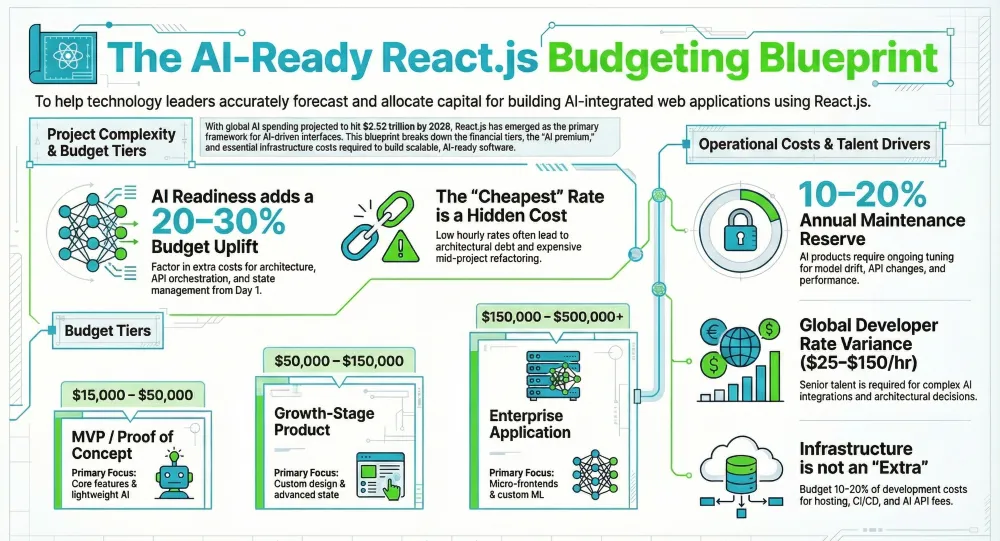
Section 1: Understanding the True Cost Landscape of React.js Development
Before you can build a budget, you need to understand what actually drives costs in modern React.js development. Many organizations underestimate the full expense picture by focusing only on developer hourly rates. The reality is far more layered.
Developer Rates by Experience and Region
React developer hourly rates range from $25 to $150 per hour globally, depending on region, experience, and specialization. A junior React developer in Asia charges $20–40/hr, while a senior React developer in the US commands $100–150/hr.
For teams building AI-integrated products, seniority matters enormously. AI-ready React.js applications require architects who understand server-side rendering, state management at scale, API orchestration, and integration with machine learning model endpoints. That means the low end of the rate spectrum often carries hidden costs in rework, slower delivery, and architectural debt.
Here is a practical breakdown to anchor your budget planning:
Junior Developers (0–2 years): $25–$60/hr | Suitable for UI component work, design system tasks, and straightforward feature implementation under senior guidance.
Mid-Level Developers (2–5 years): $60–$100/hr | Capable of owning features independently, handling state management, and integrating third-party APIs, including basic AI/ML services.
Senior Developers (5+ years): $100–$150/hr | Required for architectural decisions, performance optimization, complex AI integrations, and leading distributed frontend teams.
React Native developers and those with Next.js expertise typically earn 15–35% premiums over standard React rates. If your AI-ready product also needs a mobile presence, factor this premium into your numbers from the start.
The Hidden Cost Multipliers
Many teams go over budget not because they hired the wrong developers, but because they did not account for the full cost of the ecosystem:
Infrastructure and tooling: CI/CD pipelines, cloud hosting for SSR-based React apps (Next.js on Vercel, AWS Amplify, or GCP), and API gateway costs for AI model calls all add up. Budget 10–20% of development cost annually for infrastructure.
AI/ML integration overhead: Connecting React frontends to LLMs, vector databases, or custom ML pipelines adds meaningful complexity. AI/ML integration, such as chatbots and predictive analytics, can increase project budgets by 15–30%.
Post-launch maintenance: Post-launch support, including updates, bug fixing, and server maintenance, requires ongoing costs of around 10–20% of the initial development investment. For AI-powered applications where model behavior can drift or APIs change, this figure trends toward the higher end.
QA and testing: AI-augmented applications require not only standard functional testing but also adversarial testing, edge-case validation for AI outputs, and accessibility compliance. Allocate a minimum of 15% of your development budget here.
Section 2: Choosing the Right Model to Hire React.js Developers
One of the highest-impact budget decisions you will make is how — not just who — you hire React.js developers. There are three primary engagement models, each with distinct cost structures, risk profiles, and suitability for AI-ready projects.
Model 1: In-House Full-Time Hiring
Building an in-house React.js team gives you the highest degree of control, deep product familiarity, and cultural alignment. However, it carries the highest fixed costs.
In the United States, a mid-level React developer salary stands at around $81,337 annually, while senior-level professionals earn approximately $113,000 per year in base compensation alone. Factor in benefits, taxes, equipment, onboarding, and management overhead, and the true annual cost of a senior US-based React developer approaches $150,000–$180,000 per person.
For AI-ready teams in early-to-growth stages, this model may be justifiable for a core team of 2–3 senior engineers, but it rarely scales economically for full project delivery.
Model 2: Freelance React.js Developers
Freelancers offer flexibility and speed of access, making them appealing for short sprints, proof-of-concept work, and specific feature builds. React freelance hourly rates on platforms like Upwork average $51–75/hr, with a median of $63/hr based on 2025 marketplace data.
The challenge for AI-ready teams is consistency. Freelancers working across multiple clients often cannot commit the deep, focused time that complex AI integrations require. They are well-suited for UI work, component libraries, and isolated feature development — not for owning AI-heavy architectural layers.
Model 3: Partnering with a React.js Development Company
For organizations that need a full-cycle solution — architecture, development, QA, DevOps, and AI integration — partnering with a dedicated React.js development company is frequently the most cost-effective and outcome-reliable option.
Agencies typically add 30–50% premiums over raw developer rates, but this includes project management, code review processes, faster onboarding, bench depth, and institutional knowledge of AI integration patterns. When you factor in the risk reduction and time-to-market acceleration, a strong React.js development company often delivers better ROI than assembling a team from scratch.
Full-Stack Techies is a leading example of a specialized React.js development company purpose-built for exactly this kind of engagement. Their teams combine deep React.js expertise with proven AI integration capabilities — from LLM-powered dashboards and intelligent forms to real-time data apps backed by ML pipelines. For teams that need to move fast without sacrificing architectural quality, Full-Stack Techies delivers structured, scalable delivery that fits AI-ready product requirements.
Comparison of React.js Hiring Models for AI Projects
| Model | Avg. Hourly Rate | Best For | Main Risk |
|---|---|---|---|
| In-House | $75 – $125 | Long-term core product IP | High overhead & slow scaling |
| Freelance | $50 – $75 | UI components & isolated tasks | Inconsistent availability |
| Dev Agency | $80 – $130 | Full-cycle AI integration & QA | Requires vetting for technical depth |
The Hybrid Team Strategy
Leveraging hybrid teams that unite internal developers with external remote programmers and freelancers is a proven approach to obtaining specialized skills at economical rates.
For most AI-ready teams, the optimal structure looks like this: a small in-house core of a technical lead and product owner, supplemented by a specialized React.js development company like Full-Stack Techies handling execution, AI integration, and QA. This keeps fixed costs manageable while accessing elite execution capacity on demand.
Section 3: Project Complexity Tiers and Budget Ranges
Not all React.js development projects are created equal. Below is a practical framework for aligning budget expectations to actual project scope.
Tier 1: MVP / Proof of Concept ($15,000–$50,000)
This tier covers a focused product with a defined feature set, a clean UI built on a component library (Material UI, shadcn, Chakra), basic API integrations, and potentially a lightweight AI feature such as a chatbot powered by a third-party LLM API.
Team composition: 1–2 mid-level React developers, 1 part-time QA, basic CI/CD setup. Timeline: 6–12 weeks.
Best for: Startups validating ideas, internal tools, pilot programs for enterprise AI features.
Tier 2: Growth-Stage Product ($50,000–$150,000)
This tier involves a more complex application with custom design systems, advanced state management (Redux Toolkit, Zustand, or React Query), multiple AI service integrations (recommendation engines, NLP-powered search, predictive analytics), and deeper backend orchestration.
Team composition: 2–3 senior/mid React developers, a dedicated UI/UX resource, 1 QA engineer, 1 DevOps/cloud specialist. Timeline: 3–6 months.
Best for: Scaling SaaS platforms, AI-augmented B2B tools, digital product companies.
Tier 3: Enterprise-Grade Application ($150,000–$500,000+)
Enterprise projects require micro-frontend architecture, sophisticated security and compliance layers, custom ML model integration at the frontend layer, real-time data pipelines, and extensive performance engineering. These projects also typically involve larger distributed teams across multiple time zones.
Best for: Financial services platforms, healthcare AI applications, large-scale enterprise dashboards.
Working with a specialized React.js development company like Full-Stack Techies at this tier is especially valuable, as their teams bring battle-tested architectural patterns and cross-functional depth that dramatically reduces execution risk.
Section 4: How AI Readiness Changes Your React.js Development Budget
Building an AI-ready React.js application is a fundamentally different challenge than building a conventional web app, and your budget must reflect that. Here is what changes:
AI Integration Architecture Costs
AI-ready applications require careful thought around data flow between the React frontend and backend AI services. This typically involves building middleware layers (Node.js, GraphQL, or REST gateway) to handle model inference calls, streaming responses (for LLM outputs), error handling for non-deterministic AI outputs, and token management for cost-efficient model usage.
This architectural complexity adds meaningful time and cost at the planning and development stages. Expect to budget an additional 20–30% over a comparable non-AI project for this layer alone.
The State Management Challenge
Modern AI features generate dynamic, asynchronous states that traditional React patterns were not designed to handle elegantly. Teams building with AI must invest in advanced state management architectures — whether using React Query for server state, Zustand for lightweight local state, or Redux for complex enterprise-wide state. Skimping here is one of the most common causes of mid-project refactors that blow budgets.
Expert Insight: Don’t just budget for the API calls. Many leaders forget the Latency Tax. Building a “snappy” AI UI often requires specialized engineering to implement “optimistic UI updates” or “streaming skeletons” so users aren’t left staring at a loading spinner while the LLM processes. This specialized logic is a key driver of the 20% AI budget uplift.
Skills Premium for AI-Ready React Developers
Developers who understand both React.js best practices and AI integration patterns — prompt engineering, API rate management, response streaming with useEffect, real-time updates via WebSockets — command premiums. React developers with Next.js, GraphQL, or specialized expertise typically earn 15–35% above base rates. For AI-specific skill sets, that premium can reach 25–40% above standard senior React rates.
This is another strong argument for partnering with a React.js development company like Full-Stack Techies, where AI-ready skill sets are part of the team’s standard capability — not a premium add-on you need to source and vet independently.
GenAI Features Are Now Table Stakes
AI infrastructure software spending, which includes app development, storage, security, and virtualization tools that support IT, is expected to reach nearly $230 billion in 2026, up from nearly $60 billion the prior year.
The consequence for product teams is clear: users increasingly expect AI features in the applications they use. Projections for generative AI model spending in 2026 remain strong, with growth expected at 80.8%. Building AI readiness into your React.js application is no longer a differentiator — it is fast becoming a baseline expectation.
Section 5: What to Look for in the Best React.js Development Services
When evaluating partners to deliver your project, the difference between good and great React.js development services often comes down to factors that are invisible on a rate card. Here is what to assess:
Technical Depth Beyond React
The best React.js development services providers do not just know React — they understand the full application stack that powers AI-ready products. This includes TypeScript (now an industry standard, not optional), Next.js for server-side rendering and edge deployment, testing frameworks like Jest, Playwright, and Cypress, and cloud-native deployment on AWS, GCP, or Azure.
Ask potential partners directly: how have they integrated LLMs or AI APIs into production React applications? Request case studies. Review their GitHub or portfolio for evidence of real-world AI feature delivery.
Process and Communication Standards
AI-ready projects are iterative by nature. Model outputs shift, feature requirements evolve as you learn what the AI can and cannot do, and user feedback loops are tighter. Your React.js development company must operate in an agile, transparent fashion — clear sprint structure, regular demos, documented architecture decisions, and proactive communication when requirements create scope changes.
Full-Stack Techies builds this kind of structured, communicative delivery into every engagement. Their clients gain not just development capacity but a genuine technology partner who understands the unique demands of AI-integrated product development.
Security and Compliance Posture
AI-ready applications handle sensitive data, user-generated prompts, and model responses that may contain personally identifiable information. The best React.js development services vendors treat security as a first-class concern — not an afterthought. Look for partners with experience in OWASP-compliant frontend development, secure API key handling, and data privacy regulations like GDPR and CCPA.
Scalability and Long-Term Support
Negotiating long-term contracts can lead to reduced rates, reflecting job security and ongoing collaboration — and for AI-ready applications, ongoing collaboration is not optional. AI features require tuning, model updates, performance monitoring, and iterative improvement. Evaluate whether your partner offers structured retainer or support packages, and whether their team has the bench depth to sustain engagement post-launch.
Section 6: A Practical 8-Step Budgeting Framework for React.js Development
Here is a step-by-step approach you can apply immediately to build a defensible, realistic React.js development budget for an AI-ready product.
Step 1: Define your MVP scope ruthlessly. Write down the exact features that must be live at launch and separate them clearly from Phase 2. Scope creep is the number-one cause of budget overruns in React.js projects. Clearly outlining project goals, deliverables, and timelines sets expectations and prevents scope creep.
Step 2: Identify your AI feature requirements early. List every place in your application where AI will be involved — search, recommendations, generation, classification, prediction. Map these to specific services (OpenAI, Anthropic, AWS Bedrock, etc.) and build their API cost estimates into your operating budget separately from development costs.
Step 3: Choose your hiring model before you start. Decide whether you are building in-house, hiring freelance, or partnering with a React.js development company before you begin scoping. The answer changes your timeline estimates, risk profile, and total budget by 30–50%.
Step 4: Build a team composition map. Do not budget “per project” — budget per role. Map out how many senior, mid-level, and junior React developers you need at each phase, plus QA, DevOps, and UI/UX. This gives you a more accurate burn rate than top-line estimates.
Step 5: Add the AI integration premium. Apply a 20–30% uplift to your base development estimate for AI integration complexity, additional testing requirements, and the specialized skill premium for AI-capable developers.
Step 6: Budget for infrastructure from Day 1. Include hosting, CDN, CI/CD, monitoring (Sentry, Datadog), and AI API costs in your budget from the first week — not as an afterthought after go-live.
Step 7: Reserve 15–20% for post-launch iteration. AI applications are never truly “finished.” Reserve a meaningful portion of your budget for the first 90 days post-launch to tune AI features, respond to user feedback, and fix edge cases.
Step 8: Evaluate partners on value, not rate. A $150/hr senior developer who ships twice as fast with fewer bugs often costs less per feature than a $40/hr junior who requires more oversight, rework, and extended timelines. When budgeting for React development, evaluate total project cost — not just hourly rate.
Section 7: Industry Signals Every Budgeting Decision-Maker Should Know
Understanding the broader market context strengthens your internal case for investment and helps you anticipate where costs are heading.
According to Gartner, worldwide AI spending is forecast to reach $2.52 trillion in 2026 — a 44% increase year over year — with AI infrastructure alone accounting for the majority of that investment. This signals that the tools, platforms, and integrations your React.js application will depend on are becoming more powerful, more accessible, and more competitively priced over time.
Gartner also forecasts that worldwide IT spending will reach $6.15 trillion in 2026, with software spending growing at 14.7% year-over-year. For development teams, this means cost of tooling and AI services is rising alongside capability — making strategic budget planning more important than ever.
React remains one of the most admired web frameworks globally, with a 62.2% satisfaction score among developers, and globally, there are estimated to be 500,000 to 600,000 React jobs in 2025. This depth of talent supply gives organizations flexibility in how and where they hire React.js developers — a meaningful advantage when managing budget constraints.
Gartner’s analysts note that “AI adoption is fundamentally shaped by the readiness of both human capital and organizational processes, not merely by financial investment.” This is perhaps the most important insight of all. Throwing money at AI-ready development without the right team, the right partner, and the right architecture will produce expensive failures — not competitive advantages.
Why Full-Stack Techies Is the Right Partner to Budget React.js Development With
When organizations come to Full-Stack Techies, they are not just looking for development hours — they are looking for a partner who understands the intersection of React.js, AI integration, and responsible budget management.
Full-Stack Techies operates as a specialized React.js development company offering end-to-end delivery for teams building AI-ready web products. Their approach is built on three principles that directly address the budgeting challenges outlined in this guide:
Transparent scoping: Every engagement begins with a detailed discovery process that maps features, AI integration points, infrastructure requirements, and team composition before a single line of code is written. This eliminates the budget-busting surprises that derail so many projects.
Flexible engagement models: Whether you need a dedicated team for a 6-month product build, a specialized squad for a specific AI integration sprint, or ongoing support retainer for a live application, Full-Stack Techies structures engagements to match your budget cadence.
AI-native expertise: Full-Stack Techies developers are not just strong React.js engineers — they actively work with modern AI APIs, LLM streaming interfaces, vector search integrations, and real-time AI feature architectures. You do not need to source this capability separately or pay a skills premium on top of a standard engagement.
For teams looking for the best React.js development services that align technical excellence with financial accountability, Full-Stack Techies is a partner worth a serious conversation.
Common Budgeting Mistakes to Avoid
Treating AI as a Phase 2 concern. AI features are most expensive to bolt on after architecture is established. Build AI readiness into your data model, API design, and state management strategy from the start.
Over-hiring juniors to save money. The real cost to you will be hiring developers who aren’t skilled in the new React paradigm. Junior-heavy teams on complex AI projects consistently overrun timelines and accumulate architectural debt.
Ignoring total cost of ownership. The development budget is only part of the picture. Operational costs — AI API fees, hosting, monitoring, maintenance — often rival development costs over a 12-month horizon for AI-enabled applications.
Choosing a partner on rate alone. The most expensive mistake in React.js development is choosing the lowest bidder for a complex, AI-integrated product. Evaluate partners on demonstrated AI delivery experience, communication quality, and architectural rigor — then negotiate on rate.
Also Read: Top 10 React.js Outsourcing Models for Enterprise Cost Control 2026
Conclusion: Budget Smarter, Build AI-Ready
The Budget React.js Development challenge for AI-ready teams is not simply about finding the cheapest developers or squeezing sprint timelines. It is about making deliberate, informed decisions that align financial investment with technical outcomes.
React.js remains the dominant technology for building the AI-powered web interfaces the market demands. The teams that win are those that treat budgeting as a strategic exercise — mapping real costs, choosing the right engagement model, planning for AI integration complexity from day one, and partnering with a React.js development company that has both the technical depth and the delivery discipline to execute.
Whether you are budgeting for an MVP with a single AI feature or an enterprise-grade platform with multiple integrated models, the framework in this guide gives you a principled foundation to build on.
If you are ready to move from planning to execution, Full-Stack Techies offers free discovery consultations where their architects map your requirements, assess your AI integration needs, and deliver a transparent, detailed budget estimate — so you know exactly what you are
FAQs about How to Budget React.js Development for AI-Ready Teams
Q1. What is the average cost to budget React.js development for an AI-ready product?
The average cost ranges from $15,000 for an MVP to $500,000+ for enterprise-grade applications. AI integration typically adds 20u201330% to base development costs. The final budget depends on team size, feature complexity, AI services used, and whether you hire React.js developers in-house, freelance, or through a React.js development company.
Q2. How do I hire React.js developers for an AI-ready team?
Start by defining your project scope and AI feature requirements. Then choose an engagement model u2014 in-house, freelance, or a dedicated React.js development company like Full-Stack Techies. Prioritize candidates with proven experience in TypeScript, Next.js, API orchestration, and LLM or AI service integrations for best results.
Q3. What factors affect React.js development costs the most?
The key cost drivers in budget React.js development are developer experience and location, AI/ML integration complexity, infrastructure and cloud hosting, QA and testing requirements, and post-launch maintenance. AI features alone can increase project budgets by 15u201330% compared to standard React.js builds.
Q4. Is it cheaper to hire freelance React.js developers or work with a React.js development company?
Freelancers typically cost less per hour ($51u2013$75/hr on average) but carry higher risks for complex AI projects u2014 inconsistent availability, limited architectural ownership, and slower ramp-up. A dedicated React.js development company like Full-Stack Techies offers structured delivery, AI-native expertise, and long-term support, often delivering better ROI despite slightly higher rates.
Q5. What are the best React.js development services for AI-integrated projects?
The best React.js development services for AI projects offer full-stack expertise (React, Node.js, cloud), proven AI/ML integration experience, agile delivery with transparent communication, and post-launch support. Full-Stack Techies is a strong choice, specializing in AI-ready React.js applications with end-to-end delivery capabilities.
Q6. How much should I budget for post-launch React.js maintenance?
Budget 10u201320% of your initial development cost annually for maintenance. For AI-powered React.js applications, lean toward 20% u2014 AI model updates, API changes, performance monitoring, and iterative feature improvements require ongoing investment beyond standard bug fixes.
Q7. How does AI readiness change the React.js development budget?
AI readiness adds cost in three key areas: architecture complexity (middleware, streaming, API orchestration), specialized developer skills (AI-capable React engineers command 25u201340% premiums), and infrastructure (AI API fees, vector databases, real-time pipelines). Plan for a 20u201330% budget uplift over a comparable non-AI React.js project.
Q8. What is a realistic timeline for React.js development with AI features?
An MVP with basic AI integration typically takes 6u201312 weeks. A growth-stage product with multiple AI features takes 3u20136 months. Enterprise-grade AI-ready applications can run 6u201312+ months. Timelines vary based on team size, scope clarity, and the complexity of AI service integrations involved.
Q9. Can a small budget still support quality React.js development with AI features?
Yes u2014 with the right prioritization. Focus your budget React.js development on a tightly scoped MVP using third-party AI APIs (OpenAI, Anthropic, AWS Bedrock) rather than custom models. Use a lean hybrid team and partner with an experienced React.js development company to avoid costly architectural rework down the line.
Q10. Why should I choose Full-Stack Techies for React.js development?
Full-Stack Techies is a specialized React.js development company that combines deep React.js engineering with AI-native expertise. They offer transparent scoping, flexible engagement models, and end-to-end delivery u2014 from architecture through post-launch support. For teams seeking the best React.js development services that balance quality, AI readiness, and budget accountability, Full-Stack Techies is a trusted partner.



