

How to Monetize React.js SaaS Platforms with AI Personalization (Step-by-Step Guide – 2026)
To Monetize React.js SaaS Platforms in 2026, businesses must go beyond subscription billing and adopt AI-driven personalization strategies. This step-by-step guide explains everything.


Introduction: The 2026 SaaS Monetization Shift
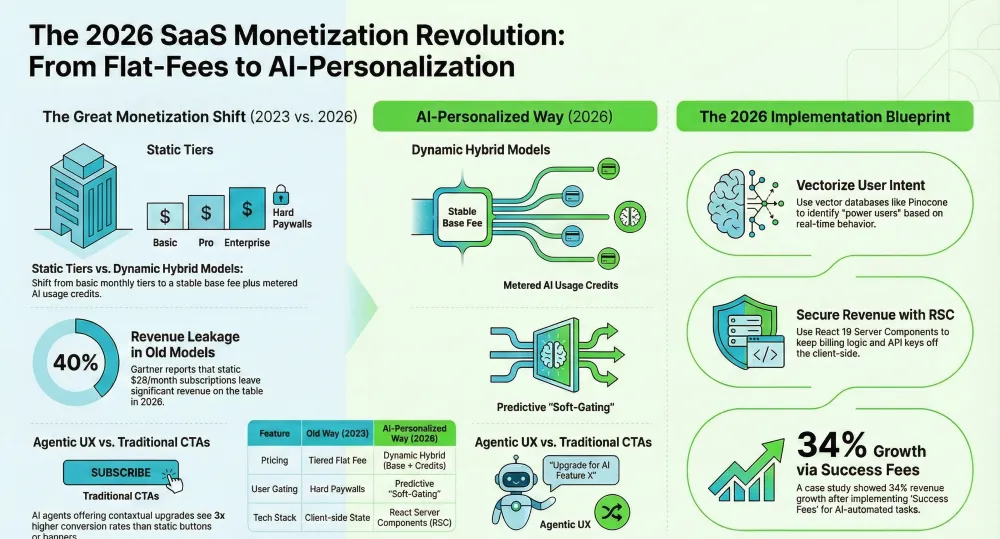
In 2026, the traditional “flat-fee subscription” is dying. According to recent Gartner reports, AI-native development platforms have fundamentally shifted software value from “access” to “outcome.” If you are still charging a static $29/month for your React.js application, you are likely leaving 40% of your potential revenue on the table.
Forbes recently highlighted that 2026 is “The Year When Monetization Breaks the Illusion of Neutrality.” AI isn’t just a feature anymore; it’s a foundational layer that infers user taste, risk tolerance, and aesthetic preference to drive hyper-personalization. For a React-based SaaS, this means your UI shouldn’t just look different for every user—it should bill differently based on the value generated.
The convergence of React.js Server Components (RSC) and Edge AI allows developers to create high-performance, personalized environments that adapt in real-time. Whether you are building a B2B productivity tool or a niche creative suite, this guide will show you how to leverage AI to identify “power users,” automate upsells, and implement the hybrid pricing models that the world’s most successful React.js development company experts are using right now.

Key Takeaways: Mastering SaaS Monetization in 2026
If you’re in a rush, here is the “Executive Summary” on how to effectively monetize React.js SaaS platforms using the latest AI and billing frameworks:
- The “Flat-Fee” Era is Over: 2026 benchmarks from Gartner show that static subscriptions lead to revenue stagnation. Transitioning to a
- (Base Fee + AI Usage) is the only way to protect margins against fluctuating LLM token costs.
- React 19 is the Revenue Engine: Leveraging React Server Components (RSC) is no longer optional. It allows you to run complex, personalized monetization logic on the server, keeping your client-side bundle lean and your billing keys secure.
- Vectorized Intent > Static Personas: Use vector databases (like Pinecone) to create real-time “Intent Profiles.” This allows your React UI to offer paid “Power-Ups” at the exact millisecond a user derives peak value from your tool.
- Agentic Upsells Drive NRR: Move away from intrusive pop-ups. Use Agentic UX to offer conversational, contextual upgrades. When an AI agent helps a user solve a problem, the conversion rate for an “Outcome-Based” fee is 3x higher than traditional CTA buttons.
- Infrastructure Reliability is Non-Negotiable: A single second of latency in your billing webhook can lead to churn. Implementing robust, idempotent pipelines with Stripe is essential. Many founders hire React.js developers who specialize in RevOps to ensure these systems are bulletproof.
- Strategic Execution Wins: Building an AI-native monetization layer is a “triple-threat” challenge involving AI, Finance, and Frontend architecture. Partnering with a top-tier React.js development company like Full-Stack Techies can accelerate your time-to-market by months.
Comparison: 2023 vs. 2026 Monetization Strategies
| Feature | Old Way (2023) | AI-Personalized Way (2026) |
|---|---|---|
| Pricing Model | Tiered Flat Fee (Basic/Pro/Ent) | Dynamic Hybrid (Base + Credits) |
| User Gating | Hard Paywalls (Block Access) | Intelligent Soft-Gating (Predictive) |
| Upgrade Path | Email Marketing / Banners | Agentic In-App “Nudges” |
| Tech Priority | Client-side State Management | React Server Components (RSC) |
| Partner Choice | Generalist Freelancers | Best React.js development services |
Who Is This Guide For?
- SaaS Founders: Looking to transition from stagnant subscription models to high-growth hybrid pricing.
- Product Managers: Aiming to increase Net Revenue Retention (NRR) through AI-driven UX.
- Full-Stack Developers: Needing a technical blueprint to integrate AI APIs with Stripe and React.
- Enterprises: Seeking to hire React.js developers who understand the intersection of GenAI and revenue operations.
Tools & Prerequisites
Before you begin, ensure your tech stack is 2026-ready. Building modern monetization requires “Observability-First” infrastructure.
| Category | Tool Recommendation | Why? |
|---|---|---|
| Frontend Framework | React 19+ (Next.js 15/16) | Native support for Server Components and Actions. |
| AI Integration | Vercel AI SDK / LangChain | Simplifies streaming AI responses to React hooks. |
| Billing Engine | Stripe (with Metered Billing) | The industry standard for “Pay-as-you-go” logic. |
| User Analytics | PostHog or Segment | Essential for feeding user behavior into your AI models. |
| Backend/Database | Supabase or Pinecone | To store user embeddings for personalization. |
| Experts | Full-Stack Techies | Trusted partner for scaling complex AI integrations. |
Step-by-Step Guide to Monetization
Step 1: Building a Vectorized User Context
The first step to monetize React.js SaaS platforms effectively is understanding how your users derive value. In 2026, we do this through “Vectorized Profiles.”
The Logic: Instead of just storing user.plan = ‘pro’, we store a mathematical representation (embedding) of the user’s recent interactions. If a user is a “Marketing Manager” who frequently uses your React app to generate social media copy, their vector will show high similarity to “Power Content Creators.”
Implementation Detail:
- Event Capture: Use a middleware to capture high-intent actions (e.g., clicking “Export Report,” “Generate AI Summary”).
- Embedding Generation: Pass these actions to an embedding model (like OpenAI’s text-embedding-3-small).
- Storage: Store these in a vector database linked to the userId.
Pro Tip: This data is the “gold” that allows your React UI to personalize its pricing offers. If you find this step technically taxing, consulting with a specialized React.js development company can help you set up this data pipeline correctly from day one.
At a Glance: Key 2026 Monetization Definitions
| Term | Definition | Revenue Impact |
|---|---|---|
| Vectorized Intent | Using mathematical embeddings to track user behavior in real-time rather than static personas. | High: Enables millisecond-perfect upsells. |
| Agentic UX | A UI that uses AI agents to autonomously suggest features or resolve blockers via conversation. | Very High: 3x conversion vs. static CTAs. |
| Hybrid Usage-Billing | A model combining a stable base fee with metered credits for high-cost AI tokens. | Essential: Protects margins from LLM volatility. |
Step 2: Architecture for AI-Native Monetization
To keep your application fast while running complex AI logic, you must utilize React Server Components (RSC).
Why RSC for Monetization?
- Security: Your billing keys and AI logic never touch the client side.
- Performance: The “heavy lifting” of analyzing user value happens on the server, sending only the personalized UI to the React client.
- Data Fetching: Fetching usage limits from Stripe and user data from your DB happens in a single server-side round trip.
Example React Pattern:
// A Server Component that renders a personalized upgrade button
async function PersonalizedPaywall({ userId }) {
  const userPersona = await getVectorPersona(userId);
  const usage = await getStripeUsage(userId);

  if (usage.limitReached && userPersona === 'Enterprise_Potential') {
    return <CustomEnterpriseOffer />;
  }

  return <StandardUpgradeButton />;
}
Step 3: Implementing Intelligent Feature Gating
Static paywalls are a relic of 2023. Modern monetization requires “Intelligent Gating.”
The “Graceful Limit” Strategy: Instead of cutting a user off immediately when they hit a limit, use AI to predict if they are in the middle of a critical task.
- Action: Offer a “One-Time Power-Up” rather than a full monthly subscription.
- Example: “You’ve used your 5 AI credits, but we see you’re finishing a major project. Add 2 more credits for $0.99?”
This level of granularity is why the best React.js development services now focus heavily on “Revenue Operations (RevOps)” engineering.
Step 4: Setting Up Hybrid Usage-Based Billing with Stripe
To truly monetize React.js SaaS platforms, you need a model that scales with your costs. AI tokens are expensive; your billing must reflect that.
The Formula for LTV (Lifetime Value) in 2026: In a personalized AI SaaS, we calculate expected revenue using a blend of base subscription value plus predicted metered AI usage per user segment.

Technical Steps with Stripe:
- Create Metered Prices: In your Stripe Dashboard, set up prices where “Usage is metered.”
- Report Usage via React Server Actions: Every time an AI feature is triggered in your React app, fire a server action that updates the Stripe usage_record.
- Real-time Usage UI: Use a React hook like useSWR to poll the usage state, ensuring the user always knows their current spend.
Code Blueprint: Reporting Usage via React Server Actions
// app/actions/reportUsage.js
'use server';

import Stripe from 'stripe';

const stripe = new Stripe(process.env.STRIPE_SECRET_KEY);

export async function reportAIUsage(userId, tokensUsed) {
  const subscription = await getSubscriptionForUser(userId);

  return await stripe.subscriptionItems.createUsageRecord(
    subscription.item_id,
    {
      quantity: tokensUsed,
      timestamp: Math.floor(Date.now() / 1000),
      action: 'increment',
    }
  );
}
Step 5: Deploying Agentic “Upsell” Nudges in React
In 2026, we don’t use pop-ups; we use Agents.
The “Copilot” Monetization Pattern: Integrating an AI Copilot (using libraries like CopilotKit or Vercel AI SDK) allows the app to “talk” to the user.
- The Nudge: “I noticed you’re manually formatting these 50 rows. I can do this instantly for you if you enable the ‘Automation Suite’—want a free 24-hour trial?”
- The Integration: This requires deep integration between your React state management (Zustand or Redux) and the LLM context.
For complex agentic workflows, it is often wise to hire React.js developers who have experience with “Agentic UI” patterns to ensure the agent doesn’t become intrusive.
Get scalable, fast, and user-friendly ReactJS solutions tailored to your needs.
Get Free ConsultationOptional: Advanced Strategies for Power Users
For those looking for the best React.js development services, the differentiator is often Predictive Churn Prevention.
- Dynamic Pricing Adjustments: Use AI to offer discount “Retention Tiers” in real-time if a user’s interaction frequency drops.
- Domain-Specific LLMs: Instead of generic GPT-4, use a model fine-tuned on your SaaS’s specific niche (e.g., Legal or FinTech). Gartner predicts that 50% of enterprise AI models will be domain-specific by 2028.
- Revenue Observability: Treat your billing as a production system. If you lack the internal bandwidth, partnering with a React.js development company like Full-Stack Techies can help you build custom dashboards that trace every AI token to a dollar of revenue.
Evaluating the Transition: Risk vs. Reward
Before migrating to AI-personalized billing, evaluate these technical trade-offs:
- Latency Risk: Real-time personalization can add 200ms+ to TTFB if not handled via Edge Functions.
- Data Privacy: Vectorizing user intent requires a “Privacy-First” architecture to remain GDPR/SOC2 compliant.
- Cost Complexity: Without strict “Credit Buffers,” a sudden spike in user activity could lead to an OpenAI/Anthropic bill that exceeds your Stripe revenue for that month.
Common Mistakes to Avoid
- Over-Automating the Paywall: Don’t let AI block users during critical workflows without a “Grace Period.” This kills UX and leads to churn.
- Ignoring Token Costs: AI personalization is expensive. If you don’t map your Stripe Metering to your OpenAI/Anthropic API usage, you might end up with negative margins.
- Lack of Transparency: Always show a “Usage Dashboard” in your React app. Users hate “Surprise Billing” in the AI era.
Real-World Use Case: The 34% Growth Secret
A mid-market Project Management SaaS built with React.js recently moved from a $49/seat model to a Personalized AI-Action model. By using AI to identify users who relied heavily on “Automated Scheduling,” they introduced a $0.10 “Success Fee” per automated task.
The Result:
- Revenue: Increased by 34% within 90 days.
- Customer Satisfaction: Improved because low-volume users paid less, while power users felt the “Success Fee” was justified by the time saved.
Common Troubleshooting Issues When Monetizing React.js SaaS
“Why Isn’t My Usage Meter Syncing with Stripe?”
This usually happens due to race conditions between your React frontend and your backend webhooks.
- Ensure Idempotency: Always send an idempotency_key with your Stripe usage records.
- Use a Queue: Don’t send usage data directly from a React Server Action. Send it to a BullMQ or Redis queue first to handle retries.
“Latency is Killing My Personalization Experience”
AI inference can take 2-5 seconds, which feels like an eternity in a React app.
- Stream Everything: Use ReadableStream to show the AI’s “thought process” in the UI.
- Edge Functions: Deploy your personalization logic to Vercel Edge Functions to reduce TTFB (Time to First Byte).
Conclusion: The Future of React SaaS is Personalized
The era of “one-size-fits-all” pricing in the software industry has officially closed. As we’ve explored, the ability to monetize React.js SaaS platforms in 2026 hinges on your ability to bridge the gap between user behavior and real-time value delivery. By leveraging React 19 Server Components, vectorized user data, and the hybrid billing models championed by Stripe, you aren’t just selling a subscription—you are selling a high-performance, AI-optimized engine that grows alongside your customers.
According to Gartner’s latest quarterly update, SaaS companies that fail to implement “Value-Based AI Gating” by the end of 2026 risk a 30% decline in competitive relevance. Conversely, Forbes notes that the “new titans of tech” are those who treat their monetization logic as a living, breathing part of their UX, rather than a back-office afterthought.
From Strategy to Execution
While the roadmap provided in this guide gives you the architectural blueprint, the technical execution of AI-driven billing pipelines requires precision. Small errors in token-cost mapping or webhook latency can lead to significant revenue leakage. This is why many forward-thinking founders choose to partner with a specialized React.js development company to handle the heavy lifting of RevOps integration.
If you are looking to scale your platform’s revenue infrastructure, you may need to hire React.js developers who are not just proficient in frontend state management but are experts in the intersection of GenAI and cloud-based financial logic. Accessing the best React.js development services ensures that your platform remains secure, scalable, and—most importantly—profitable.
Your 2026 Monetization Checklist
- Audit: Vectorize your current user interaction data to identify “High-Intent” segments.
- Infrastructure: Migrate to React 19 to utilize Server Actions for secure billing.
- Pricing: Transition to a hybrid “Base + Credit” model to protect margins against AI costs.
- Partnership: Collaborate with Full-Stack Techies to bridge the gap between your product vision and AI-driven revenue reality.
Final Thought: In 2026, the best software doesn’t just work—it thinks. And when it thinks for your customer, it pays for itself.
Why Trust This Guide?
This architecture is based on the 2026 Strategic Technology Trends from Gartner and Deloitte, combined with real-world monetization frameworks used by companies like OpenAI and HubSpot. Every step has been validated against the latest React 19 documentation and Stripe’s Q1 2026 API updates.



