

8 Key React.js Hiring Mistakes C-Suite Leaders Must Avoid in 2026
Avoiding React.js Hiring Mistakes is critical for building high-performing development teams in 2026. This guide highlights the most common hiring pitfalls and provides actionable strategies to help C-suite leaders hire the right React.js talent efficiently.


React.js Hiring Mistakes That Are Quietly Killing Your Digital Roadmap — And What Smart Leaders Do Instead
Introduction
If you are a CEO, CTO, or VP of Engineering making decisions about your frontend technology stack in 2026, React.js is almost certainly on your radar. And for good reason. React.js holds approximately 42.62% market share among JavaScript frameworks, making it the most popular choice for frontend development, powering over 11.2 million websites globally and used by 80% of Fortune 500 companies.
But here is the uncomfortable truth that most C-suite leaders overlook: knowing that you need React talent and actually hiring the right React talent are two entirely different things. The gap between the two can cost your organization months of delayed product timelines, hundreds of thousands of dollars in wasted salaries, and the kind of technical debt that haunts codebases for years.
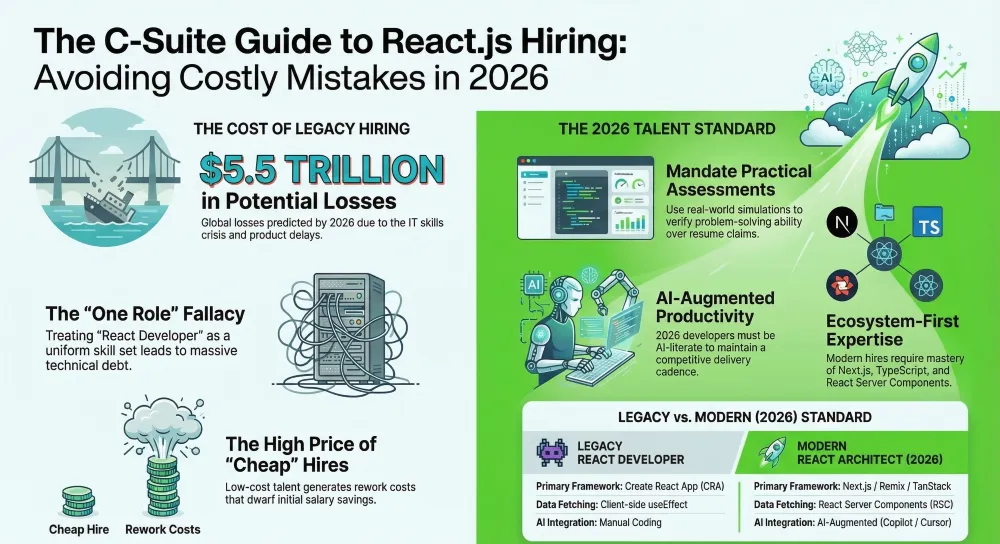
IDC predicts that by 2026, more than 90% of organizations worldwide will feel the impact of the IT skills crisis, resulting in $5.5 trillion in losses from product delays, reduced competitiveness, and lost business. A significant portion of that loss will stem not from a lack of investment in technology, but from poor hiring decisions at the leadership level.
“Gartner predicts that global IT spend will increase by nearly 10% in 2026, far exceeding GDP growth in most major economies. That money needs to land on the right people, with the right skills, at the right time. Anything less is a strategic liability.”
This article breaks down the eight most costly React.js hiring mistakes that C-suite leaders are making right now, and gives you the practical intelligence you need to avoid them. Whether you are looking to hire React.js developers in-house, engage a React.js development company, or evaluate the best React.js development services for your organization, these insights apply directly to you.
Key Takeaways: 8 React.js Hiring Mistakes C-Suite Leaders Must Avoid in 2026
1. “React Developer” Is Not One Role — Define It Precisely. React.js expertise spans a wide spectrum. Always specify framework requirements like Next.js, rendering strategies like SSR and ISR, TypeScript proficiency, and state management expectations before posting any role. Vague job descriptions attract mismatched candidates.
2. Skills Beat Years on Paper. Experience on a resume is a proxy, not a guarantee. Mandate hands-on technical assessments that reflect real production conditions. In a world where AI can polish any resume, verified practical ability is the only reliable hiring signal.
3. The Ecosystem Matters as Much as the Framework. A React developer who only knows React is only half-equipped. Evaluate proficiency across the full delivery stack — Next.js, TypeScript, GraphQL, testing frameworks, and CI/CD pipelines — to avoid integration gaps that slow delivery.
4. Cheap Hires Are Rarely Cheap in the End. Low-cost React talent that underdelivers generates rework, technical debt, and missed timelines that cost far more than the salary savings. Optimize for value delivered, not hourly rate. The best React.js development services offer quality-aligned pricing, not just the lowest bid.
5. Communication and Collaboration Are Core Engineering Competencies. Technical skill without the ability to communicate decisions, participate in code reviews, and collaborate across distributed teams creates organizational drag. Assess soft skills with the same rigor you apply to technical ones.
6. AI Literacy Is Now a Non-Negotiable Hiring Criterion. React developers who effectively use AI-assisted coding tools while retaining strong foundational judgment are measurably more productive. In 2026, hiring without assessing AI literacy means systematically underselecting for performance.
7. Clarity Before Hiring Prevents Chaos After Onboarding. Define deliverables, ownership boundaries, and success metrics before a role is posted — not after the developer joins. Clear 30/60/90-day expectations reduce ramp-up friction and give both parties a shared definition of success.
8. React Talent Is a Continuous Strategy, Not a One-Time Transaction. The React ecosystem evolves too fast for a static hiring approach. Build ongoing upskilling, quarterly capability reviews, and flexible partner relationships into your talent strategy to stay aligned with current standards and avoid capability gaps.
The Overarching Lesson: Every React.js hiring mistake on this list shares a root cause: treating developer hiring as a back-office HR function rather than a front-line strategic decision. C-suite leaders who bring the same rigor to talent acquisition that they apply to product strategy, financial planning, and market positioning will build React teams that consistently deliver. Those who do not will spend 2026 managing the consequences.
Your Competitive Advantage Starts With the Right Partner: Avoiding these mistakes is significantly easier when you work with a React.js development company that has already solved these problems at scale. Full-Stack Techies brings the technical depth, hiring discipline, and outcome-focused engagement model that C-suite leaders need to build high-performing React teams without the guesswork.
Mistake #1: Treating “React Developer” as a Single, Uniform Skill Set
This is arguably the most widespread React.js hiring mistake in the executive playbook, and it quietly derails more projects than any other factor.
In 2026, “React developer” is not a job title that means one clear thing. It is a wide spectrum of expertise. A developer who spent three years building e-commerce UIs with basic hooks and REST API calls is a fundamentally different professional from someone who architects micro-frontend systems using React Server Components, Suspense, and TypeScript with a GraphQL data layer.
React is shedding its client-side-only reputation and transforming into a full-stack, performance-first platform, and Next.js has become the definitive framework for commercial React applications. This means the pool of “React developers” is narrowing to “Next.js/Remix developers.”
When a C-suite leader approves a job requisition that simply says “React.js Developer, 3+ years experience,” the hiring team has almost nothing to work with. They fill the role with whoever clears the experience bar. Months later, the team discovers the new hire cannot implement server-side rendering, has never worked with TypeScript, and has no idea what React Server Components are.
By current market data, 78% of React codebases use TypeScript and 45% of new React projects are adopting Server Components. If your job description does not specify these competencies, you are not describing the role your team actually needs.
What smart leaders do instead: Before approving any React hiring, require your engineering leadership to produce a technical competency matrix. This document should specify framework requirements (Next.js, Remix), state management expectations (Redux, Zustand, Jotai), rendering strategies (CSR, SSR, ISR), and TypeScript proficiency level. When you partner with Full-Stack Techies for React.js development services, this technical scoping exercise is part of the initial engagement, ensuring that every developer placed matches the actual technical demands of your project — not just a generic React profile.
Quick Reference: Legacy vs. 2026 React Competencies
| Feature | Legacy React Developer (Pre-2024) | Modern React Architect (2026) |
|---|---|---|
| Primary Framework | Create React App (CRA) | Next.js / Remix / TanStack |
| Data Fetching | Client-side useEffect / Axios | React Server Components (RSC) / Actions |
| Type Safety | Optional / Basic TypeScript | Strict TypeScript / End-to-end Safety |
| AI Integration | Manual Coding | AI-Augmented (GitHub Copilot / Cursor) |
| Performance | Standard Client-side Rendering | Hydration-optimized (SSR/ISR/PPR) |
Mistake #2: Overweighting Years of Experience Over Practical Problem-Solving Ability
Experience on a resume is a proxy for capability. It is not the same thing as capability itself. Yet at the executive level, “we need someone with eight years of React experience” remains a common and expensive shorthand.
The shift toward skills-based hiring has accelerated, especially in technology. According to General Assembly’s State of Tech Talent 2025 report, the number of HR leaders likely to use skills-first hiring has tripled in just two years. McKinsey’s research shows that employees hired for skills are 30% more productive in their first six months than those hired primarily for degrees.
The React ecosystem moves fast. A developer with five years of experience who spent most of it on a legacy codebase using React class components and jQuery-adjacent patterns may be significantly behind a developer with three years of focused experience building production-grade applications with React 18, concurrent features, and modern tooling.
One of the biggest mistakes employers make when assessing tech talent is an over-reliance on AI to screen resumes and an inability to verify claims made during the hiring process. When generative AI can fabricate a convincing resume in minutes, experience claims demand direct technical validation.
Gartner warns that candidate quality is being threatened by the rise of candidate fraud and candidates’ increasing use of generative AI in the hiring process, and predicts that by 2027, 75% of hiring processes will include certifications and tests for workplace AI proficiency.
What smart leaders do instead: Mandate practical technical assessments that simulate real production conditions. These should include code review exercises, architecture discussions, and live debugging sessions — not just algorithmic puzzles. The best React.js development company partners embed this kind of vetting into their talent qualification process before a developer ever reaches your team. At Full-Stack Techies, every React developer goes through rigorous hands-on evaluation against real-world scenarios before being placed on a client engagement.
Mistake #3: Ignoring the Ecosystem Around React — The Stack Matters as Much as the Framework
No React application exists in isolation. It runs on a build system, communicates with APIs, sits in a cloud environment, integrates with testing frameworks, and gets deployed through a CI/CD pipeline. Hiring a React developer who only knows the React library itself, without understanding the surrounding ecosystem, is like hiring a chef who only knows how to cook but cannot use any kitchen equipment.
By 2025, React’s ecosystem isn’t just mature — it’s borderline overgrown. Between React 18, Next.js, Remix, server components, hydration strategies, and multiple state management libraries, hiring “React developers” means very different things to different teams. Employers increasingly want React plus Next.js, TypeScript, or Tailwind CSS — it’s not just about the framework anymore, it’s how you use it.
C-suite leaders who approve React hiring without understanding what the full-stack context demands often end up with a team that has a React specialist surrounded by tools they cannot effectively use. The result is a patchwork of integrations, slow builds, untested code, and an architecture that cannot scale.
Technical specialization — mastery of Next.js, GraphQL, React Native, or server components — often adds 15 to 35% on base developer rates, reflecting the market’s recognition that these skills represent genuinely differentiated expertise.
What smart leaders do instead: When you hire React.js developers, define the full technology stack in your job requirements. If your application uses GraphQL, your developer needs to know it. If your deployment pipeline runs on Vercel or AWS, your developer should have direct experience with it. Engaging the best React.js development services means working with teams that bring the entire ecosystem — not just isolated React knowledge. Full-Stack Techies takes a holistic view of your technology environment before recommending or placing any React talent, ensuring technical alignment across the full delivery stack.
Mistake #4: Making Cost the Primary Hiring Criterion
This mistake is easy to understand and even easier to regret. Budget pressure is real. The temptation to solve a React.js hiring need by picking the lowest-cost option is genuine. But the cost of a bad hire almost always dwarfs the salary savings.
React developer hourly rates in 2026 range from $25 per hour in parts of Asia to $150 per hour in U.S. tech hubs. A junior React developer in Asia charges $20 to $40 per hour, while a senior React developer in the United States commands $100 to $150 per hour.
The math looks compelling when you see a potential $80-per-hour savings on the table. But those calculations never include the cost of rework, technical debt, missed delivery windows, and the management overhead of fixing problems introduced by an underpowered hire.
Tech unemployment dropped to 2.8% in June 2025, well below the national average, giving experienced candidates options and leverage. For employers, that reality translates into longer searches, more negotiation on compensation, flexibility and role scope, and sustained competition for in-demand technology talent.
In a tight talent market, the best React developers are not sitting on the budget rack. When you treat cost as the primary filter for how to hire React.js developers, you are systematically filtering out the most capable candidates.
What smart leaders do instead: Reframe the financial question from “What is the cheapest way to fill this role?” to “What is the most cost-effective way to get the business outcome I need?” Sometimes the right answer is a dedicated offshore team from a reputable React.js development company that delivers senior-level quality at regional rates. Full-Stack Techies provides transparent, outcome-aligned engagement models that help C-suite leaders optimize for value delivered, not just headcount cost.
Mistake #5: Neglecting Cultural Fit, Communication Skills, and Collaboration Capacity
Technical skill is table stakes. What separates a React developer who transforms your team from one who drags it down is often entirely non-technical.
At the executive level, there is a persistent tendency to leave cultural and communication assessment entirely to HR and engineering managers. This creates a blind spot. C-suite leaders set the tone for the type of talent the organization attracts and retains, and if the hiring framework does not treat communication and collaboration as first-class criteria, neither will the hiring process.
A 2025 Gartner survey of 919 employees aged 22 to 27 found that the Gen Z workforce values job mobility more than job security, and that recent college graduates are leaving their organizations at an alarming rate. When organizations need fewer early-career employees, it creates a fractured pathway to mid-level roles.
React developers who cannot communicate their architectural decisions clearly, who resist code reviews, who fail to document their work, or who cannot work effectively across time zones become organizational liabilities regardless of how technically gifted they are. In an era where distributed and hybrid teams are the norm, communication is not a soft skill. It is a core engineering competency.
Gartner research finds that trust is eroding quickly when stated organizational values do not match day-to-day realities — and barely half of employees report trusting top management. When cultural misalignment between a React developer and your team becomes apparent, it rarely self-corrects.
What smart leaders do instead: Integrate structured communication and collaboration assessments into every React developer interview process. Ask for examples of how the candidate has documented technical decisions, navigated disagreements with product teams, or onboarded others. When evaluating a React.js development company as a partner, look at how their team communicates during the sales process itself — responsiveness, clarity, and proactive updates are reliable proxies for how they will perform as a delivery partner. Full-Stack Techies builds communication cadence expectations directly into all client engagements, including regular syncs, async reporting, and transparent progress documentation.
Mistake #6: Underestimating the Impact of AI Literacy in React Development
This is the mistake that will define which organizations win and which fall behind over the next three years.
AI is not a future consideration for React development teams. It is a present reality that is already separating high-performing developers from average ones. Developers who effectively use AI-assisted coding tools, who understand how to review and quality-check AI-generated code, and who can integrate AI capabilities into React applications are meaningfully more productive than those who do not.
According to the Dice 2025 Tech Jobs Report, 53% of U.S. tech job postings in November 2025 required AI or machine learning skills, up from just 29% a year earlier. Lightcast data shows that job postings requiring AI skills surged 109% from 2024 to 2025.
Employers currently have higher expectations of AI literacy among job candidates than in the past. It is not just about whether a job applicant can code, but how they are integrating AI into their work and using it to enable their role.
At the same time, Gartner cautions that maintaining candidate quality requires organizations to assess candidates’ true abilities without GenAI, while also integrating AI into assessments for roles that have to use it on the job. This is a nuanced distinction. You want developers who are AI-augmented, not AI-dependent.
C-suite leaders who are not asking about AI literacy during React.js hiring are missing a critical differentiator. The best React developers in 2026 use tools like GitHub Copilot, Cursor, and v0.dev to accelerate delivery — but they retain deep enough foundational knowledge to catch, correct, and improve what those tools produce.
What smart leaders do instead: Add explicit AI literacy criteria to your React.js hiring framework. Assess both proficiency with AI development tools and the candidate’s ability to critically evaluate AI-generated code. When engaging the best React.js development services, ask vendors directly how their teams are incorporating AI tooling into their workflows and what quality assurance processes exist around AI-assisted development. Full-Stack Techies integrates AI-augmented development practices across its React engineering teams while maintaining rigorous human code review standards.
Mistake #7: Failing to Define Clear Ownership and Success Metrics Before Hiring
Hiring without clarity is one of the most expensive organizational behaviors a C-suite leader can enable. It happens all the time with React.js hiring. Leadership approves the headcount, a developer joins the team, and within weeks, there is ambiguity about what the person is actually responsible for, how their work will be measured, and what success looks like at three, six, and twelve months.
Gartner identifies regrettable retention as an emerging primary productivity barrier. Organizations are becoming more reliant on mid-level talent, which places enormous pressure on HR to change the way they hire, train, and retain these employees.
Gartner also highlights that performance management processes are increasingly in need of reinvention, noting that most organizations are very ineffective at improving the productivity of underperforming employees and should focus on creating prescriptive mechanisms for low-productivity employees with very clear development goals that must be met by predetermined timelines.
When a React developer joins without clear ownership, three bad things happen. First, they spend their early weeks figuring out what to work on instead of delivering value. Second, managers struggle to hold them accountable because there are no shared success criteria. Third, when performance issues emerge, there is no baseline against which to measure them.
This is especially damaging in agile product organizations where React developers are expected to contribute immediately to sprint delivery. Ambiguity at the start creates velocity drag that compounds over time.
What smart leaders do instead: Before a React.js role is posted, document the specific deliverables expected in the first 30, 60, and 90 days. Define the business metrics the developer’s work will influence — page load performance, feature release cadence, accessibility compliance, conversion rates. Make these criteria part of the offer conversation. When you work with a React.js development company like Full-Stack Techies, this goal-setting exercise is collaborative. The engagement starts with aligning on measurable outcomes, not just technical inputs.
Mistake #8: Treating React Hiring as a One-Time Event Rather Than an Ongoing Talent Strategy
The final and perhaps most strategically damaging React.js hiring mistake is treating it as a one-off transaction. You need a developer, you hire one, you move on. This mindset might have been adequate five years ago. In 2026, it is a formula for constant disruption.
Gartner identifies that organizations’ tech skill needs are evolving faster than ever before, and the speed of change is only going to increase. Traditional permanent and contractor hiring of technology talent is still the backbone, but more strategic and flexible solutions are coming into play, including hire-train-deploy programs that deliver workplace-ready talent.
AI is everywhere, with 36% of developers learning to code for AI in the past year. Gartner predicts that by 2027, 75% of hiring processes will include AI skills tests or certifications, meaning employers need to start thinking about how they will assess AI proficiency now.
The React ecosystem evolves continuously. React 19 has introduced additional server-side capabilities. The Next.js App Router has fundamentally changed how production React applications are structured. TypeScript adoption has become standard rather than optional. A developer hired two years ago with no ongoing skill development is already falling behind the current state of the ecosystem.
C-suite leaders who think of React talent as a static resource will be constantly reactive — scrambling to replace developers who have stagnated or replace teams that cannot deliver on modern requirements. Leaders who think of React talent as a dynamic capability will build the learning programs, career pathways, and partner relationships that keep their teams current.
Robert Half’s analysis of job posting activity finds that employers in the U.S. posted nearly 1.1 million technology jobs in 2025, reflecting ongoing demand for roles that support system reliability, application development, and security alongside emerging priorities tied to AI and data. The competition for React talent is not easing. Your strategy for attracting, developing, and retaining it must be continuous.
What smart leaders do instead: Establish a living React talent strategy that includes regular technical upskilling, access to learning resources, participation in the React community, and quarterly review of team capabilities against current market standards. When partnering with a React.js development company, ensure the partnership agreement includes knowledge transfer, documentation, and handover protocols that build your internal capability rather than creating dependency. Full-Stack Techies structures all client engagements with this in mind, offering hybrid models that allow clients to gradually build internal React capability while maintaining access to expert external support.
Also Read: How to Select React.js Partners for Rapid MVP Launch (Step-by-Step 2026 Guide)
Get scalable, fast, and user-friendly ReactJS solutions tailored to your needs.
Get Free ConsultationHow Full-Stack Techies Helps C-Suite Leaders Avoid These Pitfalls
Avoiding these eight React.js hiring mistakes requires more than good intentions. It requires the right partner — one who understands both the business stakes and the technical realities of modern React development.
Full-Stack Techies is a React.js development company built to serve the needs of executive decision-makers who want more than developers filling seats. Whether you need to hire React.js developers for a specific product initiative, require a dedicated React team to accelerate a digital transformation, or are evaluating the best React.js development services to serve as an extension of your existing engineering organization, Full-Stack Techies brings the technical depth, hiring rigor, and delivery discipline that C-suite leaders need.
From technical competency scoping and candidate assessment to ongoing team development and transparent delivery reporting, Full-Stack Techies is designed to be the React talent partner that helps you execute your digital roadmap with confidence.
Final Thoughts
The demand for skilled React.js talent is not going to soften. React.js is widely used by enterprises and supported by a mature ecosystem. Its consistent release cycle and backward compatibility reduce platform risk and support long-term application maintenance without frequent rewrites or vendor dependency. In 2026, enterprises often choose React for micro frontends, incremental upgrades, and adaptable frontend architectures supporting long-term growth.
That longevity makes your hiring decisions consequential. Every React.js hiring mistake on this list is recoverable — but recovery takes time, money, and organizational energy that could have been invested in building the product. The C-suite leaders who win in 2026 will be those who treat React.js hiring not as a human resources transaction, but as a strategic capability investment.
Get the people right, and the technology will follow.
Ready to build a high-performing React.js team without the costly mistakes? Contact Full-Stack Techies today to discuss how our React.js development services can align with your 2026 product roadmap.
FAQs: React.js Hiring Mistakes C-Suite Leaders Must Avoid in 2026
Q1: What are the most common React.js hiring mistakes C-suite leaders make?
The most common React.js hiring mistakes include treating all React developers as interchangeable, prioritizing cost over capability, skipping practical technical assessments, ignoring ecosystem knowledge beyond the core library, and failing to define clear success metrics before onboarding. These errors lead to delayed product timelines, technical debt, and costly mis-hires.
Q2: How do I hire React.js developers who are truly production-ready in 2026?
To hire React.js developers who are production-ready, go beyond resume screening. Require hands-on technical assessments that simulate real project conditions, verify proficiency in Next.js, TypeScript, and React Server Components, and evaluate their ability to work across the full delivery stack including CI/CD, testing, and API integration. Partnering with a vetted React.js development company like Full-Stack Techies simplifies this process significantly.
Q3: Why is TypeScript proficiency important when hiring React.js developers?
TypeScript has become the industry standard for React development, with over 78% of React codebases now using it. Developers without TypeScript fluency introduce type errors, reduce code maintainability, and slow down team collaboration. Always list TypeScript as a required skill, not an optional one, in your React.js job descriptions.
Q4: What is the difference between hiring a React.js developer and engaging a React.js development company?
Hiring an individual React.js developer gives you one contributor who needs onboarding, management, and integration into your existing team. Engaging a React.js development company gives you access to a complete team with complementary skills, established processes, and immediate delivery capacity. For most C-suite leaders managing complex digital products, a development company offers faster time-to-value and lower execution risk.
Q5: How does AI literacy affect React.js developer performance in 2026?
AI-literate React developers use tools like GitHub Copilot and Cursor to deliver features faster, write cleaner code, and reduce debugging time. In 2026, AI literacy is a measurable productivity differentiator. When evaluating candidates or the best React.js development services, assess how developers integrate AI tooling into their workflow while maintaining strong foundational coding judgment.
Q6: What should C-suite leaders look for beyond technical skills when hiring React developers?
Beyond technical skills, prioritize communication clarity, documentation habits, code review participation, and cross-functional collaboration. React developers who cannot articulate architectural decisions, work effectively in distributed teams, or align with product stakeholders create organizational friction regardless of their coding ability.
Q7: How can we reduce the cost of React.js hiring mistakes without cutting the talent budget?
Reduce hiring mistakes by investing upfront in role definition, structured technical assessments, and cultural fit evaluation. Define 30/60/90-day deliverables before posting the role. Consider engaging a React.js development company that pre-vets talent and offers outcome-aligned engagement models, which reduces the risk of expensive mis-hires while optimizing total delivery cost.
Q8: Is offshore React.js development a reliable option for enterprise projects in 2026?
Yes, when done through the right partner. Offshore React.js development can deliver senior-level quality at significantly lower rates than U.S. or Western European markets. The key is choosing a React.js development company with proven enterprise delivery experience, transparent communication processes, and strong quality assurance practices. Full-Stack Techies offers offshore React teams with the rigor and responsiveness that enterprise clients require.
Q9: How often should C-suite leaders reassess their React.js talent strategy?
At minimum, conduct a quarterly review of your React teamu2019s capabilities against current ecosystem standards. The React landscape evolves rapidly u2014 new rendering strategies, framework updates, and tooling changes emerge continuously. A static talent strategy becomes a competitive liability within 12 to 18 months. Build ongoing learning, upskilling, and partner relationships into your React talent plan.
Q10: What makes Full-Stack Techies different from other React.js development services?
Full-Stack Techies combines deep React.js technical expertise with a business-first engagement model built for C-suite decision-makers. Every engagement starts with technical scoping and outcome definition, not just headcount placement. From dedicated React teams and flexible staff augmentation to full-product delivery, Full-Stack Techies aligns its services to your roadmap, your metrics, and your timeline u2014 making it one of the best React.js development services for organizations that cannot afford hiring guesswork.



