

11 React.js Cost Savings Strategies for C-Suite Budgets
This guide outlines practical React.js Cost Savings strategies designed for C-suite executives to control development costs while maintaining performance and scalability.


In the current fiscal climate, C-Suite leaders are shifting focus from “growth at all costs” to “capital efficiency.” For enterprises powered by React.js, the frontend is no longer just a UI layer—it is a significant driver of Total Cost of Ownership (TCO). Unoptimized React applications often hide mounting expenses in the form of cloud egress fees, developer churn, and high maintenance “taxes.”
This guide outlines 11 actionable React.js Cost Savings Strategies to help CTOs, CFOs, and Product Leaders reduce spending by up to 30% while maintaining high-performance digital experiences.
Also Read: https://fullstacktechies.com/react-js-roi-metrics-track-for-ai-projects/

Executive Summary: Why React.js ROI is a C-Suite Priority
Answer Capsule: React.js cost optimization focuses on reducing “technical waste” in three areas: compute (server/cloud costs), bandwidth (bundle sizes), and labor (developer efficiency). By leveraging modern React 19 features and architectural shifts, enterprises can lower TCO while improving revenue-generating metrics like Page Speed and SEO.
In 2025, the best React.js development services focus on “lean architecture.” Efficiency is the new growth, and React’s ecosystem provides the most robust tooling to achieve it.
Key Takeaways: React.js Cost Savings Strategies for 2025–2026
If you only have two minutes, here are the critical strategic shifts that will define your frontend ROI this year:
- Prioritize React 19 for Labor Efficiency: The new React 19 Compiler eliminates the need for manual performance tuning. By automating “memoization,” your team can improve development velocity by 15–20%, effectively reducing the cost per feature.
- Slash Cloud Spend with Server Components: Transitioning to React Server Components (RSC) can reduce client-side JavaScript bundles by up to 70%. This directly lowers your cloud egress (bandwidth) fees and improves mobile conversion rates.
- Infrastructure at the Edge: Moving from standard Server-Side Rendering (SSR) to Incremental Static Regeneration (ISR) at the Edge reduces origin server load by 30–50%, shifting your infrastructure from a high-cost fixed asset to a scalable, pay-as-you-go model.
- The “Rule of 100” in Testing: Implementing automated visual regression (Playwright/Chromatic) is your best insurance policy. Catching a bug in the CI/CD pipeline is 10x cheaper than resolving a production outage that damages your brand reputation.
- Reduce CAC through Performance: React.js optimization is a growth strategy. Improving Core Web Vitals (LCP, INP) increases organic search rankings, lowering your long-term Customer Acquisition Cost (CAC) compared to paid advertising.
- Embrace Payroll Elasticity: Avoid over-hiring for temporary spikes. Use a hybrid team model where you maintain a core internal architecture team and hire React.js developers through a specialized React.js development company to handle peak feature cycles.
- Incremental Modernization over Rewrites: Never authorize a “Big Bang” rewrite. Use the Strangler Fig pattern to incrementally modernize your React stack, ensuring your budget produces measurable ROI every 90 days rather than every 18 months.
Architect’s Perspective: > “The most common mistake C-Suite leaders make is treating technical debt as a maintenance issue rather than a capital leak. In our audits, we find that a 10% reduction in bundle size often yields a higher conversion lift than a $100k UX redesign. Focus on the plumbing before the paint.” — Senior React Architect
The Executive ROI Checklist
When evaluating your next project proposal from a React.js development service, ensure it addresses these three financial pillars:
- Code Reusability: Is there a documented Atomic Design System to prevent “re-work” costs?
- Data Efficiency: Does the architecture prevent Data Over-fetching to save on infrastructure egress?
- Deployment Agility: Are Micro-Frontends being utilized to prevent cross-departmental deployment bottlenecks?
The Anatomy of React.js Costs: Direct vs. Hidden Expenses
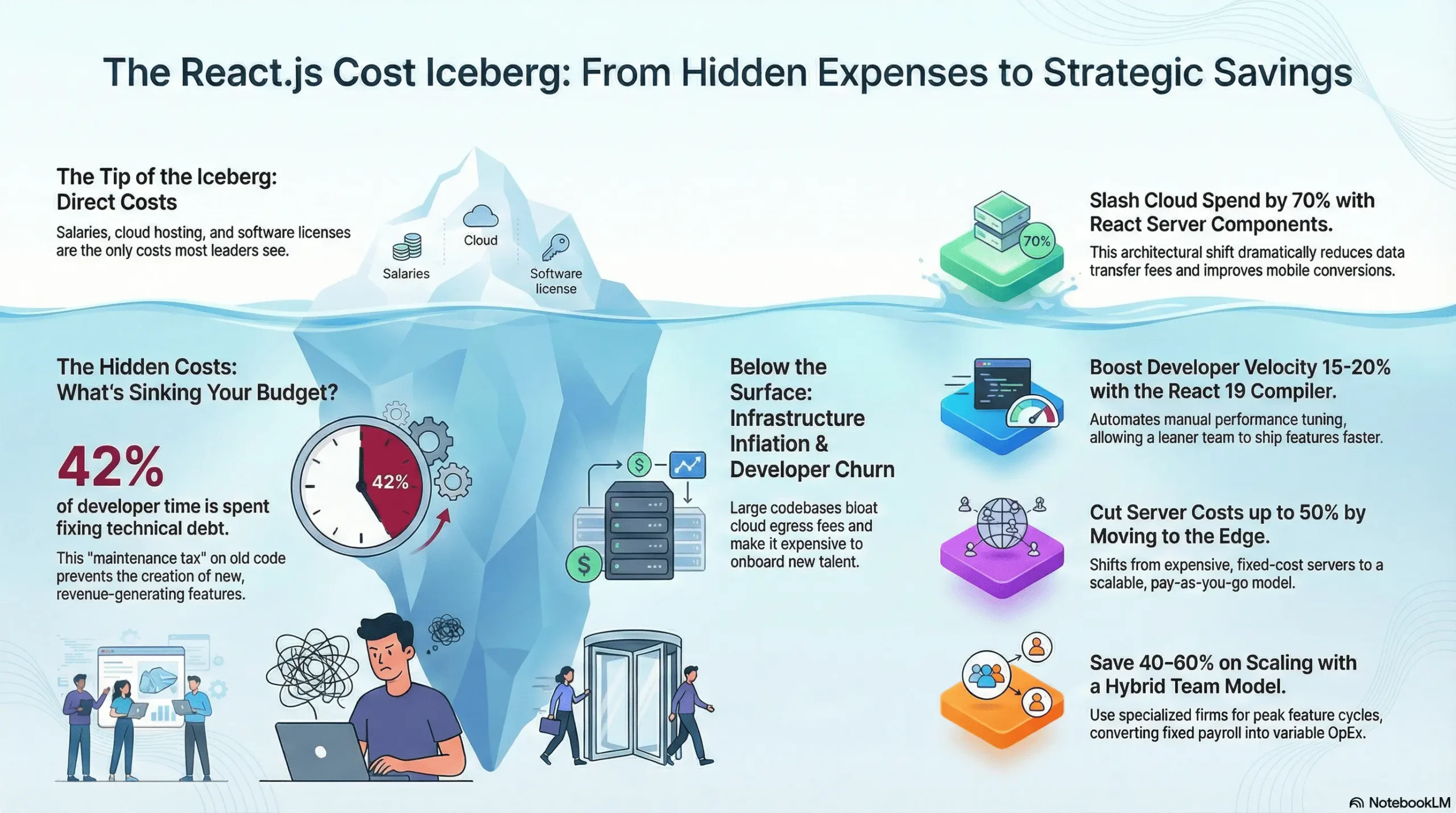
Before implementing savings, you must understand the cost formula. Most leaders only see the “Tip of the Iceberg”:
- Direct Costs: Salaries, cloud hosting (Vercel/AWS), and third-party SaaS licenses.
- Hidden Costs:
- Technical Debt: Developers spend nearly 42% of their time fixing old code rather than building new features.
- Infrastructure Inflation: Large JavaScript bundles increase data transfer (egress) costs.
- Churn & Onboarding: Complex, non-standard codebases make it expensive to hire React.js developers and get them productive.
Category I: Architecture & Rendering Strategies
Strategy #1: Adopt React Server Components (RSC) to Slash “Bandwidth Tax”
The Deep Dive: Traditional React (Client-Side Rendering) forces the user’s device to download, parse, and execute massive JavaScript bundles. RSCs shift this “heavy lifting” to the server.
The Technical Lever: RSCs allow components to stay on the server, sending only a compact, pre-rendered stream to the client. This eliminates the need for the browser to download the code for static parts of your UI (like headers, footers, and sidebars).
The ROI: Industry benchmarks show migrating to RSC can reduce client-side JavaScript by 50% to 70%. For a high-traffic enterprise app, this translates to a 25%–40% reduction in hosting and egress costs.
C-Suite Takeaway: Smaller bundles lead to faster “Time to Interactive,” which Google rewards with higher SEO rankings, lowering your long-term Customer Acquisition Cost (CAC).
Strategy #2: Leverage the React 19 Compiler for “Zero-Manual” Productivity
The Deep Dive: Historically, senior developers spent a significant portion of their week manually optimizing React performance using useMemo and useCallback to prevent “wasted re-renders.”
- The Technical Lever: The React 19 Compiler (formerly “React Forget”) automatically analyzes your code at build-time and applies these optimizations. It understands the “Rules of React” better than a human can.
- The ROI: Automating manual memoization can increase developer velocity by 15% to 20%. This essentially adds “phantom headcount” to your team without increasing your payroll.
- C-Suite Takeaway: When you hire React.js developers, you want them building features, not debugging rendering cycles. The compiler allows a leaner team to ship more code, faster.
Strategy #3: Micro-Frontends to Eliminate “Deployment Gridlock”
The Deep Dive: In a monolithic React app, a single bug in a minor feature can prevent the entire company from deploying a critical revenue-generating update.
- The Technical Lever: Micro-frontends decouple the application into independent, deployable units (e.g., Checkout, Search, Profile). Each team owns its lifecycle.
- The ROI: This architecture eliminates “coordinated releases,” which can save hundreds of man-hours per month in large organizations. It also prevents “Fault Cascades”—if the Search module crashes, the Checkout module remains functional.
- C-Suite Takeaway: Micro-frontends provide business agility. They allow you to scale specific departments independently based on market demand.
Category II: Cloud & Infrastructure Cost Control
Strategy #4: Eliminating “Data Over-fetching” with Intelligent API Layers
The Deep Dive: Many React apps download an entire 500KB “User Object” just to display a first name. This “data waste” adds up across millions of sessions.
- The Technical Lever: Utilizing tools like TanStack Query or GraphQL ensures that the frontend requests only the specific fields required for the view.
- The ROI: Reducing data payloads by 50% directly reduces Cloud Egress fees. In AWS or GCP environments, this can save thousands of dollars monthly in bandwidth costs.
- C-Suite Takeaway: Ask your best React.js development services provider for a “Payload Audit” to identify how much your infrastructure is paying for unused data.
Strategy #5: Edge Rendering & Incremental Static Regeneration (ISR)
The Deep Dive: Traditional Server-Side Rendering (SSR) is CPU-intensive and requires expensive origin servers to stay active 24/7.
- The Technical Lever: ISR (pioneered by Next.js) allows you to generate pages once and cache them at the “Edge” (closer to the user). Pages are only regenerated when data changes.
- The ROI: Shifting compute from the origin server to the Edge CDN can reduce server costs by 30% to 50%.
- C-Suite Takeaway: This strategy offers the speed of a static site with the power of a dynamic one, maximizing performance-per-dollar spent on hosting.
Category III: Engineering Productivity & Team Elasticity
Strategy #6: Atomic Design Systems: Bridging the “Design-to-Dev” Gap
The Deep Dive: The biggest “time-thief” in frontend development is recreating UI components that have already been built elsewhere in the organization.
- The Technical Lever: Implementing a centralized Storybook library based on Atomic Design principles (Atoms, Molecules, Organisms).
- The ROI: Standardized components can accelerate new feature development by 30% to 40%.
- C-Suite Takeaway: A design system is a “capital investment” that pays dividends every time a new page is launched. It ensures brand consistency while slashing the “translation tax” between designers and developers.
Strategy #7: Hybrid Team Models for “Payroll Elasticity”
The Deep Dive: Maintaining a massive in-house team for a project that has “peak” and “trough” cycles is financially inefficient.
- The Technical Lever: Maintaining a core group of internal architects while using a specialized React.js development company to scale the execution layer during high-demand sprints.
- The ROI: This shifts fixed labor costs into Variable OpEx. You only pay for high-intensity talent when there is a clear roadmap to execute.
- C-Suite Takeaway: Transitioning to a hybrid model can lead to 40%–60% cost savings compared to hiring a 100% onshore, full-time staff for temporary scaling needs.
Get scalable, fast, and user-friendly ReactJS solutions tailored to your needs.
Get Free ConsultationCategory IV: Performance-Driven Revenue Protection
Strategy #8: Tree Shaking & The “Dependency Audit”
The Deep Dive: Over time, “dead code” from old libraries accumulates in your React bundle, slowing down every user interaction.
- The Technical Lever: Tree Shaking is a build process that removes unused modules. A regular “Dependency Audit” identifies heavy libraries (like Moment.js) that should be replaced with modern, lightweight alternatives (like Date-fns).
- The ROI: Smaller bundles = faster mobile load times. A 1-second delay in mobile load time can result in a 20% drop in conversions.
- C-Suite Takeaway: Performance is a revenue metric. Every kilobyte removed from your React bundle is an investment in your conversion rate.
Strategy #9: Core Web Vitals (CWV) as an Ad-Spend Multiplier
The Deep Dive: Google uses Core Web Vitals (LCP, INP, CLS) to determine search rankings and “Quality Scores” for Paid Ads.
- The Technical Lever: Optimizing Largest Contentful Paint (LCP) ensures the main content is visible within 2.5 seconds.
- The ROI: Higher CWV scores lead to lower CPC (Cost Per Click) in Google Ads. If your site is faster than your competitors’, you pay less for the same traffic.
- C-Suite Takeaway: Technical optimization is the most effective way to lower your Customer Acquisition Cost (CAC) at the top of the funnel.
Category V: Operational & Long-Term Savings
Strategy #10: The “Rule of 100” in Automated Testing
The Deep Dive: Manual QA is slow, error-prone, and expensive. Catching a bug in production is vastly more costly than catching it during development.
The Technical Lever: Implementing Automated Visual Regression (Playwright/Chromatic).
The ROI: According to the IBM Systems Sciences Institute, the “Rule of 100” states:
Costfix= $100(Design Phase) → $100,000(Production Phase)C-Suite Takeaway: Automated testing is not a “luxury”—it is insurance against the catastrophic cost of production downtime and brand damage.
Strategy #11: The “Strangler Fig” Modernization Pattern
The Deep Dive: “Big Bang” rewrites of legacy React apps are high-risk and often fail to meet budget.
- The Technical Lever: The Strangler Fig pattern involves incrementally replacing the highest-value pages of a legacy app with modern React 19 components while keeping the old app running in the background.
- The ROI: This allows the business to see incremental ROI within 90 days rather than waiting 18 months for a “new version” that might never launch.
- C-Suite Takeaway: This de-risks your modernization strategy and ensures that capital is only spent on parts of the app that provide the most value to the user.
Summary Matrix: The React.js Cost Savings Roadmap
| Strategy | Speed of ROI | Primary KPI | Business Impact |
|---|---|---|---|
| React 19 Compiler | Immediate | Dev Velocity | 20% Increase in Shipping Speed |
| Server Components | 3-6 Months | Infrastructure Cost | 40% Reduction in Egress/CPU |
| Design System | 6-12 Months | Time-to-Market | 30% Savings on UI Rework |
| Automated QA | 1-2 Months | Maintenance Debt | 10x Prevention of Production Fixes |
Measuring Success: The C-Suite React.js KPI Dashboard
To track these React.js Cost Savings Strategies, leaders should monitor the following formula for Total Cost of Ownership:
TOC = (Dlabor + Icloud + Mdept) - Rper f
Dlabor = Developer payroll/agency fees.Icloud=Infrastructure/Hosting costs.Mdebt = Maintenance & bug-fixing hours.Rperf = Revenue gained from performance (SEO/Conversion).
Comparison: Strategic Investment vs. Tactical Refactoring
| Strategy | Speed of ROI | Risk Level | Primary Benefit |
|---|---|---|---|
| RSC Migration | Medium | Medium | 60% Bundle Reduction |
| React 19 Compiler | Fast | Low | 20% Dev Velocity Gain |
| Hybrid Team Model | Fast | Low | OpEx Flexibility |
| Design System | Slow | Low | 40% Long-term Efficiency |
Strategic Constraints: When to De-prioritize Optimization
While these strategies offer high ROI, they aren’t universal. Optimization should be deferred if:
- Market Validation Phase: If you are building a Pre-Seed MVP, speed of delivery outweighs infrastructure efficiency.
- Low-Traffic Internal Tools: For apps with <1,000 users, the cost of migrating to Micro-frontends or RSC may exceed the hosting savings.
- Legacy Stability: If a legacy system is slated for decommission within 12 months, the “Strangler Fig” pattern is an unnecessary expense.
Conclusion: Transforming React.js from a Cost Center to a Revenue Engine
In 2025 and beyond, the distinction between a “functioning” application and a “financially optimized” one will determine which enterprises lead their sectors. As we have explored, React.js Cost Savings Strategies are not merely about cutting corners; they are about eliminating technical waste and reallocating that capital toward innovation.
By adopting React Server Components, leveraging the React 19 Compiler, and stabilizing your team with a hybrid labor model, you shift your frontend from a fluctuating liability to a predictable, high-performance asset.



