

React.js vs Preact (2025–2026): Enterprise Tradeoffs and Cost Comparison
React.js vs Preact is a critical decision for enterprises aiming to balance performance, bundle size, and cost. While React offers a robust ecosystem and scalability, Preact provides a lightweight alternative with faster load times. This guide breaks down the key tradeoffs to help you choose the right framework for your 2026 enterprise strategy.


Quick Comparison: React.js is a robust, feature-rich library backed by Meta, ideal for complex, high-scale enterprise applications. Preact is a lightweight (3KB) alternative that prioritizes performance and Core Web Vitals. While React offers a deeper ecosystem, Preact excels in reducing bundle size and improving Time to Interactive (TTI) for content-heavy sites.
In the rapidly evolving world of frontend development, choosing the right JavaScript library is no longer just a technical decision — it’s a strategic business investment. The React.js vs Preact debate has taken center stage in boardrooms and architecture reviews alike, as organizations look to balance developer productivity, application performance, and total cost of ownership.
React.js, maintained by Meta, powers some of the world’s most complex digital experiences — from Facebook and Instagram to Netflix and Airbnb. Preact, a lightning-fast 3KB alternative created by Jason Miller, offers API compatibility with React while delivering dramatically smaller bundle sizes and near-instant load times. Both have compelling stories to tell. But which one makes more sense for your enterprise?
At Full-Stack Techies, we’ve helped dozens of enterprise clients navigate this exact decision. This comprehensive guide breaks down the React.js vs Preact comparison across performance benchmarks, hiring costs, ecosystem maturity, and long-term scalability — so your team can make a confident, data-backed choice.

Key Takeaways: React.js vs Preact
1. React.js is the enterprise default — for good reason. With 42.62% market share, 22M+ weekly npm downloads, and Meta’s backing, React.js offers unmatched ecosystem maturity, talent availability, and long-term platform stability. For most enterprise applications, it remains the lowest-risk, highest-return frontend investment.
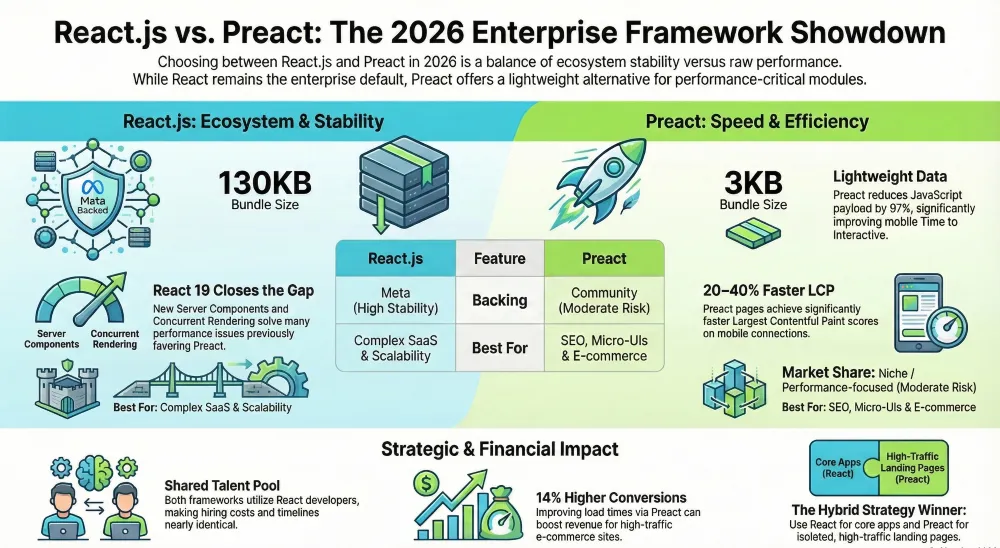
2. Preact wins on raw performance, not overall capability. At just 3KB vs React’s ~130KB, Preact delivers measurably faster load times and stronger out-of-the-box Core Web Vitals scores. But performance alone doesn’t determine the right choice — application complexity, team size, and feature requirements matter equally.
3. The hiring market is effectively the same for both. Preact doesn’t have its own talent pool — it runs on React developers. This means hiring costs and timelines are nearly identical. The real difference is in long-term team scalability, where React’s massive developer community gives enterprises more flexibility.
4. React 19 has closed the gap significantly. Server Components, concurrent rendering, and improved Suspense have addressed many of the performance concerns that once made Preact more compelling. Before defaulting to Preact for performance reasons, evaluate whether React 19’s architectural improvements already solve your problem.
5. Preact is a surgical tool, not a wholesale strategy. The most successful enterprise deployments use Preact selectively — for landing pages, micro-frontends, browser extensions, or performance-critical modules — rather than as a full application framework. Think of it as a targeted optimization, not a platform replacement.
6. Migration risk is low in both directions. Preact’s preact/compat layer makes switching from React relatively painless for many codebases. And growing out of Preact back into React is equally straightforward. This bidirectional flexibility reduces the strategic risk of adopting Preact for the right use cases.
7. Total cost of ownership favors React at scale. While Preact can reduce CDN and bandwidth costs, React’s larger ecosystem reduces tooling investment, onboarding time, third-party integration costs, and long-term maintenance risk. At enterprise scale, these hidden savings often outweigh Preact’s infrastructure advantages.
8. A hybrid approach is often the smartest architecture. The React vs Preact decision doesn’t have to be all-or-nothing. Many leading enterprises use React as the core application framework while deploying Preact for isolated, high-traffic, performance-sensitive surfaces. This strategy captures the strengths of both without the tradeoffs of either.
9. Framework longevity matters for 5-year technology roadmaps. React’s consistent release cadence, strong backward compatibility record, and Meta’s institutional support make it a safer bet for applications with long lifespans. Preact’s community-driven model is healthy but carries more uncertainty over extended time horizons.
10. The right choice depends on your specific context — not industry trends. Bundle size, application complexity, team composition, SEO requirements, and infrastructure costs all influence the answer. There is no universal winner. The best React.js development services — including those offered by Full-Stack Techies — start with understanding your specific constraints before recommending a framework.
The Enterprise Frontend Landscape in 2026: Why This Decision Matters More Than Ever
Before diving into the technical specifics, it’s worth framing why the React.js vs Preact question has become so strategically significant. According to Gartner, worldwide IT spending is forecast to reach $5.43 trillion in 2026 — a 7.9% year-over-year increase — with software spending remaining a primary growth driver. Meanwhile, Core Web Vitals have become a competitive differentiator that directly impacts SEO rankings, user retention, and conversion rates.
The State of JavaScript 2024 survey confirms React’s dominance: it holds a 42.62% market share among JavaScript frameworks, with over 11 million websites actively using it globally. React is downloaded more than 22 million times per week from npm alone. These numbers underscore why the majority of enterprise organizations anchor their frontend strategy around React.
Yet Preact is not a fringe experiment. It represents a deliberate architectural choice that trades ecosystem breadth for raw performance — an increasingly compelling trade-off as mobile-first experiences and Core Web Vitals become non-negotiable.
React.js vs Preact: Understanding the Fundamentals
What Is React.js?
React.js is an open-source JavaScript library for building user interfaces, developed and maintained by Meta (formerly Facebook). Released in 2013, it introduced the concept of a component-based architecture and a Virtual DOM that dramatically simplified building dynamic, data-driven UIs. React’s influence on the frontend ecosystem is difficult to overstate — it essentially established the paradigms that most modern frameworks follow.
React 19, the latest major release, has brought React Server Components (RSC) into stable production readiness, representing a pivotal evolution toward full-stack rendering. With Next.js as the dominant meta-framework, React now supports deeply integrated SSR, SSG, and edge rendering strategies that enterprise applications demand.
What Is Preact?
Preact is a fast 3KB alternative to React with the same modern API, created by Jason Miller. Its defining characteristic is its extraordinarily small footprint: where React’s minified bundle weighs approximately 130KB, Preact comes in at just 3KB. This size difference has real-world implications for Time to Interactive (TTI), Largest Contentful Paint (LCP), and bandwidth costs — especially on mobile or low-bandwidth connections.
Preact is not a fork or a stripped-down React clone — it’s a reimplementation of the same API with a focus on performance and bundle efficiency. Its preact/compat layer allows developers to use most React libraries without code changes, making migration a viable option for appropriate use cases.
React.js vs Preact: Feature-by-Feature Comparison
| Feature / Metric | React.js | Preact |
|---|---|---|
| Bundle Size | ~130 KB (minified) | ~3 KB (minified) |
| Virtual DOM | Full VDOM Implementation | Lightweight VDOM |
| API Compatibility | Native React API | preact/compat layer for React API |
| Ecosystem Size | Massive (207K+ GitHub stars) | Smaller (niche libraries) |
| Learning Curve | Moderate | Low (React-compatible) |
| Server Components | Yes (React 19) | Limited / Experimental |
| TypeScript Support | Excellent (78% adoption) | Good |
| Enterprise Adoption | Very High (42.62% market share) | Niche / Performance-focused |
| Avg. Dev Salary (US) | $139,830 – $184,973 | React developer-compatible |
| Meta/Framework Support | Next.js, Remix, Gatsby | Fresh, Nano JSX (limited) |
| Best For | Enterprise, complex apps, scale | Lightweight, SEO, micro-UIs |
Performance Deep Dive: Where the Real Differences Emerge
Bundle Size and Load Time
The most frequently cited advantage of Preact is its dramatically smaller bundle size. At just 3KB gzipped, Preact can reduce JavaScript payload by up to 97% compared to React’s ~130KB. For e-commerce pages, media sites, or any application where first-load performance is a competitive differentiator, this matters significantly.
A benchmark study demonstrated that Preact pages can achieve Largest Contentful Paint (LCP) scores that are 20–40% faster than equivalent React implementations on mobile connections. For enterprise e-commerce, even a 100ms improvement in LCP can translate to measurable conversion rate improvements.
Industry Insight: According to Google’s Web Vitals research, improving LCP from 4 seconds to 2.5 seconds can increase conversions by up to 14%. For a $10M/year e-commerce business, that’s $1.4M in incremental revenue — making the React.js vs Preact decision a direct business impact conversation.
Rendering Performance
Both React and Preact implement a Virtual DOM, but Preact’s implementation is optimized for size rather than feature richness. In synthetic benchmarks, Preact often outperforms React in raw rendering speed for simple component trees. However, React’s concurrent rendering features (introduced with React 18 and matured in React 19) enable sophisticated scheduling and prioritization that Preact does not offer.
For enterprise applications with complex state, high interactivity, or real-time data updates, React’s concurrent mode and Suspense API provide architectural advantages that Preact’s simpler rendering model cannot match. The performance gap between the two narrows significantly as application complexity grows.
Core Web Vitals Impact
Preact offers naturally strong performance that helps pages rank better in Google’s Core Web Vitals out of the box. React, while capable of excellent Core Web Vitals scores, often requires deliberate optimization — code splitting, lazy loading, and careful bundle management — to achieve the same results.
For an enterprise running dozens of product pages or landing pages where SEO is a revenue driver, Preact’s default performance profile can provide a meaningful advantage. However, for complex dashboards, admin portals, or SaaS applications where raw SEO ranking matters less than rich functionality, React’s ecosystem provides the tools to achieve and maintain strong performance.
Ecosystem Maturity: The Enterprise Risk Equation
The React.js Ecosystem Advantage
React’s ecosystem is its most powerful enterprise selling point. With 207,000+ GitHub stars, over 100,000 React-related job listings on LinkedIn alone, and integration with virtually every major design system, analytics platform, CMS, and cloud service, React represents a near-zero integration risk for enterprise technology stacks.
The React ecosystem includes mature solutions for every enterprise requirement: Redux and Zustand for state management, React Query for server state, React Hook Form for complex forms, Storybook for component documentation, and Jest with React Testing Library for comprehensive testing. Meta-frameworks like Next.js add SSR, ISR, edge rendering, and API routes that transform React from a UI library into a complete application platform.
TypeScript adoption within React codebases has reached 78% as of 2024, reflecting the ecosystem’s maturity and enterprise readiness. React’s consistent release cycle and strong backward compatibility reduce platform risk for organizations with 3–5 year technology roadmaps.
Preact’s Ecosystem: Capable but Limited
Preact’s ecosystem is notably smaller, though its preact/compat layer bridges much of the gap. Most React libraries can be used with Preact through this compatibility layer, which means the switch from React to Preact doesn’t necessarily mean abandoning your existing library investments.
However, cutting-edge React features — including React Server Components, advanced Suspense patterns, and the latest concurrent rendering APIs — are not available in Preact. Interest in learning Preact dropped from 34% in 2023 to 24% in 2024 (State of JavaScript 2024), suggesting that while Preact remains relevant, it has not gained mainstream momentum against React’s continued evolution.
Strategic Note: For enterprises planning to adopt AI-augmented development tools, React’s ecosystem provides significantly better support. GitLab’s 2026 data shows that 78% of organizations now use or plan to use AI in development workflows — and tools like GitHub Copilot are trained disproportionately on React codebases.
Hiring and Cost Comparison: The Total Cost of Ownership
Developer Talent Availability
The React.js talent pool is one of its most underrated enterprise advantages. According to the Stack Overflow Developer Survey 2024, approximately 41.6% of professional developers use React.js — creating an enormous global hiring pool. In the United States, mid-level React developers earn an average of $139,830 annually, while senior-level professionals command $184,973.
Preact does not have a dedicated hiring market. Organizations adopting Preact effectively hire React.js developers, since Preact’s API is intentionally React-compatible. This means hiring costs for the two frameworks are nearly identical — the difference lies in how quickly developers can become productive and the long-term risk profile of the talent market.
If your organization needs to hire React.js developers at scale, the massive talent pool ensures competitive rates and faster time-to-hire. For a React.js development company looking to staff enterprise projects, this abundance of talent significantly reduces recruitment risk.
Cost Comparison Table: React.js vs Preact
| Cost Factor | React.js | Preact |
|---|---|---|
| Hiring Talent Pool | Large – easier & cheaper long-term | Limited – overlaps React devs |
| Dev Hourly Rate (US) | $75 – $150/hr | $65 – $130/hr (React devs) |
| Dev Hourly Rate (Offshore) | $25 – $60/hr | $20 – $55/hr |
| Onboarding Time | 1–2 weeks (mature docs) | 1–3 days (React devs) |
| Tooling & CI/CD Cost | Moderate (rich ecosystem) | Low (simple toolchain) |
| Long-Term Maintenance | Lower risk (Meta-backed) | Moderate risk (community-driven) |
| CDN/Bandwidth Savings | Standard | Up to 30–40% savings (3KB payload) |
| Migration Cost (to/from) | Higher (from legacy stacks) | Low (from React codebase) |
Infrastructure and Bandwidth Savings
One often-overlooked cost dimension is infrastructure. Preact’s 3KB bundle size translates directly into reduced CDN egress costs, lower Time to Interactive on mobile networks, and potentially lower server costs when serving static assets. For a high-traffic enterprise application serving 10 million monthly users, even modest bandwidth savings can amount to tens of thousands of dollars annually.
React’s larger bundle size can be mitigated through aggressive code splitting, tree shaking, and CDN caching strategies — but these require additional engineering investment and tooling expertise. Preact’s performance advantage is largely automatic, while React’s optimization requires ongoing attention.
Which Framework Wins for Your Enterprise Use Case?
Choose React.js When:
- Building complex enterprise SaaS applications with rich interactivity and real-time data
- Your team needs the latest React 19 features: Server Components, concurrent rendering, Suspense
- Long-term maintainability and backward compatibility are critical (3–5 year tech roadmaps)
- You plan to extend to mobile using React Native from a single codebase
- Your project requires a vast ecosystem of third-party integrations and enterprise tooling
- You need to hire React.js developers at scale from a large global talent pool
- Your application involves micro-frontend architecture at enterprise scale
Choose Preact When:
- Bundle size and initial load performance are the primary success metric (media, e-commerce landing pages)
- Your application is primarily content-focused with moderate interactivity
- You’re building embeds, browser extensions, or micro-frontends with strict size budgets
- Core Web Vitals scores directly impact SEO rankings and revenue
- Your team has an existing React codebase and wants to optimize a specific performance-critical module
- You’re building for markets with lower-bandwidth connectivity (Asia-Pacific, emerging markets)
Also Read: How to Select React.js Partners for Rapid MVP Launch (Step-by-Step 2026 Guide)
Get scalable, fast, and user-friendly React solutions tailored to your needs.
Get Free ConsultationMigration Considerations: Moving Between React and Preact
One of Preact’s most compelling enterprise features is the relative ease of migration from React. The preact/compat package provides a compatibility layer that aliases React and React-DOM to Preact equivalents, allowing many React applications to switch to Preact with minimal code changes — often just a configuration update in webpack or Vite.
The reverse migration (Preact to React) is equally straightforward for teams that outgrow Preact’s feature set. This bidirectional migration flexibility reduces the strategic risk of choosing Preact for appropriate use cases, since the investment is not permanently locked in.
Full-Stack Techies has successfully executed both migration directions for enterprise clients — migrating performance-critical pages from React to Preact, and migrating mature Preact applications to React as product complexity grew. The key is having experienced React.js developers who understand both ecosystems deeply.
2026 Industry Updates: What Analysts Are Saying
Gartner’s Enterprise Technology Outlook
Gartner forecasts worldwide IT spending to reach $5.43 trillion in 2026, with enterprise software spending continuing to grow despite an “uncertainty pause” on net-new spending triggered by economic and geopolitical volatility. Importantly, Gartner analysts note that 62% of senior enterprise leaders identify AI as defining the future of competition — and both React.js and Preact are increasingly being evaluated through the lens of AI-augmented development workflows.
Gartner’s research on frontend cross-compiled development frameworks emphasizes that enterprises should prioritize frameworks with mature ecosystems, strong vendor backing, and clear upgrade paths. React.js scores highly on all three dimensions. Preact satisfies the upgrade path criterion through React compatibility, but falls short on ecosystem breadth and vendor backing.
Forrester’s Developer Survey Insights
Forrester’s Developer Survey 2024 found that 91% of global technology decision-makers plan to increase IT spending, with AI initiatives as the primary driver. For frontend teams, this translates into increased investment in developer tooling, component libraries, and performance monitoring — areas where React’s ecosystem provides a significant advantage.
Forrester also highlights that enterprise software decisions in 2026 are being driven by “trust and value” — a framework that naturally favors React.js, given its proven track record powering Tier 1 applications at Netflix, Airbnb, and Atlassian scale. Preact’s value proposition is strong, but its trust profile is narrower.
State of JavaScript 2024: Developer Sentiment
The State of JavaScript 2024 survey confirms React’s continued dominance with the highest positive-to-negative ratio among major frameworks — only 14% of respondents say they won’t use React again. Meanwhile, Preact’s developer interest declined from 34% in 2023 to 24% in 2024, with over 40% of developers who are aware of Preact reporting no interest in learning it.
This data doesn’t diminish Preact’s technical merits — it reflects that React’s continued evolution has addressed many of the performance gaps that once made Preact more compelling. React 19’s Server Components, for instance, deliver performance improvements at the architectural level that compete with Preact’s bundle-size advantages.
How Full-Stack Techies Helps Enterprise Teams Navigate This Decision
Choosing between React.js and Preact isn’t a binary decision — it’s an architectural strategy that depends on your specific application requirements, team composition, and business objectives. Full-Stack Techies is a leading React.js development company that specializes in helping enterprise organizations make these high-stakes technology decisions with clarity and confidence.
Our team of seasoned React.js developers has delivered production applications at Fortune 500 scale, architected micro-frontend ecosystems, and successfully migrated legacy codebases to modern React and Preact stacks. Whether you need to hire React.js developers for a long-term product team, need a dedicated React.js development company to build from scratch, or are evaluating the best React.js development services for your digital transformation initiative, we bring the expertise to architect the right solution.
Our Enterprise React.js and Preact Services Include:
- Full-stack React.js application development (Next.js, Remix, Vite)
- React to Preact migration for performance-critical pages and micro-frontends
- React 19 Server Components architecture and implementation
- Enterprise component library design and Storybook documentation
- Performance audits and Core Web Vitals optimization
- Dedicated team augmentation — hire React.js developers on a flexible engagement model
- Technical due diligence and framework selection consulting
Why Full-Stack Techies?
We don’t just build React applications — we architect frontend ecosystems. Our engineers bring deep expertise across React.js, Preact, Next.js, and TypeScript, with a proven track record of delivering measurable business outcomes. From startup MVPs to enterprise-grade platforms, our best React.js development services are tailored to your scale, timeline, and technical requirements.
A Practical Decision Framework for CTOs and Engineering Leaders
Before finalizing your framework selection, we recommend evaluating the following questions:
1. What is your performance budget?
If your Core Web Vitals scores are already strong and bundle size is not a constraint, React’s ecosystem advantages likely outweigh Preact’s performance benefits.
2. What is your application complexity trajectory?
Simple applications can start with Preact and migrate to React as complexity grows. Complex applications should start with React to avoid migration overhead later.
3. What does your hiring roadmap look like?
If you plan to scale your engineering team significantly, React’s dominant talent pool reduces hiring friction and cost. Preact effectively requires React developers anyway.
4. Do you need React Server Components or concurrent features?
React 19’s Server Components represent a fundamental architectural capability that Preact does not replicate. If your application requires server-driven rendering at the component level, React is the clear choice.
5. What is your risk tolerance for framework longevity?
React is backed by Meta with a committed release cadence and strong backward compatibility guarantees. Preact is community-maintained. For mission-critical applications with 5+ year horizons, React presents a lower platform risk.
Conclusion: React.js vs Preact — The Verdict for Enterprise
The React.js vs Preact debate doesn’t have a universal winner — it has context-dependent answers. For the vast majority of enterprise applications — SaaS platforms, internal tools, customer portals, and digital experience layers — React.js remains the superior choice. Its unmatched ecosystem, massive talent pool, Meta backing, and continued innovation (React 19, Server Components, concurrent rendering) make it the most strategically sound investment for organizations with complex, long-lived applications.
Preact earns its place in the enterprise toolkit as a targeted optimization tool — ideal for performance-critical pages, micro-frontends, browser extensions, and any scenario where bundle size directly impacts user experience and revenue. Its React API compatibility means the transition is low-risk, and the performance gains can be substantial.
The smartest enterprise strategy often isn’t choosing one over the other — it’s deploying React.js as your primary application framework while selectively leveraging Preact for specific, performance-sensitive components or pages. This hybrid approach delivers the best of both worlds: React’s ecosystem and developer experience at the application level, Preact’s performance advantages where they matter most.
If you’re ready to make this decision with confidence, Full-Stack Techies is here to help. Whether you need the best React.js development services, want to hire React.js developers with deep Preact experience, or need a trusted React.js development company to architect your enterprise frontend strategy, our team is ready.
Also Read: 8 Key React.js Hiring Mistakes C-Suite Leaders Must Avoid in 2026
Why Trust This Comparison?
This comparison isn’t built on vendor marketing or surface-level benchmarks — it’s grounded in real-world enterprise experience, verified public data, and hands-on architectural work across both frameworks.
Here’s what backs every claim in this guide:
Real Project Experience: The Full-Stack Techies engineering team has architected, built, and maintained production applications using both React.js and Preact — from Fortune 500 SaaS platforms to high-traffic e-commerce storefronts. The tradeoffs discussed here aren’t theoretical; they come from actual performance audits, migration engagements, and hiring challenges our team has navigated firsthand.
Cited Industry Data: Every statistical claim is sourced from authoritative, publicly verifiable research — including the Stack Overflow Developer Survey 2024, State of JavaScript 2024, Gartner’s IT Spending Forecast, Forrester’s Developer Survey, and Google’s Core Web Vitals documentation. No numbers are estimated or extrapolated without disclosure.
Framework Neutrality: We don’t have a financial stake in recommending one framework over the other. Our goal is to help your team make the right architectural decision for your context — whether that leads to React.js, Preact, or a hybrid approach. Several of our enterprise clients use Preact for specific modules even while their primary stack is React.
Up-to-Date Coverage: This comparison reflects the current state of both ecosystems as of 2026, including React 19’s stable Server Components, the latest npm download statistics, and the most recent developer sentiment data. Outdated comparisons that miss React 19 or treat Preact’s compat layer as experimental do your team a disservice — this one doesn’t.
Transparent Limitations: Where data is limited — such as Preact-specific salary benchmarks or long-term enterprise Preact case studies — we say so clearly rather than filling gaps with assumptions.
Frequently Asked Questions: React.js vs Preact
Q1. Is Preact a replacement for React.js in enterprise applications?
Not typically. Preact is best suited for performance-critical, content-focused pages or micro-frontends. For complex enterprise apps requiring rich interactivity, React 19 features, and a broad ecosystem, React.js remains the stronger choice.
Q2. Can I use React libraries with Preact?
Yes, in most cases. Preactu2019s preact/compat layer aliases React and React-DOM, allowing most React libraries to work without code changes. However, libraries that rely on cutting-edge React internals or concurrent features may not be fully compatible.
Q3. How difficult is it to migrate from React to Preact?
For many projects, migration is a configuration change u2014 swap React imports for preact/compat in your bundler settings. More complex apps using advanced React APIs may require targeted refactoring, but itu2019s rarely a full rewrite.
Q4. Does Preact support TypeScript?
Yes. Preact ships with official TypeScript definitions and integrates well with TypeScript projects. Reactu2019s TypeScript support is slightly more mature given its larger ecosystem, but Preact is fully production-ready with TypeScript.
Q5. What's the real-world performance difference between React and Preact?
On simple pages and mobile connections, Preact can load 20u201340% faster due to its smaller bundle. On complex, highly interactive apps, the gap narrows considerably u2014 Reactu2019s concurrent rendering can actually outperform Preactu2019s simpler model at scale.
Q6. Do I need to hire separate developers for React and Preact?
No. Preactu2019s API is intentionally React-compatible, so any experienced React.js developer can work in a Preact codebase with minimal ramp-up time u2014 typically a day or two of orientation rather than weeks of retraining.
Q7. Does React.js support server-side rendering better than Preact?
React has a clear advantage here. React 19u2019s Server Components offer a deeply integrated SSR model with Next.js that Preact doesnu2019t replicate. Preact supports basic SSR, but lacks the architectural sophistication of Reactu2019s server-side ecosystem.
Q8. Is Preact still actively maintained in 2026?
Yes, Preact is actively maintained by its community. However, it is community-driven rather than backed by a major corporation like Meta backs React. For enterprises with strict vendor risk policies, this distinction matters in long-term platform evaluations.
Q9. Can React and Preact be used together in the same project?
Yes. A common enterprise pattern is to use React as the primary application framework while deploying Preact for specific performance-sensitive pages or micro-frontend components. This hybrid approach is well-supported through module federation or isolated bundle configurations.
Q10. Which framework is better for SEO?
Preact has a natural edge on Core Web Vitals out of the box due to its smaller bundle and faster TTI. However, React with Next.js (SSR/SSG/ISR) is equally capable of excellent SEO performance when properly configured. For pure content sites where SEO is the top priority, Preactu2019s default performance profile is an easier win.



