

React Server Components (RSC) for Enterprise: Reducing Cloud Costs While Boosting SEO
This guide explains how React Server Components (RSC) for Enterprise help organizations cut cloud infrastructure costs while boosting SEO, performance, and scalability for modern React applications.


Introduction
The transition to React Server Components (RSC) for Enterprise represents a fundamental architectural shift. It isn’t just a performance upgrade; it is a strategic business decision that directly impacts the bottom line by slashing infrastructure overhead and securing dominant search engine rankings.
In this deep dive, we explore how RSC solves the “JavaScript Tax” that has long plagued large-scale applications, offering a roadmap for CTOs and Marketing Leads to drive 2026 growth.
Also Read: 11 React.js Cost Savings Strategies for C-Suite Budgets

Key Takeaways for Enterprise Leaders
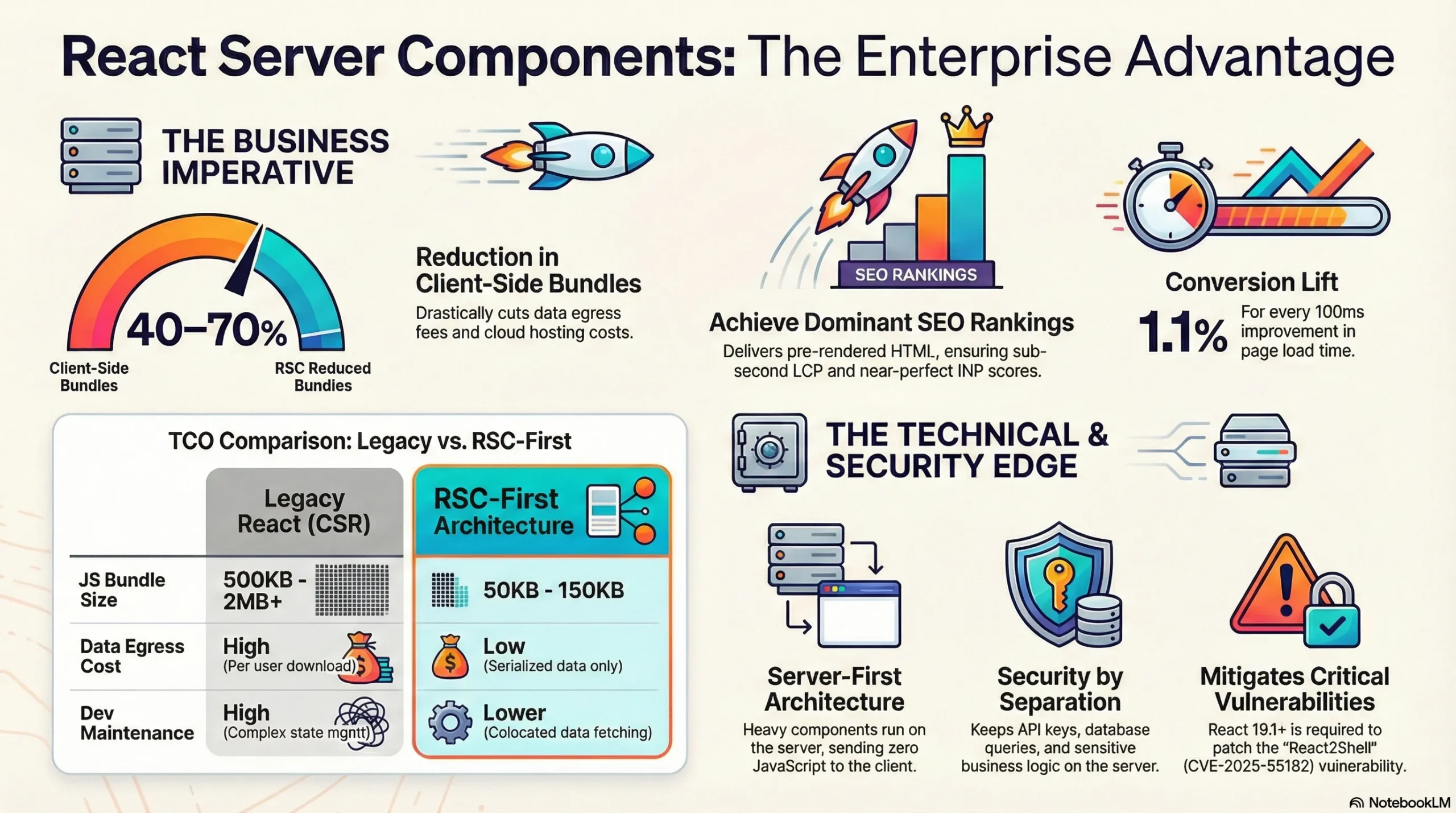
- Drastic Infrastructure Savings: By moving heavy dependencies to the server and shipping “Zero-JS” components, enterprises can reduce client-side bundles by 40–70%. This translates directly into lower data egress fees and hosting costs.
- Superior SEO Performance: RSC delivers fully-rendered HTML to search bots, bypassing the “hydration gap.” This yields sub-second Largest Contentful Paint (LCP) and near-perfect Interaction to Next Paint (INP) scores—two of Google’s most weighted ranking factors in 2025.
- Security by Separation: RSC acts as a natural security boundary. By keeping API keys, sensitive business logic, and database queries strictly on the server, you drastically reduce the attack surface area exposed to the client’s browser.
- Critical 2026 Patching: Following the December 2025 React2Shell (CVE-2025-55182) disclosure, enterprise security teams must ensure they are on React 19.1+ or Next.js 15+ to protect against unauthenticated RCE vulnerabilities in the Flight protocol.
- Strategic Incrementalism: You do not need a full rewrite to see results. The Best React.js development services recommend a “Server-First” migration for high-traffic layouts and data-heavy catalogs, keeping interactivity isolated to the “leaves” of your component tree.
- Talent as a Catalyst: The learning curve for the RSC mental model can be steep. To accelerate ROI, many organizations choose to hire react.js developers with specific experience in the App Router or partner with a react.js development company to audit their architecture and lead the transition.
Executive Summary: The Business Case for RSC
React Server Components (RSC) to allow developers to render components on the server, sending only the final HTML and a minimal data stream to the client. For the enterprise, this translates into:
- Cost Efficiency: A potential 25–40% reduction in hosting costs and up to 70% bandwidth savings by eliminating heavy client-side libraries.
- SEO Dominance: Sub-second Largest Contentful Paint (LCP) and superior indexability, as search bots receive “ready-to-read” HTML instantly.
- Security: Proprietary business logic and API keys stay behind the firewall, never reaching the user’s browser.
Expert Insight: In late 2025, with the release of React 19, RSC became the industry standard for full-stack performance, particularly for data-intensive SaaS and E-commerce platforms.
At a Glance: The Enterprise ROI of RSC
Infrastructure: Reduces client-side JS bundles by 40–70%, cutting data egress fees and CDN costs.
SEO: Achieves sub-second LCP and near-instant INP by shipping pre-rendered HTML, bypassing the hydration gap.
Security: Keeps API keys and sensitive logic server-side; mitigates CVE-2025-55182 when using React 19.1+.
Revenue: Every 100ms improvement in load time correlates to a 1.1% increase in conversion rates.
Deep Dive: What Makes RSC “Enterprise-Grade”?
Traditional React applications follow a Client-Side Rendering (CSR) model where the browser downloads a massive JavaScript bundle before the user sees a single pixel. RSC flips this script.
The Architecture Shift
RSC operates on a “Server-First” mental model. Components are categorized into two types:
- Server Components: These run only on the server. They have direct access to databases and file systems. They ship zero JavaScript to the client.
- Client Components: Designated with a
'use client'directive, these handle interactivity (e.g., carousels, forms).
By moving the heavy lifting to the server, enterprises can utilize “Zero-Bundle-Size” dependencies. For instance, if you use a 100KB library to parse Markdown, that library stays on your server. The user only receives the resulting 2KB of HTML.
Slaying Cloud Costs: Infrastructure Optimization
For a high-traffic enterprise site, cloud bills are often driven by Data Egress and Compute Execution Time. RSC directly optimizes both.
Reducing Data Egress Fees
In a standard React app, every visitor downloads the same heavy dependencies. With RSC, these are processed once on the server. Data from 2025 benchmarks shows that migrating to an RSC-heavy architecture can slice client-side JavaScript bundles by 40–60%. This results in a massive drop in bandwidth consumption across CDNs like Cloudflare or Akamai.
Lowering Client-Side Compute
RSC shifts the CPU burden from the user’s device to the server. This is critical for global enterprises targeting users on low-end mobile devices or in regions with slower networks. By providing a “visually complete” page without waiting for JavaScript execution, you reduce bounce rates and improve user retention.
TCO (Total Cost of Ownership) Analysis
| Metric | Legacy React (CSR/SSR) | RSC-First Architecture |
|---|---|---|
| JS Bundle Size | 500KB – 2MB+ | 50KB – 150KB |
| Server Response | Sequential/Blocking | Streaming/Non-blocking |
| Data Egress Cost | High (Per user download) | Low (Serialized data only) |
| Dev Maintenance | High (Complex state mgmt) | Lower (Colocated data fetching) |
Enterprise SEO: Winning the Search & Discovery Game
Google’s 2025 ranking algorithms place a heavy emphasis on Core Web Vitals, particularly the new Interaction to Next Paint (INP) metric.
Instant Indexability
Because RSC sends pre-rendered HTML, search engine crawlers (Googlebot, Bingbot) don’t have to wait for a “hydration” phase. Your content is visible and indexable the millisecond it hits the stream.
Mastering Core Web Vitals (CWV)
- LCP (Largest Contentful Paint): RSC allows for “Streaming,” where the most critical parts of the page (like a hero image) are sent first. This consistently achieves LCP scores well under the 2.5s threshold.
- INP (Interaction to Next Paint): By shipping less JavaScript, the main thread remains free. This means when a user clicks a button, the response is near-instant, boosting your “Page Experience” score.
Security, AI, and Data Governance in 2026
In December 2025, a critical RCE vulnerability (CVE-2025-55182) was discovered in the React Flight protocol, emphasizing why “Enterprise” RSC must be handled with care.
Security by Design
Modern RSC frameworks (like Next.js 15+) now feature experimental_taint APIs. These allow developers to “taint” specific data objects (like a user’s password hash) so they can never accidentally be passed from a Server Component to a Client Component.
RSC + Generative AI
For enterprises building AI-powered dashboards, RSC is the perfect delivery mechanism. It supports Streaming LLM responses directly into the UI, allowing users to see AI-generated content in real-time without the overhead of client-side web sockets or complex state synchronization.
Measuring ROI: KPIs for Tech Leaders
Adopting React Server Components (RSC) for Enterprise is an investment in long-term scalability.
- Conversion Lift: Studies show every 100ms improvement in load time correlates to a 1.1% increase in conversions.
- Operational Savings: Reduced API boilerplate means your developers spend less time writing “glue code” and more time building features.
If your internal team is at capacity, many organizations choose to hire react.js developers who specialize specifically in the App Router and RSC paradigm to accelerate this migration. Partnering with a specialized React.js development company can reduce the “Learning Curve” risk, which is often the biggest hurdle in RSC adoption.
Migration Roadmap: Moving the Needle
You don’t need a “big bang” rewrite. The Best react.js development services recommend an incremental approach:
- Audit the Layout: Convert your root layouts and navigation to Server Components first.
- Isolate Data Fetching: Identify components that fetch data from APIs and move that logic to the server.
- Optimize the Leaf Components: Keep interactivity (buttons, forms) as Client Components at the “leaves” of your component tree.
The Expert’s Caveat: When to Be Cautious with RSC
While the benefits are clear, enterprise architects must weigh the following trade-offs:
- Server Load: Shifting execution from the client to the server requires more robust backend scaling strategies.
- Complexity of State: Sharing state between Server and Client Components (the “serialization boundary”) requires a disciplined approach to prevent “Prop Drilling” or unnecessary re-renders.
- Library Compatibility: Not all third-party UI libraries are “RSC-ready,” which may necessitate custom wrappers using the
'use client'directive.
Decision Matrix: Is Your Enterprise Ready?
| Criteria | Adopt RSC Now | Wait/Partial Adoption |
|---|---|---|
| Content Type | E-commerce, SaaS, Blogs | Highly interactive Dashboards |
| SEO Priority | Critical for Revenue | Low (Internal tools) |
| Legacy Debt | Using Next.js 13+ or React 18+ | Stuck on React 16/17 |
| Team Skill | Experienced with modern React | New to Hooks/Functional React |
Get scalable, fast, and user-friendly ReactJS solutions tailored to your needs.
Conclusion: Navigating the “Server-First” Future of Enterprise
React Server Components (RSC) for Enterprise are no longer a technical luxury; they are a fiscal and strategic imperative for the 2026 digital landscape. By fundamentally decoupling data fetching from client-side execution, RSC solves the two biggest challenges facing modern organizations: ballooning infrastructure costs and the increasing complexity of SEO in an AI-driven search era.
As we move deeper into this year, the “Server-First” architecture has become the gold standard for high-traffic platforms that cannot afford to compromise speed or security. The organizations that thrive will be those that view RSC not just as a library update, but as a core component of their digital transformation. By offloading the “JavaScript Tax” to the server, you effectively future proof your application against shifting Core Web Vitals and ensure your content remains instantly accessible to both human users and AI crawlers.
Looking toward late 2026, we anticipate “Hybrid AI-RSC” architecture becoming the norm. By utilizing RSC to stream data directly into client-side LLM interfaces, enterprises will be able to deliver hyper-personalized, AI-driven experiences without the latency of traditional API polling. This synergy between server-side rendering and generative intelligence will define the next era of the enterprise web.
Your Strategic Next Steps
The path to migration requires a blend of architectural foresight and specialized expertise. To ensure a seamless transition without disrupting your current revenue streams:
Conduct a Readiness Audit: Evaluate your current tech stack for compatibility with React 19 and the App Router.
Prioritize SEO-Critical Pages: Start by migrating high-traffic landing pages and e-commerce catalogs to RSC to see immediate ROI.
- Leverage Specialized Talent: If your internal team is focused on product features, consider partnering with a top-tier React.js development company to lead the architectural overhaul. Whether you need to hire React.js developers for a short-term sprint or seek out the best React.js development services for a long-term partnership, having RSC experts at the helm is the most effective way to mitigate migration risks and maximize cloud savings.
Ultimately, the shift to RSC is about more than just cleaner code—it’s about building a leaner, faster, and more profitable enterprise.



