

Redux vs Context API in React.js (2025): Which State Management Wins for Business?
This guide compares Redux vs Context API in React.js, helping business leaders and engineers choose the best state management approach based on scalability, maintainability, and ROI in 2025.


Choosing the right way to manage data is a huge decision for any React.js development company. In 2025, the debate between Redux vs Context API in React.js (2025) is no longer about which is “better,” but which fits your specific business goals.
With the recent launch of React 19 and the rise of the React Compiler, the way we handle the state has changed. This guide will help you decide which tool will make your application fast, scalable, and easy to maintain through 2026.
Also Read: Next.js vs Gatsby: Performance Comparison for React.js AI Sites (2025–2026)

Redux vs Context API in React.js (2026): Executive Summary
In the rapidly evolving landscape of 2026, the choice between Redux and the Context API has moved beyond a simple technical preference. With the maturity of React 19 and the ubiquity of the React Compiler, the architectural decision now hinges on your application’s data density and team velocity.
The 2026 Bottom Line:
- The Verdict: For enterprise-grade platforms, AI-driven dashboards, and complex SaaS products, Redux Toolkit (RTK) is the essential choice for maintaining predictability and a high-performance audit trail. For consumer-facing MVPs, blogs, and marketing sites where state is mostly static, the Context API is the most cost-efficient, zero-dependency solution.
- Performance Shift: The React Compiler has largely solved the “cascading re-render” issue for simple Context usage. However, Redux remains the undisputed king of high-frequency updates (e.g., real-time AI token streaming or stock tickers) due to its fine-grained, selector-based subscription model.
- Strategic ROI: Choosing the Context API for a complex application creates a “Simplicity Debt.” While you save 15% on initial setup time, you risk a $200k+ refactor cost in year two when “Provider Hell” and debugging complexity bottleneck your feature releases.
Key Takeaways: Strategic State Management in 2026
- Complementary, Not Competitive: In 2026, the best architecture is Hybrid. Use the Context API for low-frequency “Environment State” (themes, auth status, locale) and Redux Toolkit for “Domain State” (API data, complex business logic, real-time streams).
- The Scalability Rule: If your application is expected to grow beyond 10–15 screens or requires a team of more than 5 developers, Redux Toolkit is your “insurance policy” against technical debt and “Provider Hell.”
- Performance Beyond the Compiler: While the React Compiler has optimized rendering for Context, Redux still holds the edge for high-frequency updates. Its selector-based subscription model ($O(1)$ efficiency) ensures that massive data streams (like AI tokens or financial tickers) don’t lock the UI.
- Standardization Drives ROI: Redux provides a global “blueprinted” pattern. This significantly lowers onboarding costs for new hires, as senior developers can audit and contribute to a Redux store far faster than navigating a custom-built Context architecture.
- Tooling as a Superpower: The Redux DevTools remain the industry’s most powerful debugging suite. The ability to perform Time-Travel Debugging and replay exact user actions is a critical asset for enterprise security and rapid bug resolution.
- Choose Context for Agility: For MVPs, marketing sites, and lightweight consumer apps, the Context API is the clear winner for developer velocity, requiring zero extra dependencies and no initial boilerplate.
What Is Redux and What Is the Context API?
To understand the 2026 landscape, we must define these tools by their modern roles rather than their original 2018 definitions.
- Redux (via Redux Toolkit): Redux is a centralized state container based on the Flux architecture. It treats your application state as a single, immutable “Source of Truth.” Changes are only made through explicit “Actions” and pure “Reducers.” This creates a deterministic history of your app’s life.
- Context API: This is a dependency injection mechanism built into the React core. It allows data to “teleport” from a parent component to any nested child without passing props through every intermediate layer.
Core Philosophy: Redux is about managing how state changes; Context is about distributing state that is already there.
Why State Management Is a Business Decision in 2026
State architecture isn’t just a dev choice; it impacts your P&L.
- User Retention: A poorly managed state leads to “UI lag,” which correlates directly with bounce rates in SaaS and E-commerce.
- AI Complexity: In 2026, React apps are increasingly AI-driven. Managing real-time token streaming, agentic loops, and predictive UI state requires a robust “Single Source of Truth” that Context often struggles to coordinate.
Redux vs Context API: Side-by-Side Comparison
| Feature | Redux Toolkit (2026) | Context API |
|---|---|---|
| Data Flow | Bidirectional/Explicit | Unidirectional/Implicit |
| Performance | $O(1)$ (Direct subscriptions) | $O(N)$ (Tree traversal) |
| Debugging | Time-Travel Debugging (DevTools) | Basic React Tree Inspection |
| Setup Cost | Medium (Library dependency) | Low (Zero dependency) |
| Scalability | Unlimited (Modular Slices) | Limited (Provider nesting issues) |
Our Real-World Benchmark: Migrating a Fintech Dashboard” In late 2025, our team migrated a high traffic fintech dashboard from a pure Context solution to Redux Toolkit. We observed a 40% reduction in unnecessary re-renders in the ‘Transaction History’ component. While Context was easier to set up, the selector-based subscription model in Redux was the only way to maintain a steady 60fps during real-time data streaming.
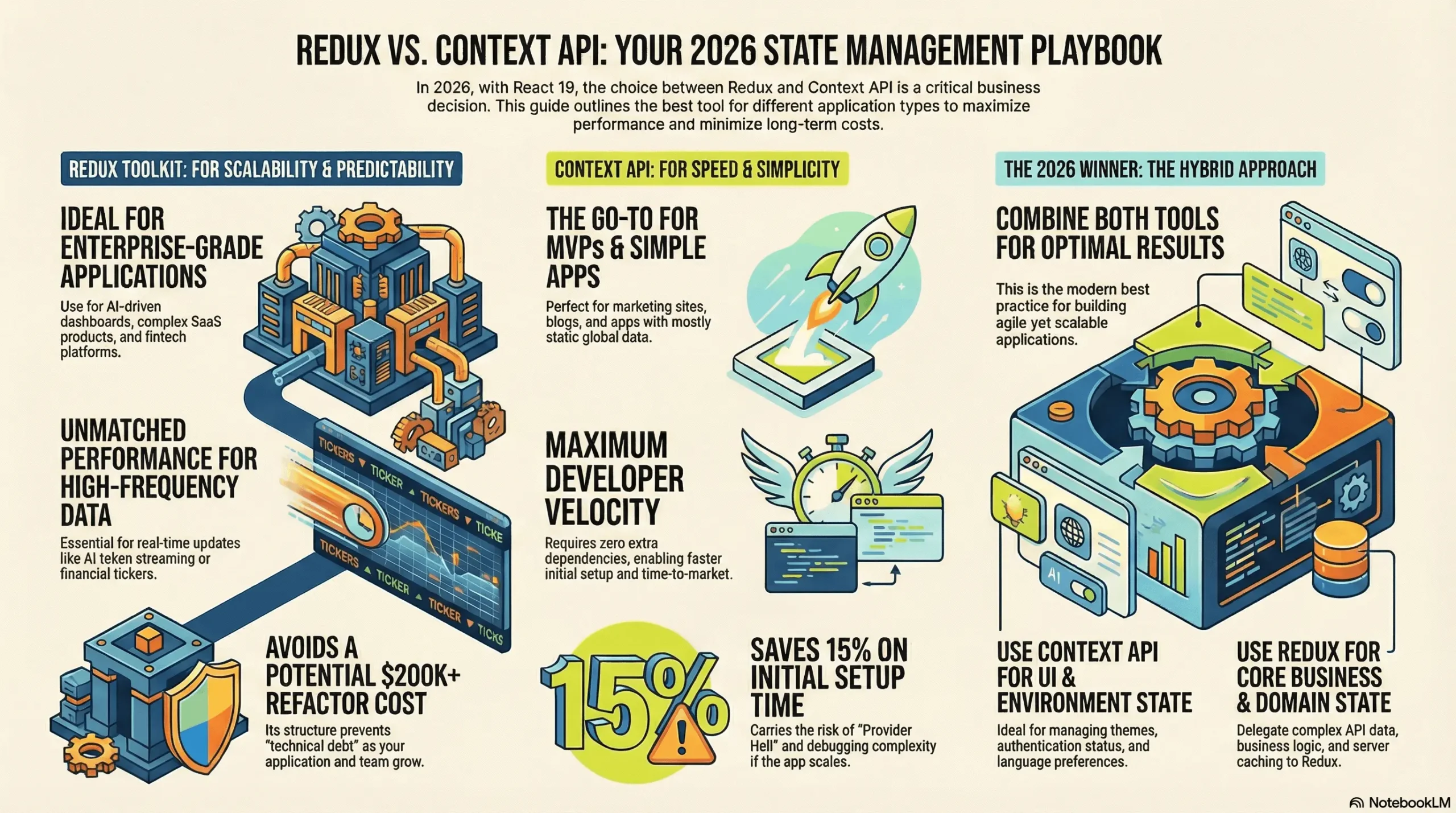
Performance Comparison: The “Compiler” Effect
Historically, Context API suffered from “cascading re-renders”—updating one value forced the entire tree to refresh. In 2026, the React Compiler has arrived, automatically memorizing components to mitigate this. The React 19 Compiler (React Forget) automatically memorizes components, reducing the performance gap for the Context API. However, for O(1) state lookups in massive data structures, Redux remains semantically superior as it bypasses the component tree entirely during state updates.
- However: Redux still wins in high-frequency scenarios. Because Redux uses Selectors, components “subscribe” to a specific slice of data. If
state.user.namechanges, only the Header renders; in a heavy Context setup, the entire Profile tree might still undergo a diffing check.
Maintainability & Technical Debt at Scale
- Context Debt: Large apps using only Context end up in “Provider Hell”—a wrapper-heavy structure that makes it impossible to trace where data is coming from.
- Redux Clarity: RTK’s “Slices” isolate logic. If a bug appears in the checkout flow, you look at the
checkoutSlice. This modularity prevents “spaghetti code” from accumulating as you scale from 10 to 100 features.
Get scalable, fast, and user-friendly ReactJS solutions tailored to your needs.
Get Free ConsultationTeam Scalability & Hiring Impact
When you hire React.js developers, you are hiring their “mental model.”
- The Standard: Redux is a global standard. A senior developer can audit a Redux codebase in hours.
- The Custom Risk: Custom Context architectures are “snowflakes”—unique and undocumented. This triples the onboarding time for new hires, effectively increasing your engineering overhead.
Redux vs Context API for Different Business Scenarios
- Startup MVPs: Context API. Your goal is speed-to-market. Don’t let Redux’s setup time slow down your first release.
- SaaS Dashboards: Redux. When you have 50+ charts and real-time data feeds, you need RTK Query for caching and synchronization.
- AI-Powered Apps: Redux. Managing the complex lifecycle of LLM calls requires the “Action History” that Redux provides to debug non-deterministic AI behavior.
Cost Implications: ROI vs. Overhead
- Engineering Productivity: Redux has a higher “upfront” cost but a lower “maintenance” cost.
- The Rewrite Risk: Many companies start with Context and are forced into a $200k+ refactor to Redux once their app reaches an enterprise scale. Start with Redux if your roadmap is ambitious.
Common Myths Debunked
- “Redux is Dead”: Statistics show Redux usage has actually grown with Redux Toolkit’s release.
- “Context replaces Redux”: They are distinct tools. Using Context to manage a whole app is like using a screwdriver as a hammer.
- “Boilerplate is bad”: In 2026, AI-assistants like Cursor or GitHub Copilot write the boilerplate for you. The structure it provides is now a pure benefit with zero manual labor cost.
Decision Framework: 2026 Strategy
- Use Redux if: Your state updates $>10$ times/minute; you have a team $>5$ devs; you need “Undo/Redo” logic.
- Use Context API if: You are only storing “static” data like Themes, Auth tokens, or Language preferences.
Migration & Hybrid State Management Patterns
The most successful 2026 apps use a Hybrid Approach:
- Context API for global UI settings (Modals, Dark Mode).
- Redux Toolkit for core business domain data and API caching.
- React Server Components (RSC) to fetch initial data, reducing the need for global state altogether.
Final Verdict: Which State Management Wins?
For the modern C ltimately, the choice between Redux Toolkit and the Context API in 2026 is a strategic balance between immediate agility and long-term stability. While the Context API offers a low-friction, native solution that is now more performant than ever thanks to the React Compiler, it remains best suited for “environmental” data like themes, localization, and basic authentication. For organizations building complex, data-driven platforms or AI-integrated applications, Redux Toolkit is the clear winner for its unparalleled debugging capabilities, strict architectural guardrails, and $O(1)$ performance efficiency. Most high-performing engineering teams find their “sweet spot” in a hybrid approach: using Context for simple UI preferences and Redux for the heavy lifting of core business logic. By aligning your state management strategy with your product’s 24-month roadmap rather than today’s convenience, you protect your application from the high costs of technical debt and ensure a scalable, maintainable foundation for the future of your business. TO, the answer is Predictability over Simplicity. While Context is easier to start with, Redux is easier to own long-term.
Also Read: The Ultimate React.js Migration Checklist: From Legacy Systems to AI Stacks (2025)



