

Next.js vs Remix: Which Server Rendering Strategy Fits Your Business?
Developers comparing Next.js vs Remix while reviewing server rendering performance, React framework architecture, and deployment strategies. This guide explains the key differences to help organizations select the best React framework for modern web applications.


Introduction: The Server Rendering Decision That Can Make or Break Your Product
In today’s hyper-competitive digital landscape, the choice of a web rendering framework is no longer a back-office technical debate — it is a core business decision. Your server rendering strategy directly influences page load speed, SEO rankings, developer productivity, infrastructure costs, and, ultimately, your bottom line.
The two most debated contenders in the React ecosystem right now are Next.js and Remix. Both are powerful, both are built on React, and both serve enterprise-grade applications. But they approach server rendering from fundamentally different philosophical foundations — and choosing the wrong one for your business context can cost months of refactoring down the road.
Industry Insight: According to Technavio, the global web development market is projected to grow by over $40 billion between 2025 and 2029, expanding at a CAGR of 10.4%. React-based frameworks, particularly Next.js and Remix, are at the centre of this growth, powering everything from e-commerce giants to SaaS platforms.
This guide offers a deeply researched, side-by-side Next.js vs Remix comparison — covering architecture, performance, developer experience, scalability, hiring considerations, and business fit. Whether you’re a CTO planning a greenfield project, a product leader evaluating a migration, or a developer making the technical case to your stakeholders, this article will give you the clarity you need.
Also Read: React.js Developer Onboarding Checklist for Fast Ramp-Up 2026
Key Takeaways: Next.js vs Remix — Which Server Rendering Strategy Fits Your Business?
1. There Is No Universal Winner — Context Is Everything. Next.js and Remix are both production-proven React frameworks. The right choice depends on your product type, team size, infrastructure preferences, and long-term roadmap — not on which framework is trending.
2. Next.js Wins on Flexibility and Static Content. With hybrid rendering (SSG, SSR, ISR, CSR), Next.js lets every page use the optimal rendering strategy. It’s the strongest choice for content-heavy sites, e-commerce platforms, and applications that mix static and dynamic pages.
3. Remix Wins on Simplicity, and Dynamic Performance. Remix’s server-first, single data model (loaders + actions) eliminates client-side data-fetching waterfalls. For dashboards, admin panels, CRMs, and data-intensive apps, Remix can be up to 2.3x faster than Next.js on dynamic routes.
4. Next.js Has the Larger Talent Pool — By a Wide Margin. Approximately 67% of React developers use Next.js in production. If hiring speed matters, Next.js gives you access to a significantly larger pool when you hire React.js developers, reducing recruitment risk and onboarding time.
5. Remix Is Platform-Agnostic; Next.js Has Vercel Gravity. Remix runs natively on Cloudflare Workers, Deno, Vercel Edge, Fly.io, and more — from a single codebase. Next.js is portable but performs best on Vercel, which can introduce cost and vendor lock-in considerations at scale.
6. React Server Components Give Next.js a Near-Term Architecture Edge. As of 2025, Next.js is the only framework with full production-ready React Server Components support. Teams aligning with React’s long-term direction should weigh this heavily in greenfield projects.
7. Remix Is Built for the Edge Computing Era. Remix’s Web Fetch API foundation makes it natively compatible with edge runtimes — a critical advantage as Gartner and Forrester identify edge computing as a top enterprise infrastructure priority for 2025–2026.
8. Build Speed Favors Remix Today — Turbopack Is Closing the Gap. Remix’s Vite + esbuild pipeline delivers significantly faster build times than Next.js’s webpack. Next.js’s Turbopack is narrowing this gap, but is still maturing for production builds.
9. Your Framework Choice Is Also a Hiring and Business Strategy. The decision between Next.js and Remix affects team structure, onboarding timelines, infrastructure costs, and long-term maintainability. Treating it as a purely technical decision underestimates its business impact. Engaging an experienced React.js development company early can prevent costly architectural pivots later.
10. Progressive Enhancement Is Remix’s Structural Advantage. Remix apps deliver functional HTML before JavaScript loads, making them resilient on slow networks and low-end devices. For global audiences and mobile-first products, this structural advantage translates directly into better Core Web Vitals and higher conversion rates.
Bottom Line: Use Next.js when your product is more website than app — content-driven, SEO-critical, and mixed static/dynamic. Use Remix when your product is more app than website — data-heavy, interaction-driven, and personalized. When in doubt, partner with a React.js development company like Full-Stack Techies to validate the decision before you build.
The State of React Frameworks in 2025: Why This Comparison Matters Now
React has long held its position as the dominant frontend library on the planet. As of 2025, React powers over 11 million websites globally and commands a 39.5–42.6% market share among all JavaScript frameworks, according to the Stack Overflow Developer Survey 2024. An estimated 80% of Fortune 500 companies run React in production, and 87% of React developers plan to continue using it in 2025.
Within the React ecosystem, meta-frameworks have become the standard for production deployments. You no longer just write React — you deploy it through a framework that handles routing, data loading, server rendering, and build optimization. This is where Next.js and Remix enter the conversation.
Next.js, developed by Vercel and launched in 2016, is the undisputed market leader. It claimed first place in the State of JavaScript 2023 survey and is used in production by companies like Netflix, TikTok, Hulu, Twitch, and Spotify. Remix, built by the creators of React Router and launched in 2021, is the challenger — newer, leaner, and philosophically distinct. Its growing adoption is driven by Shopify’s integration, a dedicated open-source community, and a steadfast commitment to web standards.
The decision between these two frameworks is not about which is universally “better” — it is about which aligns with your business model, your team’s strengths, and your product’s long-term trajectory. Let’s unpack that decision systematically.
Architectural Philosophy: How Each Framework Thinks About the Server
Next.js: The Hybrid Rendering Powerhouse
Next.js was built on the principle of “convention over configuration.” Create a file, get routing, code-splitting, and access to multiple rendering modes. The framework’s greatest strength is its flexibility: it lets you choose a different rendering strategy for every single page in your application.
Next.js supports four rendering modes:
- Static Site Generation (SSG) — Pages pre-rendered at build time and served from a CDN for lightning-fast delivery.
- Server-Side Rendering (SSR) — Pages generated on the server at every request, ideal for personalized or real-time content.
- Incremental Static Regeneration (ISR) — Static pages that can be updated in the background at set intervals without a full rebuild.
- Client-Side Rendering (CSR) — Dynamic updates handled in the browser for highly interactive components.
This hybrid model gives Next.js applications surgical precision. A marketing landing page can be SSG for maximum speed; a user dashboard can be SSR for personalization; a product listing can use ISR to stay fresh without server overhead. The trade-off is cognitive complexity — teams must consciously decide which rendering mode applies to each route, and inconsistencies can lead to performance anomalies.
Next.js 15, released in late 2024, introduced React 19 support, App Router improvements, and stable Turbopack in development. Version 15.5 (2025) added beta production builds with Turbopack, stable Node.js middleware, and significant TypeScript developer experience (DX) updates — keeping Next.js firmly at the frontier of React innovation.
Remix: The Server-First Web Standards Advocate
Remix was built by the authors of React Router with a specific mission: to fix what they saw as Next.js’s fundamental flaw — the over-reliance on client-side JavaScript and the complexity that comes with multiple rendering paradigms. Where Next.js abstracts web fundamentals, Remix exposes them.
Remix’s philosophy is simple: everything renders on the server by default. Routes stream HTML before hydration. Data is fetched server-side through “loader” functions before any page is rendered. Form submissions are handled via “actions” — no separate API layer required. The result is a framework that is deeply aligned with HTTP semantics, HTML form behavior, and the Web Fetch API.
This server-first approach has several powerful consequences:
- Smaller JavaScript payloads — less client-side code means faster parse and execution times.
- Better performance on slow networks — server-rendered HTML arrives before JavaScript, giving users something to read immediately.
- Progressive enhancement by design — core functionality works even when JavaScript is disabled or fails to load.
- Portability — Remix runs on any JavaScript runtime: Node.js, Deno, Cloudflare Workers, Vercel Edge, and more.
Remix leverages Vite and esbuild under the hood, resulting in significantly faster build times compared to Next.js’s webpack-based pipeline (though Next.js’s Turbopack is closing this gap rapidly).
Key Architectural Difference: Next.js offers a hybrid rendering model where each page can use a different strategy (SSG, SSR, ISR, CSR). Remix uses a single, consistent server-first model where all data loading and mutations happen on the server. This is not just a technical difference — it reflects fundamentally different philosophies about how web applications should be built.
Head-to-Head Feature Comparison: Next.js vs Remix
| Feature / Criteria | Next.js | Remix |
|---|---|---|
| Primary Rendering | Hybrid (SSG, SSR, ISR, CSR) | Server-First SSR |
| ISR Support | Yes (native) | No (uses HTTP caching) |
| Data Fetching | getServerSideProps, getStaticProps, App Router fetch | Loaders & Actions (server-only) |
| Form Handling | Client-side + API routes | Native HTML forms + Actions |
| Routing System | File-based (App & Pages Router) | File-based, Nested routes |
| Error Handling | Route-level Error Boundaries | Route-level Error Boundaries |
| Streaming HTML | Yes (React 18 + App Router) | Yes (by default) |
| React Server Components | Full production support | Planned / experimental |
| Build Tool | Webpack (Turbopack in beta) | Vite / esbuild |
| TypeScript Support | First-class | First-class |
| Image Optimization | Built-in next/image | Third-party required |
| API Routes | Built-in (pages/api) | Actions handle mutations |
| Deployment | Best on Vercel; Docker/AWS supported | Any JS runtime; platform agnostic |
| Vendor Lock-in Risk | Moderate (Vercel optimizations) | Low (Web Standards-based) |
| Learning Curve | Moderate (multiple patterns) | Lower (single data pattern) |
| Community / Ecosystem | Very large, mature | Growing, strong OSS |
| Hiring Pool | Very large | Smaller but growing |
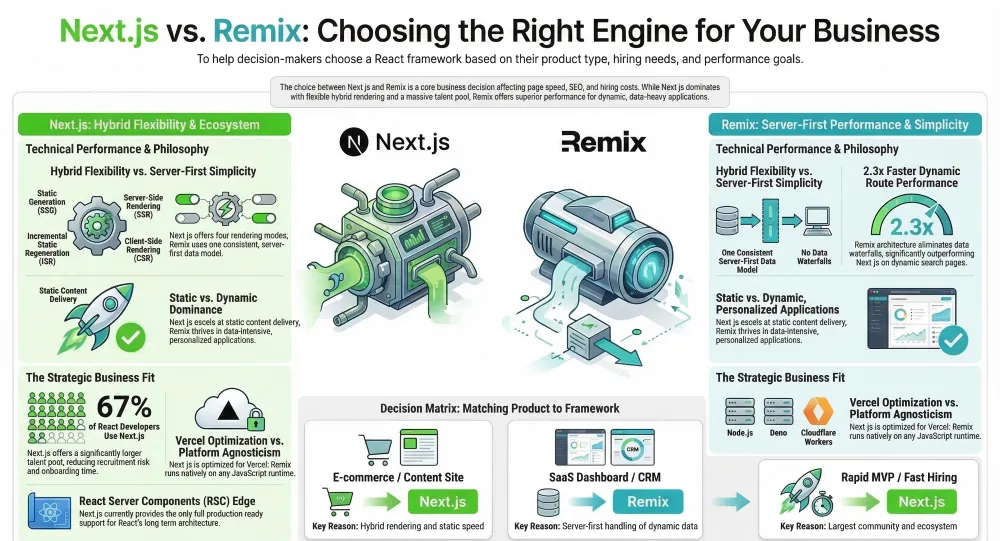
Performance Deep Dive: What the Numbers Actually Tell You
Static Content: Next.js Has the Edge
For content that rarely changes — marketing pages, documentation sites, landing pages — Next.js’s SSG and ISR capabilities deliver exceptional performance. Pre-rendered HTML files are served directly from a CDN with no server computation on each request. This translates to sub-100ms Time-to-First-Byte (TTFB) for static routes.
Remix does not support SSG in the traditional sense. Instead, it uses HTTP’s native stale-while-revalidate (SWR) caching directive, which serves cached responses from the CDN and revalidates in the background. For most use cases, this achieves comparable performance to ISR — but without the framework-specific API, making it more portable and standards-aligned. However, the initial cache-miss performance (when a page hasn’t been cached yet) can be slightly slower than pre-built SSG pages.
Dynamic Content: Remix’s Architecture Shines
For data-heavy, frequently-updating, or personalized applications, Remix’s architecture often outperforms Next.js. The reason is architectural: when Next.js runs out of static pages to serve, it falls back to client-side data fetching from the browser. This introduces a network waterfall — the browser must first load JavaScript, then make an API call, then render the data. Remix, in contrast, always fetches data on the server before rendering, delivering a complete HTML document in a single round trip.
Independent benchmarks have shown Remix to be approximately 2.3x faster than Next.js for dynamic search pages where SSG is not applicable. The difference becomes even more pronounced on slow connections and low-end mobile devices, where parsing and executing JavaScript is expensive.
Performance Insight: Remix’s streaming HTML approach means users can start reading and interacting with above-the-fold content while the rest of the page continues loading in the background — even before JavaScript fully hydrates the page. This dramatically improves perceived performance metrics like Largest Contentful Paint (LCP) and First Contentful Paint (FCP).
Build Performance: Remix Wins Today, Turbopack Closes the Gap
Remix’s use of Vite and esbuild gives it significantly faster build times than Next.js’s traditional webpack-based pipeline. For large codebases, this can mean the difference between 30-second and 3-minute build times. However, Next.js’s Turbopack (now in stable beta for development, with production builds in beta as of version 15.5) is closing this gap rapidly. Teams evaluating Next.js should factor in that Turbopack’s production maturity will likely be reached in 2025–2026.
Developer Experience (DX): Which Framework Reduces Cognitive Load?
Next.js Developer Experience
Next.js has the largest developer community of any React framework. This means abundant Stack Overflow answers, tutorials, third-party integrations, starter templates, and hiring options. The framework’s App Router (introduced in Next.js 13 and matured since) represents a significant architectural leap — introducing React Server Components, nested layouts, and co-located loading/error states at the filesystem level.
However, this maturity comes with complexity. Next.js developers must navigate two router paradigms (the legacy Pages Router and the newer App Router), multiple data-fetching patterns, and a rich but sometimes overwhelming set of configuration options. Teams migrating from the Pages Router to the App Router have frequently reported significant refactoring effort.
Remix Developer Experience
Remix’s single data model — loaders for fetching, actions for mutations — reduces the decision fatigue that Next.js developers often experience. There is one pattern for all data interaction, and it maps directly to how HTTP works. Experienced web developers often find this model intuitive and refreshing. As one developer put it: “With Remix, I follow one pattern and just move forward — this allows me to focus on business logic rather than framework peculiarities.”
The trade-off is a smaller community and less documentation, though this has improved substantially since Shopify’s adoption. Remix’s integration with React Router v6 (they are now the same project under the hood) means developers with routing experience can transfer knowledge efficiently.
DX Verdict: For teams that value a rich, battle-tested ecosystem and are building applications that mix static and dynamic content, Next.js’s DX is hard to beat. For teams building data-intensive, server-driven applications and valuing conceptual simplicity, Remix’s single-model approach reduces cognitive overhead significantly.
Get scalable, fast, and user-friendly React.js solutions tailored to your needs.
Get Free ConsultationDeployment, Infrastructure & Total Cost of Ownership
Next.js: Best on Vercel, Portable Everywhere
Next.js was created by Vercel and is optimized for Vercel’s platform. The deployment experience is unparalleled: push to Git, and your entire application — static pages, API routes, ISR functions, edge middleware — is deployed and globally distributed automatically. Next.js’s standalone build output also supports Docker containers, AWS ECS, AWS Lambda, and bare-metal servers — giving teams the option to self-host.
The catch: advanced Next.js features (A/B testing, Edge Middleware, ISR at scale) perform best on Vercel and can involve meaningful costs at high traffic volumes. Teams should model Vercel pricing carefully before committing, particularly for Pro and Enterprise tiers. Running Next.js on alternative infrastructure sacrifices some optimization benefits, though the gap is narrowing.
Remix: Platform Agnostic by Design
Remix’s use of the Web Fetch API — rather than Node.js-specific APIs — means a single Remix application can run identically on Node.js, Cloudflare Workers, Deno Deploy, Vercel Edge, Netlify, Fly.io, or any other JavaScript runtime. This is a significant business advantage: it eliminates vendor lock-in, gives teams freedom to optimize infrastructure for cost and geography, and future-proofs the application as the edge computing landscape evolves.
The trade-off is that Remix’s server-first architecture means every request that isn’t cached hits your server. Without a robust caching strategy (CDN headers, stale-while-revalidate), infrastructure costs can increase. This is manageable with proper engineering but requires intentional design — unlike Next.js’s SSG, which provides static delivery for free.
Business Use Cases: Matching the Framework to Your Needs
When Next.js Is the Right Choice
Next.js is the stronger choice for most businesses when:
- Your application has a significant proportion of content that changes infrequently — marketing pages, blog posts, product listings with hourly/daily updates, documentation.
- You need to combine static pages and dynamic features in the same application — ISR lets you do this elegantly.
- Your team is large or growing, and you need to hire quickly — Next.js has by far the largest talent pool among React meta-frameworks.
- You are building an e-commerce platform, content-driven website, or SaaS product where different pages have radically different performance requirements.
- You want to leverage React Server Components fully in production today — Next.js has the most mature RSC implementation.
- You are deploying on Vercel and want minimal DevOps complexity.
When Remix Is the Right Choice
Remix is the stronger choice when:
- Your application is fundamentally data-driven — dashboards, admin panels, financial tools, CRMs — where the majority of content is dynamic and personalized.
- Performance on slow networks and low-end devices is a priority — Remix’s smaller JavaScript payloads and progressive enhancement give it a structural advantage.
- You want platform flexibility and to avoid vendor lock-in — Remix’s Web Standards foundation means you can move between runtimes freely.
- SEO is critical and your content is highly dynamic — Remix’s consistent SSR ensures search engines always receive complete, indexable HTML.
- Your team values architectural simplicity and a single, consistent data model over a large feature set.
- You are building on Cloudflare Workers or Deno Deploy, where Remix’s edge-native architecture excels.
Decision Shortcut: If your application is more website than app (content-heavy, marketing-driven, SEO-critical), lean toward Next.js. If your application is more app than website (data-heavy, interaction-driven, personalized), lean toward Remix. Most large enterprise applications eventually benefit from both — which is where experienced full-stack React teams become essential.
Hiring Considerations: Building the Right Team for Your Framework
Your framework choice has direct implications for hiring strategy — a dimension that CTOs and engineering managers often underestimate until it becomes a bottleneck.
Next.js Talent Landscape
The Next.js talent pool is enormous. As of 2025, Next.js is used by approximately 67% of React developers, and it consistently tops developer preference surveys. When you hire React.js developers with production experience, Next.js familiarity is nearly a given. This makes it easier to staff new teams, scale existing ones, and find specialized expertise for complex Next.js features like App Router optimization, ISR strategies, and Vercel Edge Middleware.
The breadth of the Next.js community also means a richer ecosystem of ready-made solutions: authentication libraries with Next.js adapters, CMS integrations, analytics plugins, and deployment tooling — reducing time-to-market for common requirements.
Remix Talent Landscape
Remix’s talent pool is smaller but growing. Its adoption in the Shopify ecosystem has created a pipeline of experienced Remix developers, particularly in e-commerce. The React Router overlap means that developers with deep React Router knowledge can transition to Remix relatively quickly.
For companies building Remix applications, the hiring strategy should be nuanced: prioritize strong understanding of web fundamentals (HTTP, form handling, SSR principles) over framework-specific experience. A skilled web developer who understands how the web works will adapt to Remix’s model faster than a Next.js developer who has relied on framework abstractions.
Team Strategy Insight: Whether you choose Next.js or Remix, partnering with an experienced React.js development company can dramatically accelerate your timeline. Full Stack Techies specializes in both Next.js and Remix engagements — providing dedicated React.js developers who are embedded into your team with framework-specific expertise, without the overhead of full-time hiring.
Alternatives to Consider in 2026
While Next.js and Remix dominate, other players are emerging:
- Astro: Perfect for content-rich sites that need “Zero JavaScript” for maximum speed.
- TanStack Start: A new competitor focusing on type-safety and developer flexibility.
- Gatsby: Still a solid choice for large static sites, though its popularity is declining compared to Next.js.
Industry Trends Shaping the Next.js vs Remix Debate
React Server Components: Next.js’s Current Advantage
React Server Components (RSC) represent the most significant architectural shift in React’s history — allowing components to be rendered entirely on the server with zero JavaScript sent to the client. As of 2025, Next.js is the only framework with full production-ready RSC support. Only about 29% of developers have adopted Server Components, despite over half expressing positive sentiment — indicating significant near-term adoption ahead. This RSC advantage is a compelling reason for teams building new applications to consider Next.js, particularly if they want to align with React’s long-term direction.
Edge Computing and the Rise of Remix
Edge computing — running server-side code geographically close to users at CDN edge nodes — is one of the fastest-growing infrastructure trends. Gartner and Forrester have both highlighted edge computing as a top enterprise architecture priority for 2025–2026. Remix’s architecture, built on the Web Fetch API, is natively compatible with edge runtimes like Cloudflare Workers and Vercel Edge — giving it a structural advantage as edge deployment becomes mainstream.
Next.js supports edge deployment through Vercel’s Edge Middleware and Edge Runtime, but some features (like ISR) are not available in edge contexts. Teams that want comprehensive edge computing coverage with minimal constraints should weigh Remix’s architectural fit carefully.
AI-Augmented Development and Framework Choice
Gartner predicted a 60% reduction in UI development time from AI-assisted tooling by 2025, with AI-generated components comprising nearly 40% of new interface elements. GitHub’s surveys confirm that developers using AI coding assistants complete features 40% faster while maintaining quality standards. Both Next.js and Remix have strong support in tools like GitHub Copilot, Cursor, and Claude — but Next.js’s larger training data corpus means AI assistants generate Next.js code with higher accuracy. Teams heavily relying on AI-assisted development may find this a practical advantage for Next.js in the near term.
The Vite Ecosystem and Next.js’s Response
Remix’s adoption of Vite as its build tool aligns it with a rapidly growing movement. Vite has become the default build tool for most modern JavaScript frameworks, valued for its near-instant hot module replacement (HMR) and fast builds. Next.js’s Turbopack, while promising, is a proprietary solution. Some developers see this as Next.js betting on Vercel’s infrastructure stack, while Remix’s Vite integration represents betting on open, community-driven web standards. This is not merely a technical preference — it reflects a philosophical choice about long-term ecosystem alignment.
Migration Considerations: Switching Costs and Transition Strategies
Migrating FROM Next.js to Remix
Teams considering a migration from Next.js to Remix typically do so for one of three reasons: persistent performance issues with dynamic content, desire to eliminate vendor lock-in with Vercel, or architectural simplicity goals. The migration effort is significant but tractable. The most challenging aspect is translating Next.js’s multiple data-fetching patterns (getServerSideProps, getStaticProps, client-side SWR) into Remix’s single loader/action model. ISR-dependent pages require particular attention, as Remix handles caching differently.
A practical migration strategy involves identifying routes as “static-heavy” vs “dynamic-heavy” and migrating dynamic, API-driven routes first — where Remix’s advantages are most pronounced. Static marketing pages may not justify the migration effort at all and can remain in Next.js or be moved to a dedicated static site generator.
Migrating FROM Remix to Next.js
The reverse migration — Remix to Next.js — is most common when teams need to scale their talent pool rapidly or when a product’s roadmap becomes more content-marketing-driven than initially anticipated. Remix’s loader/action patterns translate well to Next.js API routes and server components, though leveraging ISR for appropriate routes requires additional architectural design.
How Full Stack Techies Help Businesses Navigate the Next.js vs Remix Decision
Choosing between Next.js and Remix is rarely as simple as picking the “fastest” or “most popular” option. It requires an honest assessment of your product roadmap, your team’s existing skills, your infrastructure preferences, your SEO and performance requirements, and your hiring strategy.
Full Stack Techies is a React.js development company with deep expertise in both Next.js and Remix, along with the full React ecosystem. As one of the best React.js development services providers, our team has delivered production applications on both frameworks across industries, including e-commerce, FinTech, healthcare, and enterprise SaaS.
When you engage Full Stack Techies, you get:
- Framework Selection Consulting — we help you make the right architectural choice based on your specific business context, not generic best practices.
- Dedicated React.js Developers — hire React.js developers with specific Next.js or Remix expertise, embedded into your team on flexible engagement models.
- Full-Stack Development — our engineers handle the complete stack: from React component architecture and server rendering optimization to database design and cloud infrastructure.
- Migration & Modernization — transitioning from legacy frameworks, Pages Router to App Router, or between Next.js and Remix? Our teams have managed these transitions at scale.
- Performance Engineering — our specialists audit and optimize Core Web Vitals, bundle sizes, server response times, and caching strategies across both frameworks.
Whether you need to hire React.js developers for a long-term embedded engagement, require a project-based team for a greenfield build, or want strategic consulting on your framework roadmap, Full-Stack Techies delivers the React.js development services that match your ambition.
Ready to Make the Right Framework Decision?
Full-Stack Techies offers a complimentary technical discovery session to help you evaluate Next.js vs Remix in the context of your specific product, team, and business goals. Connect with our team to get a framework recommendation backed by real-world experience.
The Verdict: A Framework Decision Matrix
There is no universal winner in the Next.js vs Remix debate. The right choice depends on your specific context. Use this decision matrix to guide your evaluation:
| Your Situation | Recommended Framework | Key Reason |
|---|---|---|
| Content-heavy marketing site / blog | Next.js | ISR + SSG for static performance |
| E-commerce with mixed static/dynamic | Next.js | Hybrid rendering per route |
| SaaS dashboard / admin panel | Remix | Server-first for dynamic data |
| Real-time data application | Remix | Streaming SSR, smaller JS payload |
| Enterprise app, large dev team | Next.js | Larger talent pool, richer ecosystem |
| Edge-first deployment (Cloudflare) | Remix | Web Fetch API native compatibility |
| SEO-critical, dynamic content | Remix | Consistent SSR, no client-side waterfall |
| Rapid MVP / startup | Next.js | Largest community, fastest onboarding |
| React Server Components priority | Next.js | Only full RSC production support today |
| Multi-cloud / avoid vendor lock-in | Remix | Platform-agnostic Web Standards |
Conclusion: Framework Is Strategy
The Next.js vs Remix debate is, at its core, a debate about two different theories of how the web should work. Next.js believes in giving developers maximum flexibility — let each page choose its rendering strategy and optimize accordingly. Remix believes in the power of constraints — one data model, server-first, web standards-aligned — and argues that this simplicity produces better software at scale.
Both are right in their respective contexts. Both are production-proven. Both are evolving rapidly. The React ecosystem has never been healthier, and the web development market’s continued 10%+ annual growth through 2029 means that skilled teams who make thoughtful architectural decisions today will have a significant competitive advantage.
The most important step is not picking the “right” framework in the abstract — it is aligning your framework choice with your product strategy, team capabilities, and business goals. That alignment is where great digital products are built.
If you’re ready to make that decision with expert guidance — or if you need to hire React.js developers who can execute on either Next.js or Remix — Full-Stack Techies is ready to help. As a trusted React.js development company with hands-on experience across both frameworks, we offer the best React.js development services to turn your architectural vision into a production reality.
About Full-Stack Techies
Full-Stack Techies is a React.js development company specializing in Next.js, Remix, and the broader React ecosystem. We offer dedicated developer engagements, full-stack project teams, and technical consulting to help businesses build faster, more scalable web applications. Our expertise spans e-commerce, SaaS, FinTech, and enterprise software.
Frequently Asked Questions
Q1. What is the main difference between Next.js and Remix?
Next.js offers a hybrid rendering model u2014 SSG, SSR, ISR, and CSR u2014 letting each page use a different strategy. Remix takes a server-first approach where all data fetching happens on the server through loaders and actions. Next.js prioritizes flexibility; Remix prioritizes simplicity and web standards.
Q2. Which is faster u2014 Next.js or Remix?
It depends on the content type. Next.js is faster for static content thanks to SSG and ISR served from a CDN. Remix is faster for dynamic, data-driven pages u2014 benchmarks show it can be up to 2.3x faster than Next.js on dynamic routes by eliminating client-side data-fetching waterfalls.
Q3. Is Next.js better for SEO than Remix?
Both are excellent for SEO since they deliver server-rendered HTML to search engines. Remix has a slight structural advantage for dynamic content because every page is always server-rendered u2014 thereu2019s no risk of search engines receiving an empty shell. For static content, Next.jsu2019s SSG produces equally indexable pages.
Q4. Which framework is easier to learn u2014 Next.js or Remix?
Remix has a lower conceptual learning curve due to its single data pattern (loaders and actions). Next.js is easier to get started with thanks to its massive community and documentation, but its multiple rendering modes and dual router paradigms (Pages Router vs App Router) add complexity at scale.
Q5. Can I use Remix on Vercel or AWS, or is it limited to specific platforms?
Remix is platform-agnostic by design. It runs on Node.js, Cloudflare Workers, Deno Deploy, Vercel Edge, Netlify, Fly.io, and more u2014 all from the same codebase. This makes it ideal for teams that want infrastructure flexibility and want to avoid vendor lock-in.
Q6. Which framework is better for e-commerce applications?
Next.js is generally the stronger choice for e-commerce. Its ISR capability lets product pages be statically generated and updated automatically without full rebuilds u2014 delivering CDN-fast performance at scale. However, for highly personalized or inventory-real-time storefronts, Remixu2019s consistent SSR can eliminate data freshness issues.
Q7. How does hiring differ between Next.js and Remix developers?
Next.js has a significantly larger talent pool u2014 roughly 67% of React developers use it, making it easier to hire React.js developers with production experience. Remix specialists are fewer but growing, particularly within the Shopify ecosystem. Partnering with a React.js development company like Full Stack Techies is the fastest way to access expertise in either framework.
Q8. Does Next.js or Remix support React Server Components (RSC)?
Next.js currently has the only full production-ready implementation of React Server Components via the App Router. Remix support for RSC is planned but experimental as of 2025. If RSC adoption is a strategic priority for your team, Next.js is the clear choice today.
Q9. Which framework should a startup choose for a new product in 2025?
Most startups benefit from starting with Next.js u2014 its larger community, extensive third-party integrations, and abundance of tutorials accelerate time-to-market. If the product is a data-heavy internal tool or dashboard where performance on dynamic data is critical, Remix is worth the narrower talent pool. The best React.js development services providers can help you validate this decision early.
Q10. Can Next.js and Remix be used together in the same project?
Not typically within a single codebase, but large organizations sometimes use them in a micro-frontend architecture u2014 Next.js for public-facing, content-heavy surfaces and Remix for internal, data-intensive applications. A skilled React.js development company can design this hybrid architecture when business requirements genuinely justify the added operational complexity.



