

React.js Developer Onboarding Checklist for Fast Ramp-Up 2026
A structured React.js Developer Onboarding Checklist ensures new hires become productive faster while maintaining code quality and architectural consistency.


Introduction
Hiring a new developer is a big investment for any business. When you hire React.js developers, the goal is to get them contributing to your codebase as quickly as possible. However, even the most skilled engineer cannot perform at 100% on their first day. Without a structured plan, a new hire might spend weeks just trying to understand how your project is built. This delay costs money and slows down your product roadmap.
This React.js Developer Onboarding Checklist is designed to solve that problem. In 2026, the React ecosystem is more complex than ever, featuring Server Components, advanced state management, and AI-assisted coding tools. Whether you are a startup in New York or a large React.js development company in London, having a clear ramp-up strategy is essential.
This guide provides a step-by-step framework to move your new hires from “getting started” to “shipping code” in record time. By following these steps, you ensure that your team utilizes the best React.js development services to maintain high standards and fast delivery.
Also Read: How to Scale React.js Applications for Enterprise Traffic Spikes (2026 Guide)
Executive Summary: Accelerating React.js Integration in 2026
In the fast-paced tech markets of the USA, UK, Canada, and Europe, the ability to hire react.js developers is only half the battle. The real challenge lies in how quickly those developers can start delivering value. This article provides a comprehensive, 5-phase roadmap designed to reduce developer ramp-up time from months to weeks.
As we navigate the 2026 landscape of React 19, Server Components, and AI-assisted coding, traditional onboarding is no longer enough. We explore a structured approach that covers everything from pre-boarding logistics to shipping the first feature. By implementing these best React.js development services and standards, companies can ensure higher retention, better code quality, and a significant boost in ROI. For organizations looking for pre-vetted, high-performing talent, partnering with a specialized React.js development company like Full-Stack Techies ensures that the foundation for a fast ramp-up is already in place before the first day.
Traditional vs. 2026 React Onboarding
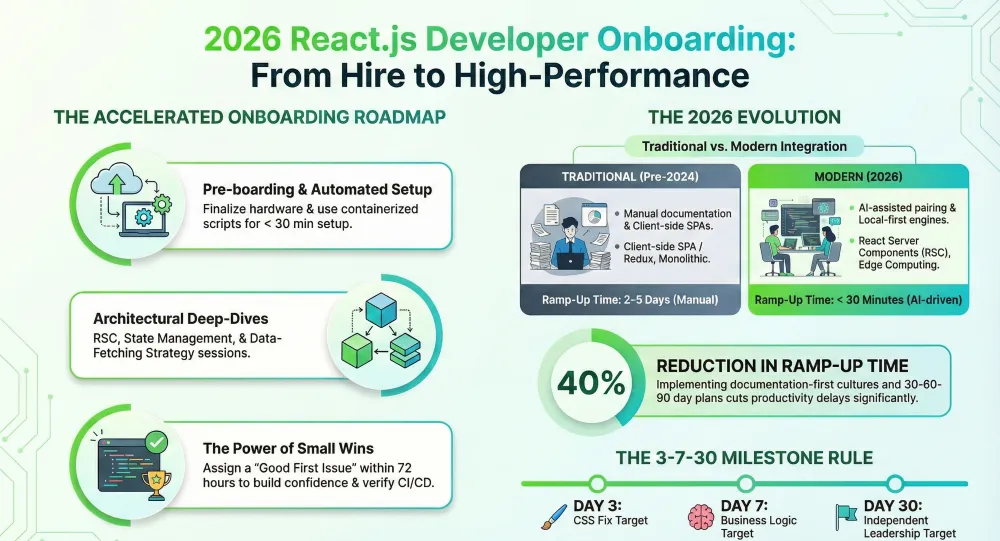
| Feature | Traditional Onboarding (Pre-2024) | 2026 Modern Onboarding |
|---|---|---|
| Setup Time | 2–5 Days (Manual) | < 30 Minutes (Containerized/AI-driven) |
| Primary Stack | Client-side SPA / Redux | React Server Components (RSC) / Next.js |
| Coding Support | Manual Documentation | AI-Assisted Pair Programming |
| Architecture | Monolithic / Simple Microservices | Edge Computing / Local-First Engines |
Key Takeaways for Engineering Leadership
- Preparation is Profit: Successful onboarding begins before the developer starts. Having hardware and cloud access ready on Day 1 prevents costly idle time.
- Automate the Boring Stuff: Use Docker or setup scripts to ensure the local development environment is running in minutes, not days.
- Documentation is a Product: A well-documented architecture and style guide are the most important tools for a React.js development company to scale its team.
- The Power of Small Wins: Assigning a “Good First Issue” within the first 72 hours builds confidence and familiarizes the new hire with the CI/CD pipeline.
- Cultural Context Matters: A dedicated “Buddy” helps the developer navigate the unwritten rules of the team, which is especially vital for remote teams in different time zones.
- Future-Proofing: In 2026, onboarding must include guidelines on AI-tool usage and Server-Side Rendering (SSR) to keep the codebase modern and efficient.
- Expert Support: Leveraging the expertise of Full-Stack Techies can help you find developers who already possess the specific technical stack and soft skills required for your industry.
What is React.js Developer Onboarding?
React.js developer onboarding is the formal process of integrating a new programmer into your existing React project and company culture. It is not just a single meeting. Instead, it is a journey that starts before the developer’s first day and continues until they are fully independent.
At its core, onboarding includes:
- Technical Setup: Configuring the local development environment.
- Domain Knowledge: Learning what the business does and how the app serves users.
- Codebase Familiarity: Understanding the specific folder structure, design patterns, and libraries used in your project.
- Culture Integration: Learning how the team communicates and works together.
For a modern React.js development company, onboarding in 2026 often involves teaching new hires how to work with Next.js, TypeScript, and the latest React 19 features. It is about giving them the map and the compass they need to navigate thousands of lines of code.
Also Read: How to Hire React.js Generative AI Developer to Automate Code and CX
Why is React.js Developer Onboarding Important?
Effective onboarding is the difference between a successful hire and a frustrated one. In markets like the USA, UK, Canada, and Europe, the competition for top talent is fierce. If a developer feels lost or unsupported during their first month, they are much more likely to leave within the first year.
Key Benefits of a Fast Ramp-Up:
- Higher ROI: The sooner a developer finishes their first ticket, the sooner your business sees a return on the cost of hiring.
- Consistent Code Quality: By teaching your standards early, you prevent “creative” coding that doesn’t match your project’s style.
- Reduced Technical Debt: Proper onboarding ensures developers understand your architecture, preventing them from building features that break existing logic.
- Improved Retention: Developers who feel confident and capable early on are happier and more engaged.
In 2026, many companies rely on Full-Stack Techies to find pre-vetted talent. Even with elite developers, a customized onboarding process is required to align their skills with your specific business goals.
Get scalable, fast, and user-friendly ReactJS solutions tailored to your needs.
Get Free ConsultationThe Ultimate React.js Developer Onboarding Checklist
Phase 1: Pre-boarding and Preparation
The goal of this phase is to remove all administrative hurdles before the developer even sits down.
- Finalize Equipment: Ensure the developer has their laptop, monitors, and peripherals delivered at least two days before their start date.
- Setup Core Accounts: Create company email addresses and accounts for Slack, Jira, GitHub, and Figma.
- Assign a “Buddy”: Pick a senior developer to be the new hire’s primary point of contact for the first two weeks.
- Send a Welcome Pack: Provide a digital document that outlines the first week’s schedule and company values.
Phase 2: Technical Environment and Access
Nothing is more frustrating for a developer than spending three days trying to run npm install.
- Repository Access: Invite the developer to the relevant GitHub or GitLab repositories.
- Documentation Site: Provide links to the internal Wiki or ReadMe files.
- Automated Setup Scripts: Use tools like Docker or specialized bash scripts to automate the local environment setup.
- Cloud Credentials: Provide access to AWS, Vercel, or Netlify dashboards if they need to monitor deployments.
- Verify Environment Variables: Ensure they have the correct .env files for the development and staging environments.
- AI Tool Access & Policy: Provision access to enterprise-grade AI coding assistants (like GitHub Copilot) and provide a “Safety ReadMe” on how to use AI without leaking proprietary API keys or sensitive logic.
“In 2026, the biggest bottleneck isn’t syntax; it’s architectural mental models. A developer who understands Server Components and data-streaming will out-deliver a ‘pure’ React developer by 3x.” — Senior Software Architect at Full-Stack Techies.
Phase 3: Knowledge Transfer and Architecture
Now that the code is running, the developer needs to understand how it is organized.
- Architecture Overview: Conduct a 1-hour session explaining the high-level design (e.g., Micro-frontends, Monorepo, or Server-Side Rendering).
- State Management Deep-Dive: Explain if the project uses Redux Toolkit, Zustand, or the Context API.
- Component Library Standards: Walk through your design system or UI kit (like Tailwind CSS, Radix UI, or Shadcn/UI).
- Data Fetching Strategy: Detail how the app handles APIs (e.g., React Query, SWR, or Apollo GraphQL).
- Testing Philosophy: Show examples of existing Unit tests (Jest) and End-to-End tests (Playwright or Cypress).
Phase 4: Workflow and Collaboration Standards
Every team has its own “vibe” and rules. Make these explicit.
- Git Workflow: Explain your branching strategy (e.g., GitFlow or Trunk-Based Development).
- Pull Request (PR) Ethics: Define what a “good” PR looks like and who is responsible for reviews.
- Meeting Cadence: Add them to the Daily Standup, Sprint Planning, and Retrospective meetings.
- Communication Channels: Clarify which Slack channels are for “work talk” versus “social talk.”
- Time Tracking and Reporting: If your business is a React.js development company providing services to clients, ensure they know how to log hours accurately.
Phase 5: The First Task and Early Success
Confidence comes from doing. Give them something real but manageable.
- Identify a “Good First Issue”: Choose a bug fix or a small UI change that touches multiple parts of the app but has low risk.
- Pair Programming: Spend 2 hours working on the first task together to show them the debugging workflow.
- The First Deployment: Walk them through the CI/CD pipeline so they see their code go live in the staging environment.
- Feedback Loop: Schedule a 15-minute check-in at the end of the first week to address any blockers.
“Onboarding is not a HR task; it is an engineering culture task. If your new hire isn’t pushing code by day three, your process is the bottleneck, not their talent.”
— Technical Director at a leading European Fintech
Case Study: Reducing Ramp-Up Time by 40%
The Client: A mid-sized E-commerce platform based in Toronto, Canada.
The Challenge: The company was growing fast and needed to hire react.js developers to build a new checkout system. New hires were taking nearly 6 weeks to become fully productive, causing delays in their product launch.
The Solution: The team partnered with Full-Stack Techies to refine their onboarding process. They implemented a “Documentation-First” approach, where every core component had a Storybook entry and a clear ReadMe. They also introduced a 30-60-90 day plan with specific milestones for each phase.
The Result: * Ramp-up time: Reduced from 42 days to 25 days.
- Code Review Cycles: Improved by 30% because new hires understood the style guide from day one.
- Launch Date: The checkout system was delivered two weeks ahead of schedule.
This case study shows that even the best react.js development services rely on a strong foundation of knowledge sharing to succeed.
Also Read: How Full-Stack Techies Built an AI-Powered Healthcare Appointment Booking System with React.js
Measuring Onboarding Success: The 3-7-30 Rule
- Day 3: The developer has successfully set up the local environment and pushed a “Hello World” or minor CSS fix to staging.
- Day 7: The developer has completed their first independent PR (Pull Request) that involves business logic.
- Day 30: The developer can lead a feature discussion or participate in a code review for a senior peer without significant oversight.
The Future of React.js Development (2026 and Beyond)
As we move through 2026, React.js is evolving. Onboarding must adapt to these trends:
- AI-Integrated Workflows: Developers now use AI agents to generate boilerplate code. Your onboarding should include guidelines on how to use these tools without compromising security.
- React Server Components (RSC): The shift from client-side to server-side logic means developers need a deeper understanding of backend concepts.
- Edge Computing: With platforms like Vercel and Cloudflare, React apps are running closer to the user. New hires must understand how this affects performance and data latency.
- Local-First Development: More apps are using sync engines to work offline. Training on libraries like Replicache or ElectricSQL is becoming a standard requirement.
Conclusion
A great React.js Developer Onboarding Checklist is your secret weapon for building a high-performance engineering team. By removing technical blockers, providing clear architectural guidance, and fostering a supportive culture, you turn new hires into key contributors in weeks instead of months.
As the tech landscape in the USA, UK, and Europe continues to shift toward more complex, AI-driven applications, your ability to integrate talent quickly will define your success. Remember, the goal of onboarding is not just to teach—it is to empower.
If you are looking to scale your team with the highest quality talent, consider partnering with experts who understand the nuances of modern web development. At Full-Stack Techies, we help businesses hire react.js developers who are ready to hit the ground running.



