

How to Choose the Right DevOps Solutions Company for Your Enterprise (2026 Guide)
Choosing the right DevOps Solutions Company is critical for enterprise success. This 2026 guide walks you through key factors, evaluation criteria, and best practices to select a partner that improves scalability, accelerates delivery, and reduces operational risks.


A Practical, Step-by-Step Guide for Technology Leaders and Decision-Makers
If you are a CTO, VP of Engineering, or IT decision-maker reading this in 2026, you already know that choosing the wrong DevOps solutions company can cost your enterprise far more than money. It can cost you time-to-market, developer morale, security posture, and competitive edge — all at once.
The good news is that the DevOps services landscape has matured significantly. The challenge is that it has also become more complex. Vendors now offer everything from pure CI/CD automation to full-spectrum DevOps as a Services engagement models, and the difference between a company that will genuinely transform your software delivery and one that will simply sell you tooling is not always obvious on first contact.
This guide walks you through exactly how to evaluate, shortlist, and select the right DevOps development company for your enterprise — backed by current industry data and practical evaluation criteria.
2026 Market Snapshot: The State of Enterprise DevOps. As of early 2026, the shift from fragmented toolchains to Platform Engineering is the defining trend for enterprises. According to Gartner, 80% of software organizations have now adopted Internal Developer Platforms (IDPs) to reduce cognitive load. When selecting a partner, the focus has shifted from “speed of deployment” to Digital Operational Resilience and AI-augmented automation (AIOps).
Who Is This Guide For?
- CTOs & VPs of Engineering: Looking to reduce “Time to Market” and stabilize infrastructure.
- IT Directors: Tasked with transitioning from legacy monolithic systems to microservices.
- Product Managers: Who need reliable release cycles to meet customer demands.
- Procurement Officers: Seeking to understand the technical nuances of a DevOps as a Service contract.
Key Takeaways
1. Define your needs before you shop. Before approaching any DevOps solutions company, clearly identify your bottlenecks, current maturity level, compliance requirements, and whether you need a managed DevOps as a Services model or a build-and-transfer engagement. Internal clarity saves months of misaligned vendor conversations.
2. The DevOps market has never been bigger — or more complex. The global DevOps market is on track to reach $86 billion by 2034. With AI, GitOps, and platform engineering reshaping delivery practices, the gap between a forward-thinking DevOps development company and an outdated one is wider than ever in 2026.
3. Technical depth separates real partners from tool resellers. Probe every candidate on CI/CD engineering, DevSecOps, Infrastructure as Code, observability, and AI-augmented automation. A credible DevOps service provider company speaks fluently in outcomes and DORA metrics — not just tool names.
4. Security is no longer optional — it is foundational. DevSecOps must be embedded throughout the pipeline, not bolted on at the end. Any enterprise-grade DevOps solutions company should demonstrate hands-on experience with supply chain security, policy-as-code, and compliance automation from day one.
5. Domain experience matters as much as technical skill. A DevOps development company that excels in SaaS startups may struggle in regulated industries like finance or healthcare. Always verify industry-specific experience, compliance credentials, and familiarity with legacy system environments before committing.
6. Engagement model and cultural fit are deal-breakers. The best DevOps partnerships are built on transparency, knowledge transfer, and shared accountability. Avoid vendors who operate as black boxes, create long-term dependency, or cannot clearly answer who is accountable when things go wrong.
7. Always insist on a paid proof of concept. A bounded, real-world PoC reveals more about a partner’s capabilities and working style than any proposal or presentation. It is the single most reliable evaluation tool available — and a confident DevOps service provider company will always welcome one.
8. Understand the commercial terms fully — especially exit clauses. Ensure your enterprise owns all code, configurations, and documentation produced during the engagement. Pricing models should align with your scope type, and SLAs must be specific and measurable, not vague or aspirational.
9. AI-augmented DevOps is the new baseline. With 76% of DevOps teams already integrating AI into their CI/CD pipelines, choosing a partner without a clear AI strategy means falling behind from the start. Your DevOps development company should be actively using AI for test optimization, anomaly detection, and predictive incident response.
10. The right partner builds your capability, not their dependency. The ultimate measure of a great DevOps solutions company is whether your internal team is stronger, faster, and more self-sufficient at the end of the engagement than at the beginning. Full-Stack Techies is built around exactly that principle — delivering measurable outcomes while transferring lasting capability to your organization.
Why This Decision Matters More in 2026 Than Ever Before
Let’s ground this conversation in numbers first.
The global DevOps market is expected to reach $86.16 billion by 2034, with AI emerging as one of the key drivers behind this growth, helping businesses automate processes, get faster feedback, and boost agility.
According to Gartner’s 2026 research roundup on DevOps, while focus on DevOps practices has been strong, continued development of capabilities is needed to realize maximum value — and organizations need to simplify DevOps tools and technologies while addressing organizational skills and culture challenges.
As of 2025, 76% of DevOps teams have integrated AI into their CI/CD pipelines, shifting from passive dashboards to predictive, automated responses in the delivery chain. At the same time, GitOps adoption reached 64%, with 81% of adopters reporting higher infrastructure reliability and faster rollback.
What this tells you is simple: the baseline has risen sharply. A DevOps service provider company that was considered advanced three years ago may be offering commodity services today. Your evaluation framework needs to reflect 2026 realities — not 2022 ones.
McKinsey’s 2024 research estimates that generative AI could automate 30% of software development tasks within the next three years, which means the DevOps company you choose today needs to be building toward an AI-augmented delivery model, not just maintaining legacy automation pipelines.
Prerequisites: Before You Start Your Search
Before interviewing a DevOps service provider company, ensure you have checked the following boxes:
| Requirement | Description |
|---|---|
| Internal Audit | Document your current tech stack (Cloud providers, CI/CD tools, legacy apps). |
| Goal Definition | Are you looking for faster deployments, better security, or lower cloud costs? |
| Budget Alignment | Define your monthly retainer or project-based budget for DevOps as a Service. |
| Stakeholder Buy-in | Ensure your internal dev and ops teams are ready for cultural change. |
Get scalable, fast, and user-friendly DevOps solutions tailored to your needs.
Get Free Consultation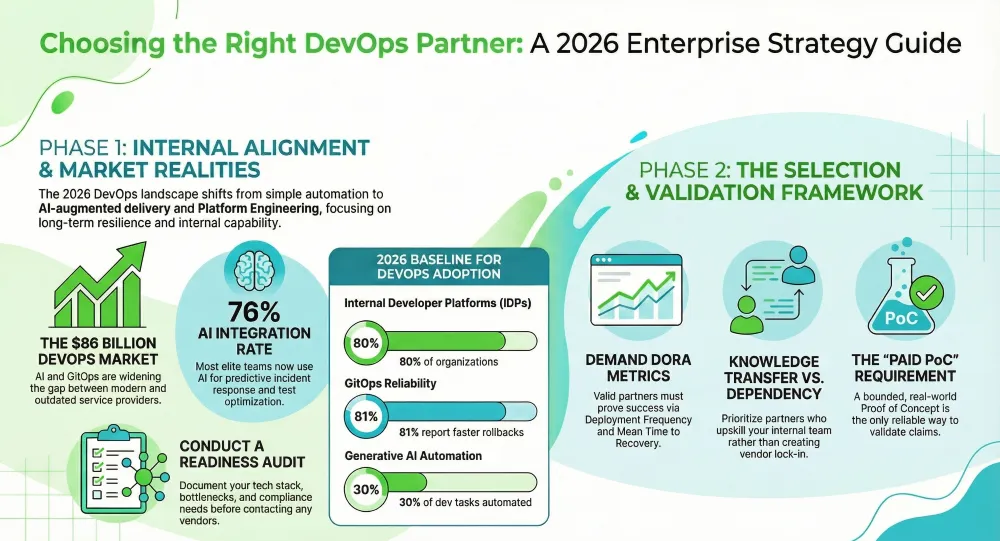
Step 1: Clarify What Your Enterprise Actually Needs
Before you send out a single RFP or take a single vendor call, do your internal homework. The most common mistake enterprises make is shopping for a DevOps solutions company before clearly defining the scope of their own problem.
Ask your team to answer these questions honestly:
Where is the real bottleneck? Is it slow deployments, flaky testing pipelines, poor observability, security vulnerabilities in your CI/CD chain, infrastructure that cannot scale, or a cultural disconnect between your dev and ops teams? Each of these problems calls for a different kind of partner.
What is your current DevOps maturity level? Are you at the beginning — still doing manual deployments and working with disconnected toolchains — or are you at an intermediate stage looking to standardize and scale? Or are you at an advanced stage, seeking AI-driven automation and platform engineering?
Do you need DevOps as a Services or a build-and-transfer model? DevOps as a Services (DaaS) means an ongoing operational partnership, where the vendor manages and evolves your DevOps infrastructure. A build-and-transfer engagement means the partner builds the capability and hands it over to your internal team. These are fundamentally different commercial and operational commitments.
What are your compliance and security constraints? Regulated industries — finance, healthcare, government — need a DevOps development company with demonstrable experience in compliance-as-code, audit trails, and DevSecOps frameworks, not just general automation expertise.
Write these answers down. They become your evaluation rubric.
Step 2: Understand the Types of DevOps Partners Available
The market has several distinct categories of providers, and conflating them leads to mismatched expectations.
Specialist DevOps boutiques focus exclusively on DevOps engineering and platform modernization. They tend to have deep technical expertise in specific ecosystems — Kubernetes, Terraform, GitLab, AWS, Azure — and are often the best choice for technically complex, greenfield modernization programs.
Full-stack technology partners offer DevOps as part of a broader software engineering capability. Companies like Full-Stack Techies fall into this category — they bring integrated expertise across software development, cloud infrastructure, and DevOps engineering, which is particularly valuable when you need your DevOps transformation to align tightly with application development and product delivery work happening in parallel.
Large system integrators (the Accentures, Infosys, and Wipros of the world) offer DevOps services at scale, typically better suited for Fortune 500 enterprises with multi-year, multi-geography programs and significant budget. They bring process rigor and global delivery capacity, but can lack the agility and hands-on depth that fast-moving engineering programs require.
Cloud-native managed service providers specialize in running your DevOps infrastructure on a specific cloud (AWS, Azure, GCP) and are best suited if your architecture is already committed to that cloud and you need operational management rather than transformation leadership.
Most mid-to-large enterprises benefit most from either a specialist boutique or a full-stack technology partner who can grow with them. The key is matching the partner type to your actual engagement model.
Step 3: Evaluate Technical Depth — What to Actually Look For
Once you have shortlisted potential partners, it is time to go deep on their technical capabilities. Here are the specific areas to probe in 2026.
CI/CD and Pipeline Engineering
This is the foundation. Any credible DevOps service provider company should be able to demonstrate mastery of modern CI/CD tools — GitHub Actions, GitLab CI, Jenkins, CircleCI, Harness, and ArgoCD. More importantly, they should be able to show you how they have reduced deployment lead times and failure rates for clients with comparable environments.
Ask for DORA metrics (Deployment Frequency, Lead Time for Changes, Mean Time to Recovery, Change Failure Rate) from their past engagements. If they cannot speak fluently to these metrics, that is an immediate red flag.
Platform Engineering and Internal Developer Platforms
Analyst firms expect that by 2026, roughly 80% of software development organizations will rely on internal developer platforms to manage complexity and improve developer experience, moving away from scattered, team-specific toolchains.
A forward-thinking DevOps development company should have a clear point of view on platform engineering — and ideally demonstrable experience building Internal Developer Platforms (IDPs) using tools like Backstage, Port, or custom-built portals.
Internal developer platform construction enables engineering teams to decrease cognitive demands while achieving a 60% reduction in onboarding duration. If your partner cannot articulate how they approach this, they are behind the curve.
DevSecOps Integration
Security can no longer be bolted on at the end of the pipeline. It needs to be embedded throughout. Your DevOps solutions company should be able to demonstrate competency in SAST/DAST tooling, container scanning, secrets management, software supply chain security (SBOM generation, Sigstore, cosign), and policy-as-code using tools like Open Policy Agent or Kyverno.
According to Gartner, the DevOps platforms market now reflects the consolidation of technologies across development, security, infrastructure, and operations to streamline software delivery — which means security is no longer a separate workstream. It is a native component of modern DevOps practice.
Infrastructure as Code and Cloud Engineering
Strong IaC capability — Terraform, Pulumi, AWS CDK, or Bicep — is non-negotiable. Probe beyond tool familiarity and ask about module design, drift detection, GitOps-based infrastructure management, and how they handle multi-cloud environments. The best DevOps engineering firms treat infrastructure the same way great software engineers treat application code: modular, tested, reviewed, and version-controlled.
Observability and SRE Practices
Shipping fast is only valuable if you can detect and resolve issues fast. Evaluate whether the partner has experience setting up full-stack observability using tools like Datadog, Grafana, OpenTelemetry, or Honeycomb, and whether they have worked with organizations on SLO-based reliability engineering. The goal is not just monitoring dashboards — it is building a culture of measurable reliability.
AI-Augmented DevOps
AIOps, the growing DevOps trend of applying AI to IT operations, is continuing to grow — with the global AIOps market valued at $16.42 billion in 2025 and expected to reach $36.6 billion by 2030.
Ask potential partners how they are incorporating AI into their DevOps practice. Are they using AI for intelligent test selection, anomaly detection, predictive incident response, or automated code review? A partner who is still treating AI as a future consideration is not the right choice for a 2026 enterprise transformation program.
Full-Stack Techies, for instance, integrates AI-assisted pipeline optimization and intelligent monitoring into its DevOps engagements, helping enterprise clients move beyond reactive operations into predictive, self-healing infrastructure.
Step 4: Assess Industry and Domain Experience
Technical capability without domain context is dangerous in enterprise environments. A DevOps service provider company that has worked exclusively with SaaS startups will face steep learning curves working in financial services, healthcare, or manufacturing — environments with strict compliance requirements, legacy system dependencies, and procurement governance.
When evaluating domain experience, look for:
Regulated industry credentials. Has the partner delivered DevOps transformations in environments governed by SOC 2, ISO 27001, HIPAA, PCI-DSS, or FedRAMP? Compliance-as-code is a specific competency, not a general one.
Legacy system integration experience. Most large enterprises are not working from a clean slate. They have mainframes, monoliths, and years of technical debt. A DevOps development company that only knows cloud-native greenfield work will struggle to deliver value in a hybrid environment.
Scale of previous engagements. A company that has only worked with 50-person engineering teams may not have the process maturity to operate effectively across a 500-person distributed development organization. Ask for references at comparable organizational scale.
Step 5: Evaluate the Engagement Model and Cultural Fit
This is where many enterprises make their biggest mistake — they over-index on technical credentials and ignore how the partner actually operates day-to-day.
Knowledge transfer, not dependency. The best DevOps as a Services engagements are designed to build internal capability, not create long-term dependency. Ask every candidate: what is your strategy for upskilling our internal team? What does success look like in 12 months from your own perspective — and does that include your team being needed less over time?
Communication and transparency practices. How does the partner report progress? Do they use shared dashboards, weekly engineering reviews, and open access to CI/CD pipelines? Or do they operate as a black box and deliver updates in PowerPoint? In 2026, there is no excuse for opacity in DevOps engagements. Every pipeline run, every deployment, every incident should be visible to your team in real time.
Agility and responsiveness. Enterprise requirements change. Cloud providers release major updates. Security vulnerabilities emerge overnight. How quickly can your partner adapt? Ask about how they handled an unplanned change or incident in a previous engagement. Their answer tells you more than any capability deck.
Team stability. One of the most common complaints about offshore DevOps vendors is high team turnover, which leads to lost context and inconsistent delivery quality. Ask directly about their attrition rates and how they manage knowledge continuity across engagements.
Step 6: Scrutinize Pricing Models and Commercial Terms
DevOps engagements have several common commercial structures, and understanding which one applies to your needs is critical.
Time and materials (T&M) works well for exploratory phases and ambiguous scopes, but can lead to runaway costs without strong governance. Use it only when paired with clear milestone reviews.
Fixed-price delivery suits well-defined scope — for example, migrating a specific application to a Kubernetes-based CI/CD pipeline with defined acceptance criteria. Be cautious of fixed-price contracts for broader transformation programs where scope will inevitably evolve.
Managed services retainers are common for DevOps as a Services models, where you pay a monthly fee for ongoing operational management, on-call support, and continuous improvement. Make sure the SLAs are specific and measurable, not just aspirational.
Outcome-based pricing is an emerging model where fees are partially tied to measurable outcomes — deployment frequency improvements, reduction in mean time to recovery, or cost savings from infrastructure optimization. This aligns incentives well but requires upfront agreement on baseline metrics.
Whatever structure you choose, scrutinize the exit terms. What happens to your infrastructure code, documentation, and configuration if the engagement ends? Everything built during the engagement should be owned by your organization, not the vendor.
Step 7: Check References and Validate Claims
No evaluation is complete without reference checks — and not just the ones the vendor hands you. Do your own research.
Look at the partner’s public work: GitHub repositories, technical blog posts, conference talks, and open-source contributions. A DevOps development company that genuinely operates at the cutting edge tends to share knowledge publicly. Silence in technical communities is a signal worth noting.
When speaking with references, ask these specific questions:
- Did the team actually deliver what was scoped, or did scope shrink to meet timelines?
- How did they handle an incident or unexpected technical challenge mid-engagement?
- Was the knowledge transfer genuine, or did you feel more dependent on the vendor at the end than at the beginning?
- Would you re-engage them for a follow-on program?
Step 8: Run a Paid Proof of Concept Before Committing
For any engagement above a certain size or risk threshold, insist on a bounded, time-limited paid proof of concept (PoC) before signing a larger contract. A well-scoped PoC — for example, rebuilding one deployment pipeline end-to-end, setting up observability for one service, or automating one compliance check — tells you more about a partner’s real capabilities and working style than any RFP response or presentation ever will.
Evaluate the PoC not just on the technical deliverable, but on how the team communicated, how they handled blockers, and whether the code and configuration they produced meets your internal standards.
A confident, high-quality DevOps solutions company will welcome a PoC. A vendor more interested in locking you into a large contract quickly may push back on it.
Red Flags to Watch Out For
As you go through the evaluation process, keep an eye out for these warning signs:
- Tooling-first conversations. If a vendor’s first question is “what tools are you using?” rather than “what business outcomes are you trying to achieve?”, that is a signal they sell tooling implementations, not transformation outcomes.
- Vague case studies. “We helped a large financial services firm improve deployment velocity” is not a case study. Demand specifics: what was the baseline, what was the outcome, how long did it take, what was the team composition?
- One-size-fits-all methodology. Every enterprise DevOps journey is different. If the partner leads with a rigid, predefined framework rather than listening to your context first, they are optimizing for delivery repeatability, not your success.
- Inability to articulate security posture. Given the explosion of supply chain attacks and the regulatory environment of 2026, any DevOps service provider company that cannot speak confidently about DevSecOps, SBOM, and zero-trust pipeline security should not be handling your enterprise infrastructure.
- No clear escalation path. Who is accountable when things go wrong? If you cannot get a clear answer to that question during the sales process, it will not improve once the contract is signed.
Common Mistakes to Avoid
- Chasing the Lowest Hourly Rate: DevOps is a high-leverage role. A cheap “script kicker” can accidentally delete a production database or leave an S3 bucket open to the public.
- Ignoring Post-Deployment Support: Building a pipeline is easy; maintaining it during a Black Friday traffic spike is hard. Ensure your DevOps service provider company offers robust SLA-backed support.
- Over-Engineering: You don’t always need a complex multi-cloud Kubernetes setup for a simple internal app. A good partner will tell you when not to use a specific tool.
Why Full-Stack Techies Stands Out as a DevOps Partner for Enterprise
Among the DevOps development companies operating in this space, Full-Stack Techies brings a differentiated combination of full-spectrum software engineering capability and deep DevOps practice — which matters more than ever in an environment where the line between application development and infrastructure is rapidly dissolving.
Rather than treating DevOps as a separate service line, Full-Stack Techies embeds DevOps engineering natively into software delivery programs. This means your CI/CD pipelines, infrastructure automation, and observability stacks are designed alongside your application architecture, not retrofitted after the fact. The result is faster delivery cycles, tighter security integration, and infrastructure that actually reflects how your applications behave in production.
Full-Stack Techies works with enterprise clients across cloud-native migration, microservices modernization, and AI-augmented DevOps as a Services engagements — with a focus on building internal team capability alongside the technical deliverables. The goal is always for your organization to emerge from an engagement stronger and more self-sufficient, not more dependent on external support.
For enterprises exploring how modern DevOps practices can accelerate their delivery roadmap, Full-Stack Techies offers an initial assessment to benchmark your current DevOps maturity and identify the highest-impact areas for improvement.
Summary: Your 2026 DevOps Partner Evaluation Checklist
To make this actionable, here is a consolidated checklist you can use when evaluating any DevOps solutions company:
Technical capabilities: CI/CD pipeline engineering with DORA metric fluency; platform engineering and IDP experience; DevSecOps and supply chain security; strong IaC and multi-cloud competency; full-stack observability; AI-augmented DevOps practices.
Domain fit: Experience in your industry’s regulatory environment; legacy system integration experience; references at comparable organizational scale.
Engagement quality: Knowledge transfer orientation, not vendor dependency; transparent communication and shared tooling access; clear team stability and continuity practices; well-defined SLAs and ownership of all deliverables.
Commercial structure: Pricing model aligned to your engagement type; clear IP and exit terms; openness to a paid PoC before larger commitment.
Cultural alignment: Outcome-first mindset, not tool-first; honest case studies with verifiable metrics; clear escalation and accountability structure.
Final Thought
The strategic question for executives in 2026 is not “which DevOps trend is best,” but “which combination fits our risk profile, talent model, and regulatory constraints over the next 12 to 36 months.”
The same logic applies to choosing your DevOps partner. There is no universally right answer — only the partner that is right for your specific engineering environment, your maturity level, and the outcomes you are accountable for delivering. Take the time to run a rigorous evaluation, insist on evidence over claims, and choose a partner who measures their success by the strength they build in your team, not the dependency they create.
If you are ready to start that conversation, Full-Stack Techies is here to help you assess where you are today and map a practical path to where you need to be.
For more information on Full-Stack Techies’ DevOps services and enterprise engagement models, reach out to schedule a complimentary DevOps maturity assessment.
Why Trust This Guide?
This guide was synthesized from current 2026 market trends, Gartner’s Infrastructure & Operations reports, and real-world deployment data from leading firms. We prioritize factual accuracy, “Shift Left” security principles, and the transition toward Platform Engineering. Our methodology focuses on identifying partners like Full-Stack Techies who emphasize long-term scalability over short-term “band-aid” fixes.



