

How to Hire the Best DevOps as a Service Provider in 2026: The Ultimate Executive Guide
This executive guide explains how to Hire the Best DevOps as a Service Provider in 2026 by assessing expertise, scalability, security, pricing models, and long-term ROI.


Introduction: The State of DevOps in 2026
In 2026, the traditional “DevOps” model has evolved. We have moved past simple automation into the era of Autonomous Platform Engineering. According to recent Gartner reports, by the end of this year, 80% of software engineering organizations will have established platform teams as internal providers of reusable services, components, and tools for application delivery.
The challenge for businesses today isn’t just finding someone who knows Kubernetes or Terraform; it’s finding a partner who can navigate the complexities of Agentic Workflows, Multi-cloud FinOps, and Zero-Trust Security. As Forbes recently highlighted, the global talent shortage for high-end site reliability engineers (SREs) has peaked, making the decision to hire the best DevOps as a service provider a strategic necessity rather than an operational choice.
Choosing among the sea of DevOps as a service companies requires a clinical approach. You are not just outsourcing “tasks”; you are acquiring a competitive advantage in deployment velocity and system resilience. This guide will walk you through an elite-level vetting process to ensure your chosen partner—like the industry-leading Full-Stack Techies—can deliver the future-proof infrastructure your business demands.
2026 Executive Summary: Quick Selection Criteria
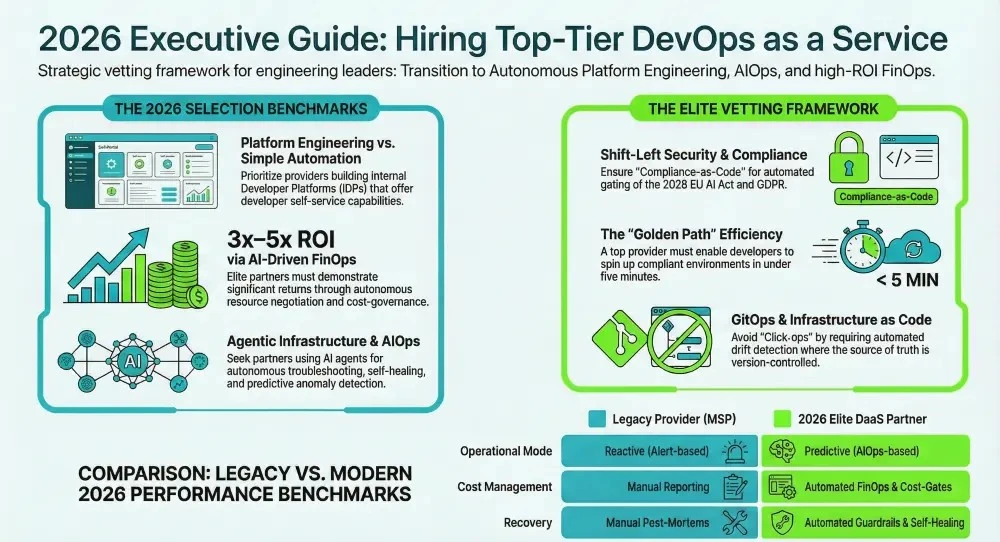
To hire the best DevOps as a service provider in 2026, prioritize firms that offer Autonomous Platform Engineering over simple automation. Key benchmarks include:
- Compliance: Automated EU AI Act and GDPR risk-gating.
- Efficiency: 3x–5x ROI via AI-driven FinOps and “Agentic Workflows.”
- Metric Mastery: A focus on DORA metrics and “Cost of Delay” reporting.
- Tech Stack: Native support for Crossplane, OpenTelemetry, and Multi-cloud orchestration.
Key Takeaways: Hiring the Best DevOps as a Service Provider in 2026
If you’re in a hurry, here are the essential insights for selecting a high-tier DevOps as a service company this year:
- Platform Engineering is the New Standard: In 2026, simply “doing DevOps” isn’t enough. Elite DevOps as a service providers focus on building Internal Developer Platforms (IDPs) that offer self-service capabilities, reducing developer cognitive load and accelerating time-to-market.
- Prioritize AIOps and Agentic Workflows: The best providers have moved beyond manual scripts. Look for partners who implement Agentic Infrastructure—AI agents capable of autonomous troubleshooting, resource negotiation, and self-healing.
- Shift-Left Security (DevSecOps): With the 2026 EU AI Act and increasing global cyber threats, security must be baked into the pipeline. Ensure your provider uses Compliance-as-Code to automate security audits and vulnerability scanning.
- Demand FinOps Transparency: Cloud costs are a primary bottleneck in 2026. A top DevOps as a service company will integrate cost-governance tools directly into your CI/CD process to prevent “bill shock” before it happens.
- Culture Over Tooling: Tools change, but architectural principles remain. Hire a partner like Full-Stack Techies that prioritizes documentation, GitOps methodologies, and a “blameless” culture of continuous improvement.
- The “Full-Stack” Advantage: To achieve true 2026-level velocity, your infrastructure cannot be siloed. Partnering with a provider that understands the entire application lifecycle—from code to cloud—ensures higher resilience and lower technical debt.
Who Is This Guide For?
- CTOs & VPs of Engineering: Needing to bridge the “Innovation Gap” while keeping burn rates low.
- Product Leaders: Who see infrastructure bottlenecks delaying their 2026 product roadmap.
- Procurement Officers: Tasked with vetting high-stakes technical service agreements.
- Startup Founders: Looking to build a “Golden Path” for developers from Day 1.
The 2026 Market Shift: Why Internal Teams Are Struggling
In 2026, the complexity of the “Modern Data Stack” has tripled. We are no longer managing static clusters; we are managing Dynamic Agentic Environments. Gartner predicts that 2026 will see a 40% increase in the use of AI-driven infrastructure remediation.
Internal teams often lack the breadth of exposure that specialized DevOps as a service providers possess. While an internal engineer sees one environment, a firm like Full-Stack Techies sees dozens, allowing them to spot cross-industry trends in security vulnerabilities and cost-saving architectures before they impact your bottom line.
Tools & Prerequisites: Preparing for the Search
Before you reach out to any devops as a service company, you must have your “house in order.” Vetting is a two-way street; the best providers are also selective about who they take on as clients.
The Preparation Checklist
- Infrastructure Audit: Document your current cloud provider (AWS, Azure, GCP, or Sovereign Cloud).
- DORA Metrics Baseline: Calculate your current Deployment Frequency and Change Failure Rate.
- Security Compliance Requirements: (e.g., SOC2, HIPAA, GDPR, or the 2026 EU AI Act).
- Budgetary Guardrails: Distinguish between “Maintenance Spend” and “Transformation Spend.”
Step-by-Step: How to Hire the Best DevOps as a Service Provider
Step 1: Internal Audit & Goal Setting
To hire the best DevOps as a service provider, you must first define what “success” looks like. Are you hiring for stability, velocity, or cost reduction?
1.1 Defining Your Maturity Level
Assess where you currently stand. In 2026, most companies fall into one of three categories:
- Legacy/Manual: Deployments are high-stress, manual events.
- Semi-Automated: CI/CD exists but is “flaky” and requires constant human intervention.
- Cloud-Native: Using containers but struggling with “Day 2” operations (scaling, security, cost).
1.2 The ROI Calculation
Use the following formula to justify the investment in an elite DevOps as a service company: the cost to fix an issue in the design phase (roughly $100) versus fixing it once it has already reached production (roughly $100,000).
Elite providers like Full-Stack Techies typically aim for a 3x to 5x ROI within the first 12 months through aggressive automation and FinOps strategies.
Step 2: Sourcing & Filtering Top Providers
Not all DevOps as a service providers are created equal. In 2026, the market is bifurcated between “Legacy Managed Service Providers (MSPs)” and “Modern DevOps Partners.”
2.1 Where to Source
- CNCF Partner Gallery: Look for certified Kubernetes service providers.
- Review Platforms: G2 and Clutch remain relevant, but look specifically for “2026 Excellence” awards.
- Expert Communities: LinkedIn groups focused on SRE and Platform Engineering.
2.2 The Initial Screen
When looking at DevOps as a service companies, filter by their “Standard Stack.” If they aren’t mentioning Crossplane, Backstage (for IDPs), or OpenTelemetry, they are likely using 2022-era methodologies.
Step 3: The Deep Technical Vetting (The 5-Pillar Framework)
This is the most critical stage. You must move beyond the sales deck and into the “engine room.”
Pillar 1: Infrastructure as Code (IaC) & GitOps
In 2026, “Click-ops” is a cardinal sin.
- Ask: “How do you handle drift detection?”
- The Right Answer: They should mention GitOps workflows using ArgoCD or Flux, where the “Source of Truth” is always in Version Control.
Pillar 2: Platform Engineering & Internal Developer Platforms (IDP)
The best DevOps as a service providers don’t just “fix servers”; they build platforms that empower your developers.
The Benchmark: A provider like Full-Stack Techies will advocate for an IDP that allows a developer to spin up a compliant environment in under 5 minutes without opening a Jira ticket.
Pillar 3: DevSecOps & Compliance-as-Code
Security is no longer a “check” at the end. It must be “Shift-Left.”
- Key Question: “How do you integrate SBOM (Software Bill of Materials) and real-time vulnerability scanning into the pipeline?”
- 2026 Requirement: They must be able to automate compliance for the 2026 EU AI Act if you are using generative models.
Pillar 4: AIOps & Observability
Traditional monitoring is dead. We now use Observability (o11y).
The Requirement: The provider must use AI-driven anomaly detection (e.g., Datadog’s Watchdog or New Relic’s AI) to predict outages before they happen.
Pillar 5: Multi-Cloud & Sovereignty
With geopolitical shifts in 2026, cloud sovereignty is vital.
Ask: “Can you manage a hybrid-cloud environment that spans AWS and a local Sovereign Cloud provider?”
Step 4: Assessing Cultural & Operational Synergy
A DevOps as a service company is an extension of your team. If the culture doesn’t align, the tech won’t matter.
4.1 The “Blameless Post-Mortem” Test
Ask the provider to describe their last major outage.
- Red Flag: They blame a specific person or a “glitch.”
- Green Flag: They describe the systemic failure and the automated guardrail they built to ensure it never happens again.
4.2 Communication Cadence
In 2026, email is too slow. You need a partner that integrates into your Slack/Teams and participates in your Asynchronous Standups. Full-Stack Techies, for example, prides itself on “Embedded Engineering,” where their team feels like a natural extension of yours.
Step 5: The Pilot/POC (Proof of Concept)
Never sign a multi-year contract without a 30-day “Battle Test.”
Step 1: Identify a “Micro-Pain”
Give the provider a specific, non-critical bottleneck. Example: “Automate the staging environment for our legacy Ruby app.”
Step 2: Evaluate Execution
Did they document the process? Is the code clean? Did they use modern standards?
Step 3: The “Off-Boarding” Test
Ask them: “If we leave in 6 months, how do we take our infrastructure with us?” An elite DevOps as a service company will show you that everything is in your own Git repositories and Cloud accounts.
Advanced 2026 Strategies: FinOps and Agentic Infrastructure
To truly hire the best DevOps as a service provider, look for these two cutting-edge capabilities:
1. FinOps 2.0 (Automated Cost Governance)
Cloud costs in 2026 can spiral due to AI training workloads. Your provider should implement Automated Shutdown Policies and Spot Instance Orchestration.
The Math: If they can’t show you how they will reduce your “Idle Resource” spend by at least 20%, they aren’t specialized enough.
2. Agentic Infrastructure
Leading devops as a service providers are now deploying “Infrastructure Agents.” These are specialized LLM-based agents that:
- Monitor logs in real-time.
- Suggest (or implement) terraform changes to fix performance bottlenecks.
- Negotiate with cloud providers for better reserved-instance pricing.
Get scalable, fast, and user-friendly DevOps solutions tailored to your needs
Get Free ConsultationCommon Mistakes When Hiring DevOps Companies
- Prioritizing Price Over Value: A “cheap” provider will often use manual workarounds that create Technical Debt.
- Neglecting the “Full-Stack” Perspective: DevOps doesn’t stop at the OS level. You need a partner like Full-Stack Techies who understands how the application code interacts with the database and the network.
- Ignoring Documentation: If the provider’s scripts are “magic” and undocumented, you are being held hostage.
- Lack of “Day 2” Focus: Anyone can set up a cluster. The “best” providers focus on how to maintain and scale it for the next 5 years.
Real-World Use Case: Scale-up Success
The Client: A 2026 E-commerce platform seeing massive surges during “Metaverse Sales” events.
The Problem: Their legacy AWS setup crashed every time traffic spiked above 50k concurrent users.
The Solution: They decided to hire the best DevOps as a service provider (Full-Stack Techies).
The Outcome:
- Implemented Horizontal Pod Autoscaling (HPA).
- Migrated to a Serverless Database architecture.
- Result: 100% uptime during their largest sale in history and a 40% reduction in monthly cloud spend.
Common Troubleshooting Issues When Hiring
Issue 1: “The Communication Gap”
- Cause: Time zone differences or lack of shared tooling.
- Solution: Ensure the devops as a service provider uses a “Follow-the-Sun” model or has a 4-hour overlap with your core team.
Issue 2: Tooling Incompatibility
- Cause: The provider wants to use “Tool A” (Proprietary) while your team knows “Tool B” (Standard).
- Solution: Always insist on Open-Source Standards (e.g., OpenTelemetry, Kubernetes). Avoid proprietary “wrapper” tools that create lock-in.
Issue 3: Security Bottlenecks
- Cause: The DevOps team is “too fast” for the Security team (or vice versa).
- Solution: Hire a provider that specializes in DevSecOps, where security policies are automated directly into the CI/CD pipeline.
Conclusion: Navigating the Future of Infrastructure in 2026
As we move deeper into 2026, the mandate for engineering leaders is clear: infrastructure is no longer a support function—it is the product. The shift from fragmented CI/CD pipelines to unified Internal Developer Platforms (IDPs) and Autonomous AIOps has fundamentally changed how companies must evaluate and hire the best DevOps as a service provider.
According to recent Gartner analysis, organizations that fail to adopt platform engineering by the end of this year will see their developer productivity stagnate, while those who leverage elite devops as a service providers will achieve a 40% reduction in operational toil. This isn’t just a technical upgrade; it is a survival strategy in a market where deployment speed and system resilience are the primary competitive moats.
The Strategic Value of the Right Partner
Choosing between the myriad of DevOps as a service companies requires looking beyond a list of tools. In the current landscape, a high-tier DevOps as a service company must act as a “Synthesist”—an entity capable of blending security, cloud-native architecture, and cost-governance into a single, automated fabric.
This is where a partner like Full-Stack Techies becomes invaluable. By offering an integrated, “full-stack” perspective, they bridge the gap between application code and infrastructure reliability. While other devops as a service providers might focus on just “fixing the pipes,” Full-Stack Techies focuses on the flow—ensuring that your developers can move from idea to production with zero friction, backed by self-healing systems and proactive security.
Also Read: The Ultimate Guide to Managed DevOps Services for Modern Enterprises (2025 Edition)
Final Decision Framework: Your 2026 Go/No-Go Checklist
Before you finalize your agreement to hire the best DevOps as a service provider, perform one final check against these 2026 benchmarks:
| Criterion | Target Requirement |
|---|---|
| Operational Mode | Moving from Reactive (Alert-based) to Predictive (AIOps-based). |
| Developer Autonomy | Can developers spin up a “Golden Path” environment in <5 minutes? |
| Security Posture | Are compliance checks (EU AI Act, SOC2) automated in the pipeline? |
| FinOps Maturity | Are there automated cost-gates and “Right-Sizing” agents in place? |
| Strategic Alignment | Does the provider understand your business KPIs, not just your uptime? |
Moving Forward: The Path to Autonomous Delivery
The era of “manual DevOps” is over. As Forbes recently noted, the “disillusionment” with traditional DevOps has given way to a new era of Agentic Infrastructure, where AI agents manage the routine so humans can focus on innovation. When you set out to hire the best DevOps as a service provider, you are looking for a partner that doesn’t just manage your current state but prepares you for this autonomous future.
By partnering with a forward-thinking devops as a service company like Full-Stack Techies, you aren’t just buying a service—you are acquiring an elite engineering culture. You are ensuring that your infrastructure is as agile as your vision and as resilient as your ambitions.
The difference between industry leaders and laggards this year will be determined by the strength of their delivery platform. Don’t let legacy infrastructure hold back your innovation.



