

Complete React.js SEO Checklist for C-Level Executives
This React.js SEO Checklist provides C-level executives with a clear framework to optimize React applications for search engines, performance, and long-term scalability.


Introduction
In the modern digital landscape of 2026, a website is often the most valuable asset a company owns. For C-level executives in the USA, UK, Canada, and Europe, choosing the right technology stack is a strategic decision that impacts the bottom line. React.js has become the gold standard for building fast, interactive user interfaces. However, many business leaders worry about how this technology affects search engine rankings.
This React.js SEO Checklist is designed to bridge the gap between high-level business goals and technical execution. Whether you are leading a fintech firm in London or a SaaS startup in New York, understanding how to optimize your JavaScript-heavy applications is vital. Search engines like Google have evolved, but they still require specific signals to rank React sites effectively.
The objective of this guide is to provide you with a clear roadmap to ensure your platform is visible, performant, and profitable. By following this React.js SEO Checklist, you can empower your team to deliver a world-class digital experience that search engines love.
Also Read: The Ultimate React.js Migration Checklist: From Legacy Systems to AI Stacks (2025)

Key Takeaways: Strategic React.js SEO for Executives
If you are short on time, these are the essential points that every C-level executive should know about maintaining a competitive edge in 2026:
- Rendering is the Foundation: Standard React (Client-Side Rendering) is often invisible to search engines. To rank in competitive markets like the USA and UK, your team must use Server-Side Rendering (SSR) or Static Site Generation (SSG) via frameworks like Next.js.
- Performance Equals Profit: Google’s Interaction to Next Paint (INP) is now a critical ranking factor. A faster site doesn’t just rank better; it directly increases conversion rates and reduces customer churn.
- Metadata is Non-Negotiable: Automated and dynamic management of titles, descriptions, and Open Graph tags is required to ensure your brand looks professional on social media and search result pages.
- AI-Readiness is the New SEO: By implementing structured data (JSON-LD), you ensure that your business is accurately represented in AI-generated search summaries and LLM queries.
- Technical Debt is a Growth Killer: Hiring low-cost developers who ignore SEO architecture leads to expensive rebuilds later. It is more cost-effective to hire React.js developers who prioritize technical SEO from day one.
- Global Scalability: A well-optimized React application allows you to target multiple regions (Canada, Europe, etc.) with a single codebase, provided your URL routing and localization strategies are sound.
How to Use These Takeaways
- For Board Meetings: Use these points to justify the investment in a high-quality React.js development company.
- For Project Kickoffs: Set these as the “Non-Functional Requirements” for your engineering team.
- For Performance Reviews: Measure your digital success not just by features, but by these SEO health metrics.
By partnering with an expert team like Full-Stack Techies, you can ensure every point on this checklist is handled with precision, allowing you to focus on high-level business growth.
What is React.js from a Business Perspective?
React.js is an open-source JavaScript library used for building user interfaces, specifically for single-page applications. From an executive viewpoint, React.js is not just a coding tool; it is a business accelerator. It allows teams to build modular, reusable components, which speeds up the development process and reduces long-term maintenance costs.
Key characteristics that matter to executives include:
- Component-Based Architecture: This allows your best React.js development services to build pieces of the site once and use them everywhere, ensuring brand consistency across global markets.
- Virtual DOM: React uses a virtual representation of the document object model, which makes updates much faster than traditional methods.
- Massive Ecosystem: In 2026, the community support for React is unmatched. This makes it easier to hire React.js developers who are already familiar with the latest standards.
- Scalability: Whether you are targeting a local audience in Toronto or a massive user base in Berlin, React scales to meet the demand.
When you work with a top React.js development company like Full-Stack Techies, you ensure that these technical benefits translate into a seamless user experience that supports your SEO goals.
Why is React.js SEO Important for ROI?
For years, there was a myth that JavaScript frameworks were “bad” for SEO. In 2026, this is no longer true—if you have the right strategy. SEO is the most cost-effective way to acquire customers in competitive markets like the UK and the USA.
1. Increased Organic Traffic
A well-optimized React site ranks higher on search engine results pages (SERP). This leads to more “free” traffic, reducing your reliance on expensive paid ads in high-cost regions like New York or London.
2. Improved User Experience (UX)
Google now uses “Page Experience” as a major ranking factor. React’s ability to provide smooth transitions and fast interactions directly correlates with higher rankings. When you hire React.js developers who prioritize SEO, you are essentially investing in a better customer journey.
3. Future-Proofing for AI Search
Large Language Models (LLMs) and AI search engines now crawl the web to find answers. A structured, SEO-friendly React application makes it easier for AI to understand your business offerings, ensuring you appear in AI-generated summaries.
4. Competitive Advantage in Global Markets
Many companies in Europe and Canada still struggle with technical SEO for JavaScript. By implementing a comprehensive React.js SEO Checklist, your business can leapfrog competitors who are neglecting their technical foundation.
“SEO is no longer a marketing add-on; it is a core architectural requirement. If your React application isn’t built for search from day one, you are leaving revenue on the table.” — Technical Strategy Report 2026
Get scalable, fast, and user-friendly ReactJS solutions tailored to your needs.
The Ultimate React.js SEO Checklist
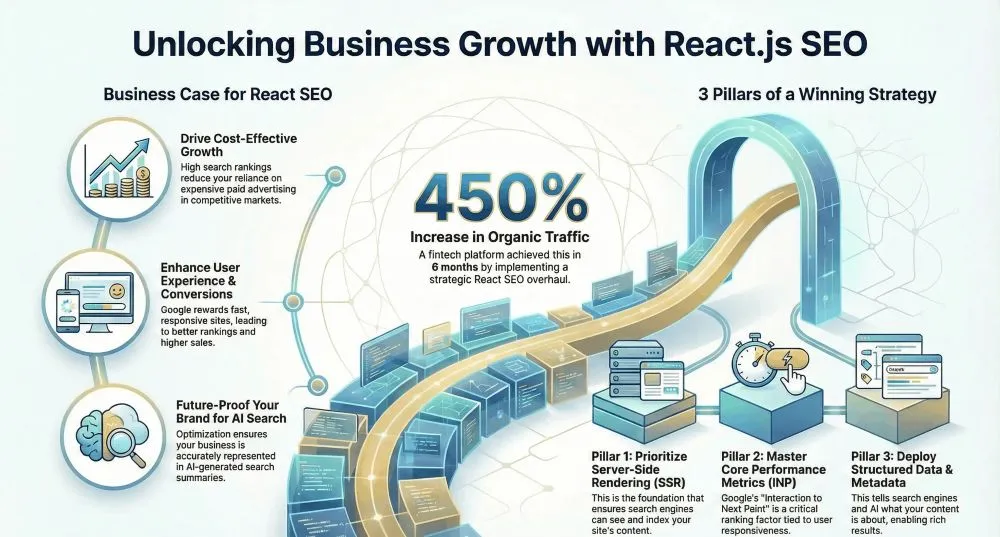
As an executive, you do not need to write the code, but you must know what to ask your technical partners. Use this checklist to hold your React.js development company accountable.
1. Select the Right Rendering Strategy
How your content is “served” to the user is the most critical factor in SEO.
- Server-Side Rendering (SSR): This renders the page on the server before sending it to the browser. It is essential for pages that need to rank on Google.
- Static Site Generation (SSG): This creates pages during the build process. It is incredibly fast and perfect for blogs or product catalogs.
- Incremental Static Regeneration (ISR): This allows you to update static pages without rebuilding the whole site—a must for large-scale enterprise apps.
- Action Step: Ensure your team is using a framework like Next.js to handle these strategies. Full-Stack Techies specializes in implementing hybrid rendering to balance speed and SEO.
2. Master Metadata Management
Search engines need to know what each page is about. Because React is a “single-page” environment, metadata must be handled dynamically.
- Unique Title Tags: Every page needs a title that includes your primary keywords.
- Meta Descriptions: These should be compelling to encourage clicks from the SERP.
- Open Graph Tags: These ensure that when your site is shared on LinkedIn or X (formerly Twitter) in the UK or USA, it looks professional with a custom image and title.
- Tooling: Your developers should use libraries like React Helmet or react-helmet-async to manage these tags effectively.
3. Optimize for Core Web Vitals and INP
In 2026, Google has shifted its focus to Interaction to Next Paint (INP) as the primary metric for responsiveness.
- LCP (Largest Contentful Paint): The main content should load in under 2.5 seconds.
- CLS (Cumulative Layout Shift): The page should be stable. Elements shouldn’t jump around while loading.
- INP (Interaction to Next Paint): This measures how quickly the page responds to a user’s click or keypress. A score under 200ms is the gold standard.
- Action Step: Ask for a monthly Core Web Vitals report. If you are looking for the best react.js development services, ensure they have a proven track record of hitting “green” scores on Google Lighthouse.
4. Implement Clean URL Routing
URLs should be human-readable and descriptive.
- Avoid Hash Symbols: Use the History API so your URLs look like
example.com/services/react-developmentinstead ofexample.com/#/services. - Hierarchy: Ensure your URL structure reflects your site’s hierarchy. This helps search engines in Europe and North America understand the relationship between pages.
- Canonical Tags: Use these to prevent “duplicate content” issues if the same content appears under multiple URLs.
5. Deploy Structured Data for Rich Snippets
Structured data (Schema.org) helps search engines display “rich results” like star ratings, prices, or FAQ dropdowns.
- JSON-LD Format: This is the preferred way to add schema to a React app.
- Types of Schema: Use Organization, Product, FAQ, and LocalBusiness schema to stand out in local searches in cities like Toronto or London.
- AI Advantage: Structured data is the primary way LLMs understand your business data.
6. Advanced Image and Asset Optimization
Heavy images are the #1 cause of slow React sites.
- Modern Formats: Use WebP or AVIF instead of old JPEG/PNG files.
- Responsive Images: Serve smaller images to mobile users and larger ones to desktop users.
- Lazy Loading: Only load images when they are about to enter the user’s view.
- Code Splitting: Ensure your React.js development company uses code splitting so users only download the code they need for the current page.
7. Ensure Robust Indexing and Sitemaps
If Google can’t find your pages, they won’t rank.
- Dynamic XML Sitemaps: Your sitemap should update automatically whenever a new page or product is added.
- Robots.txt: Properly configure this file to tell search engines which parts of your React app to ignore (like admin panels).
- Google Search Console: Ensure your site is verified and you are monitoring for “Crawl Errors.”
Case Study: Scaling Organic Reach in North America
The Client: A mid-sized fintech platform based in Canada, serving users across the USA and Europe.
The Problem: The platform was built using a standard Client-Side Rendered (CSR) React setup. While the app was fast for users once loaded, it had zero visibility on Google. Organic traffic was stagnant at 500 visits per month.
The Solution: The company decided to hire react.js developers from Full-Stack Techies to perform a complete SEO overhaul. The team implemented the following:
- Migration to SSR: Switched the frontend to a Server-Side Rendered model using Next.js.
- Metadata Overhaul: Implemented dynamic meta tags for over 2,000 financial resource pages.
- Core Web Vitals Optimization: Reduced the LCP from 4.2s to 1.8s.
The Results: Within six months, organic traffic grew by 450%. The site began ranking on page one for high-value keywords like “best digital wallet Canada” and “secure payments USA.” The conversion rate also improved by 22% due to the faster load times.
Also Explore: How Full-Stack Techies Built an AI-Powered E-Commerce Platform with React.js
The Future of React.js and AI-Driven Search
As we look toward 2027, the landscape of SEO is shifting from “keywords” to “entities and intent.”
- React Server Components (RSC): This is the next evolution. It allows developers to keep even more code on the server, resulting in nearly zero-bundle sizes for the client. This will be a game-changer for mobile SEO in regions with slower internet speeds.
- AI Search Generative Experience (SGE): Google and Bing are using AI to answer queries directly. React sites that use clean semantic HTML and structured data will be the ones cited as sources by these AI models.
- Voice Search: As users in the UK and USA use more voice-activated devices, React apps must be optimized for natural language queries.
By staying ahead of these trends, a forward-thinking React.js development company can ensure your business remains a leader in your industry.
Checklist: Is Your React Site Ready for AI Search?
- [ ] Semantic HTML: Does your code use <article>, <section>, and <aside> tags so LLMs can identify content hierarchy?
- [ ] Entity Association: Is your brand name consistently linked to your primary services in your structured data?
- [ ] Natural Language Headers: Do your H2s and H3s answer the “Who, What, and How” questions users ask voice assistants?
- [ ] API-First Content: Is your content accessible via clean endpoints that AI agents can potentially crawl?
Conclusion
Optimizing a React.js application for search engines is no longer an optional task—it is a competitive necessity. For C-level executives, the focus should be on performance, discoverability, and user satisfaction. This React.js SEO Checklist provides the foundational steps to ensure your technical team or agency is moving in the right direction.
When you invest in high-quality React.js development services, you aren’t just buying code; you are building a growth engine for your brand. By prioritizing SEO from the start, you ensure that your platform is ready to capture market share in the USA, UK, Canada, and beyond.
If you want to ensure your React project is fully optimized for 2026 and beyond, consider partnering with Full-Stack Techies. Our experts can help you implement this checklist and drive the organic results your business deserves.



