How to Choose a DevOps Solution: Top 5 Questions to Ask Before You Invest

Picking the wrong DevOps solution is an expensive mistake. Gartner reports that by 2026, 80% of large software engineering organizations will run dedicated platform engineering teams, up from just 45% in 2022. That shift means the market for DevOps support is crowded, and not every provider that claims expertise actually has it.
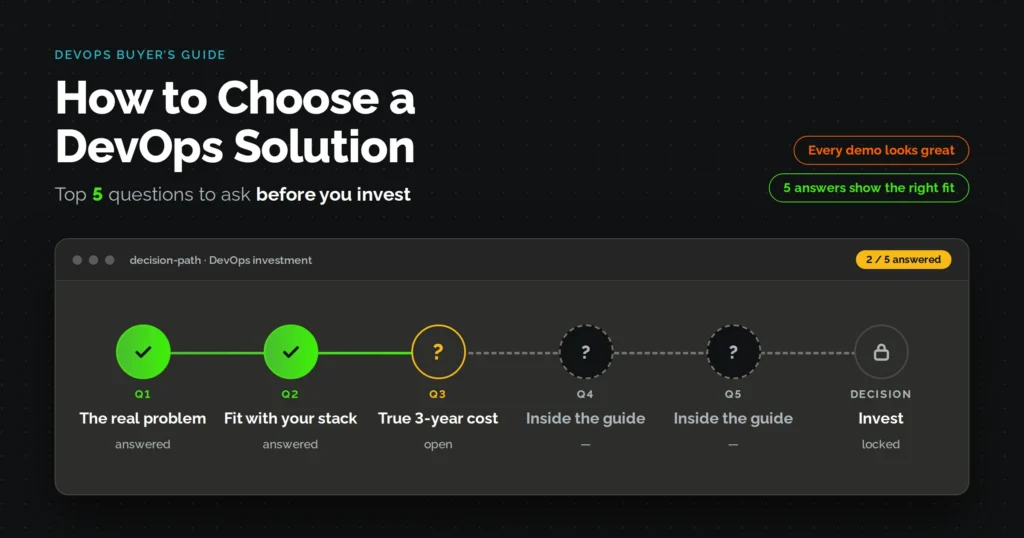
This guide is not a 20-item checklist. It narrows the decision down to five questions, asked in a specific order, that reveal whether a DevOps solution or provider is actually built for your business. Answer these before you sign anything.
Quick Steps
- Define the specific business outcome you need the DevOps solution to deliver.
- Confirm the provider has hands-on experience with your exact tech stack and cloud environment.
- Ask how security and compliance are built into their delivery process, not added at the end.
- Ask how they measure and report success, ideally using DORA metrics.
- Get a clear breakdown of pricing, including what triggers cost changes as you scale.
What You Need Before You Start
Walking into a vendor conversation unprepared wastes everyone’s time. Before you talk to a single provider, get these five things in order.
- A documented list of pain points: Slow releases, recurring incidents, high cloud spend, or manual deployment steps you want gone.
- A current stack inventory: Cloud provider, CI/CD tool, container setup, and any Infrastructure as Code you already use.
- A rough budget range: You do not need an exact number, but you need a ballpark before the first call.
- The right people in the room: Someone who owns the technical decision and someone who owns the budget.
- Time set aside: Plan for 30 to 45 minutes per vendor conversation across three to five vendors.
Whether you are evaluating a full DevOps solution and service package or a narrower engagement like CI/CD setup alone, this prep work is what keeps the next five steps focused and efficient.
Step 1: What Business Outcome Do You Need This Provider to Deliver?
Before you evaluate any tool or vendor, name the outcome you are actually buying. Not “better DevOps,” but a specific result tied to a specific pain point.
- Do you need faster release cycles because competitors are shipping features quicker?
- Do you need fewer production incidents because outages are costing you customers?
- Do you need lower cloud costs because your infrastructure bill grew faster than your user base?
- Do you need audit-ready compliance because a healthcare or fintech client is asking for it?
Why This Comes First
A provider who cannot connect their proposal to your named outcome is selling a generic service, not a solution. This is the single biggest filter, and it takes the least amount of technical knowledge to apply.
Example: Startup vs Enterprise
A 40-person SaaS startup preparing for a Series B round might prioritize deployment speed and uptime, since investors and customers both watch reliability closely. A healthcare enterprise managing a legacy claims system might prioritize compliance and change control above raw speed. The right provider adjusts their pitch to match, rather than repeating the same feature list regardless of who is in the room.
Step 2: Does the Provider Have Proven Experience with Your Tech Stack and Cloud Environment?
Once you know your outcome, check whether the provider has actually solved this problem on infrastructure like yours. This is where many companies get burned, since a provider can sound capable in a sales call and still lack real depth.
Cloud Platform Fit
Ask directly whether they have production experience on your specific cloud provider, whether that is AWS, Azure, or Google Cloud. General cloud familiarity is not the same as hands-on depth with your provider’s quirks around networking, IAM, or cost controls.
CI/CD and Automation Experience
Ask what CI/CD tools they have implemented recently: GitHub Actions, GitLab CI, Jenkins, Azure DevOps, or ArgoCD for GitOps-style delivery. A provider offering genuine DevOps Engineering Services should be able to describe how they automated testing, deployment, and rollbacks for a similar client, not just list tool names.
Infrastructure as Code and Containers
If you use Terraform, Ansible, or Kubernetes, ask how the provider handles version-controlled infrastructure and container orchestration at your scale. A provider unfamiliar with your orchestration layer will slow you down rather than speed you up.
Watch for this red flag: a provider who proposes replacing your existing toolchain before asking why you built it that way in the first place. That is a sign they are selling their preferred stack, not solving your problem. At Fullstacktechies, our DevOps as a Service engagements start with an audit of what you already have, since a stable Jenkins pipeline supporting hundreds of deployments does not need to be replaced just because a newer tool exists.
Step 3: How Does the Provider Build Security and Compliance into Delivery?
Security cannot be a phase you add at the end of a project. It has to be part of how code moves from commit to production, a practice generally called DevSecOps.
The stakes here are real and measurable. According to IBM’s 2025 Cost of a Data Breach Report, the global average cost of a data breach was $4.44 million, while breaches at U.S. organizations averaged $10.22 million. Healthcare breaches were the most expensive industry segment, averaging $7.42 million, a position it has held for 15 consecutive years.
Ask a provider these specific questions:
- Where does automated vulnerability scanning sit in the pipeline: before merge, before deploy, or both?
- How do they manage secrets and access control across environments?
- If you operate in healthcare or fintech, can they name specific compliance frameworks they have supported, such as HIPAA or SOC 2, rather than speaking in general terms?
A provider who treats security as a checkbox at the end of the sprint is not equipped for regulated industries, and the IBM data above shows exactly why that gap gets expensive.
Step 4: How Will the Provider Measure and Report Success?
If a provider cannot tell you how they measure success, you will not know whether the engagement is working until something breaks. This is where DORA metrics come in, a framework maintained by Google’s DevOps Research and Assessment program and validated across tens of thousands of engineering teams.
The four core metrics are simple to explain even if you are not technical:
- Deployment frequency: how often the team ships to production.
- Lead time for changes: how long it takes a code change to reach production.
- Change failure rate: what percentage of deployments cause a production issue.
- Failed deployment recovery time: how fast the team recovers when something breaks.
In DORA’s most recent research, elite-performing teams deploy on demand with lead times under a day and change failure rates near 5%, while low-performing teams can take one to six months to ship a single change. Ask your provider which of these they track by default and how often they report the numbers back to you.
A quick note on AI-assisted development: DORA’s 2025 research also found that increased AI adoption in coding correlates with increased delivery instability at some organizations, even as it improves individual output. Ask how a provider accounts for this rather than assuming faster code generation is automatically better.
Step 5: What Does the Engagement Actually Cost, and How Does Pricing Scale?
Cost conversations should happen early, not after weeks of discovery calls. DevOps engagements typically follow one of four pricing structures, and each fits a different situation.
| Pricing Model | Best Fit | Watch Out For |
|---|---|---|
| Fixed project pricing | Well-defined, short-term projects | Little flexibility if scope changes |
| Hourly or time and materials | Evolving or exploratory work | Costs can climb without a cap |
| Dedicated team or retainer | Ongoing, long-term partnerships | Requires trust in the provider’s staffing |
| Managed DevOps services subscription | Continuous infrastructure operations | Monthly cost needs to match actual usage |
Ask what specifically triggers a price increase, such as adding environments, higher traffic, or expanded compliance scope. Also ask what happens if you need to scale down, since a good partner should have flexibility in both directions.
Managed devops services in particular tend to suit growing companies well, since they trade a large upfront hire for predictable monthly cost and access to a full team’s expertise. Fullstacktechies structures its managed engagements this way specifically so clients are not locked into a fixed team size as their needs change.
Top 5 Questions to Ask Before You Invest in a DevOps Solution
Use this table as your quick-reference recap before any vendor call. It captures what a strong answer sounds like versus a red flag, so you can score each conversation on the spot.
| Question | Strong Answer Sounds Like | Red Flag Answer |
|---|---|---|
| What business outcome will this solve? | Names a specific metric tied to your stated pain point | A generic promise of “faster and better” with no metric |
| Do you have experience with our exact stack? | Names specific tools and recent, comparable engagements | Leads with their preferred toolchain before asking about yours |
| How is security built into delivery? | Describes exactly where scanning and access controls sit in the pipeline | Treats security as a phase added at the end |
| How do you measure success? | Names DORA metrics unprompted with a clear reporting cadence | Vague reference to “monitoring dashboards” with no specifics |
| What does this cost, and how does it scale? | Clear pricing structure plus a stated trigger for cost changes | Avoids discussing pricing until deep into the sales process |
Red Flags That Mean You Should Walk Away
Beyond the answers to specific questions, watch for these behavioral warning signs during the evaluation process itself.
- No named point of contact for the actual delivery team, only a sales representative.
- Unwillingness to provide references from clients with similar stacks or industries.
- Documentation treated as an afterthought rather than a contracted deliverable.
- Pressure to sign quickly before you have spoken with at least one reference client.
- A one-size-fits-all pitch that does not change based on your industry or company size.
Managed DevOps Service vs In-House Team: How to Decide
Not every company should outsource, and not every company should hire in-house. Use this comparison to see which model fits your current stage.
| Factor | Managed DevOps Service | In-House Team |
|---|---|---|
| Time to get started | Fast, typically weeks | Slow, includes hiring and onboarding |
| Upfront cost | Lower, subscription or retainer based | Higher, includes salaries and benefits |
| Specialized expertise | Broad, across many client environments | Deep, but limited to what you hire for |
| Long-term product context | Builds over time, shared with your team | Native from day one |
| Best fit | Startups and mid-size companies scaling fast | Enterprises with steady, large-scale engineering needs |
Many companies land on a hybrid model: an in-house engineer or two who own the roadmap, paired with a managed partner who covers specialized gaps like security automation or Kubernetes scaling. This is often the most practical starting point if you are unsure which way to go.
Final Thoughts
Five focused questions, asked in order, will tell you more about a DevOps provider than a 20-item feature checklist ever will. They force clarity on outcome, fit, security, measurement, and cost before you commit a budget line to it.
If you want a second opinion on a proposal you are already reviewing, or you would rather skip straight to a partner who starts with an audit instead of a pitch, Fullstacktechies ‘ DevOps as a Service team is available to walk through your specific stack and goals.
FAQs
Q1. How long should choosing a DevOps solution provider take?
Plan for two to four weeks, covering three to five vendor conversations and at least one reference check per finalist.
Q2. Should I use these five questions for an internal DevOps buildout too?
Yes. The same five questions work whether you are comparing outsourced providers or evaluating your own internal plan.
Q3. What is the most common mistake companies make here?
Choosing based on price or tool familiarity alone, without confirming the provider can name a measurable outcome and back it with data.
Q4. Can a small business use the same evaluation process as an enterprise?
Yes, the process scales down. A small business just needs shorter, less formal answers than an enterprise handling strict compliance requirements.
Q5. Do these five questions apply to choosing a DevOps tool instead of a provider?
Not directly. Tool selection involves different technical criteria, such as integration depth and licensing, and deserves a separate evaluation process.