

The Best DevOps Automation Services for Enterprises in 2026
DevOps Automation Services enable enterprises to streamline software delivery, reduce manual effort, and improve deployment speed. This guide highlights the best DevOps automation services, tools, and strategies to help enterprises scale efficiently in 2026.


The software delivery landscape has fundamentally changed. In 2026, teams that ship fast, maintain reliability, and scale effortlessly aren’t doing it by accident — they’re built on a set of battle-tested, industry-proven best DevOps practices.
Whether you’re a startup scaling your infrastructure, an enterprise modernizing legacy pipelines, or a mid-size company evaluating DevOps as a Service to accelerate your delivery cycles, the fundamentals remain the same: automate everything, collaborate deeply, monitor obsessively, and iterate continuously.
At Full-Stack Techies, we’ve worked with hundreds of engineering teams across industries — from FinTech to HealthTech — helping them implement DevOps managed services and custom DevOps workflows that eliminate bottlenecks and reduce time-to-market by up to 60%. This guide distills those hard-won insights into 10 actionable best practices you can implement today.
Quick Answer — What are the Best DevOps Practices?
The best DevOps practices in 2026 include: CI/CD pipeline automation, infrastructure as code (IaC), shift-left security (DevSecOps), observability and monitoring, microservices architecture, GitOps workflows, automated testing, cloud-native tooling, blameless post-mortems, and a strong DevOps culture. Scroll down for a deep dive into each.

Key Takeaways
1. DevOps is a culture first, tooling second. The biggest gains come from breaking down silos between development, operations, and security — not from purchasing new software. Tools amplify culture; they don’t replace it.
2. CI/CD and IaC are your highest-ROI starting points. If you only implement two practices, make it these. Automated pipelines and version-controlled infrastructure eliminate the most common sources of delivery delays and environment inconsistencies. Most teams see measurable ROI within 60–90 days.
3. Security belongs in the pipeline, not at the end of it. Shift-left security through DevSecOps — automated scanning, secrets detection, and policy-as-code — is far cheaper and more effective than catching vulnerabilities post-deployment. A security issue found in CI costs 10x less to fix than one found in production.
4. You can’t improve what you don’t measure. DORA metrics — Deployment Frequency, Lead Time, MTTR, and Change Failure Rate — are the universal language of DevOps maturity. Establish a baseline on day one and review the data in every retrospective.
5. DevOps as a Service accelerates transformation without the hiring burden. Not every team has the budget or time to build a full in-house DevOps function. Partnering with a DevOps managed services provider like Full-Stack Techies gives you senior expertise, proven frameworks, and measurable outcomes — typically 40–60% faster than a solo in-house build.
6. GitOps is the future of production deployments. Declarative, Git-driven deployments with Argo CD or Flux deliver auditability, automatic drift correction, and instant rollback — all without giving your CI system direct cluster access. For Kubernetes-native teams, GitOps is the gold standard.
7. Observability is not optional at scale. Metrics, logs, and traces through OpenTelemetry give your team the visibility to detect issues before users do, diagnose root causes in minutes, and build the confidence to ship faster. Without observability, speed becomes risk.
8. Phased implementation beats big-bang transformation. Trying to implement all 10 best DevOps practices simultaneously almost always fails. A phased 90-day roadmap — foundation first, delivery second, security and observability third, culture last — delivers compounding results without overwhelming your team.
9. Blameless post-mortems compound over time. Every incident is a learning opportunity. Teams that run structured, blame-free retrospectives after failures consistently outperform those that don’t — not because they have fewer incidents, but because each incident makes their systems more resilient than before.
10. Start today, start small, and stay consistent. The best DevOps teams in 2026 aren’t the ones with the most sophisticated stacks — they’re the ones that have been consistently improving for two or three years. Pick your highest-pain bottleneck, fix it, measure the result, and repeat. That compound effect is what separates elite performers from the rest.
Practice #1: Implement CI/CD Pipelines from Day One
If there’s one entry point into the world of best DevOps practices, it’s Continuous Integration and Continuous Delivery (CI/CD). CI/CD pipelines automate the process of building, testing, and deploying code — transforming what used to take days of manual work into a seamless, repeatable process that takes minutes.
Why It Matters in 2026
Modern software teams push code dozens of times a day. Without a CI/CD pipeline, each push is a potential landmine — inconsistent builds, untested code, and manual deployments create risk at every turn. With CI/CD, every commit triggers an automated pipeline that validates the code before it ever reaches production.
How to Implement It
- Choose your pipeline tool: GitHub Actions, GitLab CI, Jenkins, CircleCI, or AWS CodePipeline are all strong choices in 2026.
- Define pipeline stages: Build → Unit Test → Integration Test → Staging Deploy → Smoke Test → Production Deploy.
- Use environment-specific configurations: Never hardcode credentials. Use secrets managers like HashiCorp Vault or AWS Secrets Manager.
- Track pipeline metrics: Mean time to recovery (MTTR), deployment frequency, and change failure rate are your KPIs.
Full-Stack Techies Insight
Our DevOps managed services team at Full-Stack Techies has helped clients reduce deployment times from 4 hours to under 12 minutes by implementing parallel CI/CD stages and Docker-based build environments. The ROI on CI/CD is almost always measurable within 90 days.
Practice #2: Adopt Infrastructure as Code (IaC)
Infrastructure as Code means managing and provisioning your cloud infrastructure through machine-readable configuration files rather than manual processes or interactive configuration tools. In 2026, IaC isn’t optional — it’s the foundation of any scalable cloud strategy.
Key IaC Tools in 2026
- Terraform: The de facto standard for multi-cloud IaC. Widely supported, mature ecosystem.
- Pulumi: IaC with real programming languages (TypeScript, Python, Go) — great for developer-centric teams.
- AWS CloudFormation / Azure Bicep: Native cloud options for AWS and Azure environments respectively.
- Ansible: Excellent for configuration management and application deployment automation.
IaC Best Practices
Store all infrastructure code in version control (Git). Use modules and reusable components to avoid duplication. Apply the same code review standards to infrastructure code as to application code. Use drift detection tools to identify unauthorized manual changes.
When Full-Stack Techies onboards clients for cloud DevOps engagements, IaC is one of the first pillars we establish — it creates a single source of truth for infrastructure and dramatically reduces environment inconsistencies that plague manual setups.
Practice #3: Shift Security Left with DevSecOps
‘Shift left’ means integrating security checks earlier in the development lifecycle — ideally at the code-writing stage itself — rather than treating security as a final gate before release. This evolution of DevOps into DevSecOps is one of the most critical best DevOps practices any team can adopt.
Practical DevSecOps Implementations
- Static Application Security Testing (SAST): Run automated code analysis tools like Semgrep, SonarQube, or Snyk on every pull request.
- Dependency scanning: Use Dependabot, OWASP Dependency-Check, or Snyk to flag known vulnerabilities in third-party libraries.
- Container image scanning: Tools like Trivy, Anchore, or Prisma Cloud scan Docker images for CVEs before they reach production.
- Secrets detection: Integrate tools like GitGuardian or Gitleaks into your pipeline to prevent accidental credential exposure.
- Policy as Code: Use Open Policy Agent (OPA) to enforce security and compliance rules programmatically.
Security Stat
According to industry reports, the average cost of a data breach in 2025 exceeded $4.8 million. Teams practicing DevSecOps detect and contain breaches 35% faster than those who treat security as an afterthought. Shifting left is not just good engineering — it’s good business.
Practice #4: Build a Robust Observability Stack
Monitoring tells you when something is wrong. Observability tells you why. In 2026, high-performing engineering teams don’t just monitor uptime — they instrument their entire stack to gain real-time insights into performance, errors, and user behavior.
The Three Pillars of Observability
- Metrics: Quantitative measurements over time (CPU usage, request latency, error rates). Tools: Prometheus, Grafana, Datadog.
- Logs: Structured records of events. Tools: ELK Stack (Elasticsearch, Logstash, Kibana), Splunk, Loki.
- Traces: End-to-end request flows through distributed systems. Tools: Jaeger, Zipkin, AWS X-Ray, OpenTelemetry.
Observability in Practice
Define SLOs (Service Level Objectives) and SLAs upfront. Instrument code with OpenTelemetry for vendor-neutral observability. Set up alerting based on user-impacting conditions, not just infrastructure thresholds. Use distributed tracing to debug latency issues in microservices architectures.
The Full-Stack Techies engineering team recommends OpenTelemetry as the standard instrumentation framework in 2026. It provides a unified, vendor-neutral approach to collecting telemetry data — reducing lock-in while maximizing visibility across your entire stack.
Practice #5: Use Microservices and Containerization
Microservices architecture decomposes applications into small, independently deployable services. Combined with containerization via Docker and orchestration via Kubernetes, this approach gives teams the flexibility to deploy, scale, and update components without system-wide disruptions.
When to Use Microservices
Microservices aren’t always the right choice. For teams early in their journey, start with a well-structured monolith and migrate to microservices when the codebase complexity justifies it. The strangler fig pattern is a proven approach for gradually extracting microservices from a monolith.
Practice #6: Embrace GitOps for Deployment Workflows
GitOps is an operational framework that applies DevOps best practices — version control, collaboration, compliance, CI/CD — to infrastructure automation. In a GitOps model, Git is the single source of truth for both application and infrastructure state.
How GitOps Works
In a GitOps workflow, all changes to infrastructure and application configuration are made through Git pull requests. An automated agent (like Argo CD or Flux) continuously reconciles the desired state in Git with the actual state in the cluster. If they diverge, the agent automatically corrects the drift.
GitOps Benefits
- Auditability: Every change is tracked in Git with a full history, author, and timestamp.
- Rollback simplicity: Reverting a bad deployment is as simple as reverting a Git commit.
- Reduced blast radius: Changes are incremental and reviewed before merging, reducing the risk of large-scale failures.
- Developer empowerment: Developers can manage deployments without needing direct cluster access.
Practice #7: Automate Testing at Every Level
Automated testing is the backbone of continuous delivery. Without comprehensive test coverage, CI/CD becomes continuous deployment of untested code — which is arguably worse than no CI/CD at all.
The Testing Pyramid in 2026
- Unit Tests (base — most numerous): Test individual functions and modules in isolation. Fast, cheap, and foundational.
- Integration Tests (middle): Test interactions between components and services. Use contract testing with Pact for microservices.
- End-to-End Tests (top — fewest): Test complete user flows through the UI. Use Playwright or Cypress for web applications.
- Performance Tests: Use k6, Locust, or Gatling to validate performance under load.
- Chaos Engineering: Tools like Chaos Monkey or LitmusChaos deliberately introduce failures to test system resilience.
Testing Benchmark
High-performing DevOps teams maintain 80%+ code coverage and run their full test suite in under 10 minutes. If your test suite takes 45+ minutes, it’s time to invest in parallelization, smarter test selection, and faster build environments.
Practice #8: Leverage DevOps as a Service and Managed DevOps
Not every team has the bandwidth or expertise to build and maintain a full DevOps infrastructure in-house. This is where DevOps as a Service (DaaS) and DevOps managed services come in — providing access to enterprise-grade DevOps tooling, expertise, and processes on a flexible engagement model.
What is DevOps as a Service?
DevOps as a Service is a model where an external provider manages your DevOps toolchain, pipelines, infrastructure automation, and practices on your behalf. This can include anything from setting up CI/CD pipelines and IaC environments to providing on-demand DevOps engineers who embed with your team.
When to Consider DevOps Managed Services
Full-Stack Techies offers end-to-end DevOps managed services — from initial assessment and toolchain setup through ongoing pipeline management, monitoring, and optimization. Our clients typically see a 40–60% reduction in deployment-related incidents within the first quarter of our engagement. Whether you need a dedicated DevOps engineer, a complete cloud DevOps transformation, or targeted support for specific initiatives, our team can structure an engagement that fits your needs.
Why Full-Stack Techies?
We’re not just a vendor — we’re a technical partner. Full-Stack Techies has helped teams from 10-person startups to 500-engineer enterprises implement the best DevOps practices, reduce infrastructure costs, and ship software faster. Our DevOps as a Service offering combines deep engineering expertise with flexible engagement models that scale with you.
Practice #9: Run Blameless Post-Mortems
Incidents happen. Deployments fail. Services go down. The question isn’t whether your team will experience failures — it’s how your team responds to and learns from them. Blameless post-mortems are a cultural practice that separates high-performing engineering organizations from struggling ones.
What Makes a Post-Mortem ‘Blameless’?
A blameless post-mortem assumes that every person involved in an incident was acting with the best intentions and the best information they had at the time. Instead of asking ‘who caused this?’, the question becomes ‘what systemic factors made this failure possible, and how do we prevent it from happening again?’
Post-Mortem Structure
- Timeline: A factual, chronological account of the incident from detection to resolution.
- Impact: Quantified impact on users, revenue, SLAs, and reputation.
- Root cause analysis: Use the 5 Whys or fishbone diagram to identify contributing factors.
- Action items: Concrete, assigned, time-bound remediation tasks.
- Lessons learned: What did the team learn? What process or tooling improvements will prevent recurrence?
Google’s Site Reliability Engineering (SRE) practices, which popularized blameless post-mortems, have been adopted by leading tech companies worldwide. The cultural shift from blame to learning is one of the most impactful — and underrated — of all best DevOps practices.
Practice #10: Build a Genuine DevOps Culture
All the tooling, automation, and pipelines in the world won’t deliver the full benefits of DevOps if the underlying culture remains siloed. DevOps is fundamentally a cultural movement — it’s about breaking down the walls between development, operations, security, and business teams.
Core Pillars of DevOps Culture
- Shared ownership: Dev teams are responsible for their services in production. On-call rotations extend to the engineers who write the code.
- Psychological safety: Engineers should feel safe to raise concerns, flag risks, and admit mistakes without fear of retribution.
- Continuous learning: Teams invest in upskilling, attend conferences, run internal tech talks, and conduct regular retrospectives.
- Customer obsession: DevOps practices should ultimately be measured by their impact on the end user — not just on deployment frequency.
- Data-driven decisions: Use DORA metrics (deployment frequency, lead time for changes, MTTR, change failure rate) to track and improve DevOps maturity.
Measuring DevOps Culture Maturity
The DORA State of DevOps Report classifies teams as Elite, High, Medium, or Low performers based on their metrics. Elite performers deploy multiple times per day, have a lead time for changes under one hour, a change failure rate below 5%, and an MTTR under one hour. These benchmarks give teams a north star to work toward.
At Full-Stack Techies, culture assessment is always part of our DevOps engagement kickoff. Technical practices only stick when the organizational culture supports them. We help teams build the governance structures, communication patterns, and feedback loops that make DevOps transformation sustainable.
Also Read: The Ultimate Guide to DevOps as a Service (DaaS) in 2026
Get scalable, fast, and user-friendly DevOps solutions tailored to your needs.
Get Free Consultation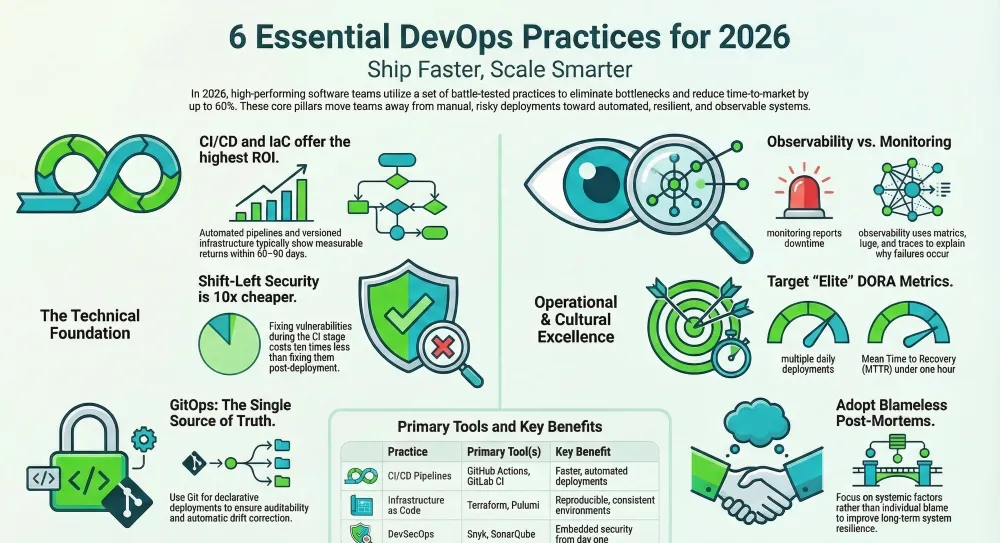
Quick Reference: 10 Best DevOps Practices at a Glance
| # | Practice | Primary Tool(s) | Key Benefit |
|---|---|---|---|
| 1 | CI/CD Pipelines | GitHub Actions, GitLab CI | Faster, automated deployments |
| 2 | Infrastructure as Code | Terraform, Pulumi | Reproducible environments |
| 3 | DevSecOps | Snyk, SonarQube, OPA | Embedded security from day one |
| 4 | Observability | Prometheus, Grafana, OTel | Full-stack visibility |
| 5 | Containerization | Docker, Kubernetes | Consistent, scalable deployments |
| 6 | GitOps | Argo CD, Flux | Git as single source of truth |
| 7 | Automated Testing | Jest, Playwright, k6 | Confidence in every release |
| 8 | DevOps as a Service | Full-Stack Techies | Expert DevOps without hiring burden |
| 9 | Blameless Post-Mortems | PagerDuty, Jira | Continuous system improvement |
| 10 | DevOps Culture | DORA Metrics | Long-term transformation success |
Final Thoughts: Building a High-Performance DevOps Organization in 2026
The best DevOps practices aren’t a one-time checklist — they’re an evolving framework that grows with your team, your technology, and your business. The teams winning in 2026 are those that have made CI/CD, IaC, DevSecOps, and observability core parts of their engineering DNA, not afterthoughts bolted on at the end.
Start small. Pick two or three practices from this list where your team has the most pain and the most to gain. Build momentum through quick wins, measure your progress with DORA metrics, and iterate.
If you’d like expert help implementing any of these practices — whether that’s setting up your first CI/CD pipeline, migrating to a Kubernetes-based architecture, or exploring DevOps as a Service to accelerate your roadmap — the team at Full-Stack Techies is here to help. We bring hands-on expertise, proven frameworks, and a genuine partnership mindset to every engagement.
Ready to Implement the Best DevOps Practices?
Full-Stack Techies offers DevOps consulting, DevOps managed services, and DevOps as a Service engagements for teams at every stage of their journey. Get in touch to schedule a free 30-minute DevOps assessment with one of our senior engineers.
Frequently Asked Questions (FAQ)
Q1. What are the most important DevOps practices in 2026?
The most important DevOps practices in 2026 are CI/CD pipeline automation, Infrastructure as Code, DevSecOps (shift-left security), observability, and a strong DevOps culture. These five form the foundation on which all other practices build. Teams that master these see the highest gains in deployment frequency, system reliability, and developer satisfaction.
Q2. What is DevOps as a Service?
DevOps as a Service (DaaS) is a model where an external provider manages your DevOps toolchain, pipelines, and practices u2014 giving your team access to expert DevOps engineers and enterprise-grade infrastructure automation without the need to hire a full in-house team. Itu2019s ideal for startups, scaleups, and enterprises going through digital transformation. Full-Stack Techies offers comprehensive DevOps as a Service engagements tailored to your teamu2019s needs and maturity level.
Q3. What are DevOps managed services?
DevOps managed services involve outsourcing the ongoing management, monitoring, and optimization of your DevOps infrastructure to a specialized provider. This typically includes CI/CD pipeline management, cloud infrastructure automation, security compliance, monitoring stack management, and incident response support. The benefit is that your internal team can focus on product development while experts handle the operational complexity.
Q4. What tools are used in DevOps?
DevOps teams in 2026 commonly use: GitHub or GitLab for version control, GitHub Actions or Jenkins for CI/CD, Terraform or Pulumi for IaC, Docker and Kubernetes for containerization, Prometheus and Grafana for monitoring, Datadog for APM, Snyk and SonarQube for security, PagerDuty for incident management, and Argo CD for GitOps deployments. The best tool stack depends on your cloud provider, team size, and maturity level.
Q5. How do I measure DevOps success?
The DORA (DevOps Research and Assessment) metrics are the industry standard for measuring DevOps performance: Deployment Frequency, Lead Time for Changes, Mean Time to Recovery (MTTR), and Change Failure Rate. Elite-performing teams deploy multiple times per day with an MTTR under one hour and a change failure rate below 5%.
Q6. Is DevOps still relevant in 2026?
Absolutely. DevOps has evolved significantly and in 2026 encompasses GitOps, Platform Engineering, AIOps, and FinOps disciplines. The core principles u2014 automation, collaboration, continuous improvement, and customer focus u2014 are more relevant than ever as software systems grow in complexity. Teams that embrace DevOps practices consistently outperform those that donu2019t across every key engineering metric.
Q7. What is the role of automation in DevOps?
Automation is the backbone of DevOps. It eliminates manual, error-prone steps across the entire software delivery lifecycle u2014 from code integration and testing to deployment and infrastructure provisioning. Teams that automate CI/CD pipelines, security scans, and monitoring alerts deploy faster, with fewer incidents, and at a scale no manual process can match.
Q8. Is Kubernetes necessary for DevOps in 2026?
Kubernetes is not mandatory, but itu2019s the dominant container orchestration platform for teams running microservices at scale. Small teams can start with simpler options like AWS ECS, Google Cloud Run, or Docker Compose. As your services grow in complexity, Kubernetes becomes the most powerful and flexible path forward u2014 especially when paired with Helm, Argo CD, and a service mesh like Istio.
Q9. What is the difference between DevOps and Platform Engineering?
DevOps is a culture and set of practices focused on collaboration between development and operations to ship software faster and more reliably. Platform Engineering is an evolution of DevOps u2014 it builds internal developer platforms (IDPs) that abstract infrastructure complexity and give developers self-service access to standardized tooling. Think of Platform Engineering as DevOps at scale, productized for large engineering organizations.
Q10. How do DevOps practices reduce cloud costs?
DevOps practices reduce cloud costs by eliminating waste through automation and visibility. Infrastructure as Code prevents over-provisioned environments. CI/CD pipelines shut down ephemeral environments after use. Observability tools surface idle or underutilized resources. FinOps practices u2014 cost tagging, budget alerts, and right-sizing u2014 layer on top of DevOps to give teams full ownership of their cloud spend from day one.



