DevOps as a Service Architecture: Toolchain, Workflow, and Automation Stack
This guide to DevOps as a Service Architecture explains how modern organizations design scalable DevOps toolchains, workflows, and automation stacks. Learn the essential components, best practices, and architectural strategies needed to streamline software delivery and improve operational efficiency in 2026.


Introduction: Why DevOps as a Service Architecture Is No Longer Optional
Software delivery has fundamentally changed. Organizations that once measured deployments in quarters now measure them in minutes. The pressure to ship faster, break less, and scale smarter has pushed engineering leaders to rethink not just their tools, but the very architecture that holds those tools together.
This is exactly where DevOps as a Service enters the conversation — not as a buzzword, but as a structural shift in how modern engineering teams operate.
DevOps as a Service (DaaS) refers to the delivery of a fully managed, end-to-end DevOps architecture — including pipelines, toolchains, automation stacks, and governance frameworks — either through a cloud provider, a managed services partner, or an internally productized platform team. Rather than assembling and maintaining disparate tools, teams consume a coherent, pre-integrated system that handles continuous integration, continuous delivery, infrastructure provisioning, observability, and security scanning as a unified service.
The global DevOps market reached USD 15.80 billion in 2025 and is projected to reach USD 83.60 billion by 2034, growing at a CAGR of 19.74% — driven by accelerating digital transformation, widespread cloud adoption, and growing enterprise demand for faster, more reliable software delivery.
According to Gartner, by 2027, 80% of organizations will incorporate a DevOps platform into their tooling to reduce complexity, up from just 25% in 2023 — a signal of explosive growth and a major shift in how businesses approach software delivery.
At Full-Stack Techies, we architect, implement, and continuously optimize DevOps as a Service environments for engineering teams across industries — from early-stage startups scaling their first pipelines to enterprises modernizing decade-old release processes. This article reflects our hands-on experience and the current state of the field.
Key Takeaways: Building a Production-Grade DevOps as a Service Architecture
A production-grade DevOps as a Service architecture is a layered system — not a collection of tools. It integrates source control, CI/CD toolchain, infrastructure as code, automation stack, and observability into a coherent, self-healing, continuously improving system.
The most important architectural decisions are:
- Adopt trunk-based development and short-lived branches to enable true continuous integration
- Design the CI/CD toolchain around enforced quality gates, not just build-and-push automation
- Treat infrastructure as code as a first-class engineering discipline with modules, tests, and policy enforcement
- Implement a GitOps pipeline model to make Git the single source of truth for both application and infrastructure state
- Use progressive delivery patterns (canary releases, feature flags, blue-green deployments) to decouple deployment from release
- Instrument observability before you need it, using the three-pillar model of metrics, logs, and traces
- Measure success with DORA metrics and set explicit targets for deployment frequency, lead time, change failure rate, and MTTR
The investment in a well-designed DevOps as a Service architecture is not a cost center. It is a force multiplier — enabling engineering teams to deliver more value, with less risk, at a higher frequency than would ever be possible with manual processes and fragmented toolchains.
What Is DevOps as a Service Architecture? A Foundational Definition
Before diving into toolchains and workflow automation, it is worth establishing what DevOps as a Service architecture actually means in structural terms.
Traditional DevOps architecture involves organizations assembling their own toolchain — choosing a CI server, a deployment platform, a secrets manager, a monitoring stack — and stitching them together with custom scripts, shared credentials, and tribal knowledge. This works at small scale. It becomes a liability at medium scale and a crisis at enterprise scale.
DevOps as a Service architecture abstracts that complexity. It delivers a coherent, opinionated system where:
- Source code triggers deterministic, automated pipelines
- Infrastructure as code provisions and tears down environments on demand
- Release pipeline architecture enforces quality gates before any artifact reaches production
- Security scanning is embedded — not bolted on — at every stage
- Observability is continuous, not reactive
- The entire system is self-healing, version-controlled, and auditable
The key distinction from traditional DevOps is service delivery model: instead of owning and operating each tool, teams consume the capability as a product. This can be cloud-native (AWS CodePipeline + CodeBuild + CodeDeploy), platform-engineered (internal developer platforms), or fully managed through a partner like Full-Stack Techies.
Get scalable, fast, and user-friendly DevOps solutions tailored to your needs.
Get Free Consultation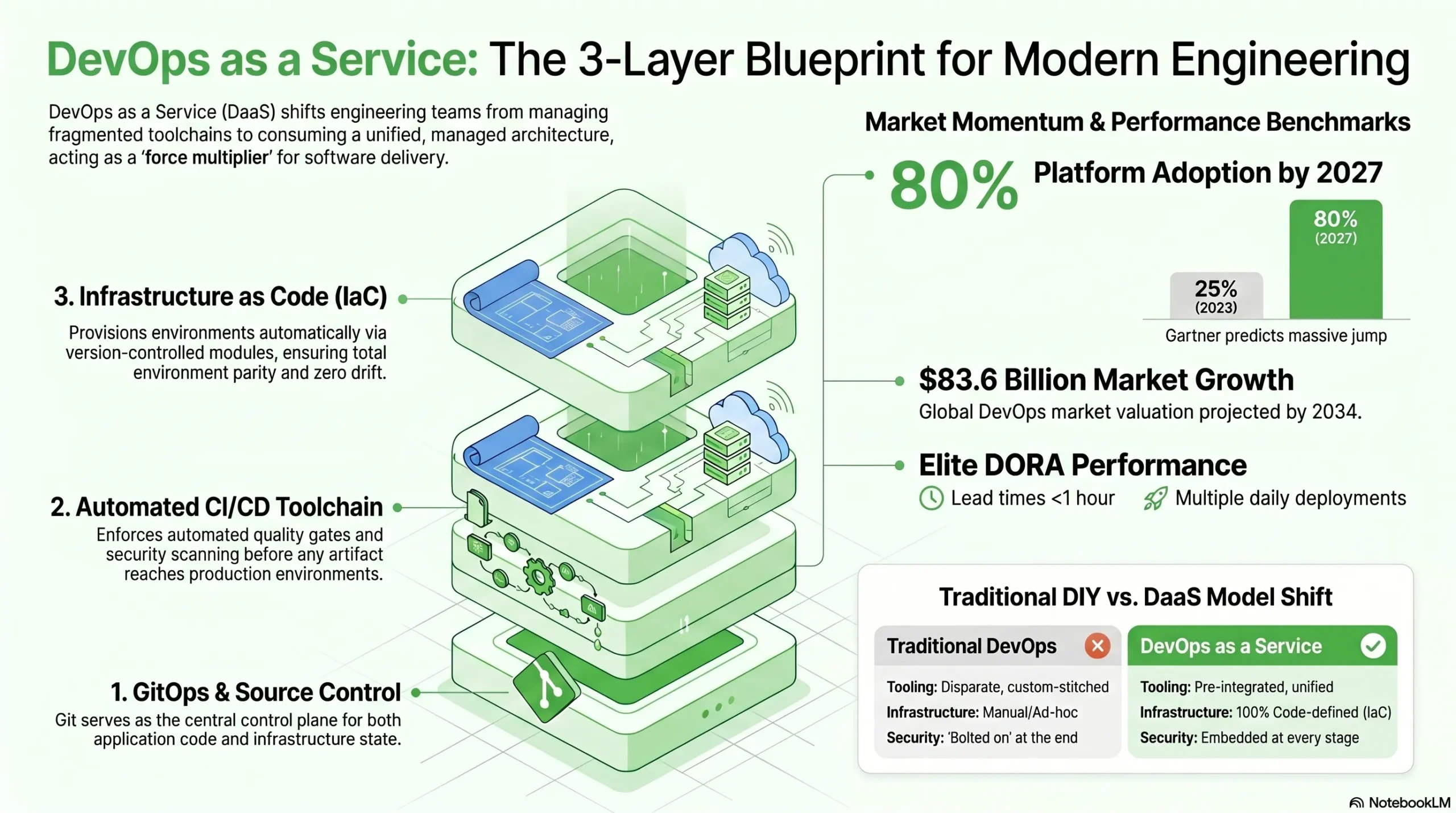
The Five Core Layers of a DevOps as a Service Architecture
A well-designed DevOps architecture is not a flat list of tools. It is a layered system where each stratum serves a specific purpose and interfaces cleanly with the layers above and below it.
Layer 1: Source Control and Collaboration Foundation
Every DevOps as a Service system begins with source control — the single source of truth for application code, configuration, pipeline definitions, and infrastructure declarations. Modern DevOps architecture treats Git not just as a code repository but as the control plane for the entire software delivery system.
This is the foundation of GitOps pipeline architecture. In a GitOps model, every change to infrastructure and application state is represented as a declarative file in a Git repository. Pull requests become the change management process. Merges become the deployment trigger. Rollbacks become a git revert.
Toolchain at this layer:
- GitHub / GitLab / Bitbucket — distributed version control and collaboration
- Git branching strategies (trunk-based development, GitHub Flow, GitFlow) — define how code moves toward production
- Pre-commit hooks — enforce code style, secret scanning, and linting before a commit reaches the remote
Full-Stack Techies consistently recommends trunk-based development for teams adopting DevOps as a service at scale. Long-lived feature branches are the enemy of continuous integration. Small, frequent commits to a shared trunk — protected by automated quality gates — are the heartbeat of a healthy DevOps workflow automation system.
Layer 2: The CI/CD Toolchain — Build, Test, and Integration Automation
The CI/CD toolchain is the operational core of any DevOps as a Service architecture. Continuous Integration (CI) ensures that every code change is automatically built and verified. Continuous Delivery (CD) ensures that every verified build can be deployed to any environment at any time.
A DevOps pipeline is a set of automated processes and tools that allows both developers and operations professionals to work cohesively to build and deploy code to a production environment — typically including building, testing, releasing, deploying, monitoring, and reporting.
CI stage tooling — the build and verify layer:
- GitHub Actions — the current market leader for cloud-native CI, deeply integrated with the GitHub ecosystem, supporting matrix builds, reusable workflows, and secrets management
- Jenkins — the leading open source automation server with hundreds of plugins, Jenkins can be used as a simple CI server or turned into the continuous delivery hub for any project, integrating with practically every tool in the continuous integration and continuous delivery toolchain
- GitLab CI/CD — a tightly integrated CI/CD system for teams using GitLab for source control, with built-in container registry and security scanning
- CircleCI / Buildkite — high-performance CI for organizations with demanding parallelization requirements
CD stage tooling — the release and deploy layer:
- ArgoCD — the de facto standard for GitOps pipeline continuous delivery on Kubernetes; watches Git repositories and continuously reconciles desired state with actual cluster state
- Flux CD — a GitOps operator for Kubernetes with strong multi-tenancy and Helm support
- Spinnaker — enterprise-grade multi-cloud cloud deployment architecture with advanced canary analysis and rollback automation
- Octopus Deploy — particularly strong for complex, multi-environment deployment orchestration with robust runbook automation
Quality gates in the CI/CD toolchain:
A professional CI/CD toolchain is not just a build-and-push system. It is a series of enforced quality gates:
- Static code analysis — SonarQube, ESLint, Pylint
- Unit and integration testing — Jest, Pytest, JUnit
- Security scanning — Snyk, Trivy, OWASP Dependency Check
- Container image scanning — before any image is pushed to a registry
- Performance baseline validation — automated load tests on staging environments
- Artifact signing and provenance — ensuring the artifact that enters the pipeline is the same one that exits it
At Full-Stack Techies, we design CI/CD toolchains with the principle that every quality gate must be automated, every failure must be observable, and every gate decision must be auditable. No manual approval steps that create delivery bottlenecks — unless specifically required by compliance policy.
Layer 3: Infrastructure as Code and the Environment Provisioning Layer
If the CI/CD toolchain handles application delivery, infrastructure as code (IaC) handles everything the application runs on. In a mature DevOps as a Service architecture, infrastructure is never provisioned manually. Every server, database, load balancer, VPC, IAM role, and DNS record is defined in version-controlled code, provisioned by automation, and destroyed by automation when no longer needed.
Infrastructure as Code toolchain:
- Terraform — the dominant IaC tool for multi-cloud cloud deployment architecture; declarative, provider-agnostic, and state-managed; widely used for provisioning AWS, GCP, Azure, and Kubernetes resources in a unified workflow
- Pulumi brings full programming language support (TypeScript, Python, Go) to infrastructure definition, enabling more complex logic than HCL
- AWS CloudFormation / Azure ARM / Google Cloud Deployment Manager — native IaC for organizations standardized on a single cloud provider
- Ansible — configuration management and application deployment automation, particularly strong for configuration drift remediation
Policy as Code — governing infrastructure automatically:
Modern DevOps as a service environments layer policy enforcement on top of IaC. Tools like Open Policy Agent (OPA), Checkov, and Sentinel evaluate IaC configurations against organizational policies before infrastructure is provisioned. This prevents misconfigured S3 buckets from being created, enforces encryption standards, and blocks non-compliant network configurations — automatically, in the pipeline.
IaC tools like Terraform, Pulumi, and AWS CloudFormation are maturing — enterprises are moving beyond writing IaC scripts to managing modular, reusable, and policy-governed IaC libraries, with GitOps integration becoming a key competitive differentiator.
Full-Stack Techies treat infrastructure as code as a first-class engineering discipline, not an ops afterthought. We structure Terraform codebases with modules, workspaces, and remote state backends from day one — ensuring that infrastructure definitions are as maintainable, testable, and reviewable as application code.
Layer 4: The Automation Stack — Orchestration, Containerization, and Deployment Patterns
The automation stack in a DevOps as a Service architecture sits between infrastructure provisioning and application delivery. It handles container orchestration, deployment strategies, secrets management, and service mesh configuration.
Container and orchestration layer:
- Docker — the universal container runtime; every application artifact in a modern DevOps architecture is a container image
- Kubernetes — the orchestration layer for containerized workloads; handles scheduling, scaling, self-healing, and service discovery
- Helm — Kubernetes package manager for templating and versioning deployment manifests
- Kustomize — overlay-based Kubernetes configuration management, often used alongside Helm in GitOps pipeline workflows
Advanced deployment strategies in the automation stack:
A professional release pipeline architecture does not deploy code directly to production. It uses progressive delivery patterns to manage risk:
- Blue-Green Deployment — two identical production environments; traffic is shifted from the old environment to the new one atomically, with instant rollback by shifting traffic back
- Canary Releases — new code is deployed to a small percentage of traffic (1%, 5%, 10%) with automated analysis of error rates, latency, and business metrics before progressive rollout
- Feature Flags — decouple deployment from release; code ships to production but features are toggled on for specific user segments using tools like LaunchDarkly or Unleash
- Rolling Updates — gradual replacement of old instances with new ones, managed by Kubernetes natively
Secrets and configuration management:
- HashiCorp Vault — dynamic secrets generation, secrets leasing, and audit logging; the gold standard for secrets management in a mature DevOps as a service environment
- AWS Secrets Manager / Azure Key Vault / GCP Secret Manager — cloud-native secrets management for provider-specific deployments
- External Secrets Operator — Kubernetes-native secrets injection from external secret stores
Layer 5: Observability, Feedback Loops, and Continuous Learning
No DevOps as a Service architecture is complete without a comprehensive observability layer. Observability is not the same as monitoring. Monitoring tells you that something is wrong. Observability tells you why.
The three pillars of observability in a modern DevOps architecture:
Metrics — quantitative measurements of system behavior over time
- Prometheus — the standard for Kubernetes-native metrics collection
- Datadog / New Relic / Dynatrace — enterprise-grade observability platforms with APM, infrastructure monitoring, and log management
- Grafana — the universal visualization layer for metrics from any source
Logs — structured records of discrete events
- ELK Stack (Elasticsearch, Logstash, Kibana) — the classic centralized logging architecture
- Loki — Grafana’s lightweight, label-based log aggregation system, designed to complement Prometheus
Traces — distributed request tracing across microservices
- Jaeger — open-source distributed tracing; follows a request as it propagates across services, revealing where latency is introduced
- OpenTelemetry — the vendor-neutral standard for instrumentation; emit traces, metrics, and logs from any language runtime without vendor lock-in
The feedback loop — DORA metrics as architecture success criteria:
The DORA (DevOps Research and Assessment) metrics provide the benchmarks that determine whether a DevOps as a Service architecture is actually delivering value:
- Deployment Frequency — how often does the team successfully deploy to production?
- Lead Time for Changes — how long from code commit to production deployment?
- Change Failure Rate — what percentage of deployments cause a production incident?
- Mean Time to Recovery (MTTR) — how long to restore service after a production incident?
Elite-performing organizations, according to DORA research, deploy multiple times per day, have lead times under one hour, change failure rates below 5%, and restore service in under one hour. These are the benchmarks that Full-Stack Techies design DevOps as a Service environments to achieve.
DevOps Workflow Automation: The End-to-End Flow in Practice
Understanding individual layers is important. Understanding how they work together as a continuous DevOps workflow automation is what separates theoretical knowledge from operational capability. Here is the end-to-end flow in a production-grade DevOps as a Service architecture:
- Step 1 — Developer pushes a commit to the feature branch. Pre-commit hooks run locally. The push triggers a webhook to the CI system.
- Step 2 — CI pipeline activates. The CI/CD toolchain clones the repository, resolves dependencies, builds the application, runs unit tests, executes static code analysis, and performs container image scanning — all in parallel where possible. If any gate fails, the developer receives immediate feedback.
- Step 3 — Pull request quality gate. Code review is initiated. Automated checks report results inline. Integration tests run against an ephemeral environment provisioned by infrastructure as code specifically for this pull request.
- Step 4 — Merge to trunk. After approval and automated gate passage, the code merges. The CD pipeline triggers.
- Step 5 — Artifact build and promotion. The container image is built, tagged with the Git SHA, signed with a cryptographic signature, and pushed to the container registry.
- Step 6 — Staging deployment via GitOps. The GitOps pipeline updates the staging environment manifest in Git with the new image tag. ArgoCD detects the drift and reconciles the staging cluster to the desired state. Smoke tests run automatically.
- Step 7 — Production deployment with progressive delivery. After staging validation, the release pipeline architecture initiates a canary deployment to production at 5% traffic. Automated analysis monitors error rates and latency against defined thresholds. On success, traffic shifts to 100%.
- Step 8 — Observability and learning. Dashboards update in real time. Alerts fire if SLOs breach. DORA metrics are automatically calculated and published. The feedback loop closes.
This is DevOps workflow automation at its most mature — every step deterministic, observable, and automated.
GitOps Pipeline Architecture: Git as the Control Plane
GitOps deserves dedicated attention because it represents the most significant architectural evolution in DevOps as a service over the past several years. The core principle is simple: Git is the single source of truth for both application code and infrastructure configuration. Everything flows from Git, and everything is reconciled back to Git.
GitOps takes all of the best DevOps practices — collaboration, version control, compliance, and CI/CD — and applies them to the infrastructure of automation, emphasizing increasing releases and consistent delivery to create, test, and deploy software fast and with maximum efficiency.
In a GitOps pipeline architecture:
- Declarative configuration replaces imperative scripting; you declare desired state, not the steps to achieve it
- Version control provides audit history, rollback capability, and change attribution for every infrastructure and application modification
- Automated reconciliation ensures that any drift between the declared state in Git and the actual state of the system is automatically corrected
- Pull-based deployment replaces push-based deployment; the cluster pulls desired state from Git rather than an external system pushing changes into it
The GitOps pipeline toolchain typically combines GitHub or GitLab for source control, ArgoCD or Flux for reconciliation, Helm or Kustomize for manifest templating, and Prometheus for drift detection alerting.
Full-Stack Techies has implemented GitOps pipeline architectures for clients managing hundreds of microservices across multi-region Kubernetes clusters. The operational simplicity that GitOps introduces at that scale is transformative — what previously required custom deployment scripts and direct cluster access becomes a Git pull request.
Cloud Deployment Architecture Patterns in DevOps as a Service
Cloud deployment architecture is the physical substrate on which DevOps as a Service runs. Modern deployments are rarely single-cloud or single-region. They are multi-cloud, multi-region, and increasingly hybrid.
According to Gartner, over 85% of organizations are adopting a cloud computing strategy, and 95% of new digital workloads will take place on cloud platforms — a 30% increase from 2021.
Common cloud deployment architecture patterns in DevOps as a Service:
- Multi-cloud with federated control plane — workloads span AWS, GCP, and Azure; a unified CI/CD toolchain and infrastructure as code layer manages deployment across all providers from a single control plane. Terraform handles provider-agnostic resource provisioning. ArgoCD handles Kubernetes-native deployment. Datadog handles cross-cloud observability.
- Hybrid cloud — production workloads run on cloud infrastructure while compliance-sensitive workloads or legacy systems remain on-premises. The DevOps as a service architecture must bridge both environments with consistent pipeline definitions, secrets management, and observability.
- Cloud-native serverless — applications are built entirely from managed services (AWS Lambda, Google Cloud Run, Azure Functions) with no persistent compute to manage. The automation stack shifts from container orchestration to event-driven function deployment and API Gateway configuration.
- Edge + cloud hybrid — emerging pattern where computation is distributed to edge nodes for latency-sensitive workloads, with the cloud as the control plane and CI/CD origin.
Industry Signals: What Analysts and Leading Sources Are Saying
The industry validation for investing in mature DevOps as a Service architecture is unambiguous.
- Gartner has identified AI-native software engineering as a top strategic trend for 2025 and beyond, predicting that by 2028, 90% of enterprise software engineers will use AI code assistants, up from less than 14% in early 2024 — with the role of developers shifting from implementation to orchestration.
- The global AIOps market was valued at $16.42 billion in 2025 and is expected to reach $36.6 billion by 2030, with AI and ML augmenting every stage of the DevOps lifecycle and automating processes using a wide range of tools and technologies.
- According to Gartner, organizations that focus on improving developer experience are expected to achieve twice the developer retention rate by 2027 compared to those that do not make similar investments — with automation and low-code tools reshaping the workforce.
- By 2027, Gartner estimates that 80% of organizations will incorporate DevOps platforms into their toolchains, with Internal Developer Portals emerging as high-value commercial opportunities for vendors that can standardize developer workflows and accelerate platform adoption.
- A 2025 DevSecOps report found that 63.3% of security professionals reported that AI has become a useful assistant for writing more secure code and automating application security testing — signaling the deep integration of AI into DevOps workflow automation.
These numbers tell a clear story: DevOps as a Service architecture is not a trend. It is the baseline that competitive engineering organizations are being measured against.
Security in DevOps as a Service Architecture: DevSecOps by Design
Security cannot be retrofitted into a DevOps as a Service architecture. It must be designed in from the foundation. The DevSecOps model integrates security controls into every layer of the automation stack and every stage of the CI/CD toolchain.
Security integration points in a mature DevOps architecture:
- Pre-commit — secret scanning with tools like GitGuardian or TruffleHog prevents credentials from reaching the repository
- Build stage — static application security testing (SAST) with SonarQube or Semgrep analyzes source code for vulnerabilities
- Dependency scanning — Software Composition Analysis (SCA) with Snyk or OWASP Dependency-Check identifies vulnerable third-party libraries
- Container scanning — Trivy or Grype scan container images for CVEs before they are pushed to any registry
- Infrastructure scanning — Checkov or tfsec validate infrastructure as code for misconfigurations before provisioning
- Runtime protection — Falco or Aqua Security detect anomalous container behavior at runtime and trigger automated responses
- Compliance as code — Open Policy Agent enforces compliance policies automatically in the pipeline, making audit evidence a byproduct of normal operations
The shift from periodic security audits to continuous security automation is one of the most impactful changes Full-Stack Techies implements for clients adopting DevOps as a service. Vulnerabilities that previously sat undetected for weeks are now surfaced within minutes of introduction.
Platform Engineering: The Next Evolution of DevOps as a Service
Platform engineering is emerging as a critical discipline within DevOps. Internal Developer Platforms (IDPs) allow organizations to create self-service environments where developers can access the necessary tools and infrastructure without relying on centralized IT teams.
Platform engineering represents the productization of DevOps as a Service architecture. Rather than providing DevOps as a set of processes and practices, platform teams build and operate an Internal Developer Platform (IDP) — a self-service product that abstracts infrastructure complexity and provides standardized templates, golden paths, and automated workflows.
Key components of a mature Internal Developer Platform:
- Service catalog — a searchable registry of all services, their owners, their SLOs, and their deployment status
- Golden paths — opinionated, pre-approved templates for creating new services that embed CI/CD toolchain configuration, security scanning, observability instrumentation, and infrastructure as code automatically
- Self-service infrastructure — developers can provision databases, caches, message queues, and environments through a UI or CLI without opening a ticket
- Developer portal — tools like Backstage (by Spotify) aggregate service information, documentation, runbooks, and deployment history into a single pane of glass
Full-Stack Techies is increasingly building platform engineering capabilities for clients who have matured beyond their initial DevOps as a Service implementations. When the engineering organization scales beyond 50 engineers, the toolchain needs to become a product — with its own roadmap, its own SLOs, and its own dedicated team.
Common Architectural Mistakes in DevOps as a Service Implementations
After implementing DevOps as a Service architecture for dozens of organizations, the Full-Stack Techies team has observed a consistent set of architectural mistakes that undermine otherwise well-intentioned implementations.
- Mistake 1 — Treating the CI/CD toolchain as a scripting layer. Many teams accumulate thousands of lines of custom shell scripts inside pipeline definitions. This creates unmaintainable, untestable automation debt. The fix is to treat pipeline code with the same engineering rigor as application code — modular, tested, and version-controlled.
- Mistake 2 — Skipping environment parity. When development, staging, and production environments have different configurations, deployments that pass in staging fail in production. Infrastructure as code solves this by ensuring all environments are provisioned from the same Terraform modules with environment-specific variable files.
- Mistake 3 — Monolithic pipelines. A single, sequential pipeline for a monorepo containing 20 services will be a bottleneck. The release pipeline architecture must be modular — each service has its own independent pipeline, triggered by changes to its specific directory.
- Mistake 4 — Neglecting observability until production breaks. Observability must be instrumented before the first production deployment, not added afterward. Every service should emit structured logs, expose Prometheus metrics, and emit OpenTelemetry traces from day one.
- Mistake 5 — Manual secrets management. Hard-coded credentials, secrets in environment variables, and unrotated API keys are the most common source of security incidents in DevOps as a Service environments. HashiCorp Vault or a cloud-native secrets manager with automatic rotation is non-negotiable.
How Full-Stack Techies Architects DevOps as a Service
Full-Stack Techies provides end-to-end DevOps as a Service architecture, implementation, and optimization services. Our approach is not to sell a single tool or platform — it is to design the right architecture for your organization’s specific context, maturity level, and delivery goals.
Our DevOps as a Service engagement typically progresses through three phases:
- Phase 1 — Architecture and Assessment. We evaluate your current DevOps architecture, toolchain, deployment frequency, DORA metrics, and security posture. We identify bottlenecks, single points of failure, and security gaps. We design the target-state architecture with a phased migration roadmap.
- Phase 2 — Implementation and Migration. We build the CI/CD toolchain, implement infrastructure as code for all environments, configure the GitOps pipeline, integrate security scanning at every stage, and instrument observability across all services. We migrate existing workloads to the new architecture without disrupting ongoing delivery.
- Phase 3 — Optimization and Enablement. We measure DORA metrics against baselines, optimize pipeline performance (most pipelines have significant parallelization opportunities), train engineering teams on the new system, and establish runbooks and on-call processes for the production environment.
Whether you are building your first CI/CD toolchain, migrating a legacy monolith to a containerized cloud deployment architecture, or scaling a 100-engineer platform team, Full-Stack Techies brings the architectural expertise to design it correctly from the start.
Let Full-Stack Techies Help You Build Your DevOps Architecture!
Let Us HelpConclusion: The Architecture Decides Everything
Modern software delivery does not fail because of bad code. It fails because of bad architecture — fragmented toolchains, manual handoffs, inconsistent environments, and observability gaps that turn minor incidents into major outages.
DevOps as a Service architecture eliminates these failure points by replacing ad hoc tooling with a coherent, automated, and continuously improving delivery system. When source control, the CI/CD toolchain, infrastructure as code, the automation stack, and observability work as a unified system — not a collection of loosely connected tools — engineering teams stop firefighting and start shipping.
The numbers reinforce the urgency. By 2027, 80% of organizations will incorporate a DevOps platform into their tooling, up from just 25% in 2023. The global DevOps market is forecast to surpass USD 83.60 billion by 2034. Organizations that delay investment in mature DevOps architecture are not standing still — they are falling behind competitors who are deploying faster, recovering faster, and scaling more efficiently every quarter.
The five layers covered in this article — source control and collaboration, the CI/CD toolchain, infrastructure as code, the automation stack, and observability — are not optional components. They are the non-negotiable foundation of any engineering organization that intends to compete on delivery speed and reliability in 2025 and beyond.
DevOps workflow automation, GitOps pipeline architecture, and progressive delivery patterns are not advanced topics reserved for tech giants. They are table stakes for any team that ships software to real users and cares about doing it safely.
At Full-Stack Techies, we have seen firsthand what happens when organizations get this architecture right — deployment frequency doubles, lead times shrink from days to hours, and on-call incidents drop dramatically. We have also seen what happens when they get it wrong, and the cost is always higher than the investment in getting it right from the start.
If your engineering team is still assembling toolchains manually, managing infrastructure through consoles, or treating security as a pre-launch checklist, the right time to redesign your DevOps as a Service architecture was yesterday. The second-best time is now.
Full-Stack Techies is ready to help you design it, build it, and operate it — correctly, from the ground up.
Also Read: 15 Top DevOps as a Service Companies to Watch in 2026 (Ranked)
Also Read: How to Hire the Best DevOps as a Service Provider in 2026: The Ultimate Executive Guide
Frequently Asked Questions
Q1. What is the difference between DevOps and DevOps as a Service?
DevOps is a set of cultural practices and technical principles. DevOps as a Service is a delivery model where those practices are provided as a managed, integrated system u2014 either through a cloud platform, an internal developer platform, or a managed services partner like Full-Stack Techies. The distinction is between doing DevOps and consuming DevOps as a product.
Q2. What tools are essential in a DevOps as a Service toolchain?
A minimal DevOps as a Service toolchain requires source control (GitHub or GitLab), a CI engine (GitHub Actions or GitLab CI), a CD system (ArgoCD for Kubernetes environments), infrastructure as code tooling (Terraform), container runtime (Docker), orchestration (Kubernetes), and observability (Prometheus + Grafana as a baseline). Security scanning tools (Trivy, Snyk, SonarQube) should be integrated from day one.
Q3. How long does it take to implement a DevOps as a Service architecture?
A baseline DevOps as a Service architecture u2014 covering CI/CD, IaC, containerization, and observability u2014 can be implemented in 8u201312 weeks for a single application. Enterprise-wide platform engineering implementations span 6u201318 months depending on organizational scope and legacy system complexity. Full-Stack Techies uses a phased approach to deliver value at each stage rather than requiring a complete implementation before any benefit is realized.
Q4. Is DevOps as a Service suitable for small teams?
Absolutely. In fact, DevOps as a Service is arguably more valuable for small teams than large ones u2014 because small teams cannot afford the operational overhead of managing toolchain infrastructure themselves. Cloud-native DevOps as a Service platforms (GitHub Actions + AWS, for example) allow a team of five engineers to operate with the same automation sophistication as a team of fifty.
Q5. What is the relationship between GitOps and DevOps as a Service?
GitOps is a specific implementation pattern within a DevOps as a Service architecture. It establishes Git as the control plane for both application and infrastructure state, using automated reconciliation to ensure that the actual system state continuously matches the declared state in Git. GitOps is the recommended deployment pattern for any organization running Kubernetes-based workloads.
Q6. What is the biggest bottleneck in most DevOps as a Service pipelines?
The most common bottleneck is slow, sequential test execution. Most teams run unit tests, integration tests, and security scans in series when they can run in parallel. Restructuring the CI/CD toolchain to parallelise test stages typically cuts pipeline duration by 40u201360% without changing a single line of application code.
Q7. How does infrastructure as code prevent configuration drift?
Infrastructure as code tools like Terraform maintain a state file that records what was provisioned. On every run, they compare declared state against actual cloud resource state and flag or automatically correct any drift. Combined with policy-as-code tools like Checkov, this ensures environments stay consistent and compliant without manual audits.
Q8. What is the role of feature flags in a DevOps as a Service architecture?
Feature flags decouple deployment from release. A team can merge and deploy code to production without activating it for users. This allows DevOps workflow automation to run continuously u2014 shipping code daily u2014 while product and business decisions control when features become visible. It also enables instant rollback without redeployment by simply toggling the flag off.
Q9. Can DevOps as a Service work for regulated industries like finance or healthcare?
Yes u2014 and it is arguably more valuable in regulated environments. A mature DevOps as a Service architecture produces automatic audit trails, enforces compliance policies through policy-as-code, and generates evidence for SOC 2, HIPAA, and PCI DSS requirements as a byproduct of normal pipeline execution. Compliance becomes continuous rather than a quarterly scramble.
Q10. How do you measure the ROI of a DevOps as a Service investment?
Measure ROI through four DORA metrics: deployment frequency, lead time for changes, change failure rate, and mean time to recovery. Track these before and after implementation. Additionally, calculate the reduction in hours spent on manual deployments, incident response, and environment troubleshooting. Most organizations that Full-Stack Techies works with recover their implementation investment within two to three release cycles through reduced incidents and accelerated delivery alone.