DevOps as a Service SLAs: What to Include in Vendor Contracts (2026 Complete Guide)
This complete guide to DevOps as a Service SLAs explains the critical service-level agreements organizations should include in vendor contracts. Learn how to define uptime guarantees, response times, security responsibilities, performance metrics, governance frameworks, and accountability measures to ensure successful DevOps partnerships in 2026.


When your business hands over its CI/CD pipelines, infrastructure automation, and release management to an external provider, you are not just buying a service. You are entering a relationship where downtime costs money, missed deployments cost market position, and a poorly worded contract clause can cost you everything. Yet, a surprising number of organizations sign DevOps vendor contracts without a single clear, enforceable metric inside.
This guide changes that. Whether you are evaluating your first managed service agreement, evaluating a DevOps-as-a-service provider, or renegotiating with an existing partner, here is a full breakdown of every clause, metric, and safeguard your DevOps-as-a-service SLA must include.
Key Takeaways: DevOps as a Service SLAs
An SLA is your only real leverage. A DevOps as a service SLA is not legal boilerplate — it is the contractual mechanism that transforms vendor promises into enforceable performance standards. Without specific numbers, remedies, and escalation paths written in, you have no recourse when things go wrong.
Scope ambiguity is the number one contract trap. Every service, tool, environment, and responsibility must be explicitly named. Vague scope language is how vendors justify charging for “out of scope” work that any reasonable client would assume was included.
Uptime alone is not enough. A DevOps SLA limited to an uptime commitment misses the metrics that matter most in modern software delivery. DORA delivery metrics — deployment frequency, lead time, change failure rate, and MTTR — must be contractually defined to reflect real pipeline health.
Severity tiers turn response commitments into operational reality. A single response window for all incidents is meaningless. A well-structured incident response SLA with P0 through P3 tiers, numeric targets, and automatic escalation triggers is what separates a functional vendor relationship from a liability.
The support escalation matrix is your emergency blueprint. Knowing exactly who to call, through which channel, and when automatic escalation occurs is the difference between a 15-minute response and a 2-hour fire drill. Every DevOps vendor contract must include this.
Security is a first-class SLA clause, not an add-on. Vulnerability patch timelines, compliance framework adherence, breach notification windows, and data sovereignty terms must appear explicitly in your managed service agreement, DevOps as a service — not in a separate verbal understanding.
Service credits need a ceiling and an exit clause. Credits are a useful accountability mechanism, but chronic SLA breaches deserve more than a discount on next month’s invoice. Always negotiate a right-to-terminate clause tied to sustained non-performance.
IP ownership and exit rights protect your future flexibility. All custom pipelines, IaC configurations, and deployment scripts built during the engagement belong to you. If this is not explicitly stated in your DevOps vendor contract, assume the vendor owns them until proven otherwise.
The SLI → SLO → SLA hierarchy sharpens negotiations. Working backwards from raw measurement (SLI) to internal target (SLO) to contractual floor (SLA) gives both parties a mathematically grounded, operationally honest framework — and removes the guesswork from service level agreement DevOps negotiations.
A living SLA beats a signed-and-forgotten one every time. Quarterly reviews, annual renegotiation rights, and a formal change management process ensure your DevOps as a service SLA grows with your business — preventing the performance gaps and disputes that static contracts almost always produce.
Why the DevOps SLA Conversation Is More Urgent Than Ever
The global DevOps market reached USD 15.80 billion in 2025 and is projected to surpass USD 83.60 billion by 2034, growing at a CAGR of nearly 20%, according to market research compiled from Gartner, IDC, and Forrester data. By 2027, Gartner estimates that 80% of organizations will incorporate a DevOps platform into their development toolchains to streamline software delivery and reduce complexity — an impressive increase from just 25% in 2023.
This explosive adoption has a direct side effect: the vendor ecosystem is flooded. Hundreds of providers now offer DevOps as a service, ranging from boutique consultancies to large managed service firms. And many of them compete primarily on price, not accountability. When something breaks at 2 a.m. on a deployment night, the question is not which vendor had the slickest sales deck. The question is: what does your service level agreement DevOps contract actually say?
The answer, for too many businesses, is “not enough.”
What Is a DevOps as a Service SLA?
A DevOps as a service SLA is a formal, legally binding agreement between your organization and a third-party DevOps vendor that defines the exact service standards, performance commitments, measurement methods, and remedies that govern the relationship. SLAs establish measurable service commitments — they are your leverage when things go sideways, your roadmap for vendor accountability, and often the difference between a minor hiccup and a major business disruption.
In the context of DevOps, this goes well beyond a standard uptime guarantee. A comprehensive DevOps SLA should cover CI/CD pipeline reliability, infrastructure provisioning speed, security patch timelines, deployment success rates, and far more.
It is also critical to distinguish three related but different concepts before you sign anything:
- SLA (Service Level Agreement) — The external, contractual commitment between you and the vendor. Breach it, and there are financial or legal consequences.
- SLO (Service Level Objective) — The internal target the vendor sets to ensure they meet the SLA. Organizations often set SLOs slightly higher than their SLA commitments to maintain a safety buffer.
- SLI (Service Level Indicator) — The actual measured metric. If your SLA guarantees 99.95% uptime, the SLI is the real-world uptime number recorded during the measurement window.
Understanding this hierarchy is not a technicality. It is how you hold vendors accountable.
Get scalable, fast, and user-friendly DevOps solutions tailored to your needs.
Get Free Consultation
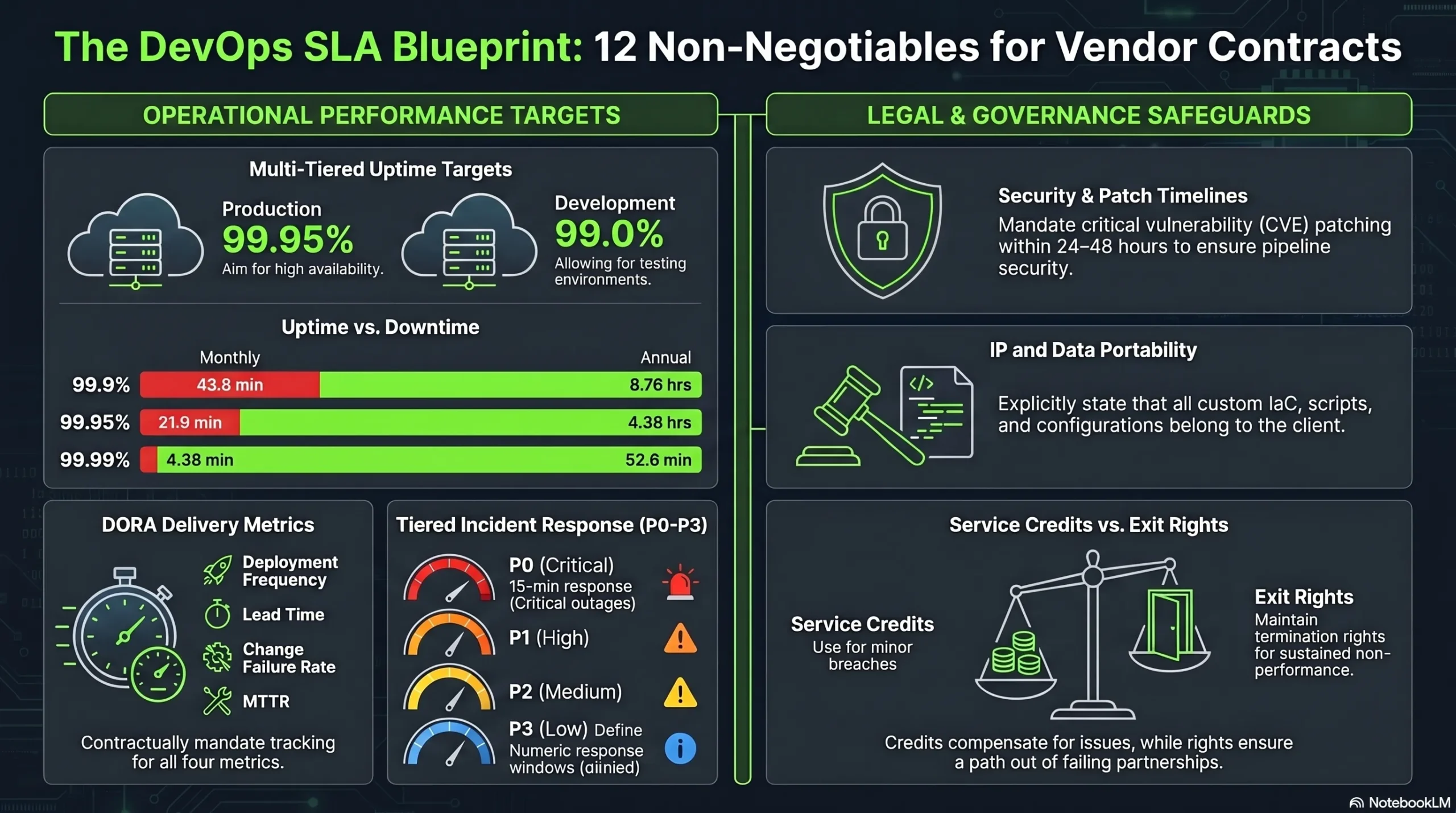
The 12 Non-Negotiable Components of a DevOps Vendor Contract
1. Scope of Services — Define Every Deliverable
The single most exploited ambiguity in any managed service agreement DevOps as a service is an undefined scope. Your contract must itemize every service the vendor is responsible for with zero room for interpretation. This includes:
CI/CD pipeline setup, maintenance, and optimization. Infrastructure as Code (IaC) management using tools like Terraform or Ansible. Container orchestration (Kubernetes, Docker Swarm). Monitoring and alerting configuration. Security scanning and vulnerability remediation. Deployment automation and release management. Environment provisioning (dev, staging, production). On-call support and incident response.
Core components include service scope, performance metrics, uptime targets, reporting cycles, and escalation clauses — each defining ownership, measurement logic, and review cadence.
If a service is not named explicitly in the scope, expect your vendor to charge for it as an out-of-scope request, or worse, simply not do it.
Practical tip from Full-Stack Techies: When negotiating scope with your DevOps vendor, ask for a “Responsibility Assignment Matrix” (RACI chart) alongside the SLA. This maps every task to who is Responsible, Accountable, Consulted, and Informed — eliminating the “we thought you handled that” conversations that erode trust fast.
2. Uptime Commitment — The Numbers Behind the Nines
The uptime commitment is the headline metric in almost every SLA, and it is also the most misunderstood. Here is what the numbers actually mean for your operations:
A 99.9% SLA permits approximately 43 minutes of downtime per month or 8.76 hours per year. A 99.99% SLA only allows about 4.3 minutes monthly or 52.6 minutes annually. This 10x reduction in allowed downtime typically requires substantially more investment in infrastructure redundancy, monitoring capabilities, and operational processes.
For a DevOps as a service SLA, your uptime commitment should be tiered by environment criticality:
Production environments — 99.95% or 99.99% minimum. Staging/QA environments — 99.5% is typically acceptable. Development environments — 99.0% may suffice.
Beyond raw uptime, your contract must specify exactly how uptime is calculated. Does scheduled maintenance count as downtime? What about partial degradation, where the service is technically “up” but slow? Maintenance windows are typically excluded from uptime SLA calculations when properly scheduled and communicated in advance. Make sure this exclusion is time-capped — some vendors will schedule suspiciously long maintenance windows to hit their numbers on paper.
Also, insist on error budgets being defined in the contract. Error budgets represent acceptable downtime within your SLO and allow teams to make informed decisions about risk and change management without either party being blindsided.
3. Incident Response SLA — Severity Tiers and Response Windows
An incident response SLA is where generic vendor promises dissolve into real operational accountability. This section of your DevOps vendor contract must define every tier of incident severity with its own response, acknowledgment, and resolution timelines.
A well-structured incident response SLA follows a tiered model:
- P0 — Critical (Full Production Outage): Initial response within 15 minutes. Engineering acknowledgment within 30 minutes. Target resolution within 2–4 hours. Executive escalation at the 1-hour mark.
- P1 — High (Significant Degradation or Major Feature Broken): Initial response within 30 minutes. Resolution target within 8 hours. Stakeholder updates every 2 hours.
- P2 — Medium (Non-Critical Issues with Workaround Available): Response within 4 hours during business hours. Resolution target within 24–48 hours.
- P3 — Low (Minor Issues, Cosmetic Bugs, Documentation): Response within 1 business day. Resolution target within 5 business days.
When these thresholds are exceeded, automated alerts and escalation policies should be triggered — this ensures that incidents are not left unattended and that response expectations are consistently enforced across teams.
Critically, the incident response SLA should also define what counts as a P0. Vague severity definitions let vendors downgrade your emergency to a P2, buying themselves hours while your pipeline is down.
4. Support Escalation Matrix — Who Calls Whom and When
A support escalation matrix is the blueprint for getting the right people on the problem at the right time. Many organizations neglect this in their DevOps as a service SLA, and then spend precious time during an incident wondering who to call.
Your escalation matrix should define:
- Level 1: First-line support engineer — handles standard requests, alerts, and routine issues.
- Level 2: Senior DevOps engineer or team lead — engages for unresolved P1/P2 incidents or technical complexity beyond L1 scope.
- Level 3: Solutions architect or principal engineer — handles P0 events, architectural failures, or multi-system outages.
- Level 4: Account manager + executive leadership — for sustained SLA breaches, legal concerns, or contractual disputes.
Each level must have defined contact information (not just a generic support email), specific trigger conditions, and maximum wait times before the next escalation level activates automatically.
Include contingency plans — develop clear escalation procedures and communication protocols for situations where standard resolution times cannot be met.
Also specify the communication channel for each severity level. Slack notifications for P2 are fine. A P0 at 3 a.m. requires a phone call, not a ticket number.
5. Delivery Metrics — Measuring What Actually Matters in DevOps
Generic service level agreement contracts focus on uptime. Great ones include delivery metrics that capture the actual performance of your DevOps operations. These are the metrics that DORA (DevOps Research and Assessment) has validated as genuine indicators of software delivery performance:
- Deployment Frequency: How often code is deployed to production. Elite performers deploy multiple times per day. Your SLA should define a minimum deployment cadence.
- Lead Time for Changes: Time from code commit to production deployment. Top-tier providers target under one hour. Your contract should specify a maximum acceptable lead time.
- Change Failure Rate: Percentage of deployments that cause incidents or require rollback. Industry best practice is below 15%. Anything above 30% should trigger a formal review clause.
- Mean Time to Recovery (MTTR): How quickly service is restored after a failure. MTTR measures the average time it takes for teams to restore service after an incident — a low MTTR indicates incidents are being resolved and service is being restored quickly.
- Pipeline Success Rate: Percentage of CI/CD runs that complete without failure. A high-quality DevOps as a service provider should maintain above 95% pipeline success rates.
- Deployment Success Rate: Percentage of releases deployed without rollback. Target above 99% for mature pipelines.
These delivery metrics should appear explicitly in your contract, with baseline benchmarks, measurement methods, and improvement trajectories defined for each quarter.
6. Monitoring, Reporting, and Transparency Standards
You cannot manage what you cannot see. Your DevOps vendor contract must include a dedicated section on monitoring infrastructure and reporting obligations. Negotiate access to real-time performance portals rather than waiting for scheduled reports, and request customized dashboards showing your most critical operational metrics.
Minimum reporting requirements in a solid DevOps as a service SLA include:
Real-time dashboards accessible to your team (not just your vendor). Weekly performance summaries covering all delivery metrics and incident response SLA compliance. Monthly SLA compliance reports with formal sign-off. Quarterly business reviews (QBRs) for trend analysis and roadmap alignment. Post-incident reports (PIRs) within 48–72 hours of any P0 or P1 event, covering root cause, timeline, resolution, and preventive measures.
The post-incident report requirement is especially important. Smart monitoring strategies focus on metrics that directly impact your business operations, with automated monitoring systems and threshold alerts deployed before SLA breaches occur. Vendors who resist post-incident transparency are vendors who are not learning from failures.
7. Security and Compliance SLA Clauses
In 2025, security is not a bolt-on. It is a first-class DevOps concern, and your managed service agreement DevOps as a service must reflect that. Your DevOps SLA should mandate:
- Vulnerability management timelines: Critical CVEs patched within 24–48 hours. High-severity vulnerabilities within 7 days. Medium-severity within 30 days.
- Security scanning frequency: Daily automated SAST/DAST scans of all pipelines. Weekly dependency audits. Monthly penetration testing reports (at minimum annually for full pen tests).
- Compliance adherence: Explicit commitment to relevant frameworks — SOC 2 Type II, ISO 27001, GDPR, HIPAA, PCI-DSS — depending on your industry.
- Data handling and sovereignty: Where is your code stored? Which regions? Who has access? This is non-negotiable if you operate in regulated industries.
SLAs should address security measures implemented by the cloud provider, such as data encryption, access controls, vulnerability management, and incident response procedures. Compliance requirements, such as industry-specific regulations or data privacy laws, may also be included.
8. Change Management and Release Communication
A DevOps vendor contract without a change management clause is an invitation to surprise maintenance windows and unannounced infrastructure changes. Define:
Minimum advance notice for planned changes — typically 48–72 hours for non-emergency changes. Emergency change procedures for critical security patches. Change Advisory Board (CAB) processes for major architectural changes. Rollback procedures and timelines for every class of change. Communication templates and channels for change notifications.
This section protects both parties. Your vendor avoids blame for unannounced changes; your business avoids unpleasant surprises.
9. Service Credits and Financial Remedies
Service credits are the financial consequence mechanism of your DevOps as a service SLA. They transform SLA commitments from aspirational targets into real accountability. A standard service credit structure for DevOps SLA breaches:
99.9%–99.5% uptime achieved: 10% credit of monthly fees. 99.5%–99.0% uptime achieved: 25% credit of monthly fees. Below 99.0% uptime: 50% credit of monthly fees. Sustained breach (three consecutive months): Right to terminate without penalty.
Recognize that SLAs function as your primary leverage when service relationships fail, establishing measurable performance standards and enforceable consequences that can limit provider liability and protect your business during critical outages or missed deadlines.
Important: service credits are not a replacement for the right to terminate. Ensure your contract includes explicit termination clauses for repeated SLA violations that are separate from the credit structure. Also watch out for liability caps — when a vendor limits liability to the fees paid in the prior month or quarter, you may find yourself unable to recover meaningful damages if their service failure causes significant business harm.
10. Disaster Recovery and Business Continuity
Your DevOps as a service SLA must define what happens when things go catastrophically wrong. This section should include:
Recovery Time Objective (RTO): Maximum acceptable time to restore service after a disaster. Typically 2–4 hours for production, 24 hours for non-production.
Recovery Point Objective (RPO): Maximum acceptable data loss, measured in time. Most DevOps environments target RPO under 1 hour.
Backup frequency and retention: Daily backups at minimum, with 30-day retention for production environments.
Geographic redundancy: Is your infrastructure multi-region? What is the failover procedure and timeline?
Verify replication infrastructure uptime guarantees — many providers commit to 99.9% availability for their replication systems. Insist on detailed recovery procedures documented in a custom Disaster Recovery Playbook.
11. Intellectual Property, Data Ownership, and Exit Rights
This section is often overlooked until an organization tries to leave a vendor — and discovers they do not own their own pipelines, configurations, or deployment scripts.
Your DevOps vendor contract must explicitly state:
All custom code, scripts, IaC configurations, and pipeline definitions created during the engagement are your property, not the vendor’s. You have the right to export all configurations and documentation at any time with no additional fees. Upon contract termination, the vendor must provide a full handover package within a defined timeline (typically 30–60 days). No vendor lock-in through proprietary tooling without your explicit consent.
Contracts that fail to address how you can export your data, or that charge excessive fees for data extraction, create vendor lock-in. This applies equally to DevOps configurations and infrastructure code as it does to data.
12. Governance, Review Cycles, and SLA Evolution
A service level agreement DevOps is not a document you sign and file away. It must evolve with your business. Build in:
Quarterly SLA review meetings with defined attendees and agenda. Annual full contract renegotiation rights. A formal process for adding new services to the scope mid-contract. A dispute resolution procedure with defined timelines (typically 30 days to resolve before escalating to mediation).
Include a change management process for updating services, metrics, or requirements as the relationship evolves. Also address termination conditions for repeated SLA violations.
Common Red Flags in DevOps Vendor Contracts to Watch For
Before signing any managed service agreement DevOps as a service, run through this checklist. If you find any of these, push back hard or walk away.
Vague language instead of numbers. Phrases like “commercially reasonable efforts,” “best endeavors,” or “as soon as practicable” have no place in a performance-based contract. Every commitment must have a number attached.
No severity tiering. A single response SLA for all incidents means your P0 production outage gets the same priority as a P3 documentation request. Unacceptable.
Maintenance window exemptions with no caps. If a vendor can exclude unlimited maintenance time from their uptime calculation, their 99.9% guarantee is meaningless.
Service credits as the only remedy. Credits are better than nothing, but they should not be the only recourse for chronic underperformance.
No exit clause or data portability. If you cannot leave without losing your configurations and paying ransom-level fees, you are not in a partnership — you are trapped.
Missing post-incident reporting obligations. Vendors who do not commit to root-cause analysis after major incidents are hiding a pattern of repeated failures.
Ambiguous scope with unlimited “out of scope” charges. Watch for contracts that list general categories (e.g., “DevOps support”) without defining specific deliverables — this is an invoice waiting to happen.
The SLI/SLO/SLA Hierarchy: A Framework for Smarter Contract Negotiation
One of the most practical frameworks for negotiating a tight DevOps as a service SLA is working backwards from SLIs to SLAs:
Start with your SLIs — identify which metrics actually measure user impact. For DevOps, these include deployment success rate, pipeline build time, infrastructure provisioning time, and incident detection latency.
Define your SLOs — set internal targets that give you a safety buffer above the contractual threshold. If your SLA requires 99.9% uptime, your SLO should target 99.95%.
Then formalize your SLA — the contractual floor below which financial or legal consequences kick in.
The goal is continuous improvement in user experience, not perfect uptime at any cost — successful programs balance ambitious reliability targets with practical implementation constraints.
This three-tier approach also gives you a principled basis for renegotiation. If your vendor consistently hits 99.97% uptime but your SLA only requires 99.9%, you have data to raise the bar at the next contract review.
How Full-Stack Techies Structures DevOps as a Service SLAs
At Full-Stack Techies, we have observed firsthand that the organizations that get the most from DevOps as a service are the ones who treat the SLA negotiation as a technical conversation, not just a legal one. Engineers need to be in the room — not just procurement managers and lawyers.
Our approach to managed service agreement DevOps as a service starts with a discovery sprint before a single clause is drafted. We map every client’s deployment architecture, identify their highest-risk failure points, define their actual business continuity requirements, and then work backwards to build SLAs that reflect operational reality — not vendor marketing copy. This means our DevOps SLA commitments are specific, measurable, achievable, and genuinely meaningful for each client’s unique context.
We also believe strongly in SLA transparency. Every client gets access to real-time dashboards, monthly compliance reports, and post-incident root-cause analysis — not because we are contractually required to (though we are), but because accountability is the foundation of a partnership that actually works long term.
Also Read: How to Hire the Best DevOps as a Service Provider in 2026: The Ultimate Executive Guide
Industry Trends Reshaping DevOps as a Service SLAs in 2025–2026
Several macro trends are forcing DevOps SLA frameworks to evolve rapidly:
- AI-Assisted Operations (AIOps): As AI co-pilots are embedded into DevOps pipelines, SLAs must address AI decision-making accountability. Who is responsible when an AI-triggered deployment breaks production? This is an emerging clause that forward-thinking contracts are beginning to include.
- Platform Engineering as a Service: By 2027, Gartner estimates80% of organizations will incorporate DevOps platforms into their toolchains, with Internal Developer Portals emerging as high-value commercial opportunities for vendors. SLAs for platform engineering engagements must cover developer experience metrics, not just infrastructure availability.
- Multi-Cloud and Hybrid Cloud Complexity: SLAs that cover only a single cloud provider are increasingly obsolete. Modern DevOps vendor contracts need to address performance standards across AWS, Azure, and GCP simultaneously, including cross-cloud failover and latency commitments.
- Security-First DevSecOps SLAs: With nearly 34% of organizations embracing DevSecOps practices, security SLA clauses — vulnerability response timelines, security audit frequencies, and breach notification obligations — are no longer optional extras. They are table stakes.
- Continuous Compliance Monitoring: Regulated industries (BFSI, healthcare, government) are requiring real-time compliance dashboards as part of their managed service agreement, DevOps as a service, rather than relying on point-in-time audits.
A DevOps as a Service SLA Checklist for Procurement Teams
Use this checklist as a minimum standard before signing any DevOps vendor contract:
Service scope explicitly lists all deliverables with no ambiguous “general DevOps support” catch-alls. Uptime commitment defined per environment with downtime calculation methodology specified. Incident response SLA includes severity tiers P0–P3 with numeric response and resolution targets. Support escalation matrix identifies named or titled contacts at each escalation level. Delivery metrics (deployment frequency, lead time, MTTR, change failure rate) are contractually defined. Monitoring dashboard access is granted to the client in real time. Reporting obligations include weekly, monthly, and post-incident reports. Security SLA clauses cover vulnerability patch timelines and compliance framework adherence. Service credits are defined per breach level with a clear calculation formula. Termination clauses exist for both cause and convenience with defined notice periods. IP ownership and data portability are unambiguously in the client’s favor. Disaster recovery commitments include numeric RTO and RPO targets. Governance section defines review cadence and dispute resolution process.
Final Thoughts
A strong DevOps as a service SLA is not a sign of distrust toward your vendor. It is the foundation of a functional partnership. The best DevOps vendor you will ever work with will not hesitate to put specific numbers in writing — because they know they can deliver. The ones who resist, who offer vague assurances and generic commitments, are telling you exactly what you need to know before you sign.
The service level agreement DevOps conversation is ultimately about one thing: operational clarity. When every delivery metric, every incident response SLA tier, every uptime commitment, and every support escalation matrix level is spelled out in plain language with enforceable consequences, both sides win. Your business gets reliability and accountability. Your vendor gets clarity and a structured partnership. That is what a well-negotiated managed service agreement, DevOps as a service, is designed to create.
Take the time to get it right before you sign. Your pipeline, your customers, and your 2 a.m. on-call engineer will thank you.
Looking for a DevOps as a service partner that backs its commitments with enforceable SLAs? Full-Stack Techies works with businesses across industries to build, manage, and continuously improve DevOps pipelines — with SLA transparency built in from day one. Reach out to explore what a real accountability-first managed service agreement, DevOps as a service, looks like.
FAQs: DevOps as a Service SLAs — What to Include in Vendor Contracts
FAQ 1: What is a DevOps as a service SLA?
A DevOps as a service SLA (Service Level Agreement) is a legally binding contract between your organization and a third-party DevOps vendor that defines measurable performance commitments u2014 including uptime commitments, incident response SLA timelines, delivery metrics, and remedies for non-compliance. It transforms vague service promises into enforceable operational standards.
FAQ 2: What delivery metrics should be included in a DevOps SLA?
A strong DevOps SLA should contractually define four core DORA delivery metrics: deployment frequency, lead time for changes, change failure rate (ideally below 15%), and Mean Time to Recovery (MTTR). These metrics measure actual pipeline performance, not just infrastructure availability, making them far more meaningful than a simple uptime commitment alone.
FAQ 3: What is a reasonable uptime commitment for a managed service agreement DevOps as a service?
For production environments, a minimum uptime commitment of 99.95% is the industry standard in a managed service agreement DevOps as a service. That translates to under 4.5 hours of downtime per year. Staging environments typically warrant 99.5%, while development environments may accept 99.0%. Always confirm exactly how uptime is calculated and whether scheduled maintenance windows are excluded.
FAQ 4: What should an incident response SLA look like for a DevOps vendor contract?
A solid incident response SLA in any DevOps vendor contract should define at least four severity tiers. P0 (full outage) should require response within 15 minutes and resolution within 2u20134 hours. P1 (major degradation) warrants a 30-minute response and 8-hour resolution. P2 and P3 can follow 4-hour and next-business-day response windows respectively, each with clear escalation triggers.
FAQ 5: What is a support escalation matrix and why does it belong in a DevOps SLA?
A support escalation matrix is a structured document that maps every incident severity level to the correct support tier, named contact, communication channel, and maximum wait time before escalating further. It belongs in every DevOps SLA because it eliminates confusion during high-pressure incidents, ensuring the right engineer is engaged immediately rather than after costly delays caused by unclear escalation paths.
FAQ 6: What is the difference between SLA, SLO, and SLI in a service level agreement DevOps context?
In a service level agreement DevOps context: an SLA is the external contract with enforceable consequences; an SLO (Service Level Objective) is the vendoru2019s internal performance target, typically set slightly above the SLA threshold as a buffer; and an SLI (Service Level Indicator) is the actual measured metric u2014 the real-world number that determines whether the SLA has been met or breached.
FAQ 7: What service credits should a DevOps vendor contract include for SLA breaches?
A fair DevOps vendor contract should tie service credits directly to the severity of the breach. A common structure: 10% credit for uptime between 99.5u201399.9%, 25% credit for 99.0u201399.5%, and 50% credit for anything below 99.0%. Crucially, service credits should not be the only remedy u2014 your contract must also include the right to terminate without penalty after sustained or repeated SLA violations.
FAQ 8: What security clauses must be in a DevOps as a service SLA?
Security clauses in a DevOps as a service SLA should define vulnerability patch timelines (critical CVEs within 24u201348 hours), daily automated security scanning of all pipelines, compliance adherence to relevant frameworks such as SOC 2 Type II or ISO 27001, breach notification timelines (typically within 72 hours), and explicit data sovereignty terms specifying where infrastructure is hosted and who has access.
FAQ 9: What are the biggest red flags in a DevOps vendor contract?
The biggest red flags in any DevOps vendor contract include vague language like u201ccommercially reasonable effortsu201d with no numeric targets, no severity tiering in the incident response SLA, unlimited maintenance window exclusions that inflate apparent uptime commitment figures, service credits as the only remedy for breaches, no IP ownership or data portability clause in your favor, and no post-incident root-cause analysis obligation.
FAQ 10: How often should a service level agreement DevOps be reviewed and updated?
A service level agreement DevOps should be formally reviewed quarterly, with a full renegotiation right annually. As your infrastructure scales, as new services are added, or as your business enters regulated markets, the SLA must evolve accordingly. Contracts that lack built-in review cycles quickly become outdated, leaving performance gaps unaddressed and creating disputes that a living, regularly reviewed agreement would have prevented.