

10 Reasons to Adopt DevSecOps as a Service in 2026
Organizations that Adopt DevSecOps as a Service gain a competitive advantage by integrating security directly into their development pipelines. This guide outlines 10 key reasons why enterprises are shifting to DevSecOps as a Service to secure modern applications without slowing innovation.


Introduction
The software landscape in 2026 looks nothing like it did just five years ago. Cyberattacks are more sophisticated, regulatory scrutiny is tighter than ever, and organizations are shipping code at a pace that traditional security models simply cannot match. In this environment, the decision to adopt DevSecOps as a Service is no longer a luxury — it is a strategic imperative.
DevSecOps — the practice of weaving security seamlessly into every phase of the development lifecycle — has matured significantly. And now, through managed DevSecOps service providers, companies of all sizes can access enterprise-grade security without building costly in-house expertise from scratch.
At Full-Stack Techies, we have partnered with dozens of organizations to help them navigate this transition. In this article, we lay out the 10 most compelling reasons why 2026 is the year your team should seriously evaluate adopting DevSecOps as a Service — and how the right DevSecOps solutions partner can make all the difference.
Quick Definition: What Is DevSecOps as a Service?
DevSecOps as a Service (DSaaS) refers to externally managed DevSecOps services where a specialized provider embeds security tooling, processes, and expertise directly into your CI/CD pipelines, cloud infrastructure, and development workflows — on a subscription or managed-service basis.
Key Takeaways: 10 Reasons to Adopt DevSecOps as a Service in 2026
Security Is No Longer Optional — It’s Structural. The cybersecurity threat landscape in 2026 demands that security be woven into every stage of development, not bolted on at the end. Adopting DevSecOps as a Service is the most practical way to make this shift without rebuilding your entire engineering culture from scratch.
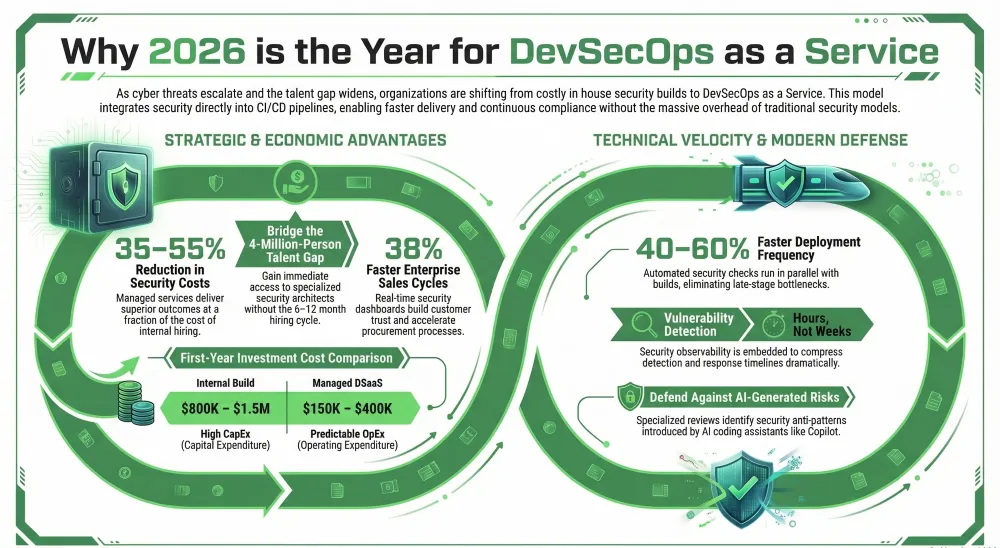
Speed and Security Are No Longer Trade-offs. One of the biggest myths this article busts is that security slows teams down. When DevSecOps services are properly implemented, automated security checks run in parallel with builds — organizations consistently report 40–60% improvements in deployment frequency after adoption.
You Don’t Need to Hire a Full Security Team. The global shortage of 4+ million cybersecurity professionals makes in-house hiring slow, expensive, and competitive. DevSecOps managed services give organizations immediate access to cloud security architects, application security engineers, compliance specialists, and incident responders — without the 6–12 month hiring cycle.
Compliance Becomes Continuous, Not Chaotic. Frameworks like SOC 2, HIPAA, PCI-DSS, ISO 27001, and NIST CSF 2.0 are no longer periodic audit exercises. With DevSecOps solutions, policy-as-code enforces controls in real time, evidence is collected automatically, and compliance posture dashboards stay current — turning audit season from a fire drill into a non-event.
The Economics Strongly Favor the Service Model. Building an equivalent internal DevSecOps capability typically costs $800K–$1.5M in year one. A managed DevSecOps service delivers comparable or superior outcomes for $150K–$400K annually, while converting unpredictable capital expenditure into a stable operational cost line.
Cloud-Native Environments Need Cloud-Native Security. Microservices, Kubernetes, serverless, and multi-cloud architectures have fundamentally changed the attack surface. Traditional perimeter security tools are blind to these environments. Modern DevSecOps services provide CSPM, runtime threat detection, container scanning, and secrets management, purpose-built for ephemeral, dynamic infrastructure.
Faster Detection Means Smaller Blast Radius. The average dwell time for an undetected breach is measured in weeks. DevSecOps managed services compress detection and response timelines dramatically through 24/7 SOC monitoring, SOAR playbook automation, and security observability embedded at the application and infrastructure layer — reducing both the frequency and impact of incidents.
AI-Generated Code Introduces New Security Risks. As development teams rely increasingly on AI coding assistants like GitHub Copilot and Cursor, a new category of risk has emerged — AI-generated code that passes syntax checks but contains security anti-patterns. Forward-looking DevSecOps services now include specialized AI-code security review as a distinct, essential capability.
Developer Experience and Security Culture Improve Together. DevSecOps is not just about tooling — it’s about culture. When security feedback is surfaced contextually in the IDE, explained in plain language, and paired with one-click remediation, developers start owning security as part of their craft rather than resisting it as an external constraint.
Security Posture Is Now a Business Differentiator. Enterprise customers, investors, and end users increasingly evaluate security maturity before buying, funding, or trusting a product. Organizations with a certified, continuously audited security program backed by real-time dashboards close deals faster, achieve SOC 2 certification in months instead of years, and command stronger positioning in competitive procurement processes.
The Bottom Line: Adopting DevSecOps as a Service in 2026 is not a purely technical decision — it is a strategic business decision. It simultaneously reduces risk, accelerates delivery, controls costs, satisfies compliance requirements, and creates competitive advantage. The window to get ahead of this shift is now, before it becomes a baseline expectation rather than a differentiator.
Also Read: DevSecOps vs DevOps (2026 Edition): Why Speed is Dead Without Security
Reason 1: The Cybersecurity Threat Landscape Has Never Been More Dangerous
In 2025 alone, global cybercrime costs exceeded $10 trillion, according to industry analysts. Ransomware, supply chain attacks, zero-day exploits, and AI-powered phishing campaigns have made legacy security approaches dangerously insufficient.
When organizations adopt DevSecOps as a Service, they gain access to continuously updated threat intelligence, automated vulnerability scanning, and proactive incident response — all managed by teams who specialize in exactly this kind of defense.
Key threats driving adoption:
- Supply chain compromises targeting third-party dependencies
- Container and Kubernetes misconfigurations exploited at runtime
- Secrets and credentials accidentally committed to repositories
- API vulnerabilities exposed through rapid feature deployment
Full-Stack Techies integrates real-time threat intelligence feeds directly into client pipelines, ensuring that every build is checked against the latest known vulnerabilities — not yesterday’s threat database.
Reason 2: Security as Code Accelerates — Not Slows — Your Delivery
One of the most persistent misconceptions about DevSecOps is that it introduces friction and slows down development. The opposite is true when it is implemented correctly. Mature DevSecOps services shift security left — detecting issues earlier when they are exponentially cheaper to fix — while automating checks that previously required manual intervention.
Organizations that have adopted a properly configured DevSecOps service report deployment frequencies improving by 40–60%, simply because developers stop being blocked by security reviews at the end of the pipeline.
Security automation touchpoints in a modern pipeline:
- Static Application Security Testing (SAST) on every pull request
- Dynamic Application Security Testing (DAST) in staging environments
- Software Composition Analysis (SCA) for open-source dependencies
- Infrastructure-as-Code (IaC) security scanning with tools like Checkov and Terrascan
- Container image scanning before registry push
Full-Stack Techies Insight: Our DevSecOps managed services team typically reduces a client’s mean time to detect (MTTD) security vulnerabilities from weeks to hours within the first 90 days of engagement — without any disruption to sprint velocity.
Reason 3: Closing the Security Skills Gap Without Expanding Headcount
The global shortage of cybersecurity talent remains one of the most pressing challenges for technology organizations. There are estimated to be over 4 million unfilled cybersecurity positions worldwide, and competition for qualified DevSecOps engineers is fierce.
Adopting DevSecOps as a Service allows organizations to immediately access a bench of experienced security engineers, threat analysts, and platform specialists — without the 6–12 month hiring timelines or the premium salaries that senior DevSecOps talent commands.
Roles your DevSecOps service provider brings:
- Cloud Security Architects with multi-cloud expertise (AWS, Azure, GCP)
- Application Security Engineers familiar with OWASP Top 10 and beyond
- Compliance Specialists versed in SOC 2, ISO 27001, GDPR, HIPAA, and PCI-DSS
- Site Reliability Engineers who balance security with uptime guarantees
The team at Full-Stack Techies functions as a seamless extension of your engineering organization — embedded in your Slack, your sprints, and your incident channels — not as a distant vendor.
Reason 4: Regulatory Compliance Is Becoming Non-Negotiable
Regulatory frameworks are multiplying and tightening. From the EU’s Digital Operational Resilience Act (DORA) to the SEC’s cybersecurity disclosure rules for public companies, organizations face an increasingly complex compliance matrix. Non-compliance is no longer just an audit inconvenience — it carries material financial and reputational consequences.
DevSecOps solutions designed for compliance embed policy enforcement directly into the development process. Audit trails are generated automatically, compliance posture dashboards are always current, and policy-as-code ensures that your infrastructure never drifts from your security baseline.
Compliance frameworks supported by leading DevSecOps services:
- SOC 2 Type II – Continuous control monitoring and evidence collection
- HIPAA – Automated PHI data flow analysis and access controls
- PCI-DSS – Cardholder data environment (CDE) segmentation and scanning
- NIST CSF 2.0 – Full framework mapping with gap analysis reporting
- ISO/IEC 27001 – Risk register integration and evidence automation
Reason 5: Cost Predictability and CapEx-to-OpEx Transformation
Building an internal DevSecOps capability from scratch requires significant upfront capital expenditure: hiring, tooling licenses, training, and infrastructure. For many organizations — especially scale-ups and mid-market companies — this investment is difficult to justify before the business case is proven.
DevSecOps managed services transform this model into a predictable operational expense. Organizations pay for what they consume, scale up during rapid growth phases, and scale back during leaner periods — without stranded costs.
Cost components typically eliminated or reduced:
- Enterprise SAST/DAST/SCA tool licensing (often $100K+ per year)
- Security training programs and certifications for internal staff
- SIEM platform procurement and tuning
- Penetration testing and red team engagements (often included in managed service SLAs)
- Incident response retainer fees
The Economics of DevSecOps as a Service: Organizations that adopt DevSecOps as a Service through a provider like Full-Stack Techies typically achieve a 35–55% reduction in total security program costs compared to building equivalent internal capabilities — while simultaneously improving their security maturity score.
Reason 6: Cloud-Native Architectures Demand Cloud-Native Security
The migration to microservices, serverless functions, and Kubernetes-orchestrated workloads has fundamentally changed the attack surface of modern applications. Traditional perimeter-based security tools are largely blind to these environments. Native cloud security requires tooling and expertise built specifically for dynamic, ephemeral infrastructure.
Leading DevSecOps service providers offer cloud-native security posture management (CSPM), Kubernetes admission controllers, runtime threat detection, and network policy enforcement — capabilities that require deep platform expertise to configure and maintain effectively.
Cloud-native security capabilities in modern DevSecOps services:
- Kubernetes Runtime Security with Falco or similar open-source tooling
- Cloud Security Posture Management (CSPM) across AWS, Azure, and GCP
- Workload identity and service mesh security (Istio, Linkerd)
- Secrets management integration with HashiCorp Vault or cloud-native solutions
- Serverless function security scanning and runtime protection
Full-Stack Techies specializes in securing cloud-native architectures, with certified experts across all three major cloud providers and a purpose-built DevSecOps service catalog tailored for organizations running containerized workloads at scale.
Reason 7: Faster Incident Detection and Response
The average time to detect a security breach remains alarmingly high — often measured in weeks or months. Every day an attacker dwells undetected inside a network represents compounding damage: data exfiltration, lateral movement, and the establishment of persistent footholds.
A mature DevSecOps service dramatically compresses detection and response timelines by embedding security observability directly into the application and infrastructure layers. Logs, metrics, and traces are correlated in real time, and automated runbooks are triggered the moment anomalous behavior is detected.
Incident response capabilities embedded in managed DevSecOps services:
- 24/7 Security Operations Center (SOC) monitoring with defined SLAs
- SOAR (Security Orchestration, Automation, and Response) playbook automation
- Runtime Application Self-Protection (RASP) for in-production threat blocking
- Automated quarantine and rollback capabilities integrated with CI/CD
- Post-incident forensics and root cause analysis reporting
Reason 8: AI-Powered Security Is Now Table Stakes
Artificial intelligence has become central to both offensive and defensive cybersecurity. Attackers are using AI to generate polymorphic malware, craft hyper-personalized spear-phishing campaigns, and automate the discovery of exploitable vulnerabilities. Defenders must respond in kind.
Modern DevSecOps solutions increasingly incorporate machine learning for anomaly detection, AI-assisted code review for security anti-patterns, and natural language processing for threat intelligence aggregation. Organizations that adopt DevSecOps as a Service in 2026 will gain access to these AI capabilities without needing to build or train their own models.
AI/ML capabilities in next-generation DevSecOps services:
- AI-assisted SAST that reduces false positive rates by up to 70%
- Behavioral analytics for detecting insider threats and compromised credentials
- LLM-based code generation security review (critical as AI coding assistants proliferate)
- Predictive vulnerability prioritization based on exploit likelihood and asset criticality
Why This Matters in 2026: As development teams increasingly use AI coding assistants like GitHub Copilot and Cursor, the risk of AI-generated insecure code entering production pipelines grows proportionally. Full-Stack Techies offers specialized AI-generated code security review as part of our DevSecOps service offering.
Reason 9: Developer Experience and Security Culture Improve Together
One of the less-discussed benefits of adopting DevSecOps as a Service is its impact on developer experience and organizational culture. When security is embedded contextually — surfacing actionable findings in the IDE, explaining vulnerabilities in plain language, and providing one-click remediation suggestions — developers stop viewing security as an adversarial force and start owning it as part of their craft.
Professional DevSecOps service providers bring structured developer enablement programs, secure coding training modules, and security champions programs that create lasting cultural change — not just tooling adoption.
Developer enablement components of leading DevSecOps services:
- IDE security plugins that surface vulnerabilities during code writing
- Security champions program design and facilitation
- Monthly secure coding workshops tailored to your tech stack
- Gamified vulnerability remediation dashboards that drive healthy competition
- Custom secure coding guidelines and internal wikis
The Full-Stack Techies developer enablement curriculum has helped engineering teams across the fintech, healthtech, and SaaS verticals increase their internal security knowledge index scores by an average of 62% within six months of engagement.
Reason 10: Competitive Differentiation and Customer Trust
In 2026, security posture is a business differentiator. Enterprise customers conduct thorough vendor security assessments before signing contracts. Investors scrutinize security practices as part of due diligence. And end consumers are increasingly aware of — and vocal about — the data privacy practices of the products they use.
Organizations that can demonstrate a mature, continuously audited security program backed by industry-recognized certifications and real-time compliance dashboards win deals that their less-secure competitors lose. Adopting DevSecOps as a Service accelerates your path to those certifications and provides the evidence artifacts that enterprise procurement teams require.
Business outcomes enabled by mature DevSecOps services:
- Faster enterprise sales cycles (security questionnaires completed in days, not months)
- SOC 2 Type II certification achieved in 3–6 months instead of 12–18 months
- Reduced cyber insurance premiums through demonstrated security maturity
- Improved developer retention — engineers want to work with modern, secure toolchains
- Stronger investor confidence in technical risk management
Get scalable, fast, and user-friendly DevSecOps solutions tailored to your needs.
Get Free ConsultationHow to Get Started: Adopting DevSecOps as a Service with Full-Stack Techies
Making the decision to adopt DevSecOps as a Service is the first step. Choosing the right DevSecOps service partner is the next — and arguably more important — one. Not all providers offer the same depth of capability, the same cultural fit, or the same commitment to being a true engineering partner rather than a tool vendor.
At Full-Stack Techies, our DevSecOps engagement model is built around three phases:
Phase 1: Discovery and Security Posture Assessment (Weeks 1–3)
We conduct a comprehensive assessment of your current development pipelines, cloud architecture, toolchain, and security controls — producing a prioritized remediation roadmap and a baseline maturity score against the NIST CSF 2.0 framework.
Phase 2: Pipeline Integration and Tooling Deployment (Weeks 4–8)
Our engineers embed security tooling into your existing CI/CD pipelines (GitHub Actions, GitLab CI, Jenkins, CircleCI, and others), configure policy-as-code guardrails, and establish your security observability stack — with zero disruption to ongoing development work.
Phase 3: Continuous Management and Improvement (Ongoing)
Your dedicated Full-Stack Techies DevSecOps team monitors your security posture continuously, manages vulnerability triage and remediation, delivers monthly maturity reports, and iterates on your security program in lockstep with your product roadmap.
Ready to Adopt DevSecOps as a Service?
Contact Full-Stack Techies today for a complimentary 60-minute DevSecOps readiness consultation. Our experts will assess your current state and help you build a business case for your leadership team — at no cost and with no obligation.
Conclusion
The 10 reasons outlined in this guide represent a convergence of technological, regulatory, economic, and competitive forces that make 2026 the clearest possible inflection point for organizations to adopt DevSecOps as a Service.
Whether you are a high-growth startup looking to achieve your first SOC 2 certification, a mid-market SaaS company trying to close enterprise deals faster, or a large organization dealing with the complexity of securing a multi-cloud, microservices-based architecture — there is a compelling and specific case for investing in professional DevSecOps solutions tailored to your context.
The organizations that treat security as a strategic capability — embedded in their culture, their pipelines, and their product — will outperform those that treat it as a compliance checkbox. With the right DevSecOps service partner, that transformation is more accessible than ever.
Frequently Asked Questions
Q1: What exactly is DevSecOps as a Service, and how is it different from hiring an in-house security team?
DevSecOps as a Service (DSaaS) means outsourcing your security-integrated development operations to a specialized managed provider who embeds directly into your CI/CD pipelines, cloud infrastructure, and workflows. Unlike in-house hiring u2014 which requires 6u201312 months to recruit, onboard, and tool up a team u2014 a DevSecOps service gives you immediate access to a full-stack security bench covering cloud, application, compliance, and incident response. You get broader expertise at a fraction of the cost.
Q2: Will adopting DevSecOps as a Service slow down our development velocity?
No u2014 when implemented correctly, it does the opposite. Mature DevSecOps services shift security checks left into the development process, catching vulnerabilities at the pull request stage rather than during a final pre-release security gate. Automated SAST, SCA, and IaC scanning run in parallel with your builds, adding seconds u2014 not hours u2014 to pipeline time. Teams typically report a 40u201360% improvement in deployment frequency after the initial tuning period.
Q3: Which compliance frameworks can a DevSecOps service help us achieve?
Leading DevSecOps services support the full modern compliance stack: SOC 2 Type I and II, ISO/IEC 27001, HIPAA, PCI-DSS, GDPR, FedRAMP, and NIST CSF 2.0. Policy-as-code controls are embedded directly into your pipelines, audit evidence is collected automatically, and compliance posture dashboards give you a real-time view of your control health u2014 eliminating the fire-drill nature of traditional audit preparation.
Q4: How do DevSecOps managed services handle cloud-native and Kubernetes environments?
Cloud-native environments require specialized tooling that legacy security approaches cannot address. A capable DevSecOps service will deploy Kubernetes admission controllers to enforce policy at the cluster level, runtime threat detection via tools like Falco, container image scanning pre-registry-push, and CSPM across AWS, Azure, and GCP. Secrets management integration, network policy enforcement, and service mesh security round out a complete cloud-native security posture.
Q5: What is the typical cost of adopting DevSecOps as a Service compared to building internally?
Organizations that build internal DevSecOps capability from scratch typically invest $800Ku2013$1.5M in the first year when accounting for headcount, tool licensing, training, and infrastructure. A comparably capable DevSecOps managed service engagement typically runs $150Ku2013$400K annually depending on organization size and scope. The ROI compounds when you factor in breach prevention, faster compliance certification, and reduced cyber insurance premiums.
Q6: How long does it take to get a DevSecOps service up and running?
A well-structured DevSecOps service engagement moves through three phases: discovery and assessment (weeks 1u20133), pipeline integration and tooling deployment (weeks 4u20138), and continuous managed operations (ongoing). Most organizations have core security automation running in their pipelines within 30 days and full managed service coverage within 60u201390 days u2014 with no disruption to active development sprints during the transition.
Q7: Can DevSecOps solutions support AI-generated code u2014 for teams using tools like GitHub Copilot or Cursor?
This is one of the fastest-growing requirements in 2026. AI coding assistants dramatically accelerate development but introduce a new category of risk: AI-generated code that passes syntax checks but contains subtle security anti-patterns, insecure defaults, or vulnerable dependencies. Progressive DevSecOps services now include AI-generated code security review as a distinct capability, using LLM-assisted SAST tuned specifically to detect common AI coding pitfalls before they reach production.
Q8: What happens during a security incident u2014 who is responsible and how fast do you respond?
A mature DevSecOps service includes clearly defined incident response SLAs. Typically, critical severity incidents trigger 24/7 SOC alerting with a 15u201330 minute response target. Your provideru2019s team leads triage, containment, and eradication while keeping your engineering team informed through your communication channels (Slack, PagerDuty, etc.). Post-incident, a root cause analysis and pipeline hardening recommendations are delivered within 48u201372 hours.
Q9: Is DevSecOps as a Service suitable for startups and scale-ups, or only for enterprises?
DevSecOps managed services are, in many ways, most impactful for startups and scale-ups. These organizations face the same threat landscape as large enterprises but lack the budget to build equivalent internal capability. A managed service levels the playing field u2014 giving a 50-person engineering team access to the same security depth as a Fortune 500, at a fraction of the cost. It also accelerates the security certifications (SOC 2, ISO 27001) that enterprise sales cycles increasingly require.
Q10: How do we evaluate and choose the right DevSecOps service provider?
Evaluate providers across five dimensions: (1) Technical depth u2014 do they cover application security, cloud security, compliance, and incident response, or just one layer? (2) Integration capability u2014 can they embed into your existing toolchain without requiring you to rebuild your stack? (3) Cultural fit u2014 will they operate as an embedded engineering partner or a distant vendor? (4) Transparency u2014 do they provide real-time dashboards and clear SLAs? (5) Track record u2014 can they show measurable outcomes from comparable clients? Request a proof-of-value engagement before signing a long-term contract.



