Top 10 Types of DevOps Services Businesses Can Outsource in 2027

DevOps outsourcing used to mean handing a vendor your entire pipeline and hoping for the best. That is not how engineering leaders buy it anymore. In 2027, DevOps outsourcing is modular. CTOs and engineering managers pick specific services, CI/CD here, cloud migration there, and build a stack of providers that matches what their team is actually missing.
This shift matters because most in-house teams are not short on ambition, they are short on hours. Fullstacktechies has seen this pattern repeat across startups and regulated enterprises alike: the gap is rarely knowledge, its bandwidth. Below is a breakdown of the ten DevOps service categories businesses are outsourcing right now, and how to tell which one you actually need.
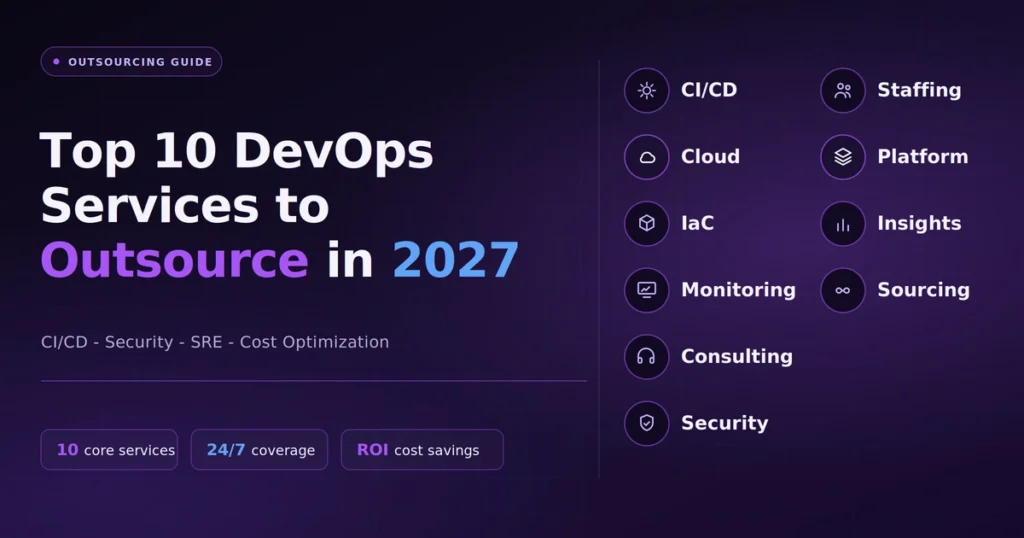
Types of DevOps Services
- CI/CD pipeline automation and management handles the setup, maintenance, and optimization of build, test, and deployment pipelines.
- Cloud migration and multi-cloud management covers moving workloads to AWS, Azure, or GCP and managing them across providers.
- Infrastructure as Code (IaC) implementation automates infrastructure provisioning using tools like Terraform and Ansible.
- Managed DevOps and 24/7 monitoring provides ongoing operational support, alerting, and incident response outside business hours.
- DevOps consulting and strategy helps businesses assess readiness and design a DevOps adoption roadmap before implementation.
- DevSecOps and compliance integration embeds security scanning and compliance controls directly into the delivery pipeline.
- Dedicated DevOps team or staff augmentation extends an internal team with external engineers under client direction.
- Platform engineering and internal developer platforms builds self-service infrastructure layers that reduce developer wait time.
- Practitioner-reported outsourcing patterns show most businesses start with CI/CD and cloud migration before expanding scope.
- In-house vs outsourced DevOps is typically a cost, control, and expertise trade-off, not an all-or-nothing decision.
1. CI/CD Pipeline Automation and Management
This is where almost every outsourcing relationship starts. A provider takes over the build, test, and deployment pipeline, the part of the software lifecycle that breaks the most often when nobody owns it full time.
That ownership gap is usually the actual problem. Teams do not fail at CI/CD because they lack Jenkins knowledge, they fail because nobody has time to maintain the pipeline once its built. An outsourced provider treats the pipeline as a living system, not a one-time setup.
The value shows up fast here compared to other service types. Fewer failed deployments, faster rollback when something breaks, and a release cadence that does not depend on one engineer’s calendar.
What CI/CD Tools Should You Expect Your Provider to Use?
Most providers work across three tool categories rather than pushing one platform. Git-native pipelines like GitHub Actions and GitLab CI dominate for teams already living in those ecosystems. Jenkins still holds ground in legacy and enterprise environments, and CircleCI is common where teams want a managed, cloud-native option with less infrastructure overhead.
Fullstacktechies builds and maintains CI/CD pipelines as part of its DevOps as a Service offering, matched to whatever version control system a team already uses.
2. Cloud Migration and Multi-Cloud Management
Cloud migration used to be a single project with a start and end date. Now it is closer to a service, because most businesses do not stop at one cloud provider anymore.
The reasons vary. Some companies want to avoid vendor lock-in, others inherit multiple clouds through acquisitions, and some just need workload-specific placement, AWS for compute-heavy jobs, GCP for data pipelines, that kind of split.
Outsourced providers typically run this in four phases: assessment of the current environment, migration planning, execution with minimal downtime, and post-migration cost optimization. Skipping that last phase is the most common mistake businesses make when they migrate without outside help, they move the workload but never tune it, and the cloud bill creeps up quietly.
AWS, Azure, or GCP: How Do Providers Handle Multi-Cloud Environments?
Provider choice usually comes down to what a business already has invested in, not which cloud has the best feature list. A healthcare company with existing Azure Active Directory integration rarely benefits from switching to GCP just for pricing.
Most outsourced teams manage multi-cloud through a shared Infrastructure as Code layer, so provisioning stays consistent even when the underlying cloud differs.
| Consideration | Single Cloud | Multi-Cloud |
|---|---|---|
| Setup complexity | Lower | Higher |
| Vendor lock-in risk | Higher | Lower |
| Cost management effort | Simpler | Requires dedicated tooling |
| Compliance flexibility | Limited to one provider’s regions | Broader regional coverage |
3. Infrastructure as Code (IaC) Implementation
IaC turns infrastructure provisioning into version-controlled code instead of manual configuration clicked together by hand. That sounds like a small change, but it removes one of the biggest sources of environment drift between staging and production.
Businesses outsource this because writing reusable, auditable Terraform or Ansible modules is a specialized skill, and most internal teams only touch infrastructure code occasionally. An outsourced provider treats it as their core competency, which usually means fewer misconfigurations and faster environment spin-up.
Terraform vs Ansible: What Do Outsourced DevOps Teams Prefer?
Terraform handles provisioning, spinning up the servers, networks, and storage that infrastructure needs to exist. Ansible handles configuration management, installing software and setting configurations on infrastructure that already exists. Most outsourced teams use both together rather than picking one, Terraform for the initial build, Ansible for ongoing configuration.
4. Managed DevOps and 24/7 Monitoring
Managed DevOps is different from project-based outsourcing in one key way, the provider takes ongoing responsibility for uptime, not just a deliverable. That distinction matters more than it sounds.
A project-based engagement ends when the pipeline ships. A managed engagement continues after that, covering monitoring, alerting, and incident response as a standing service. This model appeals most to companies that do not have, and do not want to build, an internal site reliability team.
Monitoring stacks typically cover three layers: metrics (system performance), logging (event history), and alerting (notification when something crosses a threshold). Providers rarely build all three from scratch, they configure existing platforms like Prometheus, Grafana, or the ELK stack around a client’s specific infrastructure.
What Does Round-the-Clock Incident Response Actually Include?
Three things, mainly. An on-call rotation so someone is always reachable, an escalation path so alerts reach the right engineer instead of getting lost in a shared inbox, and a postmortem process after every significant incident so the same failure does not repeat.
Fullstacktechies runs managed DevOps engagements this way, with defined escalation paths agreed before onboarding rather than figured out during the first outage.
5. DevOps Consulting and Strategy
Consulting fits a specific moment, usually right before implementation or right after an attempt has stalled. Companies do not always need more engineers, sometimes they need someone to tell them what to build first.
A useful consulting engagement produces something concrete: a readiness assessment, a prioritized roadmap, and tool recommendations tied to the business’s actual constraints, not a generic best-practices deck. If a consulting engagement ends without a document you can act on, it did not do its job.
How Much Does DevOps Consulting Typically Cost?
Industry-reported ranges place DevOps consulting between roughly $120 and $250 per hour, though this varies significantly by region, scope, and the provider’s seniority mix. These figures are directional only, actual project scoping determines real quotes, and businesses should validate current rates directly with providers before budgeting.
6. DevSecOps and Compliance Integration
DevSecOps stopped being a CI/CD add-on a few years ago and became its own outsourced line item. The reason is straightforward: security scanning bolted onto the end of a pipeline catches problems too late to fix cheaply.
The global DevSecOps market was valued at $8.84 billion in 2024 and is projected to reach $20.24 billion by 2030, growing at a 13.2% compound annual rate, according to Grand View Research. That growth reflects how many organizations are now embedding security checks earlier in the delivery pipeline, a practice generally called shift-left security, rather than treating it as a final gate before release.
Which Compliance Frameworks Do DevSecOps Providers Commonly Support?
- SOC 2 is the baseline most SaaS companies need for enterprise sales conversations
- PCI DSS applies to any business handling payment card data
- HIPAA governs healthcare organizations handling patient information
- GDPR applies to any business processing EU resident data, regardless of where the company is headquartered
Fullstacktechies integrates these compliance checkpoints directly into the CI/CD pipelines it manages, so security review happens before a release ships instead of during a post-incident scramble.
7. Dedicated DevOps Team or Staff Augmentation
Staff augmentation and managed services get confused constantly, and the difference actually matters when negotiating a contract. Staff augmentation means external engineers work under your direction, inside your existing processes. Managed services means the provider owns the outcome and decides how to get there.
Businesses choose augmentation when they already have engineering culture and process in place, they just need more hands executing it. Billing is typically time and materials, though businesses should confirm this directly since models vary by provider and region.
Staff Augmentation vs Managed Services: What is the Real Difference?
Think of it as a spectrum of control. With staff augmentation, your team leads and the outsourced engineers follow your existing sprint cycles and tooling decisions. With managed services, the provider leads, they decide the tooling, the process, and the escalation path, and you review outcomes rather than day-to-day execution. Neither model is objectively better, it depends on whether your business wants to retain operational control or hand it off.
8. Platform Engineering and Internal Developer Platforms
Platform engineering is the newest category on this list, and its growing fast enough that Gartner now tracks it as a distinct discipline separate from general DevOps. The core idea: build a self-service layer so developers can provision environments and deploy code without waiting on a central operations team every time.
Gartner projects that by 2026, 80% of large software engineering organizations will have established dedicated platform engineering teams, up from 45% in 2022. That is not a marginal shift, it reflects how much cognitive load modern cloud-native stacks put on individual developers.
The distinction from general DevOps matters here. DevOps focuses on pipelines and infrastructure delivery. Platform engineering focuses on developer experience, building the internal tooling layer that sits between raw infrastructure and the people writing application code.
Why are Businesses Outsourcing Platform Engineering Instead of Hiring In-House?
Platform engineers are scarce and expensive, and building an internal platform team from zero usually takes longer than most businesses expect, often a year or more before it delivers measurable value. Outsourcing this function lets a company get a working internal developer platform without the multi-quarter hiring and ramp-up cycle.
9. What are Businesses Actually Outsourcing? A Practitioner Snapshot
Vendor content tends to present outsourcing as a clean decision. Practitioner discussions outside that content tell a messier, more honest story about what actually gets outsourced first and why.
A small SaaS team recently asked the devops community whether DevOps services were actually worth it, describing broken deploys, unexplained cloud billing spikes, and no one internally willing to own operations work full time. The thread drew dozens of responses, most pointing to the same starting point: fix the pipeline and the monitoring gaps before anything else.
That pattern lines up with what shows up across most outsourcing engagements: companies start with CI/CD and cloud migration, the two categories with the fastest, most measurable payoff, and only expand into consulting or managed services once trust with the provider is established.
10. In-House vs Outsourced DevOps: What Practitioners Say
The in-house versus outsourced debate rarely has a clean winner, and practitioner discussions reflect that better than vendor comparison pages do.
A widely upvoted r/devops thread described the field as an exhausting stack of tools, Terraform, Kubernetes, Jenkins, and several others layered on top of each other, with burnout common among engineers juggling on-call rotations and brittle pipelines. The thread pointed to Puppet’s State of DevOps Report and the DORA Accelerate report as evidence that most organizations, outside a small group of elite teams, keep facing the same bottlenecks year after year.
That kind of fatigue is a big part of why businesses look outward instead of expanding an already stretched in-house team further. Outsourced providers absorb the toolchain complexity as their core job, while in-house engineers keep the institutional knowledge that no external team can replicate on day one. The businesses that get the most value tend to blend both, keeping strategic decisions in-house while outsourcing execution-heavy categories like CI/CD or cloud management.
How to Choose the Right DevOps Service Provider
Picking a provider comes down to a handful of concrete checks, not a gut feeling after a sales call. Look for proven experience in your specific tech stack, a transparent pricing model with no vague line items, a documented security and compliance track record, and a communication cadence that matches how your team actually works.
Questions to Ask Before Signing a DevOps Outsourcing Contract
- What are the SLA terms, and what happens if they are not met
- Who owns the tooling and configurations if the contract ends
- What does the offboarding or exit process look like
- Who has access to production data, and how is that access controlled
- What is the escalation path when something breaks at 2am
Red Flags to Watch for in DevOps Service Proposals
Vague scoping is the biggest one, if a proposal cannot name specific deliverables, its probably going to expand endlessly once signed. No named point of contact is another warning sign, you want one accountable person, not a rotating support queue. Unclear pricing tiers and missing security documentation round out the list, both are easy to request and reasonable to expect before signing anything.
Fullstacktechies scopes every DevOps as a Service engagement with named deliverables and a single point of contact from day one, specifically because vague scoping is where most outsourcing relationships go wrong.
The Right Mix Depends on Where You are, Not a Universal Answer
There is no single correct outsourcing model here. A five-person startup and a 500-engineer enterprise need entirely different combinations from this list, and the right approach is almost always a mix rather than picking one category and stopping.
Fullstacktechies works across these categories as end-to-end DevOps services, from CI/CD automation and cloud migration through managed DevOps and DevSecOps integration. If you are trying to figure out which combination fits your team’s current stage, that scoping conversation is a reasonable place to start.
FAQs
Q1. What is the difference between DevOps outsourcing and DevOps as a Service?
DevOps outsourcing is the broad category covering any external engagement. DevOps as a Service is a managed, subscription-style model where a provider owns ongoing pipeline and infrastructure operations.
Q2. How much do end-to-end DevOps services typically cost?
Costs range from a few thousand dollars monthly for a small CI/CD engagement to six figures annually for full managed DevOps at enterprise scale. Get a scoped quote rather than relying on published averages.
Q3. Which DevOps services should a startup outsource first?
CI/CD automation and cloud migration usually deliver the fastest, most measurable return for early-stage teams. Platform engineering and staff augmentation tend to make sense later, once the core pipeline is stable.
Q4. Can DevSecOps be outsourced without losing compliance control?
Yes, provided the provider documents its compliance processes and gives the client visibility into scan results and audit trails. Control comes from reviewable processes, not from keeping the work in-house.
Q5. What is the best type of DevOps service for a small engineering team?
Managed DevOps or staff augmentation usually fits small teams best. It adds capacity without requiring the team to build monitoring or incident response processes from scratch.