

React.js Security Checklist for AI-Driven Enterprise Apps
This React.js Security Checklist outlines critical steps enterprises must follow to protect AI-driven applications from threats while ensuring compliance and scalability.


In 2026, enterprise applications are no longer just tools for data entry. They are now dynamic, AI-driven platforms that provide real-time insights and automated workflows. However, as we integrate Large Language Models (LLMs) into our frontend frameworks, the attack surface expands. Organizations in the USA, UK, Canada, and Europe are facing more sophisticated threats than ever before. To protect your business and your users, following a React.js security checklist is not just an option—it is a necessity.
The primary goal of this guide is to provide a clear, actionable path for securing enterprise-grade React applications. Whether you are looking to hire React.js developers or you are working with a premier React.js development company, understanding these security principles ensures that your AI integrations remain safe and compliant. We will explore how to defend against modern vulnerabilities while leveraging the best React.js development services provided by leaders like Full-Stack Techies.
Key Takeaways for React.js Security in 2026
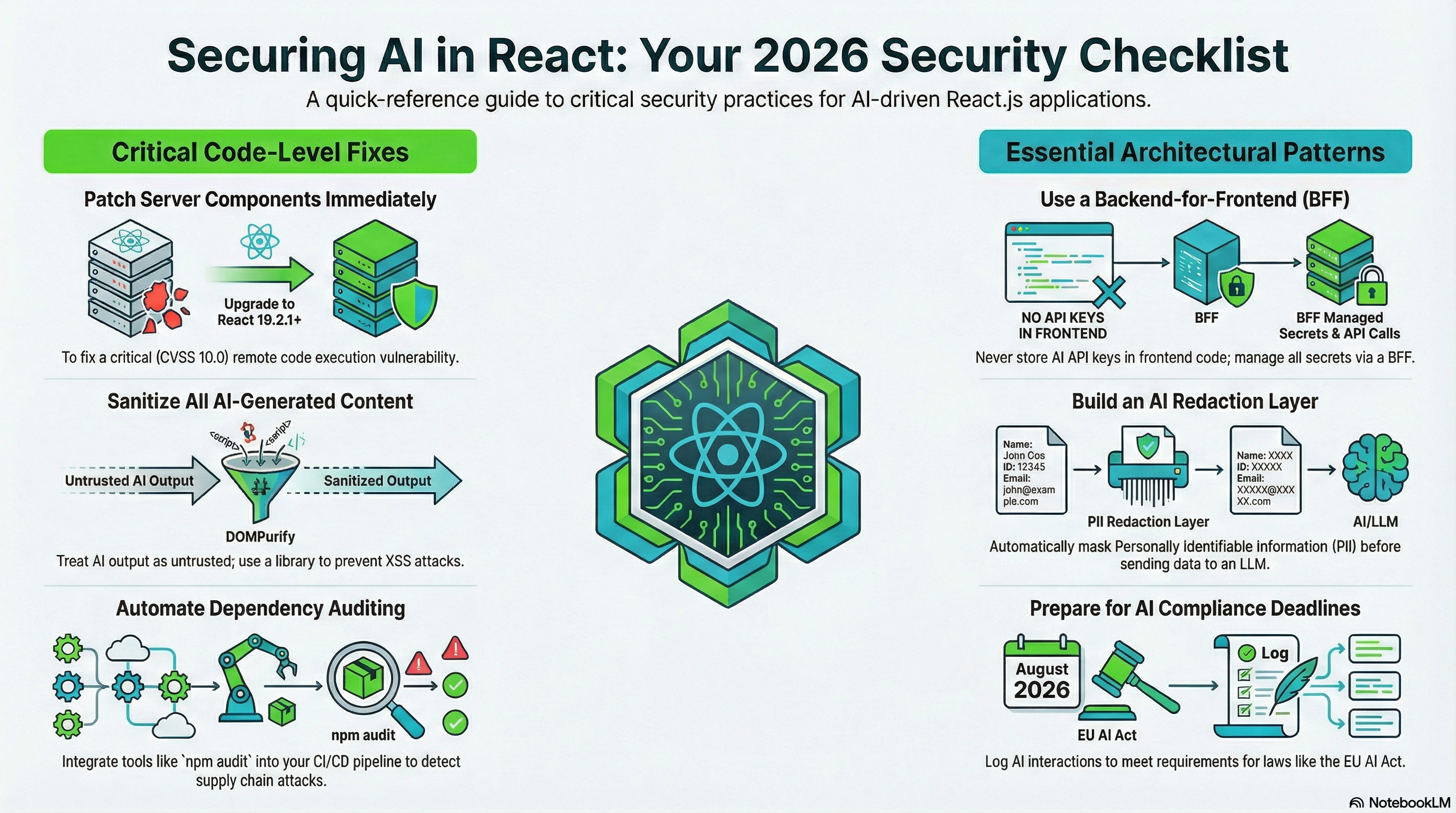
- Patch React Server Components Immediately: The critical CVE-2025-55182 vulnerability (rated CVSS 10.0) has made older versions of React Server Components (RSC) a target for unauthenticated remote code execution. Upgrading to React 19.2.1 or higher is the single most important step for any React.js development company this year.
- Build an AI Redaction Layer: Never send raw user data to an LLM. Implementing a redaction layer—either through custom logic or tools like Microsoft Presidio—ensures that Personally Identifiable Information (PII) is masked before it leaves your network. This is a core requirement for GDPR and CCPA compliance.
- Zero Trust for AI Output: Treat all AI-generated content as “untrusted” input. Always use a library like DOMPurify to sanitize AI responses before rendering them in your React UI. This prevents sophisticated Cross-Site Scripting (XSS) attacks that originate from the AI model itself.
- Adopt the BFF Architecture: Using a Backend-for-Frontend (BFF) pattern is the best React.js development service standard for 2026. It allows you to hide sensitive AI API keys, manage authentication tokens in
HttpOnlycookies, and centralize security logic away from the client-side code. - Prepare for the August 2026 Compliance Deadline: The EU AI Act enters full enforcement for high-risk systems in August 2026. Enterprises must maintain detailed logs of AI interactions and ensure human-in-the-loop checkpoints for critical decisions. Similar frameworks like the Colorado AI Act in the USA also require strict impact assessments.
- Leverage Automated Security Scanning: Modern CI/CD pipelines must include real-time dependency auditing. Tools should be configured to detect “Supply Chain Attacks” where malicious code is injected into common npm packages used by React developers.
- Partner with Security Experts: Security is no longer a one-time setup. To navigate these complexities, many organizations choose to hire React.js developers from specialized firms like Full-Stack Techies, who provide ongoing security audits and migration support to the latest, most secure versions of the framework.
Expert Insight
“In the 2026 enterprise environment, a secure frontend is the only thing standing between your private corporate data and a public AI model. If you do not control the data flow at the React level, you have already lost control of your security.”
— Senior Security Architect at Full-Stack Techies
Quick Reference: 2026 React-AI Security Impact Matrix
| Security Layer | Primary Threat Addressed | Recommended Tool/Action |
|---|---|---|
| Frontend Sanitize | Cross-Site Scripting (XSS) | DOMPurify / React State |
| Server Components | Remote Code Execution (RCE) | Upgrade to React 19.2.1+ |
| API Interaction | Secret Leakage / Key Theft | Backend-for-Frontend (BFF) |
| AI Prompting | PII Leakage / Data Training | Redaction Layer (Presidio) |
| UI Integrity | Indirect Prompt Injection | Human-in-the-loop (HITL) |
What is React.js Security in the AI Era?
React.js security refers to the set of practices and tools used to prevent malicious attacks on the frontend of a web application. In the context of AI-driven enterprise apps, this involves protecting the user interface from being used as a gateway to compromise AI models or leak sensitive corporate data.
Key characteristics of a secure React environment include:
- Data Integrity: Ensuring that the information shown to the user is accurate and has not been tampered with by an attacker.
- Privacy Protection: Shielding personal identifiable information (PII) from being inadvertently sent to third-party AI providers.
- Access Control: Verifying that only authorized users can trigger specific AI actions or view confidential reports.
By partnering with a trusted React.js development company, enterprises can implement these characteristics from the ground up, ensuring a resilient digital architecture.
Why is React.js Security Crucial for Enterprise AI?
Enterprise applications often handle massive amounts of sensitive data. In regions like Europe and the UK, strict regulations such as the GDPR (General Data Protection Regulation) and the new UK Data Use and Access Act of 2025-2026 demand high security standards. In the USA, the CCPA (California Consumer Privacy Act) and similar state laws in New York and Connecticut impose heavy penalties for data breaches.
AI adds a new layer of risk. “Indirect Prompt Injection” can occur when an AI model processes untrusted data from a React UI, leading the model to perform unauthorized actions. If your React app is not secured, an attacker could use your own AI tools to steal user credentials or export private databases.
“In 2026, the UI is no longer just a display; it is the frontline for AI model integrity. A single unsanitized output from an LLM rendered in React can compromise an entire enterprise network.”
— Security Lead at Full-Stack Techies
The Ultimate React.js Security Checklist
1. Sanitize AI-Generated Content
Overview & Explanation: AI models often return markdown or HTML. If you render this content directly using dangerouslySetInnerHTML, you invite Cross-Site Scripting (XSS) attacks.
- Actionable Steps:
- Use libraries like
DOMPurifyto clean any HTML returned by an AI before rendering it. - Avoid direct DOM manipulation; always rely on React’s built-in state management.
- Validate the structure of AI responses to ensure they do not contain hidden
<script>tags.
- Use libraries like
Why it matters: This prevents attackers from injecting malicious scripts into the AI’s output, which could then execute in the browsers of your employees or customers in Canada or the USA.
Get scalable, fast, and user-friendly ReactJS solutions tailored to your needs.
2. Secure React Server Components (RSC)
Overview & Explanation: The introduction of React Server Components and Server Functions has changed how data is fetched. A critical vulnerability (CVE-2025-55182) discovered in late 2025 showed that unauthenticated remote code execution is possible if RSC endpoints are not properly patched.
- Actionable Steps:
- Upgrade to React 19.2.1 or higher to patch known RSC vulnerabilities.
- Ensure that Server Functions do not expose internal database IDs or logic.
- Implement strict input validation for all arguments passed to Server Functions.
Why it matters: In an enterprise setting, a breach at the server component level could give an attacker access to your entire backend infrastructure. If you hire React.js developers, ensure they are experts in RSC security.
3. Implement Robust Authentication and Authorization
Overview & Explanation: Standard logins are no longer enough. For AI-driven apps, you must ensure that the user has the right to access specific AI features.
- Actionable Steps:
- Use
HttpOnly and Securecookies for storing JWT (JSON Web Tokens) to prevent theft via script. - Implement Multi-Factor Authentication (MFA) as a standard for all enterprise users.
- Apply Role-Based Access Control (RBAC) so that a junior employee cannot trigger a high-cost AI training session.
- Use
Why it matters: This prevents unauthorized access to expensive AI resources and sensitive corporate data, especially important for businesses operating under the strict compliance rules of London or New York.
4. Protect Sensitive Data in AI Prompts
Overview & Explanation: React apps often send user-provided data to an AI model. If this data contains PII, it could be used to train the model or be stored by the AI provider, violating privacy laws.
- Actionable Steps:
- Implement a “Redaction Layer” in your React app or middleware that removes names, emails, and credit card numbers before they reach the AI.
Technical Implementation Tip: When building your redaction middleware, use a “Deny-by-Default” strategy. Instead of looking for specific names, mask any string that follows patterns for emails, credit cards, or physical addresses before the payload ever reaches the LLM endpoint. This ensures compliance with the strict data minimization requirements of the UK Data Use and Access Act.
- Use encryption for data in transit (TLS 1.3).
- Inform users in the USA, UK, and Europe about what data is being shared with AI via clear privacy notices.
Why it matters: Compliance with GDPR and CCPA is mandatory. Using the best React.js development services from Full-Stack Techies can help you automate these redaction processes.
5. Strengthen Content Security Policy (CSP)
Overview & Explanation: A CSP is a security header that tells the browser which sources of content are trusted.
- Actionable Steps:
- Define a strict policy that disallows
eval() - Whitelist only the specific domains of your AI providers (e.g., OpenAI, Anthropic, or Azure).
- Use “Nonces” for any necessary inline styles to prevent style-injection attacks.
- Define a strict policy that disallows
Why it matters: A strong CSP acts as a second line of defense. If an attacker finds a way to inject a script, the CSP will prevent it from running.
6. Audit Third-Party Dependencies
Overview & Explanation: React apps rely on thousands of npm packages. A single vulnerability in a small library can compromise your whole app.
- Actionable Steps:
- Run
npm audit or yarn auditdaily as part of your CI/CD pipeline. - Use tools like Snyk or Socket to detect “Supply Chain Attacks” where malicious code is hidden in popular packages.
- Minimize the number of dependencies used in your AI-driven components.
- Run
Why it matters: Supply chain risks are a top concern for enterprises in 2026. Working with a dedicated React.js development company ensures your software stack is constantly monitored.
Proactive Audit Steps: > React developers should integrate the following command into their local pre-commit hooks to ensure no known vulnerabilities (like the RSC exploit) are introduced: npm audit --audit-level=high Additionally, use npx lockfile-lint to ensure the integrity of your npm-shrinkwrap or package-lock files against supply chain poisoning.
7. Manage Secrets and Environment Variables
Overview & Explanation: API keys for AI services are often accidentally leaked in frontend code.
- Actionable Steps:
- Never store AI API keys (like OpenAI keys) in .env files that are shipped to the browser.
- Always use a backend proxy or “BFF” (Backend-for-Frontend) pattern to call AI services.
- Rotate your keys every 30 to 90 days.
Why it matters: If an attacker gets your AI API key, they can run up massive bills on your account or access your private AI models.
Case Study: Securing AI Portals in the UK Financial Sector
The Client: A mid-sized investment firm based in London, UK.
The Problem: The firm launched a React-based portal that used AI to summarize client portfolios. Within weeks, they noticed “prompt injection” attempts where users tried to trick the AI into revealing other clients’ data.
The Solution: The firm hired Full-Stack Techies to perform a security overhaul. The team implemented the following:
- A React.js security checklist-driven audit.
- A robust DOMPurify sanitization layer for AI summaries.
- A Backend-for-Frontend (BFF) architecture to hide AI API keys.
- Automatic PII redaction to comply with UK GDPR.
The Result: The firm reduced security incidents by 95% and passed a major regulatory audit with flying colors. This demonstrates why choosing the best React.js development services is a strategic business decision.
Also Explore: How Full-Stack Techies Built an AI-Powered Healthcare Appointment Booking System with React.js
The Future of React.js and AI Security
As we move toward 2027, several trends will shape the security landscape:
- AI-Driven Security Automation: We will see “Agentic AI” that automatically scans React code for vulnerabilities and suggests patches in real-time.
- Quantum-Resistant Encryption: As quantum computing advances, enterprise apps in the USA and Europe will begin adopting new cryptographic standards to protect data.
- Shadow AI Mitigation: Companies will implement stricter controls to prevent employees from using unauthorized AI tools through their React dashboards.
- Zero-Trust UI: The industry is moving toward a model where the frontend is never trusted, and every action is verified by decentralized identity providers.
Conclusion
Building AI-driven enterprise applications with React.js offers incredible potential for innovation. However, this innovation must be balanced with a rigorous approach to security. By following this React.js security checklist, you can protect your organization from XSS, RSC exploits, and data breaches while ensuring compliance with global privacy laws.
If you are ready to build a secure, high-performance application, you should hire React.js developers who understand the complexities of the 2026 threat landscape. Full-Stack Techies is a leading React.js development company dedicated to providing the best React.js development services for enterprises worldwide.
Securing the “Last Mile” of AI—the React UI—is the defining challenge for CTOs in 2026. As the boundary between client and server blurs through Server Components, the security checklist provided here serves as your roadmap for building “Secure-by-Design” AI portals.
Also Read: Complete React.js SEO Checklist for C-Level Executives (2026)



