

The Ultimate DevOps Vendor Evaluation Checklist for Enterprises (2026)
Selecting the right DevOps partner is critical for enterprise success. This DevOps Vendor Evaluation Checklist helps organizations assess providers, compare capabilities, reduce implementation risks, and choose the best-fit DevOps vendor for long-term scalability and operational efficiency in 2026.


Introduction
Choosing the right technology partner can make or break your company’s digital transformation. In 2026, finding the right provider requires more than just looking at their pricing. It requires a detailed DevOps Vendor Evaluation Checklist. The landscape of software development is changing fast. Businesses are moving beyond basic automation and looking at advanced AI pipelines, platform engineering, and zero-trust security.
This article provides the ultimate guide to evaluating DevOps vendors. Whether you want to hire a DevOps as a Service company or run a complete managed DevOps evaluation, you need a clear path. Our objective is to give you a step-by-step roadmap. You will learn how to choose the right DevOps partner, compare DevOps providers effectively, and build a lasting business relationship.
By following this checklist, you will avoid common traps. You will not fall for marketing hype. Instead, you will use data, technical facts, and proven methods to make a smart choice. We will also show how the right partner can empower your internal teams, especially your expert techies, to do their best work. Let us dive into the details.
At a Glance: 2026 DevOps Vendor Selection Criteria
| Priority Area | Key Metric/Requirement | Goal |
|---|---|---|
| Technical | Platform Engineering & IDPs | Improve Developer Experience (DevEx) |
| Security | Automated Vulnerability Scanning | Zero-Trust Compliance |
| Financial | FinOps & Cloud Cost Optimization | Reduction in Monthly Cloud Spend |
| Operations | AIOps & Predictive Monitoring | Lower MTTR and Downtime |
| Compliance | Geo-Specific Data Residency | Legal Alignment (GDPR/HIPAA/CCPA) |
Key Takeaways: DevOps Vendor Evaluation (2026)
- Self-Assessment comes first: Before evaluating external vendors, you must clearly define your internal goals, current pain points, and existing infrastructure maturity. You can’t measure a vendor’s success without knowing your starting line.
- Modern Tech is Non-Negotiable: A capable partner in 2026 must be fluent in Platform Engineering (building internal developer platforms), DevSecOps (baking security into code automatically), and managing Multi-Cloud environments.
- AI and Cost Management are Critical: Look for vendors actively utilizing AIOps for predictive system maintenance and FinOps to strictly monitor and optimize your cloud spending.
- Empower, Don’t Replace: The ideal DevOps partner acts as a force multiplier for your internal team. They should focus on improving the Developer Experience (DevEx), building self-service tools that remove friction for your full-stack techies.
- Strict SLAs and KPIs: Hold vendors accountable with hard data. Contracts should include financial penalties tied to strict metrics like Deployment Frequency, Change Failure Rate, and Mean Time to Recovery (MTTR).
- Geo-Compliance is Mandatory: Your vendor must explicitly prove they can handle data localization and privacy laws specific to your operating regions (e.g., GDPR in Europe, HIPAA in the US).
- Look for Future-Proofing: Ensure the vendor is championing emerging standards. In 2026, GitOps (using Git as the single source of truth for infrastructure) is becoming the default, and pipelines are increasingly becoming autonomous.
What is DevOps Vendor Evaluation for Enterprises?
DevOps vendor evaluation is the systematic process a company uses to assess, compare, and select a third-party technology partner. This partner will help build, manage, or improve the company’s software delivery pipelines and cloud infrastructure. A proper evaluation uses a structured DevOps Vendor Evaluation Checklist to measure the skills, tools, and cultural fit of potential vendors.
In simple terms, it is how you decide who gets the keys to your technology engine.
When you evaluate a vendor, you are not just buying a piece of software. You are hiring a team of experts. This process, often called DevOps Procurement & Comparison, looks at many factors. You must check their knowledge of continuous integration and continuous delivery (CI/CD). You must see if they understand cloud platforms like AWS, Microsoft Azure, and Google Cloud Platform (GCP).
In 2026, the definition has expanded. A modern evaluation must look at new trends. Does the vendor understand Platform Engineering? Can they build Internal Developer Platforms (IDPs)? Do they use Artificial Intelligence for IT Operations (AIOps)?
It also involves looking at how the vendor works with your people. Your full-stack techies need a partner who makes their jobs easier, not harder. A good vendor removes roadblocks so your developers can write code faster and safer.
To do this right, companies often use a DevOps RFP template. RFP stands for Request for Proposal. This document asks vendors specific questions about their services. By comparing the answers, businesses can score each vendor and find the best match for their needs.
Summary of this section: DevOps vendor evaluation is a formal process to find the best external partner for your cloud and software delivery needs, focusing on technical skills, modern tools, and cultural fit.
Also Read: How to Hire the Best DevOps as a Service Provider in 2026: The Ultimate Executive Guide
Why is a DevOps Vendor Evaluation Checklist Important?
Using a DevOps Vendor Evaluation Checklist is critical because making the wrong choice is very expensive. A bad partner can cause system downtime, security breaches, and wasted money. A checklist acts as your safety net. It ensures you ask all the right questions before you sign a contract.
The Real Business Benefits
The primary goal of a checklist is to bring order to a chaotic process. When you compare DevOps providers, you will hear many promises. A checklist cuts through the noise. It helps you focus on facts.
Here are the main reasons why this checklist is vital:
- Risk Reduction: It helps you find vendors who prioritize security and compliance. This is very important for companies in the USA, UK, Canada, and Europe, where data laws are strict.
- Cost Control: Cloud computing can be expensive. A good checklist forces you to evaluate how a vendor manages cloud costs, known as FinOps.
- Speed to Market: The right partner will automate your processes. This means you can release new products faster than your competitors.
- Empowering Your Team: A strong partner supports your internal staff. When a vendor builds a good system, your full-stack techies can focus on writing great software instead of fixing broken servers.
Geographic Importance (USA, UK, Canada, Europe)
Location matters in cloud computing. If you are a business in New York, USA, you need a vendor who understands American compliance laws like HIPAA or SOC2. If you are in London, UK, or anywhere in Europe, the vendor must strictly follow the General Data Protection Regulation (GDPR). In Canada, they must know the Personal Information Protection and Electronic Documents Act (PIPEDA).
A strong checklist includes questions about geo-specific data hosting. It ensures your vendor knows how to store data locally to meet these regional laws.
A Brief Case Study in Success
To understand the value, look at a mid-sized financial technology company based in London in early 2025. They were struggling with slow software updates. They only released new features once a month. Their servers crashed often. They decided to use a strict DevOps Vendor Evaluation Checklist to find a new managed DevOps evaluation partner.
By following the checklist, they found a vendor skilled in GitOps and automation. Within six months, the results were amazing. They went from monthly updates to weekly updates. Their system crashes stopped. Furthermore, they reduced their monthly cloud bill by 30% because the new vendor optimized their server usage.
An Expert Opinion
“The measure of DevOps success in 2026 is no longer just how fast you can release code. It is about how safely you can integrate security, manage cloud costs, and empower your full-stack techies to innovate without friction.” — Industry Expert Consensus on 2026 Technology Trends.
Summary of this section: A vendor checklist is important because it prevents costly mistakes, ensures legal compliance across different countries, and guarantees you hire a partner who truly improves your business speed and security.
Need Expert DevOps Solutions? We Got You!
Get Free Consultation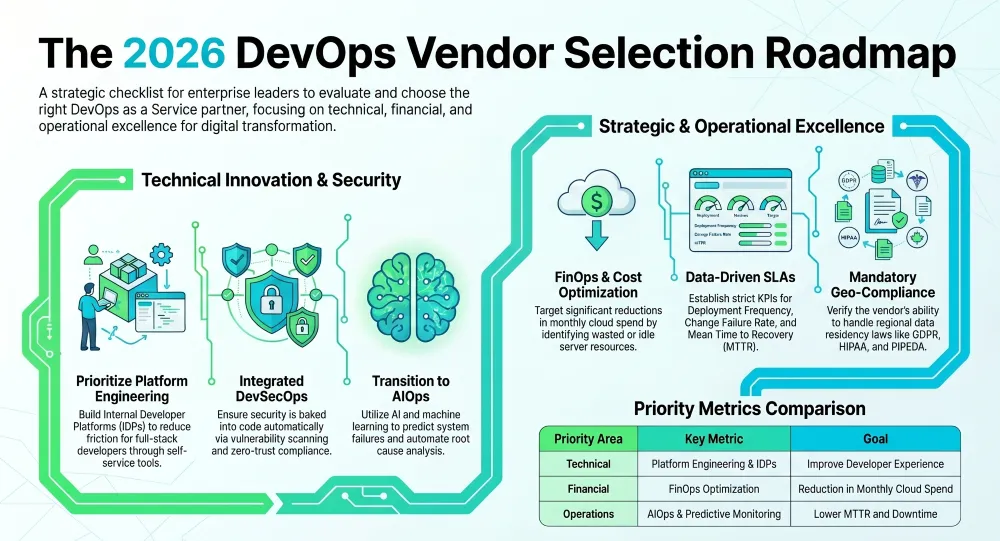
The Ultimate DevOps Vendor Evaluation Checklist
Checklist Overview
This is the core of our guide. We have broken down the evaluation into 15 actionable steps. Use this checklist when you send out your DevOps RFP template. Each point below will tell you what to look for, why it matters, and the exact steps to take.
1. Define Your Internal Goals and Maturity Level
Overview & Explanation: Before you judge an external company, you must know your own current state. You cannot ask a vendor for directions if you do not know where you are starting from.
Actionable Steps:
- Conduct an internal audit of your current software delivery speed.
- Identify your biggest pain points (e.g., slow testing, high server costs, security bugs).
- Document what you want the vendor to achieve in the first 90 days.
Why this is crucial: If your team is currently firefighting basic server crashes, you need a vendor who specializes in stabilizing systems. If you are already stable, you might need a vendor who specializes in advanced AI automation.
Summary: Start by knowing exactly what problems you need the vendor to solve.
2. Evaluate Technical Proficiency and Core Tools
Overview & Explanation: The vendor must be an expert in modern technology. They need to know the specific tools that will make your project successful.
Actionable Steps:
- Ask the vendor to list their preferred Continuous Integration/Continuous Delivery (CI/CD) tools (like Jenkins, GitHub Actions, or GitLab).
- Verify their knowledge of Infrastructure as Code (IaC) tools like Terraform or Ansible.
- Check their expertise in container technology like Docker and Kubernetes.
Why this is crucial: These tools are the building blocks of modern software. If the vendor does not use IaC, they will build your infrastructure manually. Manual work leads to human errors and slow recovery times.
Summary: Ensure the vendor uses modern, automated tools to build and manage systems.
3. Assess Platform Engineering Experience
Overview & Explanation: In 2026, Platform Engineering is a massive trend. It means building an Internal Developer Platform (IDP) so your own developers can work independently without waiting for the IT team.
Actionable Steps:
- Ask the vendor if they have built self-service portals for developers before.
- Check if their platforms come with built-in security and automated testing.
- Evaluate how their platform solutions will benefit your full-stack techies.
Why this is crucial: Platform engineering removes delays. When full-stack techies have a self-service platform, they can test and launch their code instantly. This greatly increases your company’s overall productivity.
Summary: Look for a vendor who can build internal platforms that make your developers’ lives easier.
4. Review Cloud Infrastructure Expertise
Overview & Explanation: Most modern software lives in the cloud. You need a vendor who deeply understands the major cloud providers: AWS, Microsoft Azure, and Google Cloud Platform (GCP).
Actionable Steps:
- Ask for the number of certified cloud engineers on their team.
- Determine if they specialize in one cloud or if they can handle a multi-cloud strategy.
- Request examples of past cloud migration projects they have completed.
Why this is crucial: Each cloud provider has different strengths. A good vendor in the USA or Canada might recommend AWS for its massive scale. A vendor in Europe might suggest Azure for its strict enterprise compliance. The vendor must match the cloud to your specific needs.
Summary: Verify the vendor has proven, certified experience in the specific cloud environment you want to use.
5. Verify DevSecOps and Security Compliance
Overview & Explanation: DevSecOps means putting security at the very beginning of the development process. Security is no longer an afterthought; it must be baked into the code.
Actionable Steps:
- Require the vendor to explain their automated vulnerability scanning process.
- Ask how they handle secret management (like passwords and API keys).
- Check their knowledge of local data privacy laws (e.g., GDPR in the UK and Europe, CCPA in the USA).
Why this is crucial: A single security breach can ruin a company’s reputation. A proper managed DevOps evaluation must ensure the vendor enforces policy-as-code. This means security rules are applied automatically every time someone writes new code.
Summary: Make sure the vendor automates security checks and understands regional data laws.
6. Examine AIOps and Automation Capabilities
Overview & Explanation: Artificial Intelligence for IT Operations (AIOps) uses machine learning to predict system failures before they happen. This is a major factor in choosing the right DevOps partner in 2026.
Actionable Steps:
- Ask the vendor what AI tools they use to monitor server health.
- Inquire if they use AI to automate root cause analysis when a server crashes.
- Check if they use predictive analytics to scale servers up or down based on traffic.
Why this is crucial: AI saves time. Instead of a human spending hours finding a bug, AI can spot it in seconds. This leads to less downtime and a smoother experience for your customers.
Summary: The vendor should use AI to monitor systems and predict problems automatically.
7. Check FinOps and Cloud Cost Optimization
Overview & Explanation: Cloud bills can grow out of control if no one is watching. FinOps is the practice of managing and optimizing these cloud costs.
Actionable Steps:
- Ask the vendor how they track and report daily cloud spending.
- Require them to show how they identify wasted or idle server resources.
- Ask for a past example where they reduced a client’s monthly cloud bill.
Why this is crucial: You do not want to pay for servers you are not using. A vendor skilled in DevOps as a Service will constantly look for ways to run your systems efficiently, saving your company thousands of dollars.
Summary: Ensure the vendor has a strict process for monitoring and reducing your monthly cloud expenses.
8. Demand Proof of Industry Experience
Overview & Explanation: A vendor might be good at technology, but do they understand your specific business industry?
Actionable Steps:
- Request at least three case studies from clients in your specific industry.
- Ask for client references you can call directly.
- Check if they have experience with the specific challenges of your market (e.g., high traffic events in retail, strict compliance in healthcare).
Why this is crucial: Healthcare companies have different needs than e-commerce companies. A vendor with industry experience will already know the common problems you face and how to fix them quickly.
Summary: Hire a vendor who has a proven track record of success in your specific industry.
9. Scrutinize the DevOps RFP Template and Procurement Process
Overview & Explanation: The way a vendor responds to your Request for Proposal (RFP) tells you a lot about how they do business.
Actionable Steps:
- Evaluate if their RFP response is clear, detailed, and customized to your needs.
- Check if their pricing structure is transparent with no hidden fees.
- Look for clear timelines and deliverables in their proposal.
Why this is crucial: If a vendor provides a vague or confusing RFP response, their actual work will likely be confusing too. You want a partner who communicates clearly from day one.
Summary: Judge the vendor by the quality, clarity, and honesty of their official proposal.
10. Measure Communication and Culture
Overview & Explanation: Technology is important, but people do the work. A successful partnership requires great communication and a shared culture.
Actionable Steps:
- Schedule a meeting with the actual engineers who will work on your project, not just the sales team.
- Evaluate how fast they respond to your emails during the evaluation phase.
- Ask them how they handle disagreements or project delays.
Why this is crucial: DevOps is built on collaboration. If the vendor’s team cannot communicate well with your internal team, the project will fail. They must be transparent and honest at all times.
Summary: Pick a vendor whose team communicates clearly, quickly, and honestly.
11. Test Support for expert Techies
Overview & Explanation: Your internal developers are your most valuable asset. The vendor must prove they will support and uplift your full-stack techies, rather than replacing them or ignoring them.
Actionable Steps:
- Ask how the vendor plans to train your internal team on the new systems.
- Ensure the vendor writes clear, easy-to-read documentation for all their work.
- Check if the vendor’s solutions reduce the daily manual tasks for your developers.
Why this is crucial: When your techies spend less time managing servers, they can spend more time building the actual product. A great vendor acts as a mentor and guide to your internal staff.
Summary: The vendor must empower your developers by providing great tools and thorough training.
12. Establish clear SLAs and KPIs
Overview & Explanation: You need a way to measure if the vendor is doing a good job. You do this through Service Level Agreements (SLAs) and Key Performance Indicators (KPIs).
Actionable Steps:
- Define the target Deployment Frequency (how often new code is released).
- Set a goal for Lead Time for Changes (how fast a new idea becomes live code).
- Agree on a maximum Change Failure Rate (the percentage of releases that cause a bug).
- Establish an acceptable Mean Time to Recovery (MTTR) if a server goes down.
Why this is crucial: Without KPIs, you are just guessing if the vendor is successful. These numbers give you concrete proof of their performance. If they fail to meet the SLAs, there should be financial penalties in the contract.
Summary: Put strict performance numbers in the contract to guarantee high-quality work.
13. Analyze the Onboarding Strategy
Overview & Explanation: The first few weeks with a new vendor are critical. You need to know exactly how they will take over your systems without causing disruptions.
Actionable Steps:
- Ask for a detailed 30-60-90 day onboarding plan.
- Identify who will be the dedicated project manager from their side.
- Check their process for securely transferring passwords and system access.
Why this is crucial: A messy transition can cause server downtime and lost revenue. A structured onboarding plan proves the vendor is organized and professional.
Summary: Demand a clear, written plan for how the vendor will start the project safely.
14. Ensure Geo-Specific Compliance
Overview & Explanation: If you operate in multiple countries, your vendor must understand the laws of those specific regions.
Actionable Steps:
- Verify their ability to set up servers in specific regions (e.g., AWS Europe, Azure Canada).
- Ask for proof of compliance with local data protection laws.
- Ensure they can provide local technical support during your normal business hours.
Why this is crucial: Sending European customer data to a server in the USA without proper safeguards is illegal under GDPR. The vendor must prove they can keep your data legally safe based on your location.
Summary: The vendor must prove they know and follow the laws of the countries where you do business.
15. Plan for Scalability and Flexibility
Overview & Explanation: The vendor might be great for your company today, but can they support you when your company doubles in size next year?
Actionable Steps:
- Ask how quickly they can add more engineers to your team if needed.
- Check if their contracts allow you to scale services up or down based on your budget.
- Ensure the infrastructure they build is designed to handle massive increases in web traffic.
Why this is crucial: You do not want to change vendors every two years. You need a partner who can grow with you. Their systems must be flexible enough to handle your future success.
Summary: Ensure the vendor’s team and technology can grow as your business grows.
Get scalable, fast, and user-friendly DevOps solutions tailored to your needs
Get Free ConsultationThe Future of DevOps Vendor Evaluation (2026 & Beyond)
As we move deeper into 2026, the way we compare DevOps providers is evolving. The focus is shifting from simple automation to deep intelligence and continuous value delivery. If you are evaluating a vendor today, you must ask them about their vision for the future.
The Rise of Autonomous Pipelines
In the near future, CI/CD pipelines will become mostly autonomous. Powered by AI agents, these pipelines will not just run tests; they will write their own tests, fix simple code bugs, and deploy software without human intervention. When checking your DevOps Vendor Evaluation Checklist, ask the vendor if they are experimenting with AI agents that can self-heal infrastructure.
The Shift to GitOps as a Standard
GitOps is no longer just a trend; it is becoming the default standard. In GitOps, the Git repository is the single source of truth for both code and infrastructure. Every change is tracked, and rollbacks are instant. Vendors who do not use GitOps in 2026 are falling behind. Ensure your partner mandates GitOps for all new projects.
Focus on Developer Experience (DevEx)
The future of DevOps is heavily focused on the developer experience. It is not enough to have fast servers. The tools must be pleasant and easy to use. Vendors are now measured on how much friction they remove from the daily lives of full-stack techies. A happy developer writes better code. Future evaluations will include metrics on developer satisfaction alongside traditional uptime metrics.
Expanding Multi-Cloud and Hybrid Strategies
Companies no longer want to be locked into one cloud provider. They want the freedom to use AWS, Azure, and GCP simultaneously to get the best pricing and features. Managing a multi-cloud environment is highly complex. The vendors of the future must provide unified control panels that allow businesses to manage all their clouds from one single screen.
Summary of this section: The future of DevOps relies on AI automation, GitOps standards, improving the developer experience, and mastering multi-cloud environments. Your vendor must be prepared for these changes.
Conclusion
Finding the right technology partner is a major decision for any enterprise. By using this ultimate DevOps Vendor Evaluation Checklist, you take the guesswork out of the process. You move from making emotional decisions to making data-driven choices.
Remember to clearly define your goals first. Then, rigorously test the vendor’s technical skills, their understanding of cloud costs, and their commitment to security. Do not forget the human element. The best DevOps as a Service provider will not just fix your servers; they will actively support and empower your internal full-stack techies to do brilliant work.
The software landscape in 2026 is complex, but with the right partner, you can navigate it safely and efficiently. Use this checklist, ask tough questions, and choose a partner who will drive your business forward.
Frequently Asked Questions
Q1. What is a DevOps Vendor Evaluation Checklist?
It is a detailed list of criteria used to assess and compare third-party companies that offer DevOps services. It ensures you evaluate their technical skills, culture, and security practices thoroughly.
Q2. Why should I use a managed DevOps evaluation process?
A managed evaluation removes bias. It provides a structured, objective way to score vendors based on facts, reducing the risk of hiring the wrong partner.
Q3. How do I compare DevOps providers effectively?
Compare them using clear KPIs. Look at their deployment frequency, their cloud cost optimization (FinOps) strategies, and their proven case studies in your specific industry.
Q4. What should be included in a DevOps RFP template?
Your RFP should include questions about their CI/CD tools, their experience with AWS/Azure/GCP, their security compliance processes, and their strategies for supporting full-stack techies.
Q5. How important is cloud cost optimization in the evaluation?
It is extremely important. In 2026, cloud bills can be massive. You must choose a vendor with strong FinOps skills who can constantly monitor and reduce your cloud expenses.
Q6. What is the role of AIOps in modern DevOps?
AIOps uses artificial intelligence to monitor systems and predict failures before they happen. A modern vendor should use AIOps to reduce downtime and automate troubleshooting.
Q7. How do I know if a vendor is good for my full-stack techies?
Ask how they build Internal Developer Platforms (IDPs). A good vendor builds self-service tools that allow your developers to work independently without waiting for IT approvals.
Q8. What security questions should I ask a potential partner?
Ask about their DevSecOps practices. Specifically, ask how they automate vulnerability scanning in the pipeline and how they manage secret access keys.
Q9. Why does geographic location matter when choosing a vendor?
Location matters for legal compliance. If you are in Europe, the UK, Canada, or the USA, the vendor must understand and follow your local data privacy laws (like GDPR or HIPAA).
Q10. What are the most important DevOps metrics to track?
The most important metrics are Deployment Frequency, Lead Time for Changes, Change Failure Rate, and Mean Time to Recovery (MTTR).
Q11. Is DevOps as a Service a good idea for large enterprises?
Yes. It allows large enterprises to scale their infrastructure quickly without having to hire and train a massive internal IT department.
Q12. How does a vendor prove their industry experience?
They should provide detailed case studies and direct client references from other companies in your exact business sector.
Q13. What is GitOps, and why should the vendor use it?
GitOps uses a Git repository to manage infrastructure. It ensures every system change is tracked and can be instantly rolled back if a mistake occurs. It is a mandatory best practice in 2026.
Q14. How fast should the vendor respond during an emergency?
This should be defined in the Service Level Agreement (SLA). Typically, critical system failures require a response time of less than 15 to 30 minutes.
Q15. Can a DevOps vendor help with a multi-cloud strategy?
Yes. A highly skilled vendor can help you deploy and manage your software across multiple cloud providers (like AWS and Azure) to avoid vendor lock-in and optimize costs.



