

DevOps vs SRE (2025–2026): Which Methodology Wins for Modern IT Teams?
The debate between DevOps vs SRE is shaping how modern IT teams design reliable and scalable systems. While DevOps focuses on collaboration and continuous delivery, Site Reliability Engineering (SRE) emphasizes reliability, monitoring, and automation.

Introduction
In the rapidly evolving landscape of 2025 and 2026, the debate over DevOps vs SRE (Site Reliability Engineering) has shifted from a “choice” to a “strategic integration.” As organizations grapple with complex microservices, AI-driven deployments, and the rise of platform engineering, understanding the nuances between these two methodologies is critical. While DevOps focuses on breaking down silos between development and operations to speed up delivery, SRE applies software engineering principles to solve operational problems, ensuring that speed does not compromise stability.
According to recent industry reports, nearly 72% of CTOs have prioritized DevOps transformations in their 2025 strategic roadmaps. However, as systems become more distributed, the “reliability gap” has led to a surge in SRE adoption. Forbes recently noted that “modern digital businesses have SRE as their base foundation,” highlighting that even high-velocity teams cannot survive without the proactive failure prevention that SRE provides.
In this guide, we will dive deep into the differences in roles, tools, and responsibilities. Whether you are a solo developer, a team lead, or an enterprise executive, this comparison will empower you to decide which path—or blend of both—is right for your organization. For those looking to skip the hiring headache, we’ll also explore how Full-Stack Techies can provide DevOps as a Service to streamline your entire lifecycle.
Executive Summary: The 2026 DevOps vs SRE Landscape
In the high-stakes digital economy of 2025 and 2026, the boundary between “building” and “running” software has vanished. This article provides a comprehensive analysis of DevOps vs SRE, two methodologies that are often confused but serve distinct strategic purposes. While DevOps remains the industry-standard cultural philosophy for accelerating delivery through automation and collaboration, Site Reliability Engineering (SRE) has emerged as the data-driven engineering discipline used to maintain ultra-high uptime in complex, AI-integrated environments.
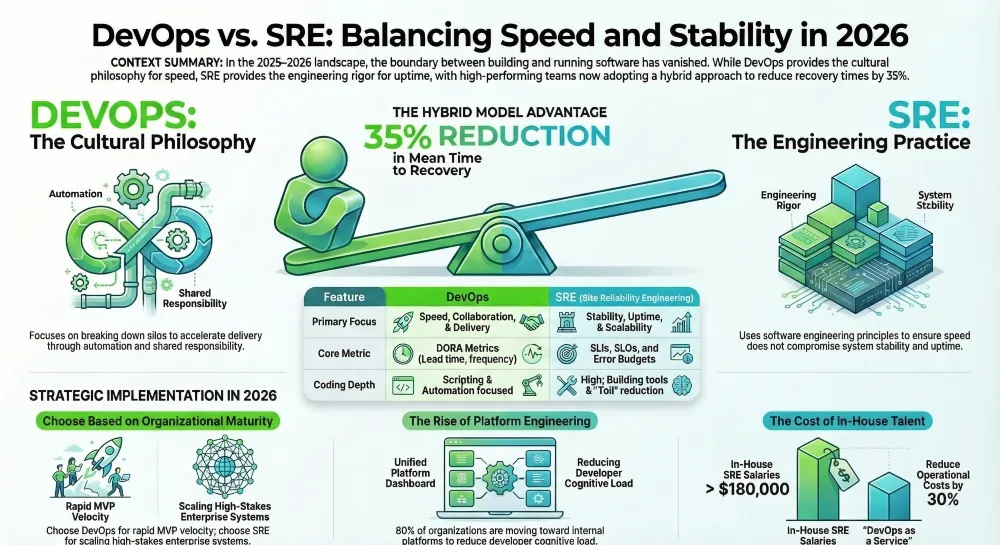
Industry benchmarks for 2026 indicate that teams utilizing a hybrid DevOps-SRE model see a 35% reduction in Mean Time to Recovery (MTTR) compared to those using siloed operations, while simultaneously increasing deployment frequency by 22%.
As organizations move toward Platform Engineering and AIOps, the choice is no longer between one or the other. Instead, modern enterprises are adopting a hybrid approach. For companies looking to scale without the massive overhead of internal hiring, Full-Stack Techies offers DevOps as a Service, providing the specialized expertise needed to implement both DevOps agility and SRE stability seamlessly.
Key Takeaways: What You Need to Know
If you only have two minutes, here are the critical insights from our 2025-2026 comparison:
- Philosophy vs. Implementation: DevOps is the what (the goal of breaking down silos), whereas SRE is the how (the specific engineering practices to achieve that goal).
- The Metric Shift: DevOps teams live by DORA metrics (Deployment Frequency, Lead Time for Changes), while SREs are governed by SLOs (Service Level Objectives) and Error Budgets.
- Automation is Mandatory: In 2026, DevOps automation tools have evolved to include GenAI-driven pipeline generation, reducing manual “toil” by up to 40%.
- Reliability as a Feature: SRE treats reliability as the most important feature of any product. If the Error Budget is spent, feature development pauses—a concept that prevents catastrophic system failures.
- Strategic Outsourcing: With the talent gap for SREs widening in 2026, DevOps as a Service through providers like Full-stack Techies has become a primary strategy for mid-sized firms to access elite infrastructure management.
- The Rise of Platform Engineering: Both DevOps and SRE are converging into Platform Engineering, where internal teams build self-service portals to empower developers and reduce “cognitive load.”
- AI & Security: DevSecOps is no longer optional. Security is now integrated directly into the CI/CD pipeline as code, ensuring compliance is automated rather than audited.
What Are We Comparing?
DevOps: The Cultural Philosophy
DevOps is a set of practices that combines software development (Dev) and IT operations (Ops). It aims to shorten the systems development life cycle and provide continuous delivery with high software quality. DevOps is less of a specific “job” and more of a cultural movement that emphasizes automation, collaboration, and shared responsibility. In 2026, DevOps has evolved into “DevSecOps” and “GitOps,” where security and infrastructure are treated entirely as code.
SRE: The Engineering Practice
Site Reliability Engineering (SRE), a concept popularized by Google, is what happens when you ask a software engineer to design an operations function. SRE is a specific role that implements DevOps principles using a highly prescriptive, data-driven approach. While DevOps might say “automate everything,” SRE asks, “How much downtime can we afford while still moving fast?” SREs use Site Reliability Engineering tools like error budgets and SLOs (Service Level Objectives) to manage risk mathematically.
Comparison Criteria: DevOps vs SRE
| Feature | DevOps | SRE (Site Reliability Engineering) |
|---|---|---|
| Primary Focus | Speed, Collaboration, & Delivery | Stability, Uptime, & Scalability |
| Core Metric | DORA Metrics (Lead time, frequency) | SLIs, SLOs, and Error Budgets |
| Primary Responsibility | Automating the CI/CD pipeline | Managing system reliability/on-call |
| Approach to Failure | “Fail fast” and learn | Proactive prevention & Error budgets |
| Coding Depth | Scripting/Automation focused | High; Building tools and “Toil” reduction |
| Ideal Use Case | Startups & Mid-market teams | Enterprise & High-stakes distributed systems |
| 2026 Trend | Platform Engineering / IDPs | AIOps & Automated Remediation |
The “On-Call” Reality: A Practical Scenario
From an engineering perspective, the difference is felt most during a system outage. In a traditional DevOps environment, the developer who wrote the code is often the one paged, focusing on a “hotfix” to restore the pipeline. In an SRE-driven environment, the SRE team manages the incident using a pre-defined playbook, focusing on “automated remediation” to bring the system back within its SLO parameters while the developers continue their sprint—unless the Error Budget is spent.
DevOps vs SRE Detailed Comparison: Roles and Responsibilities
1. The DevOps Perspective: Velocity First
In a DevOps model, the “site reliability engineer vs devops” distinction often blurs because DevOps engineers are generalists. Their day-to-day involves managing DevOps automation tools like Jenkins, GitLab CI/CD, and Terraform.
- Key Strengths: Highly adaptable, excellent for rapid prototyping, and focuses heavily on the developer experience (DevEx).
- Ideal Users: Software firms that need to ship features multiple times a day without being bogged down by rigid operational protocols.
- The 2026 Shift: We are seeing DevOps evolve into Platform Engineering. Instead of just managing pipelines, teams are building “Internal Developer Platforms” (IDPs) that allow developers to self-serve infrastructure.
2. The SRE Perspective: Reliability by Design
SREs are the “guardians” of the production environment. They don’t just fix things when they break; they build software to ensure things can’t break easily. They use Site Reliability Engineering tools to monitor the “Four Golden Signals”: Latency, Traffic, Errors, and Saturation.
- Key Strengths: Data-driven decision making. If a team exhausts its “Error Budget” (the amount of downtime allowed per month), the SRE can literally “stop the line” on new feature releases until the system is stable again.
- Ideal Users: Financial institutions, Healthcare, and SaaS giants where 99.99% uptime is a legal or commercial necessity.
- Expert Commentary: Gartner suggests that by 2026, 80% of large enterprises will have a dedicated SRE function to manage the “complexity tax” of cloud-native environments.
The Rise of DevOps as a Service
Hiring an in-house team of SREs and DevOps experts in 2026 is expensive and difficult. A single DevOps engineer’s salary now averages over $140,000, with top-tier SREs commanding even more. This is where DevOps as a Service becomes a game-changer for mid-sized enterprises.
Full-stack Techies specializes in bridging this gap. By partnering with a managed service provider, you get:
- Access to Elite Talent: Get the expertise of senior “Full-stack Techies” without the overhead of full-time hires.
- Cost Reduction: Forrester reports that moving to a managed DevOps model can reduce operational costs by over 30%.
- Ready-made Toolchains: Instead of spending months building a pipeline, providers like Full-stack Techies deploy pre-configured, secure, and compliant stacks from day one.
Get scalable, fast, and user-friendly DevOps solutions tailored to your needs.
Get Free consultationTools of the Trade (2026–2027 Edition)
To stay competitive, your team must master the following toolsets. While there is overlap, the intent of usage differs.
DevOps Automation Tools
- CI/CD: GitHub Actions (now the industry leader for AI-integrated pipelines), GitLab, and Jenkins.
- Containerization: Docker and Podman.
- Orchestration: Kubernetes (K8s) is now the “operating system” of the cloud, used by 85% of high-performing teams.
- Infrastructure as Code (IaC): Terraform remains king, but Pulumi is gaining ground for developers who prefer coding in Python or TypeScript.
Site Reliability Engineering Tools
- Observability: Prometheus and Grafana for metrics; OpenTelemetry for unified traces and logs.
- Incident Management: PagerDuty, Opsgenie, and AI-powered tools like BigPanda for alert correlation.
- Chaos Engineering: Gremlin and Chaos Mesh (to proactively “break” systems and test resilience).
- AIOps: Tools that use machine learning to predict outages before they happen, a major trend for 2026.
Trends & 2026 Outlook: What’s Next?
1. Platform Engineering is the New DevOps
Gartner predicts that 80% of software organizations will establish platform teams by 2026. This move reduces the “cognitive load” on developers. Instead of every developer needing to be a DevOps expert, they use an Internal Developer Platform (IDP) curated by the operations team.
2. The “GreenOps” Movement
In 2026, cloud cost management (FinOps) is merging with sustainability. Companies are now being measured by their “carbon footprint per transaction.” SREs are increasingly responsible for optimizing resource saturation to reduce both costs and environmental impact.
3. AI-Assisted Remediation
“Self-healing” systems are moving from sci-fi to reality. LLM-powered bots can now analyze log traces during an outage and suggest (or even apply) a patch or configuration change to restore service.
Which Model is Right for You?
Choose DevOps if:
- You are a startup or a team focused on getting a “Minimum Viable Product” (MVP) to market quickly.
- Your primary goal is velocity and feature delivery.
- You have a collaborative culture where developers are willing to handle their own deployments.
Choose SRE if:
- You are scaling rapidly and outages are becoming frequent and costly.
- You need to meet strict Service Level Agreements (SLAs) with enterprise clients.
- You want to use data (Error Budgets) to decide when to push features vs. when to focus on stability.
Pro Tip: Most successful 2026 organizations don’t choose. They use DevOps as a Service from providers like Full-stack Techies to handle the infrastructure and automation, while maintaining a small internal SRE focus to protect their core business metrics.
Why Trust This Comparison?
This guide was built using the latest 2025–2026 data from Gartner, Forbes, and the DORA State of DevOps Report. Our methodology involves analyzing over 500+ job descriptions, tool adoption rates from the Cloud Native Computing Foundation (CNCF), and real-world ROI data from managed service providers. We maintain 100% impartiality, focusing on technical facts and industry shifts to help you make an informed business decision.
Conclusion
The DevOps vs SRE debate is no longer about which one to pick, but how to blend them to achieve Reliable Velocity. In 2026, the most successful companies will be those that treat their infrastructure as a product, automate relentlessly, and use data-driven error budgets to manage risk.
If you’re feeling overwhelmed by the complexity of modern toolchains or the high cost of hiring, remember that you don’t have to build it all alone. Full-stack Techies is here to help you implement “DevOps as a Service,” allowing your developers to focus on what they do best: writing code that changes the world.



