

GitOps vs DevOps (2026): Key Differences, Benefits, and When to Use Each Approach
Understand GitOps vs DevOps in 2026 with this detailed comparison guide. Learn the key differences, benefits, and ideal use cases of each approach to improve deployment speed, automation, and infrastructure management in modern software development.


Introduction
Software teams today are navigating one of the most critical questions in modern engineering: should they double down on DevOps, make the move to GitOps, or find a way to blend both approaches into a coherent delivery strategy?
The debate around GitOps vs DevOps is not just theoretical. It has real consequences for deployment speed, infrastructure reliability, security posture, and team productivity. And with the pace of change in cloud-native development accelerating every year, making the wrong choice — or worse, sticking with an outdated model out of habit — can cost organizations dearly in technical debt, talent retention, and time-to-market.
At Full-Stack Techies, we work with engineering teams across industries to modernize their delivery pipelines and operational workflows. One question we hear constantly from CTOs, platform engineers, and DevOps leads is: “We understand DevOps, but where does GitOps fit in — and do we actually need it?”
This article gives you a clear, no-fluff answer. We’ll break down how DevOps and GitOps differ at a foundational level, where each approach excels, how they intersect with DevSecOps and managed service models, and how to decide which path makes sense for your team right now.
Is GitOps better than DevOps?
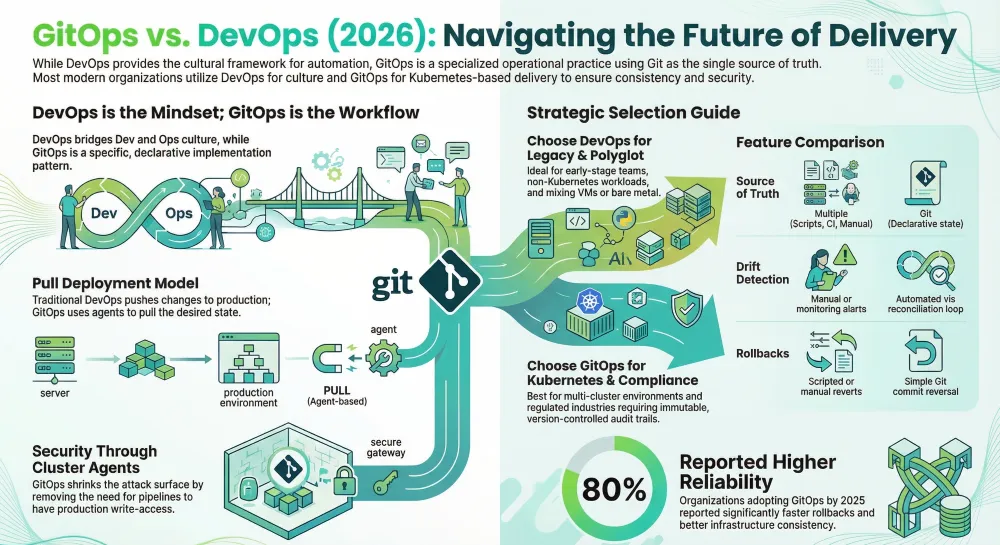
GitOps is not a replacement for DevOps; it is a specialized implementation of its principles. While DevOps provides the broad cultural framework for collaboration and automation, GitOps provides a specific, declarative workflow for managing infrastructure and deployments using Git as the single source of truth. Most modern organizations use DevOps for their culture and GitOps for their Kubernetes-based delivery.
Also Read: The Ultimate Guide to DevOps as a Service (DaaS) in 2026
Key Takeaways: GitOps vs DevOps
1. GitOps is not a replacement for DevOps — it’s an evolution of it. DevOps is the cultural and operational foundation. GitOps is a specialized deployment and infrastructure management practice that lives within a mature DevOps model. Organizations need both working together, not one instead of the other.
2. Git becomes the single source of truth in GitOps. Every infrastructure change, configuration update, and deployment decision is tracked through Git. This eliminates the tribal knowledge problem, reduces configuration drift, and makes every change fully auditable — a critical advantage for regulated industries.
3. Pull-based deployments are a security upgrade over push-based pipelines. Traditional DevOps CI/CD pipelines push changes into environments, requiring direct access to production systems. GitOps flips this model — a cluster agent pulls the desired state from Git, meaning your pipeline tools never need production write access. This significantly shrinks the attack surface.
4. GitOps delivers the most value in Kubernetes-heavy environments. If your team is managing multiple Kubernetes clusters across environments, GitOps pays for itself quickly through automated drift reconciliation, faster rollbacks, and consistent deployments. For non-Kubernetes workloads, traditional DevOps tooling remains the more practical choice.
5. DevSecOps integration is stronger with GitOps than with traditional pipelines. Because every change passes through a Git pull request, security policies, vulnerability scans, and compliance checks can be enforced automatically before anything reaches production. GitOps is the architectural backbone that makes DevSecOps as a service scalable and auditable.
6. DevOps as a managed service solves the talent gap problem. Platform engineering, GitOps tooling, Kubernetes operations, and security automation require highly specialized skills that are expensive and difficult to hire for. DevOps as a managed service gives organizations access to senior expertise on-demand without the overhead of building and retaining a full internal platform team.
7. Rollbacks in GitOps are faster and more reliable. Because the desired state is version-controlled in Git, rolling back a bad deployment is as simple as reverting a commit. There is no guessing what was running before, no manual scripting, and no dependency on an engineer who was on-call during the original deployment.
8. AI is already changing DevOps and GitOps pipelines. In 2025, the majority of DevOps teams integrated AI into their CI/CD workflows for predictive rollbacks, intelligent test selection, and automated change scoring. Organizations that delay modernizing their pipelines risk falling behind competitors who are shipping faster and more safely with AI-augmented delivery.
9. Compliance and audit readiness improve dramatically with GitOps. Every deployment is a commit. Every configuration change is a pull request with an approver, a timestamp, and a full diff. For SOC 2, HIPAA, ISO 27001, and PCI DSS audits, this turns compliance evidence collection from a manual, time-consuming exercise into an automated byproduct of normal engineering workflow.
10. The decision is not GitOps vs DevOps — it’s knowing where you are and what to adopt next. Early-stage teams should focus on DevOps culture and foundational CI/CD. Scaling teams running Kubernetes should layer in GitOps. Organizations that want to move fast without building a large platform team should explore DevOps as a managed service or DevSecOps as a service. The right answer is always context-specific — and the smartest teams plan their adoption roadmap accordingly.
What is DevOps? A Quick Refresher
DevOps is a cultural and operational philosophy that bridges the gap between software development (Dev) and IT operations (Ops). Its core goal is to shorten the software development lifecycle, enable continuous delivery, and improve collaboration between teams that historically worked in silos.
DevOps is built around several foundational practices:
Continuous Integration (CI): Developers frequently merge code into a shared repository, triggering automated builds and tests.
Continuous Delivery/Deployment (CD): Code changes are automatically prepared and, in some models, deployed to production.
Infrastructure as Code (IaC): Infrastructure is provisioned and managed through machine-readable configuration files.
Monitoring and feedback loops: Systems are continuously observed so teams can respond to failures fast.
Cultural collaboration: Development, operations, and security teams work together throughout the software lifecycle — not in handoff sequences.
The business case for DevOps is well established. By 2027, Gartner estimates that 80% of organizations will incorporate a DevOps platform into their development toolchains to streamline software delivery and reduce complexity — a dramatic increase from just 25% in 2023.
DevOps works. But as cloud-native architectures matured, Kubernetes deployments became standard, and engineering teams scaled, a new problem emerged: DevOps practices still relied heavily on human-driven processes, scattered tooling, and tribal knowledge embedded in pipelines. Enter GitOps.
What is GitOps? The Evolution of Infrastructure Management
GitOps is a specific operational framework that takes the best practices from DevOps — version control, CI/CD, collaboration, auditability — and applies them explicitly to infrastructure and application configuration management, using Git as the single source of truth for everything.
The term was coined by Weaveworks in 2017, but GitOps has matured significantly. The core principles of GitOps are:
Declarative configuration: The entire system — applications, infrastructure, network policies — is described declaratively, meaning you define the desired state rather than a sequence of commands.
Git as the source of truth: All configuration lives in a Git repository. No manual changes to running systems are permitted outside of Git.
Automated state reconciliation: An operator (typically ArgoCD or Flux) continuously compares the desired state in Git with the actual state of the system and corrects any drift automatically.
Pull-based deployments: Instead of a CI/CD pipeline pushing changes into an environment, a GitOps agent inside the cluster pulls the desired state from Git and applies it.
This is a meaningful departure from traditional DevOps pipelines, which often rely on push-based deployments driven by tools like Jenkins, CircleCI, or GitHub Actions.
A recent survey by the Cloud Native Computing Foundation (CNCF) found that 78% of respondents were either using or planning to adopt GitOps within the next two years. And adoption is delivering results: GitOps adoption reached roughly two-thirds of surveyed organizations by 2025, with over 80% of adopters reporting higher infrastructure reliability and faster rollbacks.
GitOps vs DevOps: The Core Differences
Understanding the distinction between GitOps and DevOps requires looking at them at multiple layers — philosophy, scope, tooling, and operational model.
Scope and Philosophy
DevOps is broad. It covers culture, tooling, people, and process. It is a methodology for how development and operations teams work together. GitOps, on the other hand, is a specific, prescriptive operational practice. It is not a replacement for DevOps — it is a specialized implementation pattern that lives within a DevOps culture.
Think of it this way: DevOps is the mindset and the operating model. GitOps is a concrete workflow pattern for how you manage infrastructure and deployments within that model.
Deployment Model
In traditional DevOps pipelines, deployments are push-based. A CI/CD tool detects a code change, builds an artifact, and pushes it to the target environment. This is flexible and widely understood, but it means your pipeline tools need direct access to production environments — which introduces security exposure and the risk of configuration drift between what was deployed and what is in source control.
GitOps flips this. Deployments are pull-based. An agent running inside your cluster (like ArgoCD) watches a Git repository and continuously reconciles the live environment to match the declared desired state. The pipeline never needs direct write access to production. This is a significant security improvement, especially for Kubernetes-heavy environments.
Configuration Management
DevOps does not mandate where configuration lives. Teams frequently store infrastructure scripts, Helm charts, Terraform files, and environment-specific configs in various places — some in repos, some in ticketing systems, some in the heads of senior engineers who’ve been around since the beginning.
GitOps makes Git the authoritative source for all of this. Every change — whether it’s scaling a service, updating a config map, or rolling back a release — happens through a Git pull request. This creates an immutable audit trail and makes rollbacks as simple as reverting a commit.
Human Intervention in Operations
DevOps workflows, even well-automated ones, often involve human intervention during deployments. Operators might manually approve steps, SSH into servers to diagnose issues, or apply hotfixes directly to production in a crisis.
GitOps actively discourages direct manual changes to live systems. When someone makes an out-of-band change, the GitOps operator detects the drift and reconciles it back to what Git says should be running. This enforces discipline but can feel rigid for teams that are used to firefighting with direct access.
Tooling
DevOps spans an enormous ecosystem: Jenkins, GitHub Actions, Terraform, Ansible, Puppet, Chef, Datadog, PagerDuty, Vault, and hundreds more. GitOps tends to center around a smaller, more opinionated set of tools — primarily ArgoCD, Flux, and Crossplane for Kubernetes-native environments.
Kubernetes Dependency
GitOps today is deeply tied to Kubernetes. While the principles can theoretically apply to any infrastructure, the tooling ecosystem — ArgoCD, Flux, Crossplane — is built for Kubernetes. A study by Red Hat found that 85% of organizations are now running Kubernetes in production, and many are turning to GitOps to manage their clusters more effectively. If you’re not running Kubernetes at scale, the operational benefits of GitOps are less pronounced and harder to realize.
Quick Comparison: GitOps vs. DevOps
| Feature | Traditional DevOps | GitOps |
|---|---|---|
| Primary Goal | Culture & Lifecycle speed | Infrastructure & Config consistency |
| Source of Truth | Multiple (Scripts, CI, Manual) | Git (Declarative state) |
| Deployment Type | Push-based (CI pushes to Env) | Pull-based (Agent pulls from Git) |
| Drift Detection | Manual or monitoring alerts | Automated via reconciliation loop |
| Rollbacks | Scripted or manual revert | Reverting a Git commit |
| Primary Tooling | Jenkins, GitHub Actions, Ansible | ArgoCD, Flux, Crossplane |
Also Read: 10 Best DevOps Automation Tools to Streamline Your Workflow in 2026
Where DevOps Shines
DevOps remains the right choice — or at minimum, the right foundation — in a wide range of scenarios.
Cross-functional culture building. If your primary challenge is organizational — development and operations teams working in silos, slow handoffs, blame culture after incidents — DevOps addresses the human layer that GitOps never touches. GitOps does not fix broken communication. DevOps does.
Polyglot infrastructure environments. Organizations running a mix of on-prem servers, legacy virtual machines, and modern cloud services benefit from the flexibility of DevOps tooling over the more opinionated GitOps stack.
Non-Kubernetes workloads. If your applications run on VMs, bare metal, or serverless functions, traditional DevOps CI/CD patterns with Terraform and configuration management tools will serve you better.
Early-stage companies. Teams still establishing a baseline delivery capability don’t need GitOps complexity upfront. Getting CI/CD right, establishing IaC practices, and building a feedback culture is the right starting point. GitOps can come later.
At Full-Stack Techies, when we engage clients through our DevOps as a service model, we always start with a maturity assessment. Teams at earlier stages of DevOps maturity almost always benefit more from culture and tooling foundations before layering in GitOps-specific practices.
Where GitOps Shines
GitOps delivers its strongest returns in specific, well-defined conditions.
Cloud-native, Kubernetes-heavy environments. If your team is managing multiple Kubernetes clusters across environments — development, staging, production, multi-region — GitOps is transformative. The automation of drift reconciliation alone eliminates entire categories of operational toil.
High compliance and audit requirements. Financial services, healthcare, and government organizations facing regulatory scrutiny benefit enormously from GitOps’ immutable audit trail. Every change is a commit. Every deployment is traceable. Rollbacks are deterministic. According to a report by Gartner, 99% of cloud security failures through 2025 will be the customer’s fault due to misconfigurations and inadequate controls — and GitOps directly mitigates this risk by enforcing configuration management through reviewed pull requests.
Large distributed teams. When dozens of engineers need to deploy to shared environments, GitOps provides guardrails. Pull requests for infrastructure changes mean peer review, discussion, and approval before anything touches production.
Frequent rollbacks. For teams with a high deployment frequency that also need reliable, fast rollbacks, GitOps’ Git-based model is far more dependable than traditional pipeline rollback mechanisms.
A real-world example: Mettle, a UK fintech, partnered with Weaveworks to adopt a GitOps approach when their engineering team needed to deploy new features rapidly without compromising their CI/CD pipeline security. The GitOps adoption helped Mettle develop a self-service program that enabled engineers to focus on delivering value via innovation without platform team assistance, resulting in a 50% increase in production and a 25% increase in deployment speed.
The Rise of DevSecOps as a Service
One of the fastest-growing areas where GitOps and DevOps converge is security. DevSecOps — the practice of embedding security into every stage of the software development lifecycle — is no longer optional for organizations serious about protecting their infrastructure.
According to Cybersecurity Ventures, global cybercrime costs are expected to hit $10.5 trillion annually, underscoring the urgency for integrated security within development pipelines.
GitOps naturally supports DevSecOps principles. When all infrastructure changes must pass through a Git pull request, security teams can embed automated policy checks, vulnerability scans, and compliance validations directly into the review process. Tools like OPA (Open Policy Agent), Trivy, and Kyverno integrate with GitOps workflows to enforce security policies before code ever reaches production.
This is why DevSecOps as a service has emerged as one of the most in-demand managed offerings in the market today. Rather than hiring and retaining a full in-house security engineering team, organizations increasingly partner with specialized providers to get continuous security integration, compliance automation, and threat detection built into their pipelines.
Full-Stack Techies offers DevSecOps as a service engagements that are purpose-built for cloud-native environments, combining GitOps-based deployment controls with runtime security monitoring, secrets management, and shift-left vulnerability scanning. For regulated industries especially, this approach dramatically reduces audit preparation time and incident response overhead.
DevOps as a Managed Service: Why More Teams Are Outsourcing
The skills required to run a high-performing DevOps practice — platform engineering, Kubernetes operations, IaC, GitOps tooling, observability, security integration — have become extraordinarily specialized. DevOps Engineering was one of the top five most in-demand jobs globally in 2024, and demand continues to be high.
For many organizations — particularly mid-market companies, fast-growing startups, and enterprises undergoing digital transformation — building all of this in-house is neither practical nor cost-effective. This has driven significant growth in the DevOps as a managed service market.
Managed DevOps services provide teams with a fully operational delivery platform without the overhead of hiring, training, and retaining specialists across every layer of the stack. The scope typically includes CI/CD pipeline design and management, cloud infrastructure provisioning and optimization, GitOps workflow implementation, monitoring and alerting, incident response, and compliance and security automation.
Full-Stack Techies delivers DevOps as a managed service for companies that want to move fast without the burden of building and maintaining a dedicated internal platform team. Our engagements are structured around outcomes — deployment frequency, mean time to recovery, infrastructure cost efficiency, and security posture — rather than simply managing tools.
Forrester notes that 75% of businesses cite complexity as their top challenge, driving demand for skilled DevOps professionals — and managed service models directly address this by giving organizations access to senior expertise on-demand.
Also Read: The Ultimate Guide to Managed DevOps Services for Modern Enterprises (2026 Edition)
Get scalable, fast, and user-friendly DevOps solutions tailored to your needs.
Get Free ConsultationGitOps and DevSecOps: A Natural Partnership
The integration of GitOps with DevSecOps workflows is one of the most important emerging trends in platform engineering. The future of GitOps includes deeper integration with DevSecOps workflows, enabling application and infrastructure management through a unified process, providing valuable insights for tailoring infrastructure configurations based on application behavior.
Here’s why this combination is so powerful:
Policy as code becomes enforced, not advisory. Security policies written in OPA or Kyverno live in Git alongside application configs. Any deployment that doesn’t meet policy requirements is rejected before it reaches the cluster.
Supply chain security is improved. With Software Bill of Materials (SBOM) generation, image signing, and verified artifacts integrated into GitOps pipelines, teams gain visibility into exactly what software is running and where it came from.
Compliance evidence is generated automatically. For SOC 2, ISO 27001, HIPAA, or PCI DSS, the Git commit history becomes a continuous compliance record — dramatically reducing the time and cost of audits.
For organizations offering or consuming DevSecOps as a service, GitOps provides the architectural backbone that makes security integration both scalable and auditable.
Industry Trends You Can’t Ignore
Several major industry developments are shaping how organizations think about the GitOps vs DevOps decision in 2025 and 2026.
AI is transforming DevOps pipelines. In 2025, 76% of DevOps teams integrated AI into their CI/CD pipelines, shifting from passive dashboards to predictive, automated responses in the delivery chain. AI-assisted test selection, intelligent change scoring, and automated rollback triggers are becoming standard features in mature platforms.
Gartner’s DevEx prediction signals a talent retention imperative. According to Gartner’s forecast, organizations that focus on improving developer experience are expected to achieve twice the developer retention rate by 2027 compared to those that do not make similar investments. GitOps, when implemented well, improves developer experience by giving engineers a consistent, self-service workflow for deployments that doesn’t require deep infrastructure expertise.
Platform engineering is rising. The CNCF and major analysts are identifying platform engineering — building internal developer platforms that abstract away infrastructure complexity — as one of the dominant DevOps trends of this era. GitOps is the operational backbone of most modern internal developer platforms.
Cloud-native is the norm, not the exception. Gartner predicts that by 2025, 95% of new digital workloads will be deployed on cloud-native platforms. As organizations move workloads to cloud-native architectures, the operational patterns of GitOps become more relevant and the tooling ecosystem more mature.
Technical debt is accelerating. According to Forrester, by 2026, 75% of technology decision-makers will experience a moderate to high increase in technical debt due to the rapid development of AI solutions, adding complexity to IT landscapes. Organizations that don’t invest in disciplined infrastructure management — exactly what GitOps enforces — will find this debt increasingly difficult to service.
GitOps vs DevOps: Which Should You Choose?
The honest answer is that for most mature engineering organizations, you should not choose between them — you should understand how they work together.
DevOps is the operating model. GitOps is a deployment and infrastructure management pattern within that model. Organizations running modern cloud-native applications should be practicing DevOps culture and using GitOps workflows for Kubernetes-based infrastructure.
That said, here’s a practical framework for making the decision:
Choose to start with DevOps if your team is in the early stages of establishing CI/CD practices; you’re running primarily non-Kubernetes infrastructure; your biggest challenges are cultural and organizational; or you have limited experience with declarative infrastructure management.
Adopt GitOps when you’re managing multiple Kubernetes clusters; you need an immutable audit trail for compliance; your team has a strong DevOps foundation and is ready for more structured workflows; or you’re dealing with configuration drift, inconsistent deployments, or slow rollback times.
Consider DevOps as a managed service or DevSecOps as a service if you lack in-house platform engineering expertise; you want to accelerate your DevOps or GitOps maturity without building a full team; you’re facing regulatory requirements that demand continuous compliance automation; or your internal team should be focused on product features rather than platform operations.
How Full-Stack Techies Can Help
Full-Stack Techies specializes in helping engineering organizations modernize their delivery infrastructure — from foundational DevOps implementations to advanced GitOps workflows and security-integrated pipelines.
Our services are built for the realities of modern software teams:
Our DevOps as a service offering gives you a fully managed delivery platform — CI/CD pipelines, infrastructure automation, observability, and platform operations — without the overhead of a dedicated internal team. Whether you’re migrating from legacy systems or scaling an existing practice, we handle the complexity so your engineers can focus on building.
Our DevSecOps as a service model embeds security throughout your delivery lifecycle. From shift-left scanning and secrets management to policy-as-code enforcement and compliance automation, we help you build security in rather than bolt it on.
Our GitOps implementation service takes organizations from traditional push-based deployments to pull-based, Git-driven infrastructure management. We design and implement ArgoCD or Flux-based workflows tailored to your Kubernetes environment, team structure, and compliance requirements.
Our DevOps as a managed service engagements are ongoing partnerships — not one-time projects. We provide the platform engineering expertise, tooling maintenance, incident response support, and continuous optimization that keeps your delivery infrastructure performing at its best.
If you’re evaluating whether GitOps is the right next step for your organization, or if you’re looking to accelerate your DevOps maturity with expert support, the Full-Stack Techies team is ready to help. We start every engagement with a delivery infrastructure assessment that maps your current state, identifies the highest-leverage improvements, and builds a realistic roadmap — whether that means adopting GitOps, evolving your DevSecOps posture, or fully outsourcing platform operations.
Conclusion
The GitOps vs DevOps conversation often gets framed as a competition, but that framing misses the point. DevOps is the cultural and operational foundation. GitOps is a powerful, increasingly essential practice that matures within it — particularly as organizations scale their Kubernetes footprint, tighten security requirements, and demand more reliable, auditable deployments.
The organizations winning on software delivery in 2025 and 2026 are not choosing between these approaches. They’re building DevOps cultures, implementing GitOps workflows for cloud-native infrastructure, integrating security through DevSecOps practices, and — where it makes sense — leveraging DevOps as a managed service to access the expertise they need without the hiring overhead.
The question isn’t whether GitOps or DevOps is better. The question is where your team is today, what your biggest bottlenecks are, and how to build the most direct path to a faster, more secure, more reliable delivery system.
Full-Stack Techies is here to help you find that path.
Ready to assess your DevOps or GitOps maturity? Contact Full-Stack Techies for a complimentary delivery infrastructure review. Our team of platform engineering specialists is ready to help you build a roadmap tailored to your team, your stack, and your goals.
Why Trust This Comparison?
This guide was developed by analyzing official documentation from the CNCF (Cloud Native Computing Foundation), recent Gartner infrastructure reports (Q1 2026), and Forbes technology trend forecasts. We maintain strict impartiality, focusing on technical feasibility and market-proven outcomes rather than tool-specific hype.
FAQs: GitOps vs DevOps
Q1. What is the main difference between GitOps and DevOps?
DevOps is a broad cultural and operational methodology that unites development and operations teams to accelerate software delivery. GitOps is a specific deployment practice within DevOps that uses Git as the single source of truth for managing infrastructure and application state. In short: DevOps is the philosophy; GitOps is a workflow pattern inside it.
Q2. Is GitOps replacing DevOps?
No. GitOps does not replace DevOps u2014 it extends it. GitOps builds on DevOps principles like version control, automation, and collaboration, applying them specifically to infrastructure management and Kubernetes deployments. Most mature teams practice DevOps culture while using GitOps workflows for cloud-native operations.
Q3. When should a company adopt GitOps over traditional DevOps pipelines?
Adopt GitOps when you are managing multiple Kubernetes clusters, need an immutable audit trail for compliance, or are dealing with configuration drift and unreliable rollbacks. If your infrastructure is not Kubernetes-based or your team is still building foundational CI/CD practices, traditional DevOps pipelines are the better starting point.
Q4. What are the key benefits of GitOps?
The key benefits of GitOps are automatic drift reconciliation, pull-based deployments that reduce security exposure, Git-based audit trails for every infrastructure change, faster and more reliable rollbacks, and improved consistency across multi-cluster environments. These benefits are most impactful in cloud-native, Kubernetes-heavy organizations.
Q5. What is DevOps as a service and who needs it?
DevOps as a service is a managed offering where an external provider handles your CI/CD pipelines, infrastructure automation, observability, and platform operations. It is ideal for mid-market companies, fast-scaling startups, and enterprises that lack in-house platform engineering expertise and want to accelerate DevOps maturity without the cost and complexity of building a full internal team.
Q6. How does DevSecOps as a service differ from standard DevOps?
DevSecOps as a service embeds automated security u2014 vulnerability scanning, policy-as-code enforcement, secrets management, and compliance automation u2014 directly into the delivery pipeline. Unlike standard DevOps, security is not a separate phase or team review. It is continuous, automated, and integrated at every stage from code commit to production deployment.
Q7. Which tools are most commonly used in GitOps?
The most widely used GitOps tools are ArgoCD and Flux for Kubernetes-native deployment management, Crossplane for infrastructure provisioning, OPA and Kyverno for policy enforcement, and Helm for packaging Kubernetes applications. These tools work together to automate deployment reconciliation and enforce the desired state declared in Git.
Q8. Can GitOps work without Kubernetes?
GitOps principles u2014 declarative configuration, Git as the source of truth, automated reconciliation u2014 can theoretically apply to any infrastructure. In practice, however, the current GitOps tooling ecosystem is built for Kubernetes. Organizations running VMs, bare metal, or serverless workloads will find traditional DevOps IaC tools like Terraform and Ansible more practical and better supported.
Q9. How does GitOps improve security and compliance?
GitOps improves security by enforcing pull-based deployments, which means pipeline tools never need direct write access to production environments. Every infrastructure change must pass through a reviewed Git pull request, creating a tamper-evident audit trail. This directly supports compliance frameworks like SOC 2, ISO 27001, HIPAA, and PCI DSS by making all changes traceable and reviewable.
Q10. What is the right approach u2014 GitOps, DevOps, or DevOps as a managed service?
The right approach depends on your teamu2019s maturity and infrastructure. Start with DevOps to build foundational CI/CD and cultural practices. Layer in GitOps when youu2019re operating Kubernetes at scale and need tighter deployment controls. Choose DevOps as a managed service if you need senior platform engineering expertise without the cost of building an internal team u2014 this lets your engineers focus on product while specialists manage the delivery infrastructure.



