

DevOps as a Service vs In-House DevOps: Which Model Wins in 2026?
DevOps as a Service vs In-House DevOps is a critical decision for enterprises in 2026. While in-house teams offer direct control and cultural alignment, DevOps as a Service delivers faster scalability, predictable costs, and access to specialized expertise.


Introduction
In 2026, the speed of software delivery is no longer just a competitive advantage—it is a survival requirement. As we move deeper into this year, industry giants like Gartner report that over 80% of organizations have now integrated specialized DevOps platforms into their toolchains, a massive jump from just 25% three years ago. However, the biggest question facing CTOs and founders today isn’t if they should adopt DevOps, but how.
Should you build an internal team from the ground up, or should you partner with a DevOps as a service company? This debate—DevOps as a Service vs In-House DevOps—has become more complex as AI-driven automation (AIOps) and platform engineering become the standard.
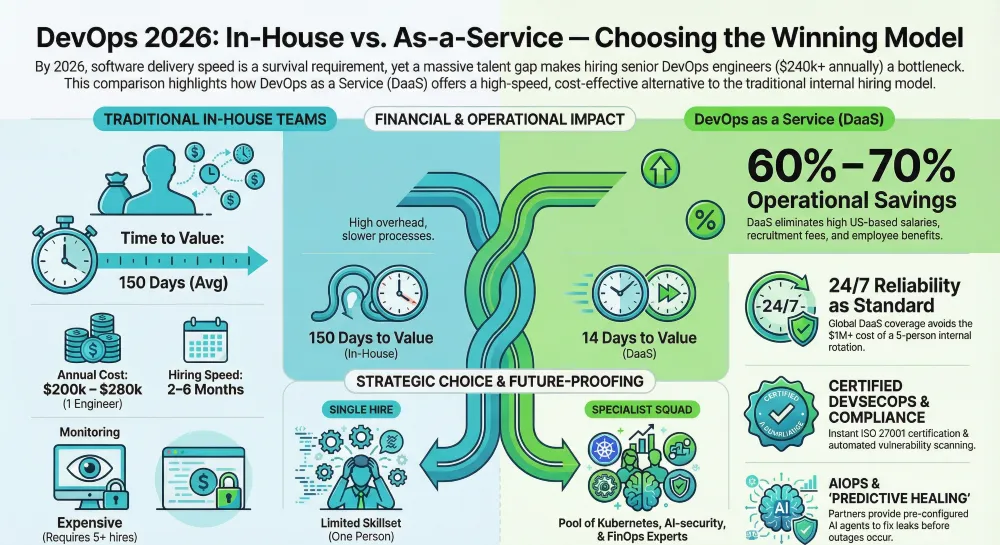
The “State of DevOps 2025-2026” reports highlight a widening talent gap. Nearly 11% of recruiters now struggle to find qualified DevOps candidates, and the cost of hiring a single senior engineer in the US has climbed past $240,000 per year when including benefits and overhead. For many, the traditional in-house model is becoming a financial and operational bottleneck.
This guide provides a comprehensive, 3,000-word deep dive into both models. We will analyze the total cost of ownership (TCO), security implications, and how modern partners like Full-stack Techies are redefining the “as-a-service” landscape to help businesses scale faster than ever.
Key Takeaways: DevOps as a Service vs In-House DevOps
If you are in a hurry, here are the most critical points to consider for your 2026 strategy:
- Massive Cost Savings: Choosing a DevOps as a service company can reduce your operational overhead by 60% to 70%. You avoid the high costs of US-based salaries, recruitment fees, and employee benefits.
- Immediate Expertise: While hiring an in-house engineer takes 3–6 months, partners like Full-stack Techies offer immediate onboarding with a full squad of experts in Kubernetes, AWS, and AI-driven security.
- 24/7 Reliability: Achieving “always-on” monitoring in-house requires at least five full-time hires. A devops as a service model provides 24/7 global coverage as a standard feature, ensuring your site stays up while you sleep.
- Scalability on Demand: In 2026, market conditions change fast. The “as-a-service” model allows you to scale your DevOps resources up during a major launch and down during maintenance phases—something impossible with fixed in-house staff.
- Certified Security (DevSecOps): Security is no longer optional. Using an outsourced provider gives you instant access to ISO 27001 and ISO 9001 certified processes, ensuring your infrastructure meets global compliance standards from day one.
- Developer Focus: By offloading “plumbing” tasks (pipelines, server patches, and monitoring) to Full-stack Techies, your internal developers can stay focused on what actually makes you money: shipping new features.
What Are We Comparing?
Before we look at the features, let’s define these two distinct approaches to managing your software lifecycle.
1. In-House DevOps
The in-house model involves hiring full-time employees to manage your infrastructure, CI/CD pipelines, and cloud environments. These individuals are part of your company culture, attend your daily stand-ups, and have a deep, exclusive focus on your specific product architecture.
2. DevOps as a Service (DaaS)
DevOps as a service is an outsourcing model where a specialized third-party provider, such as Full-stack Techies, manages your development and operations tasks. This model provides you with a “squad” of experts—including cloud architects, SREs (Site Reliability Engineers), and security specialists—for a flat monthly fee or a project-based rate.
Comparison Criteria: At a Glance
The following table summarizes the key differences you need to know for 2026 planning.
| Feature | In-House DevOps | DevOps as a Service (DaaS) |
|---|---|---|
| Hiring Speed | 2–6 Months | Immediate Onboarding |
| Annual Cost (1 Engineer) | $200k – $280k (with overhead) | $60k – $150k (for a team) |
| Skill Diversity | Limited to 1–2 individuals | Full access to senior specialists |
| Scalability | Slow (requires new hiring) | Instant (add/remove resources) |
| 24/7 Monitoring | Very Expensive (requires 5+ hires) | Included in most service tiers |
| Security & Compliance | Internal responsibility | Managed (e.g., ISO 27001 standards) |
| Best For | Large Enterprises, High Regulation | Startups, Mid-market, High-growth |
Quick Decision Matrix: Which Model Fits Your 2026 Goal?
To help you decide instantly, match your current primary challenge to the recommended model:
- Goal: “We need to launch our MVP in 45 days.” → Winner: DevOps as a Service (Immediate onboarding vs. 4-month hiring cycle).
- Goal: “We have highly proprietary, air-gapped hardware.” → Winner: In-House DevOps (Requires physical presence and deep internal security silos).
- Goal: “Our AWS bill is 30% higher than last quarter.” → Winner: DevOps as a Service (Access to specialized FinOps experts is usually included).
- Goal: “We need 24/7 global uptime for a Tier-1 app.” → Winner: DevOps as a Service (Avoids the $1M+ cost of a 5-person internal rotation).
Detailed Feature Comparison
1. Cost Efficiency and Financial Impact
When evaluating DevOps as a Service vs In-house DevOps, cost is often the primary driver. However, many companies fail to look at the “hidden” costs of internal hiring.
In-House Financials:
In 2026, the base salary for a mid-to-senior DevOps engineer in the US averages $160,000. But the “fully loaded” cost includes:
- Recruitment fees: Usually 20% of the first-year salary ($32,000).
- Benefits & Taxes: Health insurance, 401(k), and payroll taxes add ~30% ($48,000).
- Infrastructure & Tools: Office space, hardware (M3/M4 MacBooks), and software licenses ($15,000+).
- Training: Constant upskilling in tools like Kubernetes and Terraform ($5,000/year).
- Total: ~$260,000 per year for one person.
DaaS Financials:
A DevOps as a service company like Full-stack Techies offers a different math. Instead of paying for one person, you pay for a result.
- Saving: You save approximately 60–75% compared to building a team of three in-house engineers.
2. Speed to Market (Deployment Frequency)
According to the DORA 2025 Report, elite performers deploy code multiple times per day.
- In-House: If your lone DevOps engineer is busy fixing a server issue or is on vacation, your deployment pipeline stops. Bottlenecks are common in small internal teams.
- DaaS: Providers like Full-stack Techies use a “follow-the-sun” model. With global delivery centers in the USA, India, and Australia, they ensure your CI/CD pipelines are monitored 24/7. This consistency allows businesses to maintain a high deployment frequency without burning out internal staff.
Time-to-Value (TTV) Comparison:
- In-House: Recruitment (90 days) + Onboarding (30 days) + Infrastructure Audit (30 days) = 150 Days to first optimization.
- DevOps as a Service: Contract Sign-off (7 days) + Discovery Phase (7 days) + Immediate Execution = 14 Days to first optimization. In the fast-moving market of 2026, a 136-day head start is often the difference between a market leader and a laggard.
3. Access to Specialized Talent
The tech stack in 2026 is massive. A single person can rarely be an expert in AWS, Kubernetes, Terraform, Prometheus, Jenkins, and AI-security platforms.
- In-House: You are limited by what your hire knows. If you suddenly need to move from a monolithic architecture to a multi-cloud serverless setup, your team may need months of training.
- DaaS: You gain a “pool” of expertise. When you partner with a DevOps as a service provider, you can pull in a Kubernetes expert for a week, a security auditor for a month, and a cloud architect for your long-term strategy.
Why Full-stack Techies is the Modern Choice
In the landscape of devops as a service company options, Full-stack Techies stands out as an ISO 9001:2015 and ISO/IEC 27001:2013 certified provider. Their approach isn’t just about “outsourcing” but about “integration.”
Strategic Advantages of Full-stack Techies:
- Certified Security: In an era where Gartner predicts AI-targeted cyberattacks will rise, having a partner with ISO 27001 certification ensures your infrastructure is built with security-first principles (DevSecOps).
- Global Reach: With operations in the USA, Canada, India, and Australia, they provide the 24/7 coverage that a local in-house team simply cannot match without extreme expense.
- Proven Track Record: Having served over 550+ customers with a 98% client retention rate, they bring “battle-tested” configurations to your project, preventing the “trial and error” costs of an in-house team.
Detailed Deep Dive: Security & Compliance
In 2026, security is no longer a “step” in the process; it is the process. This is known as DevSecOps.
In-House Security Challenges:
Small internal teams often prioritize “features” over “firewalls.” When deadlines loom, security patches might be delayed. Furthermore, if your internal team lacks a dedicated security architect, you risk misconfigurations in your S3 buckets or Kubernetes secrets.
DaaS Security Strengths:
A professional DevOps as a service company treats security as a core KPI. Full-stack Techies, for example, implement:
- Automated Vulnerability Scanning: Tools like Snyk or Aqua Security are integrated into the pipeline.
- Secret Management: Using HashiCorp Vault or AWS Secrets Manager to ensure zero-leakage of API keys.
- Audit Readiness: For businesses in Fintech or Healthcare, DaaS providers ensure your infrastructure is always “audit-ready” for SOC2, HIPAA, or GDPR.
Industry Insights: What the Experts Say
Forbes on DevOps as a Competitive Advantage
A recent Forbes Tech Council article noted that “Amazon’s ability to deploy code every 11.6 seconds is the reason they outearn competitors.” In 2026, the focus has shifted to ROI-driven DevOps. Forbes emphasizes that every week of delay in a product release can cost a mid-sized firm a million dollars in market opportunity.
Gartner on Platform Engineering
Gartner identifies “Platform Engineering” as a top trend for 2026. This is the practice of building internal developer platforms (IDPs). For most companies, building an IDP in-house is too expensive. However, DevOps as a service providers already have “pre-built” platforms they can customize for you, giving you the power of an enterprise-grade setup at a fraction of the cost.
Get scalable, fast, and user-friendly Devops solutions tailored to your needs.
Get Free ConsultationWhich Model is Right for You?
Choosing between DevOps as a Service vs In-House DevOps depends on your stage of growth.
Choose In-House DevOps if:
- You are a massive enterprise (500+ developers) with a $1M+ monthly cloud budget.
- You have extremely niche, proprietary hardware requirements that require physical presence.
- You have already built a high-performing “Platform Engineering” team over the last 5 years.
Choose DevOps as a Service (DaaS) if:
- You are a Startup or SMB: You need to scale fast without the “hiring drag” of 3-month recruitment cycles.
- You Need 24/7 Uptime: You cannot afford five in-house SREs but need 99.99% reliability.
- Your Cloud Costs are Spiraling: You need a “FinOps” expert to optimize your AWS/Azure spend immediately.
- You Value Flexibility: You want to be able to scale your DevOps support up during a big launch and down during maintenance periods.
The 2026 Outlook: Trends to Watch
As we look toward 2027, the DevOps landscape is being reshaped by three major forces:
- AIOps (AI for IT Operations): AI is now predicting system failures before they happen. Full-stack Techies uses AI-driven monitoring to detect anomalies in traffic, preventing outages before your customers even notice.
Note: The 2026 AIOps Reality Check: While many internal teams want to adopt AI-driven observability, the “Technical Debt” of legacy pipelines often gets in the way. A DaaS provider like Full-stack Techies bridges this gap by providing pre-configured AI agents that sit on top of your existing infrastructure. This allows for Predictive Healing—where the system identifies a memory leak and auto-scales the cluster before a crash occurs—without your team having to build the LLM-orchestration layer themselves.
- Green DevOps: 2026 has seen a surge in “Carbon-aware computing.” Businesses are now being measured on their cloud’s carbon footprint. DaaS providers are leading the way in optimizing server usage to reduce both costs and environmental impact.
- Serverless Dominance: The “NoOps” movement is gaining ground. By moving more workloads to serverless (AWS Lambda, Google Cloud Run), the focus shifts from managing servers to managing code.
Alternatives to Consider
While DaaS and In-House are the primary routes, some companies opt for:
- The Hybrid Model: Keeping one “Head of DevOps” in-house to set the strategy while using Full-stack Techies for all the execution and 24/7 monitoring. This is often the most successful model for mid-market companies.
Why the Hybrid Model is Winning in 2026: This “Best of Both Worlds” approach allows companies to keep their “Tribal Knowledge” in-house while offloading the high-burnout, repetitive tasks to a partner. It eliminates the “Single Point of Failure” risk—if your internal lead goes on vacation, the DaaS team ensures the lights stay on.
- Managed Cloud Providers: Services like AWS Managed Services (AMS). However, these are often “black boxes” and lack the personalized consulting and app-level support that a dedicated DevOps as a service company provides.
Conclusion: Making the Final Call
The choice between DevOps as a Service vs In-house DevOps in 2026 is ultimately a choice between agility and traditional control.
In-house teams offer deep cultural integration but come with massive financial risks, hiring delays, and the threat of “single-point-of-failure” if your key engineer leaves. On the other hand, DevOps as a service provides an “on-tap” ecosystem of elite talent, 24/7 coverage, and predictable costs.
For companies looking to dominate their market in 2026, the speed and expertise offered by a partner like Full-stack Techies is often the winning strategy. They don’t just manage your servers; they transform your delivery pipeline into a high-speed engine for innovation.
Also Read: 5 Top-Rated DevOps Outsourcing Companies You Should Know (2026–2027 Edition)
Why Trust This Comparison?
This guide was built using data from the 2025 DORA Report, Gartner 2026 Strategic Trends, and Forbes Tech Council insights. Our methodology focuses on:
- Financial Accuracy: Real-world 2026 salary and overhead data.
- Operational Reality: The actual challenges of the 2026 talent market.
- Impartiality: Highlighting when in-house models do make sense, while being honest about the cost-savings of DaaS.



