

How to Implement DevOps as a Service for Startups in 2026 (Full Guide)
Implementing DevOps as a Service for Startups in 2026 allows early-stage companies to build scalable infrastructure without hiring a full in-house DevOps team.


Introduction
In 2026, the “Valley of Death” for startups isn’t just about lack of funding—it’s about the inability to scale technically. Gartner reports that as of 2026, 80% of software engineering organizations will have established platform engineering teams as a way to provide reusable services and tools for application delivery. For a startup, hiring a dedicated in-house DevOps team with salaries averaging $134,000+ is often a luxury they cannot afford.
This is where DevOps as a Service for Startups becomes a strategic game-changer. It bridges the gap between high-speed development and reliable infrastructure without the heavy overhead of full-time hires. Whether you are building a FinTech MVP or a GenAI SaaS, your ability to ship code every hour—rather than every month—determines your market survival.
This guide provides a comprehensive, 2026-ready blueprint for implementing a DevOps-as-a-Service (DaaS) model that is lean, automated, and ready for global scale. We will also explore why specialized partners like Full-Stack Techies are becoming the preferred choice for founders who want to focus on product, not pipelines.
Quick Summary: What is DevOps as a Service (DaaS)?
DevOps as a Service (DaaS) is a fractional outsourcing model where startups partner with external experts to manage their cloud infrastructure, CI/CD pipelines, and security protocols. Unlike hiring a full-time engineer (avg. $150k+), DaaS provides senior-level architecture on a subscription or project basis, allowing lean teams to scale deployment frequency by up to 300% without the overhead of full-time headcount.
Key Takeaways: Mastering DevOps for Startups in 2026
If you’re in a rush to get back to coding, here are the essential insights from this guide to help you dominate your market:
- Operational Agility is the New Gold: In 2026, the speed at which you can move code from a developer’s laptop to a production environment determines your survival. DevOps as a Service (DaaS) provides the infrastructure to achieve this without the friction of traditional hiring.
- Cost Efficiency via Fractional Expertise: Hiring a full-time DevOps engineer can cost upwards of $180,000/year. By opting for affordable DevOps for startups through partners like Full-Stack Techies, you get senior-level architecture at a fraction of the price (often saving 30–50% on operational overhead).
- The “Everything as Code” Mandate: Manual configurations (ClickOps) are a liability. To scale in 2026, your entire infrastructure must be defined through Infrastructure as Code (IaC) using tools like Terraform or Pulumi.
- Security is a Day-One Requirement: With global cyber threats rising, DevSecOps is no longer an “advanced” step. Integrating automated security scanning into your CI/CD pipeline is essential for protecting customer data and achieving compliance with SOC2.
- Choose a Partner, Not a Vendor: The best DevOps as a service provider for startups is one that integrates into your culture. Full-Stack Techies goes beyond ticket-based support, acting as an extension of your engineering team to ensure your “Golden Path” is always optimized.
- Observability Over Monitoring: Don’t just watch for crashes; use the LGTM stack (Loki, Grafana, Tempo, Mimir) to gain deep insights into system performance. This proactive approach prevents downtime before it impacts your users.
Who Is This Guide For?
- Early-Stage Founders: Need to move from local development to a production-ready cloud environment.
- CTOs & Lead Developers: Tired of “putting out fires” and wanting to automate deployment cycles.
- Product Managers: Seeking faster time-to-market and reliable feature releases.
- Lean Engineering Teams: Looking to integrate affordable DevOps for startups without the $150k/year headcount.
Why DevOps as a Service (DaaS) in 2026?
According to Forbes, organizations successfully implementing DevOps fail 60 times less often and recover much faster than those without these practices. In the current 2026 landscape, DaaS offers:
- 50% Faster Release Cycles: Automation removes the manual “bottleneck” between code completion and deployment.
- 30% Reduction in Operational Costs: By outsourcing to providers like Full-Stack Techies, you pay for the output, not the idle time of an in-house engineer.
- Built-in DevSecOps: Security is no longer an afterthought; it’s baked into the CI/CD pipeline from day one.
Tools & Prerequisites
Before you start, ensure you have access to the following:
| Category | Recommended Tools (2026 Standard) | Requirement Level |
|---|---|---|
| Cloud Provider | AWS (Startups Credit), Azure, or GCP | Essential |
| Version Control | GitHub or GitLab | Essential |
| IaC | Terraform or Pulumi | Essential |
| CI/CD | GitHub Actions, GitLab CI, or Jenkins | Essential |
| Containers | Docker & Kubernetes (K8s) | Recommended |
| Observability | Prometheus, Grafana, or Datadog | Recommended |
| Partner | Full-Stack Techies | Highly Recommended |
Get scalable, fast, and user-friendly DevOps solutions tailored to your needs.
Get Free Consultation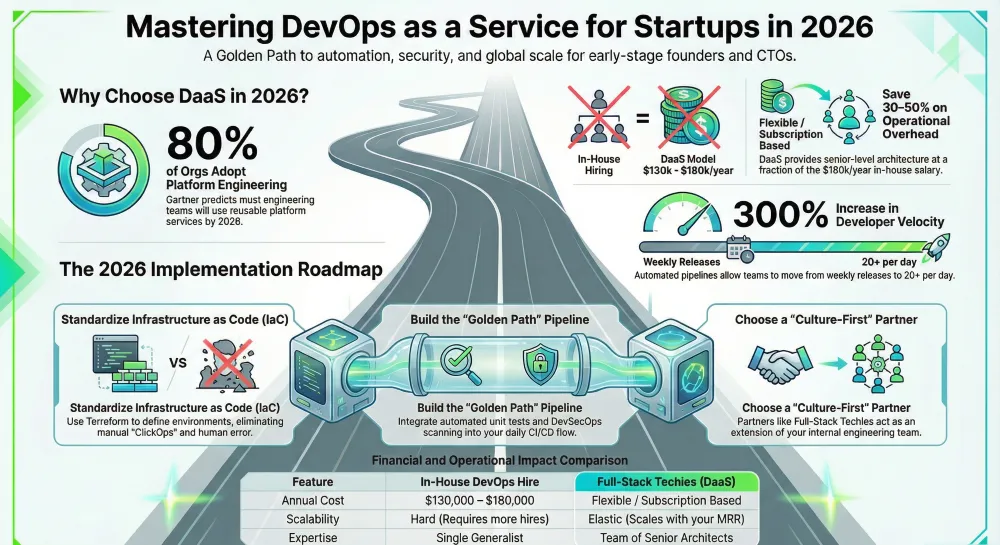
Step-by-Step Guide to Implementation
Implementing DevOps as a Service for Startups isn’t just about installing tools; it’s about building a “Golden Path” for your developers.
Step 1: Conduct a DevOps Maturity Audit
Before writing a single line of Infrastructure as Code (IaC), you must understand your current gaps.
- Action: Measure your “Lead Time for Changes” and “Change Failure Rate” (DORA metrics).
- Pro Tip: If your developers are spending more than 20% of their time on deployment issues, you need immediate DaaS intervention.
Step 2: Choose the Right DaaS Partner
You shouldn’t do this alone. Selecting the best DevOps as a service provider for startups is the most critical decision.
- Action: Look for partners like Full-Stack Techies who specialize in startup agility. They provide “Fractional DevOps,” giving you access to senior architects at a fraction of the cost.
- Why Full-Stack Techies? They understand the need for affordable DevOps for startups, offering modular services that grow as your MRR grows.
Step 3: Standardize Infrastructure as Code (IaC)
Manual server configuration is the enemy of scale. In 2026, if it’s not in code, it doesn’t exist.
- Action: Use Terraform to define your VPCs, subnets, and clusters.
- Implementation: Store your Terraform state in a secure, remote backend (like AWS S3 with DynamoDB locking). This allows your DaaS partner to collaborate on your infrastructure safely.
Pro Tip: Standardizing your Provider Block. When working with a DaaS partner, ensure your Terraform provider blocks are version-locked to prevent “breaking changes” during collaborative updates.
Terraform
terraform {
  required_providers {
    aws = {
      source  = “hashicorp/aws”
      version = “~> 5.0” # Prevents major version drift
    }
  }
  backend “s3” {
    # Ensure locking is enabled via DynamoDB to prevent state corruption
    encrypt = true
  }
}
Step 4: Build Your “Golden Path” CI/CD Pipeline
Your pipeline should be the only way code reaches production.
- Action: Set up GitHub Actions or GitLab CI.
Logic:
– Commit: Developer pushes code.
– Test: Automated unit and integration tests run.
– Security Scan: Tools like Snyk or SonarQube check for vulnerabilities.
– Build: Create a Docker image.
– Deploy: Push to a staging environment for QA.
Step 5: Implement Shift-Left Security (DevSecOps)
Don’t wait for a breach to think about security. Gartner highlights that “Compliance Automation” is a top 2026 trend.
- Action: Integrate secret scanning (to prevent API keys from leaking) and dependency audits into your automated pipeline.
Step 6: Enable Full-Stack Observability
You cannot fix what you cannot see.
- Action: Deploy a centralized logging and monitoring stack.
- Tooling: Use the LGTM stack (Loki, Grafana, Tempo, Mimir) for a comprehensive view of logs, metrics, and traces.
Affordable DevOps for Startups: A Cost Comparison
Budgeting is the biggest hurdle for early-stage companies. Let’s look at the startup DevOps pricing models for 2026.
| Feature | In-House DevOps Engineer | Traditional Agency | Full-Stack Techies (DaaS) |
|---|---|---|---|
| Annual Cost | $130,000 – $180,000 | $100,000+ (Project-based) | Contact Us to discuss |
| Availability | 40 hours/week | Varies | 24/7 Monitoring & Support |
| Scalability | Hard to scale (needs more hires) | Fixed scope | Elastic (Scales with you) |
| Expertise | Generalist | Specialist | Team of Senior Architects |
When is DaaS NOT the right fit? While DaaS is ideal for most startups, it may not be suitable if your product requires highly proprietary, “black-box” hardware integrations or if your regulatory environment (e.g., high-level GovCloud) mandates 100% on-site, cleared personnel. In these rare cases, a localized, dedicated hire is preferred over a service-based model.
Best DevOps as a Service Providers for Startups
When searching for the best DevOps as a service provider for startups, prioritize those who offer:
- Full-Stack Techies: Known for their “Startup-First” mentality and transparent pricing.
- Platform-Specific Experts: Companies that specialize exclusively in AWS or Azure.
- Managed Service Providers (MSPs): Large firms that handle 24/7 NOC operations.
Why Full-Stack Techies Win: They don’t just “manage” your servers; they integrate into your Slack/Teams, participate in your sprints, and act as an extension of your engineering team. This cultural alignment is what differentiates a “provider” from a “partner.”
Advanced Tips: AI & FinOps Integration
AIOps (The 2026 Frontier)
76% of DevOps teams have integrated AI into their CI/CD by 2026. Use AI-driven tools to predict system failures before they happen. Platforms like Datadog’s Watchdog can alert you to “anomaly patterns” that manual thresholds might miss.
FinOps: Cloud Cost Optimization
Startups often go bankrupt due to “cloud sprawl.”
- Tip: Implement Kubecost or AWS Cost Explorer alerts.
- Automation: Set up “Auto-Stop” for non-production environments during nights and weekends to save up to 40% on compute costs.
Common Mistakes to Avoid
- Over-Engineering Early: Don’t build a multi-region Kubernetes cluster for an MVP with 10 users. Start small with ECS or App Runner.
- Neglecting Documentation: Even with DaaS, ensure your “internal developer platform” has a README.
- The “Human Bottleneck”: If your DaaS partner requires a ticket for every small change, they aren’t the right fit. Look for “Self-Service” capabilities.
- Ignoring Logs: Collecting logs is useless if nobody is looking at the dashboards. Full-Stack Techies ensures that observability leads to actionable insights, not just noise.
Startup Scaling: Choosing the Right Deployment Path
| Startup Stage | Recommended Tooling | Why? |
|---|---|---|
| MVP / Seed | AWS App Runner / Vercel | Zero-ops; focus entirely on product-market fit. |
| Early Growth | AWS ECS (Fargate) | Scalable containers without managing Kubernetes complexity. |
| Scale-up | Managed Kubernetes (EKS/GKE) | Maximum control for microservices and multi-cloud needs. |
Real-World Use Case: From 1 Release a Week to 20 a Day
A SaaS startup in the E-commerce space was struggling with 4-hour manual deployment windows. After partnering with Full-Stack Techies for DevOps as a Service, they:
- Automated their entire QA-to-Production flow.
- Reduced downtime during updates to zero.
- Achieved SOC2 compliance in record time due to automated audit logs.
- Result: Increased developer velocity by 300% and reduced cloud costs by 22% through rightsizing.
Common Troubleshooting Issues When Implementing DaaS
“Why Isn’t My CI/CD Pipeline Triggering?”
This is the #1 issue for teams setting up automation.
- Cause: Usually a mismatch in Webhook permissions or an incorrectly named YAML file in the .github/workflows directory.
- Solutions:
– Verify the Webhook status in your GitHub repository settings.
– Check for YAML syntax errors using a linter.
– Ensure the “Branch Protection” rules aren’t blocking the service account.
“Infrastructure Drift: My Cloud Doesn’t Match My Code”
Someone manually changed a setting in the AWS Console, and now Terraform is failing.
- Cause: Manual intervention (ClickOps).
- Solutions:
– Run Terraform plan to identify the discrepancy.
– Use terraform import to bring manual changes into your state.
– Best Practice: Revoke “Write” access to the production console for all humans; only allow the CI/CD service account to make changes.
“Unexpectedly High Cloud Bills”
You wake up to a $5,000 bill because a developer left a GPU instance running.
- Cause: Lack of guardrails or automated cleanup.
- Solutions:
– Enable “AWS Budgets” with 80% threshold alerts.
– Implement “Tagging Policies” so you know exactly which project is costing money.
– Ask your Full-Stack Techies lead to implement an automated “Nuke” script for idle dev resources.
Conclusion: Future-Proofing Your Startup with DevOps as a Service
As we navigate the competitive landscape of 2026 and 2026, one thing is clear: the divide between successful startups and those that stall is defined by operational agility. DevOps is no longer a “luxury” for the later stages of growth; it is the foundational engine that allows a startup to move from a validated idea to a market leader.
Implementing DevOps as a Service for Startups is the most effective way to bypass the traditional hiring bottlenecks and high overhead costs. By adopting a “fractional” or service-based model, you gain access to the same high-level automation, security, and scalability used by tech giants, but at startup DevOps pricing that fits a lean budget. As Forbes has noted in recent industry shifts, the move toward outsourced infrastructure management allows internal teams to focus 100% on their core value proposition—the product.
However, the success of this transition depends entirely on choosing the best DevOps as a service provider for startups. You need a partner that doesn’t just provide a toolset but understands the unique, high-pressure environment of a growing company. Full-Stack Techies stands out in this regard, offering the perfect blend of technical excellence and business-centric strategy. Their approach to affordable DevOps for startups ensures that you aren’t just “moving to the cloud,” but are building a sustainable, automated ecosystem that scales with your ambition.
In the end, your infrastructure should be invisible—a silent, reliable force that pushes code to users without friction. By following this guide and partnering with experts like Full-Stack Techies, you are not just setting up a pipeline; you are securing your startup’s future in the digital economy.
Also Read: How to Hire the Best DevOps as a Service Provider in 2026: The Ultimate Executive Guide
Why Trust This Guide?
This guide was architected based on 2026/2027 industry benchmarks from Gartner, Forbes, and the DORA (DevOps Research and Assessment) group. Our methodology involves analyzing the top-performing startups in the Y-Combinator and Techstars ecosystems, where speed and reliability are non-negotiable. Updates are performed quarterly to ensure compliance with the latest cloud provider updates and security protocols.



