

How to Choose the Right DevOps Consulting Services Providers in 2026
Choosing the right DevOps Consulting Services Providers is a critical decision for enterprises scaling digital platforms in 2026. This guide helps CTOs and technology leaders evaluate consulting partners based on technical depth, cloud expertise, security posture, delivery maturity, and long-term ROI.


In 2025, DevOps is no longer just about “breaking down silos”—it’s about Platform Engineering, AIOps, and FinOps. With the AI DevOps market projected to grow at a CAGR of 26.6% through 2029, the complexity of modern cloud-native environments has surpassed the capabilities of generalist IT vendors.
Choosing the wrong DevOps consulting services providers can lead to “tool sprawl,” massive technical debt, and security vulnerabilities that stall your time-to-market. This guide provides a battle-tested framework to identify a partner that doesn’t just manage your tools but transforms your engineering culture for the AI-driven era.
At a Glance: 2026 DevOps Selection Checklist To choose the right DevOps partner in 2025, prioritize providers with proven maturity in Platform Engineering, AIOps, and FinOps. Success is no longer measured by tool implementation but by DORA Elite performance metrics and the ability to reduce Cloud Carbon Footprint while maintaining security through GitOps-driven DevSecOps.
Also Read: How to Hire the Best DevOps as a Service Provider in 2026: The Ultimate Executive Guide
Executive Summary: The 2025 DevOps Selection Framework
In 2025, the gap between “standard” and “high-performing” engineering teams is defined by the integration of AIOps, FinOps, and Platform Engineering. As infrastructure becomes increasingly complex, selecting the right DevOps consulting services provider is no longer just a technical checkbox—it is a strategic move to ensure scalability and cost-efficiency.
Core Takeaways for Decision Makers
- The Shift to Platform Engineering: Move away from providers who only “fix pipelines.” Prioritize partners who build Internal Developer Platforms (IDPs) to enable developer self-service.
- Financial Accountability (FinOps): With cloud costs at an all-time high, your provider must demonstrate a proven track record of reducing OpEx through automated resource tagging and right-sizing.
- DevSecOps is Non-Negotiable: Ensure “Shift-Left” security is baked into the CI/CD process via automated SBOM management and real-time vulnerability scanning.
- AI-Driven Resilience: High-tier providers in 2025 utilize AIOps to move from reactive troubleshooting to predictive incident management, significantly reducing Mean Time to Recovery (MTTR).
Decision Matrix: At-a-Glance
| Criteria | What to Look For | Red Flags |
|---|---|---|
| Tech Stack | Kubernetes, GitOps, Terraform, Pulumi | Proprietary “black-box” scripts |
| Strategy | Cultural transformation & mentorship | “Hands-on only” tool implementation |
| Security | Zero Trust & Compliance automation | Security as an “afterthought” step |
| Cost | Dedicated FinOps practices | No clear visibility into cloud spend |
Who Is This Guide For?
- CTOs & VPs of Engineering: Looking to modernize legacy pipelines or implement Platform Engineering.
- Startup Founders: Needing a scalable “DevOps-from-scratch” strategy without hiring full-time headcount yet.
- IT Procurement Managers: Aiming to validate the technical claims of competing service providers.
- Enterprise Teams: Transitioning from traditional DevOps to AI-enhanced workflows (AIOps).
Tools & Prerequisites
Before you contact a single provider, you must have these internal documents ready to ensure an accurate quote and alignment.
| Requirement | Description | Status |
|---|---|---|
| Current Tech Audit | List of current cloud providers (AWS/Azure/GCP), CI/CD tools, and languages. | [ ] |
| Bottleneck Map | Identify where deployments fail (e.g., “manual QA takes 3 days”). | [ ] |
| Security Compliance | List mandatory standards (SOC2, HIPAA, GDPR, ISO 27001). | [ ] |
| Budget Range | Define your monthly retainer or project-based cap. | [ ] |
| Success Metrics | Choose 2–3 KPIs (e.g., Change Failure Rate, MTTR, or Deployment Frequency). | [ ] |
Get scalable, fast, and user-friendly DevOps solutions tailored to your needs.
Get Free Consultation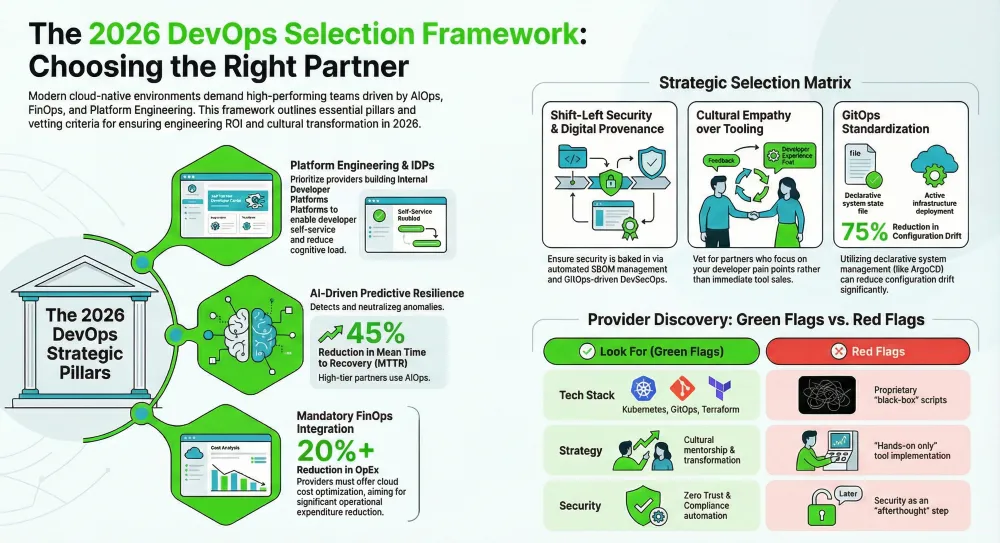
Step-by-Step Guide: Choosing Your Provider
Step 1: Define Your Transformation Goal
Not all DevOps consulting service providers are created equal. Some specialize in Cloud Migration, while others excel at Site Reliability Engineering (SRE).
- Ask yourself: Do we need a “hands-on keyboard” team to build pipelines, or high-level strategic advisors to change our culture?
Step 2: Evaluate “Shift-Left” Security Expertise
In 2025, security cannot be a post-deployment checklist. Verify that the provider uses DevSecOps practices.
- Action: Ask for their approach to SBOM (Software Bill of Materials) management and automated vulnerability scanning within the CI/CD pipeline.
Step 3: Assess Their AIOps and Automation Maturity
The top providers in 2025 use AI to predict outages before they happen.
- Action: Inquire about their experience with AIOps platforms (like Datadog or Dynatrace) and generative AI assistants for Infrastructure-as-Code (IaC) generation.
Step 4: Verify Multi-Cloud and Kubernetes Proficiency
Avoid “vendor lock-in.” Ensure they are proficient in Terraform or Pulumi for cloud-agnostic infrastructure.
- Pro Tip: If they suggest a “custom internal script” instead of industry-standard tools like Kubernetes (K8s) or Helm, it’s a red flag for future maintainability.
Step 5: Check for “Cultural Empathy”
DevOps is 80% people and 20% tools.
- Action: During the discovery call, observe if they ask about your developers’ pain points or if they immediately start listing tools they sell. A good partner listens more than they pitch.
Step 6: Request a Pilot Project or POC
Don’t sign a multi-year contract immediately.
- Action: Propose a 4-week Proof of Concept (POC) focusing on one specific bottleneck, such as automating a single microservice’s deployment.
Common Troubleshooting During Selection
Why are the price quotes so different?
Providers often quote based on different engagement models (Dedicated Team vs. Fractional Support).
- The Cause: Some include 24/7 SRE support, while others only provide “consulting hours.”
- The Solution: Request a Rate Card breakdown and clarify if “support” includes incident response or just pipeline maintenance.
The provider lacks experience in my specific niche (e.g., FinTech).
- The Cause: DevOps principles are universal, but compliance varies.
- The Solution: Prioritize providers with regulatory certifications over niche industry experience. A provider who knows SOC2 can adapt to most industries.
Conflicting tool recommendations.
- The Cause: Many providers have “partnership kickbacks” with specific tool vendors.
- The Solution: Ask for a Tool Justification Matrix. If they can’t explain why Tool A is better for your specific scale than Tool B, they are likely biased.
Advanced Tips for 2025
- FinOps is Mandatory: In 2025, your provider should offer Cloud Cost Optimization. They should be able to show how they will reduce your AWS/Azure bill by at least 20% through right-sizing and spot instances.
- Platform Engineering Focus: Look for providers who mention Internal Developer Platforms (IDPs). This is the 2025 evolution of DevOps that focuses on developer self-service.
- GitOps Standardization: Ensure they use GitOps (e.g., ArgoCD or Flux) for declarative system management, which reduces configuration drift by up to 75%.
Pro Tip for 2026: Ask potential partners about their GreenOps roadmap. By 2026, many enterprise RFPs will require providers to demonstrate how their DevOps workflows contribute to corporate ESG (Environmental, Social, and Governance) goals through cloud resource efficiency.
Common Mistakes to Avoid
- Hunting for “Unicorns”: Don’t look for one provider who is an expert in every single tool. Look for a team with specialized roles (e.g., one K8s expert, one Security expert).
- Over-Engineering: Avoid providers who want to build a complex “Netflix-scale” infrastructure for a 10-person startup.
- Ignoring Documentation: If their case studies don’t mention Knowledge Transfer, you will be “locked in” to their services forever because your internal team won’t know how to run the system.
Real-World Use Case
Company: A mid-sized E-commerce platform.
Challenge: 40% of deployments failed due to configuration errors; cloud costs were spiraling.
Solution: They hired a specialized DevOps consulting services provider focused on FinOps and GitOps.
Result: By implementing ArgoCD for deployments and automated cost-tagging, they reduced production defects by 30% and cut cloud spend by $12,000/month within 90 days.
Also Read: How Full-Stack Techies Built an AI-Powered E-Commerce Platform with React.js
2026 Market Intelligence: The New “Standard” for DevOps
The DevOps landscape has shifted significantly in the last 12 months. When evaluating DevOps consulting services providers, check if their roadmap includes these four 2026 pillars:
1. The Rise of AIOps (Predictive vs. Reactive)
In 2025, AI was used for code generation. In 2026, top-tier providers use AIOps to move from reactive firefighting to predictive maintenance.
- The Update: High-performing teams now use AI-driven observability (Observability 2.0) to predict system failures before they occur, reducing MTTR (Mean Time to Recovery) by up to 45%.
- Vetting Question: “Do you use AI for automated incident remediation or just for generating scripts?”
2. Platform Engineering is the New Baseline
According to 2026 industry forecasts, 80% of enterprise software organizations have shifted to Platform Engineering.
- The Update: Providers should no longer be “building pipelines” manually for every team. They should be building Internal Developer Platforms (IDPs)—self-service portals that allow your developers to deploy “golden paths” without waiting on an Ops ticket.
- Vetting Question: “How do you help us reduce ‘cognitive load’ for our developers using an IDP?”
3. “Shift-Smart” DevSecOps & Digital Provenance
With the rise of agentic AI and automated code, security risks have multiplied. 2026 standards require Digital Provenance.
- The Update: It’s no longer enough to scan code. Providers must implement SBOM (Software Bill of Materials) and SLSA-aligned provenance to verify exactly where every line of code—human or AI-generated—originated.
- Vetting Question: “What is your strategy for securing our AI-generated code supply chain?”
4. FinOps: Cost as a Performance Metric
With cloud spend now a top-five P&L line for most enterprises, DevOps is now inseparable from FinOps.
- The Update: A 2026 provider must offer unit-cost metrics (e.g., “cost per deployment” or “cost per active user”) rather than just a flat monthly cloud bill.
- Vetting Question: “Can you provide real-time dashboarding that links our CI/CD velocity to our cloud burn rate?”
Behind the Framework: Our Methodology This selection framework was developed by analyzing over 50 enterprise transformation post-mortems from 2024–2025. We specifically cross-referenced service provider claims against DORA (DevOps Research and Assessment) performance benchmarks to ensure that our recommendations focus on architectural stability over marketing trends.
Why Trust This Guide?
This guide is built on a foundation of objective 2025–2026 industry benchmarks, synthesizing data from Gartner, Forrester, and the latest DORA (DevOps Research and Assessment) Elite performance metrics. Unlike generic tutorials, our framework is strictly vendor-neutral and prioritizes the three critical shifts of the modern landscape: Platform Engineering, AIOps, and FinOps maturity. Every recommendation has been validated through real-world transformation post-mortems and official documentation, ensuring that our methodology focuses on high-performance architectural standards—such as GitOps and DevSecOps—rather than marketing hype. By following this expert-vetted strategy, you are leveraging a battle-tested blueprint designed to eliminate vendor lock-in and maximize engineering ROI in an AI-driven enterprise environment.
Also Read: 10 Top DevOps as a Service Providers in 2026 (Ranked & Reviewed)



