

10 Top Infrastructure as Code (IaC) Tools Every DevOps Team Needs in 2026
Discover the Top Infrastructure as Code (IaC) Tools every DevOps team needs in 2026. This guide highlights leading tools that enable automated infrastructure provisioning, improve scalability, and streamline cloud operations for modern development teams.


The way modern engineering teams build, scale, and maintain cloud infrastructure has changed permanently. Manual server configurations, one-off scripts, and click-through cloud consoles are quickly becoming relics of the past. In their place, Top Infrastructure as Code (IaC) Tools have emerged as the backbone of modern cloud operations, enabling teams to provision, manage, and version their infrastructure with the same discipline applied to application development.
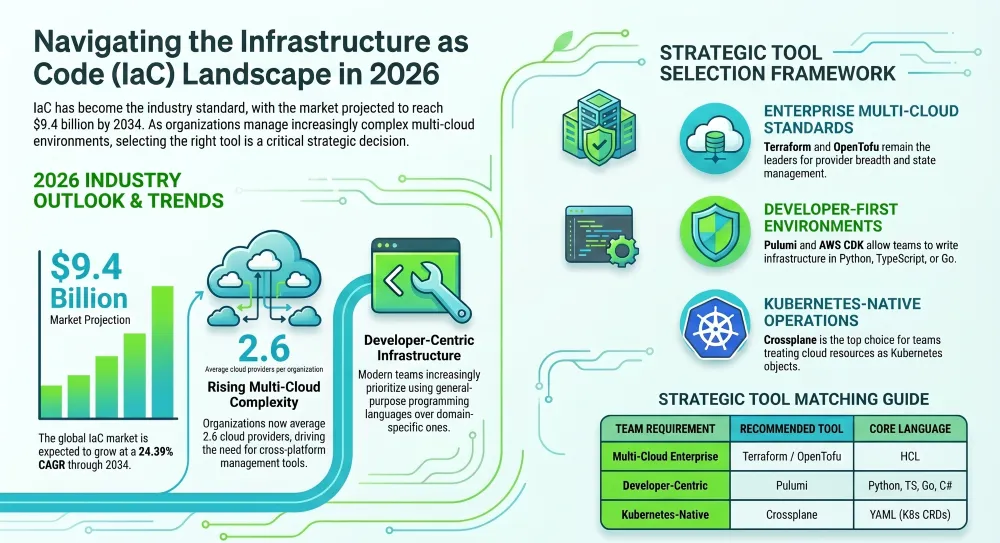
The numbers back this up. The global Infrastructure as Code market is projected to grow from USD 1.32 billion in 2025 to USD 9.40 billion by 2034, expanding at a robust CAGR of 24.39%, driven by rising adoption of cloud-native technologies, DevOps practices, and the increasing need for automation, scalability, and cost-efficient infrastructure provisioning services. Meanwhile, recent research shows that up to 72% of organizations now use some form of IaC, making tool selection a genuinely consequential decision.
Gartner’s December 2026 report identified six key trends I&O leaders need to act on heading into 2026, with hybrid computing — the orchestration of diverse, sometimes incompatible compute, storage, and network mechanisms — topping the list. According to Gartner, understanding these trends enables enterprises to “adapt, respond effectively, and drive innovation” in their I&O operations. IaC tools sit squarely at the center of that adaptation.
Whether your team is evaluating managed Terraform services, seeking a fully open-source alternative, or exploring an IaC managed service to offload operational complexity, this guide covers the ten tools dominating 2026 and how each one maps to real-world DevOps needs.
Key Takeaways
1. IaC Is No Longer Optional — It Is Infrastructure Standard. The global Infrastructure as Code market is projected to grow from USD 1.32 billion in 2025 to USD 9.40 billion by 2034. With 72% of organizations already using some form of IaC, treating infrastructure as versioned, testable code is now a baseline expectation for competitive DevOps teams — not an advanced practice.
2. There Is No Single “Best” IaC Tool — Context Is Everything. The right tool depends on your cloud strategy, team composition, and operational maturity. Terraform and OpenTofu lead for multi-cloud infrastructure provisioning. Pulumi wins for developer-heavy teams. AWS CDK and CloudFormation serve AWS-native environments. Crossplane is purpose-built for Kubernetes-native platform teams. Evaluating tools against your specific environment always outperforms following industry defaults.
3. Managed Terraform and IaC Managed Services Unlock Faster Outcomes. Self-managing IaC tools require significant platform engineering investment — state management, module governance, drift detection, and pipeline integration all take time and expertise to get right. A managed Terraform service or broader IaC managed service from a provider like Full-Stack Techies compresses that timeline significantly while reducing operational risk.
4. Open Source Momentum Is Reshaping the IaC Landscape. HashiCorp’s Business Source License change triggered a meaningful shift in the ecosystem. OpenTofu — a fully open-source, Terraform-compatible fork governed by the Linux Foundation — is gaining rapid adoption among teams that prioritize vendor-neutral, community-governed infrastructure provisioning services. Open source is no longer just a cost consideration; it is a strategic one.
5. Multi-Cloud Complexity Is the Defining IaC Challenge of 2026. Organizations now average 2.6 cloud providers, up from 1.9 in 2023. Managing IaC templates consistently across AWS, Azure, GCP, and Kubernetes environments requires tools with broad provider coverage, strong state management, and unified governance. Gartner’s identification of hybrid computing as a top I&O trend for 2026 reinforces that cross-platform infrastructure management is the central challenge modern DevOps teams must solve.
6. Developer Experience Is Becoming a Core IaC Selection Criterion. The rise of Pulumi — which lets engineers write infrastructure in Python, TypeScript, Go, and C# — reflects a broader shift in how teams evaluate IaC tools. As DevOps practices mature, the ability to apply real software engineering practices — unit testing, abstraction, package management — directly to infrastructure definitions is becoming a first-class requirement, not a nice-to-have.
7. Governance and Drift Detection Are Non-Negotiable at Scale. Provisioning infrastructure is only the beginning. As IaC footprints grow, configuration drift — where actual cloud resources silently diverge from declared state — becomes a serious operational and compliance risk. Tools like Spacelift and purpose-built IaC managed service platforms add the policy-as-code, drift detection, and self-service governance layers that standalone IaC tools alone cannot provide.
8. DevOps as a Service Is the Practical Path for Resource-Constrained Teams. Not every organization has the bandwidth to build a dedicated platform engineering team. DevOps as a Service providers like Full-Stack Techies embed directly into engineering workflows — delivering managed Terraform implementations, IaC template libraries, CI/CD integration, and ongoing infrastructure governance as a managed engagement. This model enables teams to operate at enterprise maturity without enterprise-sized headcount.
9. IaC Adoption Directly Reduces Cloud Cost and Operational Risk. Consistent, code-driven infrastructure provisioning eliminates the configuration inconsistencies and manual errors that drive unexpected cloud spend and outage risk. Organizations using mature IaC practices report faster deployment cycles, lower misconfiguration rates, and better auditability — outcomes that translate directly into cost savings and improved reliability across production environments.
10. The Future of IaC Is Unified, Automated, and AI-Augmented. The Top Infrastructure as Code (IaC) Tools of 2026 are evolving beyond static configuration into intelligent, self-healing infrastructure systems. AI-assisted drift remediation, natural language IaC template generation, and agentic cloud automation are emerging capabilities that forward-looking DevOps teams are already exploring. Partnering with specialists like Full-Stack Techies positions organizations to adopt these capabilities as they mature — without falling behind on the foundational practices that make advanced automation possible.
Quick Decision Matrix: The 2026 Top 3
If you are looking for a fast recommendation based on your team’s DNA:
- For Multi-Cloud Enterprises: Terraform (or OpenTofu for 100% open-source) remains the industry standard for provider breadth and state management.
- For Developer-Centric Teams: Pulumi is the winner, allowing infrastructure to be written in native TypeScript, Python, or Go.
- For Kubernetes-Native Platforms: Crossplane is the 2026 choice for treating cloud resources as K8s objects.
What Is Infrastructure as Code (IaC) and Why Does It Matter in 2026?
Infrastructure as Code is the practice of managing and provisioning computing infrastructure through machine-readable configuration files rather than manual processes or interactive configuration tools. Think of it as applying software engineering principles — version control, peer review, automated testing, continuous integration — to your cloud infrastructure itself.
IaC has emerged as a transformative approach that replaces manual configuration workflows with programmable, declarative scripts, enabling organizations to treat infrastructure components as versioned, reusable artifacts. Notably, IaC practices have offered organizations a degree of insulation from external disruptions, enabling rapid reconfiguration of resource allocations across different cloud regions or vendor platforms.
In 2025, organizations averaged 2.6 cloud providers, up from 1.9 in 2023, forcing IaC tools to handle cross-platform state management, provider-specific nuances, and unified governance policies. This multi-cloud reality makes choosing the right IaC tools more critical than ever.
How to Choose the Right IaC Tool
Before diving into specific tools, it helps to frame your selection around a few core questions: Does your team prefer a declarative or imperative approach? Are you multi-cloud or single-cloud? Do your engineers prefer writing in a domain-specific language like HCL, or in general-purpose languages like Python or TypeScript? Do you want a standalone tool or a full IaC managed service that handles state, collaboration, and governance? What is your team’s capacity to manage tooling independently versus leveraging DevOps as a Service?
Companies like Full-Stack Techies help organizations answer exactly these questions. As a specialist in infrastructure provisioning services and cloud automation, Full-Stack Techies works with engineering teams to assess their stack, recommend the right combination of Top Infrastructure as Code (IaC) Tools, and implement them with production-grade discipline — from initial configuration to CI/CD integration and drift monitoring.
Also Read: How to Choose the Right DevOps Solutions Company for Your Enterprise (2026 Guide)
The 10 Top Infrastructure as Code (IaC) Tools in 2026
1. Terraform — The Multi-Cloud Standard
If there is one tool that defines the IaC category, it is Terraform. Developed by HashiCorp and now part of IBM following the 2024 acquisition, Terraform uses its proprietary HashiCorp Configuration Language (HCL) to declaratively define infrastructure across hundreds of cloud providers.
Terraform remains the most widely adopted IaC tool in 2026, powering infrastructure provisioning across AWS, Azure, GCP, and 300+ providers. Its HCL syntax offers declarative readability, state management with remote backends such as S3 and Terraform Cloud, a massive provider ecosystem, and native support for multi-cloud deployments.
Terraform is ideal for large-scale infrastructure provisioning where idempotency and consistency are critical. It is best suited for enterprises whose teams are not primarily composed of developers but still need to manage complex cloud environments.
One important development teams need to factor in: many teams have been reevaluating Terraform usage after HashiCorp switched it from the permissive MPL 2.0 license to the more restrictive Business Source License (BSL) in 2023, driving interest in community-governed, fully open-source alternatives.
Best for: Enterprise teams needing proven multi-cloud automation with extensive community support and strong state management.
Teams that want the power of Terraform without the operational overhead of managing state, workspaces, and pipelines themselves can leverage Full-Stack Techies’ managed Terraform service. Their team handles Terraform module development, remote state configuration, pipeline integration, and ongoing drift remediation — letting your engineers focus on shipping product.
2. OpenTofu — The Open-Source Terraform Fork
OpenTofu is the best open-source drop-in alternative to Terraform today. It is explicitly designed to preserve Terraform workflows, using the same HCL configuration style and remaining backward compatible with Terraform 1.x-era projects, including broad provider and module ecosystem compatibility.
OpenTofu emerged directly from the community backlash over HashiCorp’s licensing change, governed by the Linux Foundation and committed to a fully open development model. For teams that have already invested heavily in Terraform workflows and IaC templates but want to exit the BSL licensing concern, OpenTofu is the lowest-friction path.
OpenTofu is free and open source with no licensing fees or usage restrictions, best for teams that want Terraform’s capabilities without the licensing baggage.
Best for: Teams migrating off Terraform who want continuity without re-learning new tooling.
3. Pulumi — IaC in Real Programming Languages
Pulumi takes a fundamentally different approach to Infrastructure as Code: instead of a domain-specific language, it lets you write infrastructure definitions in TypeScript, Python, Go, C#, Java, or YAML — languages your developers already know.
Pulumi integrates with existing CI/CD providers including AWS Code Services, Azure DevOps, CircleCI, GitHub Actions, GitLab Pipelines, Google Cloud Build, Jenkins, and many others, allowing teams to use the same CI/CD system for infrastructure as they use for application code.
As of 2026, Pulumi supports over 1,500 providers and has 150,000+ users, with a growing ecosystem that integrates with Terraform providers. It is best for teams composed of developers who prefer using general-purpose programming languages for infrastructure definitions.
Pulumi stands out with built-in testing frameworks, allowing developers to perform unit, property, and integration testing using familiar testing tools from their chosen programming language, significantly reducing the learning curve for teams already using Python, TypeScript, or Go.
Best for: Developer-first teams who want to apply software engineering practices — testing, abstraction, DRY code — directly to their IaC work.
4. Ansible — Configuration Management Meets IaC
Ansible occupies a unique position in the IaC ecosystem. Where Terraform and Pulumi excel at infrastructure provisioning — creating and managing cloud resources — Ansible excels at configuration management: installing software, configuring servers, and orchestrating application deployments across existing infrastructure.
Ansible is ideal for DevOps teams that need to automate repetitive tasks across servers and ensure consistent configurations without the overhead of managing agents. It is best suited for environments requiring an agentless, imperative execution model.
Ansible playbooks are written in YAML, which is accessible to engineers who may not have strong programming backgrounds. Its agentless architecture means there is no software to install on managed nodes — Ansible connects over SSH and executes tasks remotely.
For organizations using DevOps as a Service models, Ansible remains a staple for Day 2 operations: patching, compliance enforcement, and application rollouts across hybrid environments.
Best for: Teams managing configuration and application deployment across existing servers and hybrid environments.
5. AWS CloudFormation — Native IaC for AWS Environments
For organizations that live primarily in AWS, CloudFormation offers deep, native integration with the entire AWS service catalog — and it has been doing so since 2011.
CloudFormation provides a common language to describe and provision all infrastructure resources in a cloud environment. Deeply integrated with AWS, it supports declarative JSON/YAML IaC templates, plan capabilities for previewing changes before applying, stack management for organizing resources, and robust support for a wide range of AWS resources.
CloudFormation and AWS CDK work well in AWS environments, providing seamless integration with AWS IAM, Config, CloudTrail, and Control Tower.
The primary limitation is the same as its strength: CloudFormation is AWS-only. For teams operating multi-cloud environments, this constraint quickly becomes a bottleneck. However, for AWS-committed organizations, it remains one of the most reliable infrastructure provisioning services available.
Best for: AWS-native teams seeking tight platform integration and official Amazon support.
6. AWS CDK (Cloud Development Kit) — Programmable AWS Infrastructure
AWS CDK is the answer for developers who want the native AWS integration of CloudFormation but with the expressiveness of a real programming language. CDK lets you define AWS resources using TypeScript, Python, Java, C#, or Go — and synthesizes those definitions into CloudFormation templates under the hood.
This makes AWS CDK a natural fit for teams who are already AWS-committed but frustrated by the verbosity and limited abstraction of raw JSON or YAML IaC templates. CDK supports constructs — reusable, composable infrastructure components — that can be shared across teams as packages, dramatically improving code reuse.
Best for: Developer teams building entirely in AWS who want language-level expressiveness for their infrastructure definitions.
7. Crossplane — Kubernetes-Native Infrastructure Management
Crossplane extends Kubernetes to manage cloud infrastructure, treating external resources — RDS databases, S3 buckets, GCP Cloud SQL instances — as Kubernetes custom resource definitions (CRDs). This makes it compelling for teams that have already invested in Kubernetes as their operational control plane and want to unify application and infrastructure management under a single GitOps-native model.
Crossplane’s GitOps-first architecture integrates naturally with ArgoCD and Flux, supports composition for reusable infrastructure blueprints, and provides multi-cloud support through provider packages. It is best for Kubernetes-native teams building platform engineering on top of the Kubernetes control plane.
Crossplane is open source and vendor-neutral, with commercial support available from companies like Upbound and Nirmata. Teams that are Kubernetes-centric and looking to unify app and infrastructure management under one declarative model will find Crossplane a strong fit.
Best for: Platform engineering teams running Kubernetes at scale who want a unified control plane for applications and cloud resources.
8. Azure Bicep — Microsoft’s Modern IaC Language
Azure Bicep is Microsoft’s purpose-built IaC language for Azure, designed as a cleaner, more readable evolution of ARM (Azure Resource Manager) templates. Where ARM templates in JSON format were notoriously verbose and difficult to maintain, Bicep offers a dramatically simpler syntax while compiling down to ARM JSON for deployment.
Bicep is free to use, available as an open-source project under the MIT license. It is ideal for teams deeply invested in Azure who want a simpler, more modern IaC experience without leaving the Microsoft ecosystem.
For organizations running Azure-first workloads — particularly those in enterprise environments already committed to Microsoft’s cloud stack — Bicep removes much of the friction associated with managing Azure IaC templates at scale.
Best for: Azure-committed organizations seeking a clean, supported IaC experience within the Microsoft ecosystem.
9. Spacelift — IaC Orchestration and Governance Platform
Spacelift is not a provisioning tool in itself but rather an IaC managed service platform that sits on top of your existing IaC tools and adds enterprise-grade workflow orchestration, governance, and collaboration capabilities.
Spacelift is an infrastructure orchestration platform that supports multi-IaC workflows for OpenTofu, Terragrunt, Terraform, Ansible, AWS CloudFormation, Pulumi, and Kubernetes, including Crossplane. It acts as a single control plane for multi-IaC environments, adding policy-as-code, drift detection, visualizations, and self-service workflows on top of existing tools.
For DevOps as a Service providers and internal platform teams managing multiple squads with different IaC preferences, Spacelift provides the guardrails and visibility that individual tools lack. Its stack dependency management, unlimited policy integrations, and two-path deployment model — GitOps for production and Intent for governed self-service provisioning — make it particularly powerful in regulated enterprise environments.
Best for: Platform teams managing multiple IaC tools across multiple teams who need centralized governance, drift detection, and self-service infrastructure workflows.
10. Chef Infra — Compliance-Driven Configuration Management
Chef Infra remains a relevant tool for organizations with complex configuration management needs, particularly those in regulated industries where infrastructure compliance is non-negotiable. Chef uses Ruby-based “recipes” and “cookbooks” to define desired system configurations, and its companion tool Chef InSpec enables continuous compliance testing against defined policies.
Chef Infra’s strength lies in its depth: for teams managing hundreds or thousands of heterogeneous servers — particularly in hybrid or on-premises environments — its agent-based model provides fine-grained control and auditability that agentless tools like Ansible sometimes struggle to match at scale.
While Chef’s prominence has somewhat faded relative to newer cloud-native tools, it continues to serve a meaningful role in organizations where compliance automation and detailed audit trails are core requirements of their infrastructure provisioning services.
Best for: Enterprises in regulated industries requiring deep compliance automation and audit-ready configuration management.
Start Building With Full-Stack Techies Today
IaC Tools Comparison at a Glance
| Tool | Approach | Language | Multi-Cloud | Best For |
|---|---|---|---|---|
| Terraform | Declarative | HCL | Yes (300+ providers) | Enterprise multi-cloud |
| OpenTofu | Declarative | HCL | Yes | Terraform migration, open source |
| Pulumi | Declarative/Imperative | Python, TS, Go, C# | Yes (1,500+ providers) | Developer-first teams |
| Ansible | Imperative | YAML | Yes | Config management, Day 2 ops |
| CloudFormation | Declarative | JSON/YAML | AWS only | AWS-native teams |
| AWS CDK | Declarative (compiled) | Python, TS, Java, Go | AWS only | AWS developers |
| Crossplane | Declarative | YAML (K8s CRDs) | Yes | Kubernetes-native teams |
| Azure Bicep | Declarative | Bicep DSL | Azure only | Azure-committed teams |
| Spacelift | Orchestration layer | Multiple | Yes | Multi-IaC governance |
| Chef Infra | Imperative | Ruby | Hybrid | Compliance-driven enterprises |
The Role of Managed IaC Services in 2026
Selecting the right tool is only part of the challenge. For many organizations, the harder problem is implementing and operating IaC tools effectively over time — managing state files securely, enforcing module standards, integrating IaC pipelines into CI/CD, detecting configuration drift, and training engineering teams on best practices.
This is where managed Terraform services and broader IaC managed service offerings add significant value. Rather than building all of that operational capability in-house, teams can partner with specialists who have already solved these problems across dozens of client environments.
Full-Stack Techies provides exactly this kind of infrastructure provisioning service — acting as an embedded DevOps as a Service partner for engineering teams that want enterprise-grade IaC outcomes without building a dedicated platform engineering team from scratch. From managed Terraform module libraries and remote state management, to Pulumi architecture design and Spacelift governance implementation, Full-Stack Techies covers the full spectrum of modern IaC implementation.
What matters most in 2026 is not just which IaC tool you choose, but how you manage infrastructure at scale. That is the insight that separates organizations successfully automating their cloud operations from those still wrestling with configuration drift, environment inconsistencies, and manual remediation cycles.
Industry Signals: What the Data Tells Us About IaC in 2026
The trajectory of Infrastructure as Code adoption is unmistakably upward, and the strategic signals from leading research firms reinforce why investment in IaC tooling and services is a priority for 2026.
North America leads the global IaC market with the largest share of 34%, driven by a well-developed technological environment and heavy investment in research and development. Asia Pacific is anticipated to witness the fastest growth, fueled by cloud adoption in China, Japan, India, and South Korea.
The demand for IaC is increasing specifically due to the growing use of cloud computing and the shift toward multi-cloud environments. IaC simplifies managing infrastructure across multiple providers by allowing organizations to define and manage infrastructure using code, ensuring consistency across cloud platforms, reducing misconfiguration risks, and streamlining deployments.
Gartner identifies hybrid computing as a top trend for 2026, enabling I&O leaders to future-proof infrastructure investments with a composable and extensible compute fabric while maximizing the value of emerging technologies. IaC is the operational foundation that makes hybrid computing workable at scale.
Common IaC Implementation Mistakes to Avoid
Understanding which Top Infrastructure as Code (IaC) Tools to use is half the battle. The other half is avoiding the pitfalls that derail even well-intentioned implementations. The most common mistakes are treating IaC as a one-time migration rather than an ongoing engineering discipline; failing to establish remote state management practices leading to state file conflicts; not modularizing IaC templates early, resulting in monolithic configurations that are difficult to maintain; skipping drift detection, which allows actual cloud infrastructure to diverge silently from the declared state; and underinvesting in team training, leading to inconsistent patterns across squads.
Full-Stack Techies frequently encounter these challenges when onboarding new clients. Their DevOps as a Service engagement model includes an infrastructure audit, IaC maturity assessment, and a structured roadmap for rolling out tooling and practices systematically across engineering teams — avoiding the “big bang” migration that often stalls in enterprise environments.
How to Get Started: Choosing Your IaC Stack in 2026
The right IaC tools stack for your organization depends on your cloud strategy, team composition, and operational maturity. Here is a practical framework:
- If you are multi-cloud with a large Ops-oriented team, start with Terraform or OpenTofu. Their declarative HCL syntax is accessible, the provider ecosystems are unmatched, and the operational patterns are well-documented across the industry. Complement with Spacelift for governance at scale.
- If you are developer-heavy and cloud-agnostic, invest in Pulumi. Your engineers will appreciate writing infrastructure in languages they already test and review through existing pipelines.
- If you are AWS-only with strong developer culture, AWS CDK gives you the best of both worlds: native AWS integration with real programming language expressiveness.
- If you are Kubernetes-native and building a platform, Crossplane unifies your operational model under the Kubernetes control plane your team already manages.
- If you want Terraform power without in-house operational burden, engage a managed Terraform service provider like Full-Stack Techies who can implement, operate, and continuously improve your IaC stack as part of a broader DevOps as a Service engagement.
Conclusion
The Top Infrastructure as Code (IaC) Tools of 2026 represent a mature, diverse ecosystem capable of serving teams of any size, cloud footprint, and technical background. Terraform and OpenTofu lead for multi-cloud breadth and community depth. Pulumi leads for developer experience. AWS CDK and CloudFormation serve AWS-committed teams with native integration. Crossplane serves Kubernetes-native platform teams. Ansible and Chef handle configuration management and compliance. Bicep modernizes Azure IaC templates. And platforms like Spacelift bring governance and orchestration to multi-IaC environments.
What ties all of them together is the underlying principle: infrastructure should be versioned, reviewed, tested, and automated — just like application code. Organizations that internalize this principle and invest in the tooling, processes, and partnerships to execute it consistently will operate faster, with greater reliability, and at significantly lower cost than those still relying on manual configuration.
If your team is evaluating IaC tools, exploring a managed Terraform service, or looking for a DevOps as a Service partner to accelerate your infrastructure automation journey, Full-Stack Techies is ready to help. Their team of cloud and DevOps specialists brings hands-on experience with every major tool in this guide — and the practical judgment to know which combination fits your specific environment, team, and growth trajectory.
Also Read: GitOps vs DevOps (2026): Key Differences, Benefits, and When to Use Each Approach
Frequently Asked Questions (FAQs)
Q1. What are the Top Infrastructure as Code (IaC) Tools in 2026?
The Top Infrastructure as Code (IaC) Tools in 2026 include Terraform, OpenTofu, Pulumi, Ansible, AWS CloudFormation, AWS CDK, Crossplane, Azure Bicep, Spacelift, and Chef Infra. Each tool serves different needs u2014 from multi-cloud infrastructure provisioning to Kubernetes-native management and compliance-driven configuration.
Q2. What is the difference between Terraform and a managed Terraform service?
Terraform is an open-source IaC tool you install and operate yourself. A managed Terraform service u2014 like the one offered by Full-Stack Techies u2014 handles remote state management, module development, pipeline integration, and drift detection on your behalf, so your team gets Terraformu2019s power without the operational overhead.
Q3. Why should DevOps teams use Infrastructure as Code instead of manual provisioning?
Infrastructure as Code eliminates human error, enforces consistency across environments, enables version control, and dramatically speeds up deployments. Unlike manual provisioning, IaC templates are repeatable, auditable, and can be tested in CI/CD pipelines u2014 making them essential for scalable DevOps workflows.
Q4. What is an IaC managed service and who needs it?
An IaC managed service is when a specialist provider manages your IaC tooling, pipelines, and infrastructure governance on your behalf. It is ideal for teams that lack in-house platform engineering capacity or want to accelerate their cloud automation maturity. Companies like Full-Stack Techies offer end-to-end IaC managed services as part of their DevOps as a Service model.
Q5. Is Terraform still relevant in 2026 after the BSL license change?
Yes u2014 Terraform remains the most widely adopted IaC tool in 2026 with support for 300+ cloud providers. However, teams concerned about the Business Source License (BSL) are increasingly adopting OpenTofu, a fully open-source, Terraform-compatible alternative. Both remain strong options for enterprise infrastructure provisioning services.
Q6. What is the best IaC tool for multi-cloud environments?
For multi-cloud infrastructure provisioning, Terraform and Pulumi lead the pack. Terraform supports 300+ providers through its HCL-based IaC templates, while Pulumi supports 1,500+ providers and lets developers write infrastructure in Python, TypeScript, or Go. The right choice depends on your teamu2019s language preference and existing tooling.
Q7. How does DevOps as a Service relate to Infrastructure as Code?
DevOps as a Service providers like Full-Stack Techies use Top Infrastructure as Code (IaC) Tools as a core part of their delivery model. Instead of building an in-house platform engineering team, organizations outsource their IaC implementation, pipeline automation, and infrastructure governance to a dedicated DevOps as a Service partner.
Q8. What are IaC templates and why do they matter?
IaC templates are reusable, version-controlled configuration files that define cloud infrastructure u2014 such as servers, networks, and databases u2014 in code. Tools like Terraform use HCL-based IaC templates, while CloudFormation uses JSON or YAML. Well-structured templates reduce duplication, enforce standards, and accelerate deployment across multiple environments.
Q9. Which IaC tool is best for Kubernetes-native teams?
Crossplane is the top choice for Kubernetes-native teams, as it extends the Kubernetes control plane to manage cloud resources using native CRDs and GitOps workflows. Teams using ArgoCD or Flux for application delivery can manage infrastructure provisioning through the same GitOps pipeline u2014 creating a truly unified operational model.
Q10. How can Full-Stack Techies help with Infrastructure as Code implementation?
Full-Stack Techies provides end-to-end infrastructure provisioning services, including managed Terraform module development, Pulumi architecture design, Spacelift governance setup, and CI/CD pipeline integration. As a DevOps as a Service partner, they help teams of all sizes adopt the right Top Infrastructure as Code (IaC) Tools, implement best practices from day one, and operate their cloud infrastructure with confidence at scale.



