

The Ultimate Guide to Multi-Cloud DevOps: Strategy, Tools & Best Practices
This Guide to Multi-Cloud DevOps explains how organizations can manage multiple cloud environments efficiently in 2026. Learn proven strategies, essential tools, and best practices to improve scalability, strengthen security, automate workflows, and optimize cloud operations across platforms.


Introduction to Multi-Cloud DevOps (The ‘Why’ and ‘What’)
Definition & Explanation
In an era where digital agility dictates market survival, relying on a single cloud provider is rapidly becoming an obsolete strategy. Multi-cloud DevOps is the practice of implementing Continuous Integration and Continuous Deployment (CI/CD), infrastructure automation, and monitoring across two or more public or private cloud environments (such as AWS, Azure, and Google Cloud). This approach combines the collaborative, agile culture of DevOps with the flexibility, resilience, and specialized capabilities of distributed cloud architectures.
A well-executed guide to multi-cloud DevOps helps organizations escape vendor lock-in, leverage best-of-breed services, and ensure high availability. By decoupling the deployment lifecycle from a single vendor’s ecosystem, engineering teams gain unparalleled control over where and how their applications run.
Use Cases & Examples
Modern enterprises leverage multi-cloud environments to solve complex operational challenges:
- Disaster Recovery & High Availability: A leading financial institution hosts its primary transactional databases on AWS but maintains real-time failover replicas on Microsoft Azure. If an AWS region experiences an outage, Azure immediately takes the load, ensuring zero downtime.
- Best-of-Breed Technology Utilization: A retail giant uses GCP DevOps management to leverage Google’s superior AI and machine learning tools for personalized recommendations, while utilizing AWS for robust, scalable e-commerce compute infrastructure.
- Data Sovereignty & Compliance: Global healthcare providers use a hybrid cloud DevOps approach, keeping sensitive patient records on highly secure on-premises private clouds while utilizing public cloud resources for anonymized data analytics.
Statistical Support
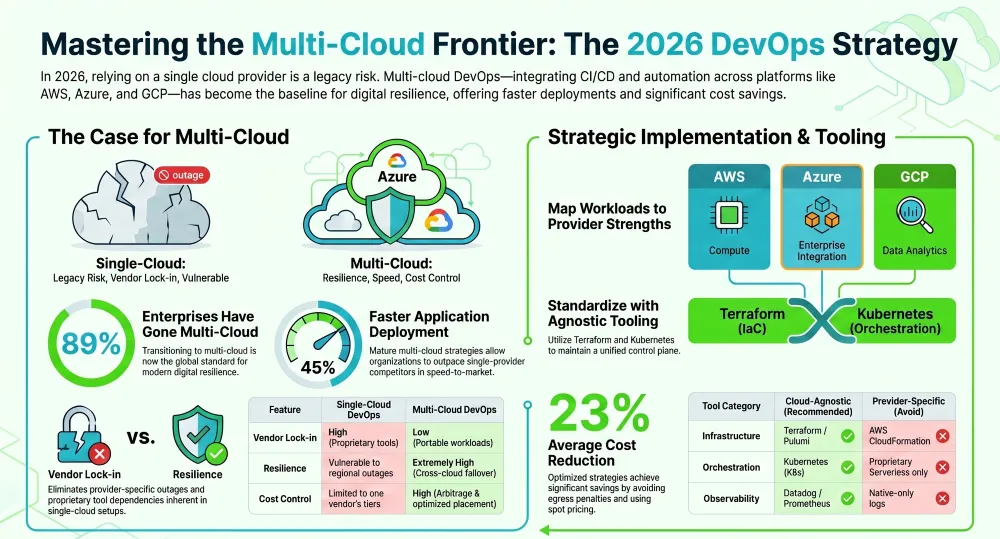
The shift toward distributed computing is undeniable. According to the Flexera State of the Cloud Report, a staggering 89% of enterprises have embraced multi-cloud strategies, and Gartner projects that global cloud infrastructure spending will surpass $500 billion in 2026. Furthermore, Forrester data reveals that organizations with mature multi-cloud strategies deploy new applications 45% faster than those relying on a single provider.
Comparisons & Frameworks: Single-Cloud vs. Multi-Cloud DevOps
| Feature | Single-Cloud DevOps | Multi-Cloud DevOps |
|---|---|---|
| Vendor Lock-in | High. Infrastructure is tied to one vendor’s proprietary tools. | Low. Workloads are portable across various environments. |
| Resilience | Vulnerable to provider-specific regional outages. | Extremely high. Cross-cloud failovers ensure continuity. |
| Tooling | Native tools (e.g., AWS CodePipeline exclusively). | Agnostic tools (e.g., Jenkins, Terraform, GitLab CI). |
| Cost Optimization | Limited to one vendor’s pricing tiers. | High. Ability to arbitrage and select the most cost-effective compute. |
| Complexity | Low. Easier to manage and secure. | High. Requires advanced orchestration and governance. |
Expert Quotes & Perspectives
“In these early days of a very transformative technology, the risks of under-investing are dramatically higher than the risks of over-investing. Multi-cloud architectures are no longer an experiment; they are the baseline for digital resilience.” — Industry Analyst Perspective, 2025.
Strategic Product Integration
Transitioning to this model requires robust data management. For organizations migrating massive datasets across clouds, leveraging platforms like Aimleap for AI-driven data processing can streamline data structuring before migration. However, mapping the overarching infrastructure requires specialized consulting.
Format Recommendation: Long-form blog post & high-production YouTube explainer video.
Distribution Channel: Company Blog, LinkedIn Articles, and Tech Forums (Reddit/HackerNews).
Multi-Cloud DevOps at a Glance (2026)
- Core Objective: Decouple software delivery from provider-specific limitations.
- Winning Toolchain: Terraform (IaC), Kubernetes (Orchestration), and HashiCorp Vault (Security).
- Primary Benefit: 45% faster deployment speeds compared to single-cloud setups.
- Key Risk: Operational complexity and “Cloud Shock” (unplanned egress costs).
Key Takeaways
1. Multi-Cloud is the New Global Standard
The shift is no longer theoretical; 89% of enterprises now operate in multi-cloud environments. Transitioning from a single-cloud to a multi-cloud model is now recognized as a baseline for digital resilience, allowing organizations to avoid vendor lock-in and minimize the risk of regional outages.
2. Portability Requires Deliberate Engineering
Simply using Kubernetes doesn’t guarantee portability. True multi-cloud agility comes from:
- Cloud-Agnostic Tooling: Standardizing on tools like Terraform, Pulumi, and GitLab CI that work across all providers.
- Abstracting Infrastructure: Moving away from proprietary services (like AWS CloudFormation) in favor of agnostic Infrastructure as Code (IaC).
3. Strategic Workload Placement is Key
Avoid a “one-size-fits-all” approach. Successful teams map workloads to the specific strengths of the “Big Three”:
- AWS: Best for massive compute and mature serverless (Lambda).
- Azure: The go-to for Windows-heavy ecosystems and enterprise identity (Active Directory).
- GCP: The leader for high-performance data analytics (BigQuery) and AI-native services.
4. FinOps is an Operational Necessity
With cloud costs now frequently the #2 expense for IT companies, FinOps is no longer optional. Organizations must track “unit economics” (cost per transaction) and use automated guardrails to prevent “cloud shock”—unplanned bills caused by idle resources or high egress fees between clouds.
5. Security Must “Shift-Left”
In a multi-cloud perimeter, security cannot be reactive. DevSecOps—integrating automated vulnerability scanning and secret management (like HashiCorp Vault) directly into the deployment pipeline—is the only way to protect a sprawling attack surface.
6. Platform Engineering Solves Complexity
To manage the “talent gap” and operational chaos, Gartner predicts 80% of large engineering organizations will establish Platform Engineering teams by late 2026. These teams build internal platforms that provide “golden paths” for developers, making multi-cloud deployments as simple as a single command.
The Bottom Line: Success in 2026 isn’t defined by having the biggest cluster, but by having the most automated and resilient decision-making fabric. Partnering with experts like Full-Stack Techies can help bridge the gap between complex multi-cloud architecture and seamless technical execution.
Core Strategies for a Multi-Cloud DevOps Architecture
Definition & Explanation
Building a multi-cloud architecture is not as simple as opening accounts with AWS, Azure, and GCP. It requires a deliberate, engineered approach to cloud devops management services. Without a cohesive strategy, organizations face fragmented security perimeters, ballooning costs, and disjointed deployment pipelines. A successful strategy requires abstracting the underlying cloud infrastructure using containerization, standardizing deployment pipelines, and implementing a centralized governance model.
Step-by-Step Guide: Designing a Multi-Cloud Strategy
- Assess and Categorize Workloads: Audit your current applications. Identify which are mission-critical, which handle sensitive data, and which require high compute power.
- Choose the Right Architecture Model:
- Active-Active: Applications run simultaneously on multiple clouds. Traffic is load-balanced based on user geography or cloud performance.
- Active-Passive (Disaster Recovery): One cloud serves as the primary host, while the secondary cloud remains on standby, continuously syncing data.
- Best-of-Breed: Workloads are permanently distributed based on provider strengths (e.g., Azure for Windows workloads, GCP for Big Data).
- Standardize on Agnostic Infrastructure as Code (IaC): Move away from vendor-specific deployment templates (like AWS CloudFormation) and adopt cloud-agnostic tools like Terraform or Pulumi.
- Implement Centralized Identity and Access Management (IAM): Utilize Single Sign-On (SSO) and federated identity providers to ensure seamless, secure access across all cloud environments.
- Establish FinOps Governance: Implement cross-cloud cost monitoring tools to prevent resource sprawl and budget overruns.
Statistical Support
The financial imperative of strategic multi-cloud planning is immense. According to recent Flexera data, organizations implementing optimized multi-cloud strategies achieved an average of 23% cost reduction compared to poorly managed single-cloud deployments, primarily through workload optimization and avoiding vendor egress penalties.
Use Cases & Examples
A prime example is the media streaming industry. To ensure flawless user experiences during high-traffic events (like the Super Bowl or season premieres), streaming platforms utilize an Active-Active multi-cloud strategy. They distribute edge caching across AWS/Azure/GCP DevOps pipelines, dynamically routing users to the nearest, lowest-latency server, regardless of the underlying cloud provider.
Comparisons & Frameworks: Multi-Cloud Patterns
- Service-Oriented Multi-Cloud: An enterprise chooses multi-cloud based on specific business applications. For example, legacy Microsoft SQL databases migrate to Azure, while frontend Kubernetes clusters run on Google Cloud.
- Process-Oriented Multi-Cloud: Workloads are portable and shifted dynamically based on real-time spot pricing or capacity constraints. This requires a highly mature DevOps pipeline.
Expert Quotes & Perspectives
“By 2028, over 95% of new digital workloads will be deployed on cloud-native platforms. Organizations that invest now in modern IaC, unified governance, and policy frameworks will lead the market.” — Gartner Research.
Strategic Product Integration
When planning a multi-cloud data pipeline, acquiring accurate market data to inform your applications is critical. Apiscrapy provides exceptional AI-driven web scraping services that can feed robust datasets into your newly architected multi-cloud data lakes. To manage the actual migration and architecture strategy, partnering with Full-Stack Techies ensures that your multi-cloud foundation is built on scalable, secure, and cost-efficient principles from day one.
Format Recommendation: Downloadable Whitepaper / E-book and Technical Webinar.
Distribution Channel: Email lead generation campaigns and B2B tech platforms.
Need Help with Your Multi-Cloud Strategy? Reach Us We can Help
Get Free ConsultationEssential Tools for Hybrid and Multi-Cloud Environments
Section Goal: To compare and recommend the best-in-class DevOps tools that enable seamless CI/CD, infrastructure provisioning, and observability across multiple clouds.
Definition & Explanation
The backbone of any successful hybrid cloud DevOps or multi-cloud initiative is its toolchain. Utilizing native tools provided by a specific cloud vendor leads directly back to vendor lock-in—the very problem multi-cloud aims to solve. Therefore, organizations must adopt a “cloud-agnostic” toolchain. These tools interface with diverse cloud APIs to provide a single, unified control plane for developers and operations teams.
Categories of Essential Tools
1. Infrastructure as Code (IaC)
IaC is non-negotiable for multi-cloud. It allows teams to provision and manage infrastructure using human-readable code.
- Terraform (by HashiCorp): The undisputed king of multi-cloud IaC. It uses a consistent workflow and provider plugins to manage resources on AWS, Azure, GCP, and on-premises servers.
- Pulumi: A rising star that allows developers to write infrastructure using familiar programming languages (Python, TypeScript, Go) rather than domain-specific languages.
2. Containerization and Orchestration
Containers decouple the application from the underlying operating system, making it portable.
- Docker: The industry standard for packaging applications.
- Kubernetes (K8s): The ultimate multi-cloud enabler. K8s orchestrates container deployment, scaling, and networking. Whether you run Amazon EKS, Azure AKS, or Google GKE, the underlying Kubernetes API remains largely consistent.
3. Continuous Integration and Deployment (CI/CD)
- GitLab CI/CD & GitHub Actions: Both offer powerful, cloud-agnostic pipelines that can deploy code to any target environment via secure API integrations.
- ArgoCD: A declarative, GitOps continuous delivery tool specifically built for Kubernetes, ensuring state synchronization across multi-cloud clusters.
4. Observability and Monitoring
- Datadog: Provides a unified dashboard for metrics, traces, and logs across all cloud providers and on-premises infrastructure.
- Prometheus & Grafana: The open-source standard for cloud-native monitoring and data visualization.
Statistical Support
Complexity is the enemy of uptime. A recent IT survey revealed that 73% of respondents believe cloud technology has added complexity to their operations, and unplanned IT downtime now averages $14,056 per minute. Investing in unified observability tools is critical to mitigating these massive financial risks.
Comparisons & Frameworks: IaC Tools
| Feature | Terraform | Pulumi | AWS CloudFormation |
|---|---|---|---|
| Multi-Cloud Support | Excellent (Thousands of providers) | Excellent (Extensive providers) | None (AWS only) |
| Language | HCL (HashiCorp Configuration Language) | Python, TS, Go, C#, Java | JSON / YAML |
| State Management | Required (Local or Remote) | Required (Pulumi Service or Custom) | Managed by AWS |
Expert Quotes & Perspectives
“Platform engineering will ultimately solve the central problem of cooperation between software developers and operators. Establishing reusable components across clouds is the future.” — Industry Outlook, 2025.
Strategic Product Integration
Configuring and maintaining this complex toolchain requires niche expertise. This is where Full-Stack Techies excel. As a premier provider of cloud native devops services, Full-Stack Techies can architect, deploy, and manage your entire multi-cloud CI/CD and observability stack, ensuring your developers focus on writing code, not fighting infrastructure.
Format Recommendation: Infographic (Toolchain Map) and GitHub Repository with sample code.
Distribution Channel: Developer Communities (Dev.to, GitHub), Tech Blogs.
Navigating AWS/Azure/GCP DevOps & Cloud Native Services
Section Goal: To provide a comparative analysis of the “Big Three” cloud providers and how to effectively integrate their native capabilities into a cohesive multi-cloud strategy.
Definition & Explanation
While cloud-agnostic tools are vital, ignoring the powerful native capabilities of AWS, Microsoft Azure, and Google Cloud Platform (GCP) is a mistake. A mature guide to multi-cloud DevOps advocates for using agnostic tools to manage infrastructure, while strategically tapping into native managed services to accelerate development. Understanding the strengths of AWS/Azure/GCP DevOps environments allows architects to place workloads optimally.
Deep Dive: The Big Three
Amazon Web Services (AWS)
Strengths: Market leader (vast ecosystem), unparalleled compute capacity, highly mature serverless offerings (AWS Lambda).
DevOps Ecosystem: While tools like AWS CodeDeploy are powerful, in a multi-cloud setup, AWS is best utilized as the primary engine for heavy compute, database hosting (Amazon Aurora), and scalable storage (S3).
Microsoft Azure
Strengths: Seamless enterprise integration (Active Directory, Windows Server), strong hybrid cloud capabilities (Azure Arc), and leading AI integration via OpenAI partnerships.
DevOps Ecosystem: Azure DevOps is one of the most comprehensive native suites available. Many organizations use Azure DevOps as their primary CI/CD orchestrator, even if the ultimate deployment target is AWS or GCP.
Google Cloud Platform (GCP)
Strengths: Unrivaled data analytics (BigQuery), leading machine learning tools, and the birthplace of Kubernetes.
DevOps Ecosystem: GCP DevOps management shines in containerized environments. Google Kubernetes Engine (GKE) is widely considered the most advanced managed Kubernetes service.
Statistical Support
The market distribution underscores the necessity of multi-cloud. By late 2025, AWS held roughly a third of the market, Azure followed closely with ~23%, and Google Cloud maintained over 11%. Furthermore, analysts report that the Big Five hyperscalers will spend over $600 billion on CapEx in 2026, with 75% tied to AI infrastructure. Organizations must be multi-cloud to access the diverse AI models hosted across these disparate providers.
Use Cases & Examples
A global logistics company utilizes a distinct “Best-of-Breed” multi-cloud setup. They run their legacy Windows applications on Microsoft Azure, leveraging Azure Arc for hybrid management. Their massive data ingestion pipeline and real-time route optimization algorithms run on GCP, utilizing BigQuery. Finally, their global customer-facing web applications are hosted on AWS for low-latency content delivery.
Step-by-Step Guide: Workload Placement
- Identify Constraints: Does the app require Windows Server? (Favor Azure).
- Evaluate Data Needs: Does the app require massive, fast data warehousing? (Favor GCP).
- Assess Scale: Does the app require global edge locations and massive serverless scale? (Favor AWS).
- Network Considerations: Calculate data egress costs before spanning a single app’s frontend and backend across different clouds.
Strategic Product Integration
If your enterprise heavily relies on large-scale data analytics to fuel your GCP workloads, OutsourceBigData provides specialized data processing and analytics support. To seamlessly weave these AWS, Azure, and GCP services together without creating data silos, Full-Stack Techies offers unparalleled cloud devops management services, bridging the technical gaps between hyperscalers.
Format Recommendation: Comparison Matrix (Interactive Web Page) & Podcast Episode.
Distribution Channel: Technical Newsletters and Audio Platforms.
Multi-Cloud DevOps Best Practices & Security Checklists
Section Goal: To enforce actionable security protocols, governance standards, and DevSecOps best practices tailored for the complexities of a multi-cloud perimeter.
Definition & Explanation
Multi-cloud architectures drastically expand an organization’s attack surface. A misconfiguration in AWS might expose data, while an overly permissive IAM role in Azure could lead to a breach. Therefore, security cannot be an afterthought; it must be integrated into the DevOps pipeline from day one—a practice known as DevSecOps. Security in a multi-cloud environment relies on standardization, zero-trust principles, and continuous automated auditing.
Statistical Support
The stakes for cloud security have never been higher. According to cybersecurity leader Fortinet, 95% of companies are concerned about cloud security. Furthermore, 2024 saw data breaches increase by 6%, exposing over 16.8 billion records. Organizations cannot afford inconsistent security postures across their cloud providers.
Core Best Practices
- Embrace Zero Trust Architecture: Never trust an entity by default, regardless of whether they are inside or outside the network. Implement strict identity verification for every person and device accessing cloud resources.
- Shift-Left Security: Integrate security scanning tools (like Snyk or SonarQube) directly into the CI/CD pipeline. Code should be scanned for vulnerabilities before it is ever deployed to staging, let alone production.
- Unified Secret Management: Never hardcode API keys or passwords in source code. Use a centralized secret management tool like HashiCorp Vault to dynamically inject secrets into AWS, Azure, or GCP workloads.
- Automated Compliance Monitoring: Use Cloud Security Posture Management (CSPM) tools to continuously monitor cloud environments against compliance frameworks (HIPAA, GDPR, SOC2).
The Multi-Cloud Security Checklist
- IAM: Are all root accounts secured with hardware MFA?
- IAM: Is the principle of least privilege (PoLP) enforced via automated role auditing?
- Network: Are Virtual Private Clouds (VPCs) correctly peered and segmented?
- Data: Is all data encrypted at rest (using customer-managed keys) and in transit (TLS 1.3)?
- IaC: Are Terraform scripts scanned for misconfigurations (e.g., using Checkov) before execution?
- Observability: Are logs from all cloud providers aggregated into a centralized SIEM (Security Information and Event Management) system?
Expert Quotes & Perspectives
“By 2028, over 50% of enterprises will use AI security platforms to protect their AI and cloud investments. Automation is the only way to defend a multi-cloud perimeter.” — Global Cybersecurity Analyst.
Strategic Product Integration
Maintaining strict security compliance across multiple providers requires dedicated oversight. Full-Stack Techies embed DevSecOps directly into your delivery pipelines. Their experts ensure that your hybrid cloud DevOps environments meet stringent regulatory standards, implementing automated guardrails that prevent insecure deployments before they happen.
Format Recommendation: Downloadable PDF Checklist and Interactive Web Tool.
Distribution Channel: Gated Content (Lead Magnet) on Website.
Also Read: The Ultimate DevOps Vendor Evaluation Checklist for Enterprises (2026)
Get scalable, fast, and user-friendly DevOps Solutions tailored to your needs.
Get Free ConsultationOvercoming Multi-Cloud Management Challenges with Full-Stack Techies
Section Goal: To address the specific operational hurdles of multi-cloud adoption and position Full-Stack Techies as the premier partner for resolving these challenges.
Definition & Explanation
Despite the immense benefits of agility and resilience, multi-cloud introduces severe challenges: exponential complexity, lack of internal technical skills, fragmented monitoring, and unpredictable “cloud shock” bills. Attempting to build an internal team capable of mastering the nuances of AWS, Azure, GCP, and Kubernetes simultaneously is often prohibitively expensive and slow. The solution lies in partnering with managed service experts who specialize in cloud native devops services.
Common Challenges & Solutions
- The Talent Gap: Finding engineers proficient in multiple clouds is incredibly difficult. Solution: Augment your team with specialized external talent.
- Runaway Costs (Cloud Waste): Without centralized governance, developers may spin up expensive GPU instances across different clouds and forget to tear them down. Solution: Implement aggressive FinOps practices and automated lifecycle policies.
- Operational Silos: The Azure team doesn’t talk to the AWS team, leading to disjointed processes. Solution: Establish a centralized Platform Engineering team that provides internal, cloud-agnostic tools to all developers.
Statistical Support
Cost optimization is a universal struggle. A recent Flexera survey highlights that 78% of organizations are making cloud cost optimization their top priority. With cloud costs becoming the #2 expense at midsize IT companies, bridging the management gap is a financial necessity.
Why Choose Full-Stack Techies?
When navigating the complexities of multi-cloud architectures, Full-Stack Techies stands out as an industry-leading partner. Here is how they solve multi-cloud chaos:
- Deep Cross-Cloud Expertise: Instead of hiring individual specialists for AWS, Azure, and GCP, Full-Stack Techies provides a cohesive team of certified architects who understand the interoperability between hyper-scalers.
- Custom Platform Engineering: They build tailored Internal Developer Platforms (IDPs) that abstract cloud complexity. Your developers simply push code; Full-Stack Techies’ automated pipelines handle the multi-cloud routing, security scanning, and deployment.
- FinOps & Cost Optimization: Full-Stack Techies implements rigorous resource tagging, rightsizing algorithms, and spot-instance orchestration, routinely saving clients up to 30% on their monthly cloud spend.
- 24/7 SRE & Monitoring: They establish unified observability dashboards, providing round-the-clock Site Reliability Engineering (SRE) to ensure high availability across your entire distributed architecture.
Case Study Snapshot
A rapidly growing SaaS provider was struggling with deploying updates across their hybrid AWS and GCP environment. Deployments took days and were prone to manual errors. By partnering with Full-Stack Techies, they transitioned to a fully automated, GitOps-driven deployment model using Kubernetes and Terraform. The result? Deployment frequency increased by 400%, infrastructure costs dropped by 25%, and zero-downtime deployments became the standard.
Format Recommendation: Long-form Case Study / Customer Success Video.
Distribution Channel: Sales Collateral and Website Landing Pages.
Performance Tracking & Content Audit
To ensure your multi-cloud strategy (and the content surrounding it) yields tangible results, rigorous performance tracking is required.
Measuring Success Metrics:
- Deployment Frequency & Lead Time: Track how much faster your teams are releasing features post multi-cloud implementation.
- Infrastructure Cost per Customer: Use FinOps tools to calculate unit economics. Is your multi-cloud setup actually driving down the cost of serving a single user?
- Uptime & MTTR (Mean Time to Recovery): Monitor how quickly your automated cross-cloud failovers resolve regional outages.
Data-Driven Iteration
Regularly audit your cloud infrastructure. Utilize AI-driven cost anomaly detection to identify abandoned resources. From a content perspective, analyze user engagement on this guide—if readers drop off during the DevOps tooling section, update it with more visual diagrams or simplified explanations. Continuous iteration is the heart of DevOps, and it should be the heart of your cloud strategy.
Conclusion & Further Reading
Summary of Key Insights
The future of enterprise IT is irrefutably distributed. As we have explored in this guide to multi-cloud DevOps, leveraging a multi-cloud strategy empowers organizations to eliminate vendor lock-in, optimize costs, and build ultra-resilient applications. By adopting cloud-agnostic IaC tools, enforcing rigorous DevSecOps practices, and strategically utilizing the native strengths of AWS, Azure, and GCP, businesses can transform their infrastructure into a competitive advantage.
However, this journey is complex. The operational overhead, security risks, and talent shortages require expert guidance. Partnering with industry leaders like Full-Stack Techies ensures that your transition to a multi-cloud ecosystem is seamless, secure, and highly profitable.
Are you ready to untangle your cloud infrastructure and accelerate your deployment pipelines? Contact Full-Stack Techies today to schedule a comprehensive multi-cloud architecture audit and discover how our managed DevOps services can transform your engineering lifecycle.
If you found this guide valuable, please share it with your network on LinkedIn!
Frequently Asked Questions
Q1. What is multi-cloud DevOps?
Multi-cloud DevOps is the practice of automating software delivery, infrastructure provisioning, and monitoring across two or more cloud service providers (such as AWS, Azure, and Google Cloud). This approach combines agile DevOps workflows with a distributed cloud architecture to prevent vendor lock-in, ensure high availability, and allow organizations to leverage the best tools from different platforms.
Q2. Why choose a multi-cloud strategy over a single cloud?
Companies adopt a multi-cloud strategy primarily to achieve disaster recovery, cost optimization, and technology flexibility. Key benefits include:Zero Vendor Lock-in: Workloads remain portable across environments.rnHigh Availability: Cross-cloud failovers protect against provider-specific regional outages.rnBest-of-Breed Services: Teams can use specialized tools, like GCP for machine learning and AWS for massive compute power.
Q3. What are the best tools for multi-cloud DevOps?
The most effective multi-cloud DevOps tools are u201ccloud-agnostic,u201d meaning they seamlessly integrate with multiple providers via APIs. Essential tools include:rnrnInfrastructure as Code (IaC): Terraform and Pulumi.rnContainer Orchestration: Kubernetes (K8s) and Docker.rnCI/CD Pipelines: GitLab CI, GitHub Actions, and ArgoCD.rnMonitoring & Observability: Datadog, Prometheus, and Grafana.
Q4. How do AWS, Azure, and GCP differ in a multi-cloud architecture?
In a multi-cloud setup, organizations route workloads based on the unique strengths of the u201cBig Threeu201d providers:rnrnAWS: Market leader utilized for massive, scalable compute and highly mature serverless infrastructure.rnMicrosoft Azure: Ideal for enterprise integrations (Active Directory) and advanced hybrid cloud management via Azure Arc.rnGoogle Cloud (GCP): Industry leader for big data analytics (BigQuery) and advanced AI/Machine Learning models.
Q5. What is the biggest challenge of multi-cloud DevOps?
The greatest challenge in managing a multi-cloud environment is exponential operational complexity. Managing distinct APIs, billing models, and security perimeters often leads to fragmented deployments, cloud waste (runaway costs), and a significant talent gap, as finding engineers proficient in multiple hyperscalers is difficult.
Q6. How do you secure a multi-cloud DevOps environment?
Securing a multi-cloud architecture requires integrating security directly into the pipeline, a practice known as DevSecOps. Best practices include:rnrnImplementing Zero Trust Architecture and strict identity verification.rnUsing centralized secret management tools like HashiCorp Vault.rnApplying u201cShift-Leftu201d security by scanning code for vulnerabilities before deployment.rnUtilizing Cloud Security Posture Management (CSPM) to monitor cross-cloud compliance.
Q7. What is the role of Kubernetes in multi-cloud deployments?
Kubernetes (K8s) acts as the universal orchestrator for multi-cloud deployments. By decoupling applications from the underlying operating system using containers, Kubernetes allows engineers to deploy, scale, and manage workloads seamlessly across Amazon EKS, Azure AKS, or Google GKE without rewriting application code.
Q8. Can a multi-cloud strategy save money?
Yes, a well-managed multi-cloud strategy can significantly reduce IT costs. By implementing strict FinOps governance, organizations can achieve up to a 23% cost reduction. Savings are generated through cloud arbitrage (shifting workloads to the cheapest provider in real-time), avoiding proprietary egress penalties, and utilizing optimized spot pricing.
Q9. What is Infrastructure as Code (IaC) and why is it essential?
Infrastructure as Code (IaC) is the process of provisioning and managing cloud resources using human-readable code rather than manual dashboards. In a multi-cloud environment, agnostic IaC tools like Terraform are essential because they provide a single, unified workflow to deploy servers, databases, and networks across AWS, Azure, and GCP simultaneously.
Q10. How can managed services like Full-Stack Techies help with multi-cloud?
Full-Stack Techies provides specialized cloud-native DevOps services to eliminate the operational chaos of managing multiple cloud vendors. They assist enterprises by:rnrnBuilding custom Internal Developer Platforms (IDPs) to abstract cloud complexity.rnImplementing aggressive FinOps and automated resource lifecycle policies.rnProviding 24/7 Site Reliability Engineering (SRE) and unified observability dashboards across all environments.



