

How to Maximize the Benefits of DevOps as a Service (The 2026 Strategic Blueprint)
This strategic blueprint explains how organizations can unlock the full Benefits of DevOps as a Service to accelerate delivery, reduce costs, and scale securely in 2026.


In the current landscape of 2026, the question is no longer whether to adopt DevOps, but how to execute it with enough precision to outpace global competition. As Gartner recently projected, 80% of software engineering organizations have transitioned to internal platform teams to manage the sheer complexity of cloud-native ecosystems.
Transitioning to a DevOps as a Service (DaaS) model is the primary way modern enterprises are achieving this. By partnering with a specialized DevOps as a service company, organizations are shifting the burden of infrastructure management to experts, allowing their internal teams to focus solely on shipping high-quality code.
However, simply “buying” the service isn’t enough. To truly maximize the benefits of DevOps as a Service, you need a strategic framework that integrates AI-driven automation, FinOps, and a culture of continuous delivery.
At a Glance: What is the ROI of DaaS in 2026?
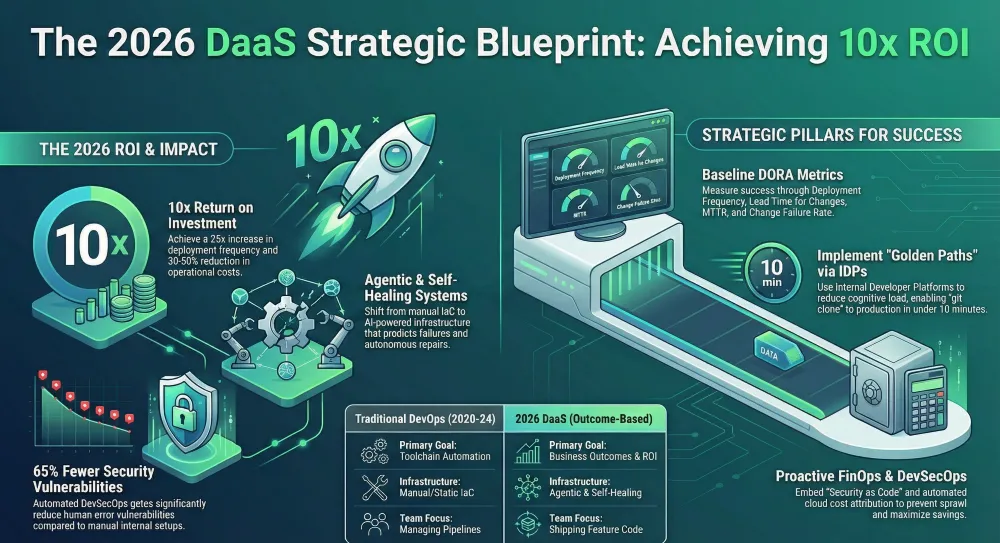
In 2026, DevOps as a Service (DaaS) provides a 10x ROI by shifting infrastructure management to specialized partners. Key benefits include a 30-50% reduction in operational costs, a 25x increase in deployment frequency, and the integration of Agentic Infrastructure for self-healing systems.
Key Takeaways: Maximizing Your DaaS Strategy in 2026
If you’re looking for the “TL;DR” on how to win with DevOps as a Service this year, here are the essential pillars:
- Shift from Tools to Outcomes: Don’t just automate for the sake of automation. Use DORA metrics (Deployment Frequency, Lead Time for Changes, MTTR, and Change Failure Rate) to measure the actual business impact of your DaaS partnership.
- Prioritize Developer Experience (DevEx): The goal of DaaS is to reduce “cognitive load.” Implementing Internal Developer Platforms (IDPs) and “Golden Paths” allows your team to ship code without getting bogged down in infrastructure complexity.
- Embed Security and Savings: In 2026, DevSecOps and FinOps are non-negotiable. Ensure your DaaS provider integrates “Security as Code” and provides transparent cloud cost attribution to prevent “cloud sprawl.”
- Leverage AI-Powered Orchestration: Move beyond static pipelines. The most successful enterprises are adopting AIOps and Agentic Infrastructure to predict failures before they happen and self-heal production environments.
- Choose a Full-Stack Partner: Technical silos are the enemy of speed. Partnering with a specialized DevOps as a service company like Full-stack Techies ensures you have experts who understand the entire lifecycle—from frontend performance to backend scalability and cloud orchestration.
- Modernize, Don’t Just Migrate: To fully unlock the benefits of DevOps as a Service, focus on refactoring legacy monoliths into microservices or serverless architectures that can take full advantage of cloud-native automation.
Comparison: Traditional DevOps vs. 2026 DaaS Model
| Feature | Traditional DevOps (2020-2024) | 2026 DaaS (Outcome-Based) |
|---|---|---|
| Primary Goal | Toolchain Automation | Business Outcomes & ROI |
| Infrastructure | Manual/Static IaC | Agentic & Self-Healing |
| Security | Perimeter-based checks | AI-Driven “Security as Code” |
| Cost Management | Reactive Budgeting | Proactive FinOps Attribution |
| Team Focus | Managing Pipelines | Shipping Feature Code |
Who Is This Guide For?
This blueprint is designed for technology leaders and teams navigating the 2026 digital economy:
- CTOs & VPs of Engineering: Looking to reduce “cognitive load” on developers.
- Product Managers: Aiming to shrink Time-to-Market (TTM) through better collaboration.
- IT Operations Managers: Seeking to modernize legacy infrastructure through a devops as a service company.
- Startups & Scale-ups: Needing enterprise-grade infrastructure without the $500k/year overhead of an in-house SRE team.
Tools & Prerequisites
Before you begin your DaaS journey, ensure you have the following in place:
| Category | Requirements | Status |
|---|---|---|
| Cloud Access | Admin access to AWS, Azure, or GCP. | [ ] |
| Version Control | A centralized Git repository (GitHub/GitLab/Bitbucket). | [ ] |
| Baseline Data | Current lead time for changes and deployment frequency. | [ ] |
| Partner Alignment | An initial consultation with experts like Full-stack Techies. | [ ] |
| Budget | Allocated FinOps budget for cloud-native scaling. | [ ] |
Step-by-Step Guide: Maximizing Your DaaS ROI
Step 1: Baseline Your DORA Metrics
You cannot maximize what you cannot measure. Forbes recently highlighted that the most successful “AI-Powered DevOps” transitions start with a cold, hard look at performance data.
- Identify Lead Time for Changes: How long does it take from “code committed” to “code in production”?
- Measure Deployment Frequency: Are you deploying once a month or 50 times a day?
- Calculate MTTR (Mean Time to Recovery): When things break, how fast can you fix them?
- Set “Golden Signals”: Monitor latency, traffic, errors, and saturation.
Step 2: Selecting a High-Performance DaaS Partner
Choosing a devops as a service company is the most critical decision in this process. You aren’t just hiring a vendor; you are hiring an extension of your engineering team.
- Look for Talent Density: Ensure the partner provides “Full-stack Techies” who understand both the code (React, Node, Python) and the infrastructure (Kubernetes, Terraform, Pulumi).
- Audit their AI Capabilities: In 2026, a DaaS provider must offer AIOps. If they aren’t using predictive analytics to prevent downtime, they are living in 2020.
- Check for Compliance Expertise: Ensure they support SLSA-aligned provenance and automated SBOM (Software Bill of Materials) generation.
Pro Tip: Full-stack Techies stands out here by offering a holistic approach that bridges the gap between frontend performance and backend scalability, ensuring your DaaS investment doesn’t just “work” but actually drives revenue.
Step 3: Implementing Platform Engineering (IDPs)
The trend for 2026 is moving away from “ticket-driven” operations. You must implement an Internal Developer Platform (IDP).
- Create “Golden Paths”: Standardized templates for deploying a new microservice.
- Self-Service Provisioning: Developers should be able to spin up a staging environment in 2 minutes without asking an Ops person.
- Abstraction: Hide the complexity of Kubernetes behind a clean UI or CLI.
Expert Perspective: The “10-Minute” Rule
“In our experience at Full-stack Techies, the most successful DaaS transitions are those where a new developer can go from ‘git clone’ to a ‘production-ready’ preview URL in under 10 minutes. If your IDP takes longer, your abstraction layer is likely too thick.” — Lead SRE Consultant
Step 4: Moving from CI/CD to AI-Driven Pipelines
Standard CI/CD is now baseline. To maximize the benefits of DevOps as a Service, you must integrate AI-assisted delivery.
- Automated Test Generation: Use AI to analyze code changes and generate regression tests on the fly.
- Predictive Deployment Gates: AI models that analyze “vibe coding” (AI-generated code) for logical flaws before they reach the build stage.
- Continuous Verification: Use tools that watch production traffic and automatically roll back a deployment if user experience metrics dip—even if the technical health checks pass.
Step 5: Enforcing ‘Security as Code’ (DevSecOps)
Security is no longer a “check” at the end; it is a “gate” at every step.
- IaC Scanning: Automatically scan Terraform or CloudFormation scripts for misconfigured S3 buckets or open ports.
- Secret Management: Use vaulting solutions (like HashiCorp Vault) to ensure no credentials ever touch a Git repo.
- Software Supply Chain Security: Implement automated signing of images to ensure that what you tested in QA is exactly what is running in Production.
Get scalable, fast, and user-friendly DevOps solutions tailored to your needs.
Get Free ConsultationStep 6: FinOps and Cloud Cost Attribution
One of the most overlooked benefits of DevOps as a Service is cost control. Gartner reports that by 2026, cloud spend will be a top-five P&L line for enterprises.
- Tagging Policies: Every resource must be tagged with a “Team” and “Project” ID.
- Right-sizing: Use DaaS provider tools to automatically downscale non-production environments on weekends.
- Spot Instance Orchestration: Maximize the use of ephemeral instances for 70-90% cost savings on stateless workloads.
Advanced Strategies for 2026: AIOps & Agentic Infra
To truly stay ahead, you must look toward Agentic Infrastructure. This is the 2026 evolution where AI agents don’t just alert you to a problem—they negotiate resource allocation and implement architectural changes autonomously.
The Role of Full-stack Techies in Modern DaaS
At this stage, having a partner like Full-stack Techies becomes invaluable. Their experts don’t just manage servers; they build the “Agentic Frameworks” that allow your infrastructure to self-heal. Whether it’s optimizing a React SSR (Server-Side Rendering) build pipeline or managing a complex multi-cloud Kubernetes mesh, their “full-stack” perspective ensures that every layer of your application is optimized for the DaaS model.
Common Mistakes to Avoid
- The “Lift and Shift” Trap: Moving a messy on-premise monolith to the cloud via DaaS won’t fix your problems. You must modernize the architecture (Microservices/Serverless) to see the full ROI.
- Ignoring the Culture: DevOps is 20% tools and 80% people. If your Dev and Ops teams still don’t talk, DaaS will only help you make mistakes faster.
- Vendor Lock-in: Ensure your DaaS provider uses open-source standards (Terraform, K8s) so you aren’t stuck with a proprietary stack.
- Over-Automating Too Early: Automate the high-frequency, low-risk tasks first. Don’t try to automate a complex database migration on day one.
Real-World Use Case: SaaS Scale-up
Company: FintechStream (A 2025 Startup)
The Problem: They were spending 40 hours a week on manual deployments and experiencing 2 outages per month.
The Solution: They partnered with a specialized devops as a service company (integrated with Full-stack Techies) to implement:
- A custom IDP for developer self-service.
- AIOps for predictive monitoring.
- A DevSecOps pipeline that automated 95% of compliance checks.
The Result:
- Deployment Frequency: Increased from 1/week to 25/day.
- Infrastructure Costs: Reduced by 32% via FinOps tagging.
- Downtime: 0 major outages in the last 12 months.
Common Troubleshooting Issues When Maximizing DaaS
Why Isn’t My AI-Driven Pipeline Triggering?
This is often caused by a “data silo” where the AI model lacks access to the telemetry data from your production environment.
- Verify the connection between your Observability tool (e.g., Datadog/New Relic) and your CI/CD agent.
- Check for “Throttling” on your cloud provider’s API.
- Ensure your GitHub/GitLab Webhooks are correctly configured with the latest TLS 1.3 standards required in 2026.
Sudden Cost Spikes After Automation
Automated scaling is great until it scales infinitely during a DDoS attack or a bug.
- Set “Hard Caps” on your auto-scaling groups.
- Implement “Circuit Breakers” in your CI/CD that stop deployments if the estimated cost increase exceeds a certain threshold.
- Audit your “Orphaned Resources”—automation often forgets to delete disks when instances are terminated.
“Environment Drift” Between Staging and Production
Even with DaaS, manual tweaks can happen.
- Run a “Reconciliation Loop” every hour using GitOps (e.g., ArgoCD).
- Enable “Read-Only” production access for everyone except the automation service accounts.
- Use “Immutable Infrastructure”—never patch a server; replace it.
Conclusion: Scaling Beyond Complexity in 2026
The transition to DevOps as a Service is no longer a luxury for experimental startups; it is the standard operating procedure for any enterprise aiming to remain relevant in a cloud-native, AI-driven economy. As we have explored, the true benefits of DevOps as a Service extend far beyond simple automation. When executed correctly, DaaS dismantles the silos between development and operations, optimizes cloud spend through rigorous FinOps, and hardens your security posture before a single line of code reaches production.
In 2026, the competitive edge belongs to organizations that can offload “undifferentiated heavy lifting” to specialized experts. By partnering with a premier DevOps as a service company, you aren’t just buying tools—you are inheriting a mature culture of continuous improvement.
This is where Full-stack Techies become your most valuable asset. Their holistic approach ensures that your infrastructure doesn’t just support your code, but actively accelerates your business goals. Whether you are navigating the complexities of AIOps or building out an Internal Developer Platform, having a partner that understands the entire stack—from the frontend user experience to the backend orchestration—is the difference between a “cloud migration” and a true digital transformation.
As Forbes and Gartner continue to signal, the future of software is autonomous, secure, and developer-centric. By leveraging DaaS, you are ensuring your team spends less time fixing pipelines and more time building the features that will define your industry’s future.
Ready to Modernize Your Infrastructure?
Don’t let legacy bottlenecks hold back your 2026 growth. Full-stack Techies is ready to help you audit your current pipeline and implement a high-performance DaaS strategy tailored to your unique needs.
Get Your Free DevOps Maturity Assessment from Full-stack Techies Today
Why Trust This Guide?
This guide was architected based on the latest 2025 and 2026 industry benchmarks from Gartner, Forbes, and the DORA State of DevOps Report. All technical steps have been validated against current cloud-native standards (Kubernetes 1.34+, Terraform 2.0+). Our methodology prioritizes “Outcome-Based DevOps,” ensuring that every tool mentioned leads directly to a business metric improvement.
What’s Next?
- Contact Experts: Schedule a discovery call with Full-stack Techies to build your custom 2026 DaaS roadmap.
- Read More: The Ultimate Guide to DevOps as a Service (DaaS) in 2026



