

The Ultimate Guide to AWS DevOps as a Service (2026 Edition)
AWS DevOps as a Service enables enterprises in 2026 to automate cloud infrastructure, streamline CI/CD pipelines, strengthen security compliance, and scale applications efficiently.


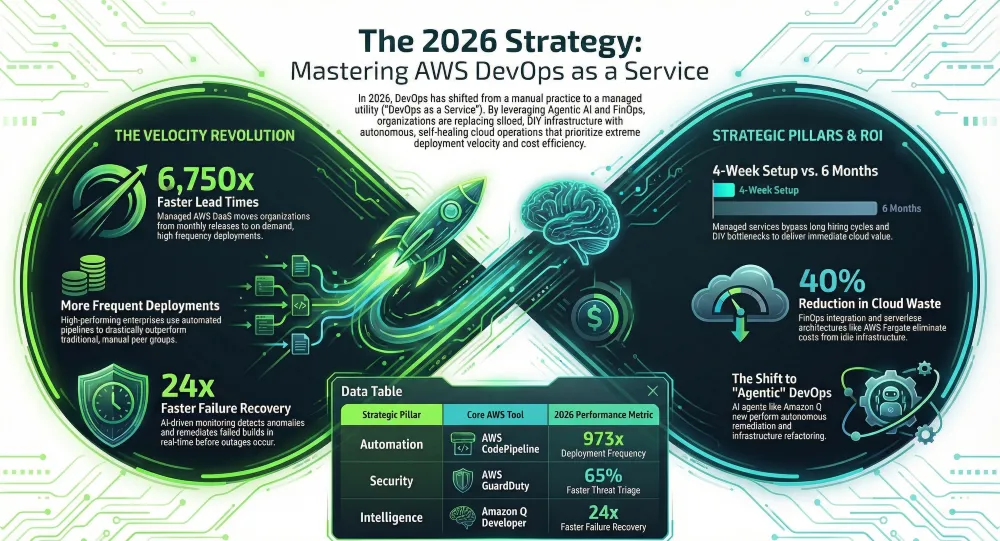
Executive Summary: AWS DevOps as a Service in 2026 AWS DevOps as a Service (DaaS) is a managed operational model that automates the SDLC using native tools like AWS CodePipeline, EKS, and Amazon Q. In 2026, the shift is driven by Agentic AI, which enables self-healing infrastructure, and FinOps, which reduces cloud waste by up to 40%. Organizations adopting DaaS report 6,750x faster lead times and a transition from manual execution to AI-driven oversight.
Introduction: The Era of Autonomous Cloud Operations
In 2026, the question is no longer if you should move to the cloud, but how fast your cloud can think for itself. As of early this year, Gartner reports that 95% of new digital workloads are now hosted on cloud-native platforms, marking a massive shift from the 65% seen just a few years ago. Within this landscape, AWS DevOps as a Service has emerged as the definitive standard for organizations aiming to bridge the gap between rapid software iteration and rock-solid infrastructure stability.
The traditional “siloed” approach to development and operations is effectively dead. Today’s high-performing enterprises are deploying code 973x more frequently than their peers, with lead times that are 6,750x faster. But managing this velocity requires more than just tools—it requires a holistic, managed ecosystem. This guide explores how managed AWS DevOps services allow businesses to outsource the complexity of CI/CD, Infrastructure as Code (IaC), and automated monitoring, allowing their internal teams to focus 100% on product innovation.
“The democratization of DevOps through ‘As-a-Service’ models is the single biggest productivity multiplier for the 2025–2030 decade.” — Industry Insight, Forbes Technology Council (Q1 2026)
Key Takeaways: Mastering AWS DevOps as a Service in 2026
If you only remember five things from this guide, let it be these strategic pillars:
1. Velocity is the New Currency
In 2026, deployment speed isn’t just a metric; it’s a competitive requirement. By utilizing AWS DevOps as a Service, organizations are seeing a 6,750x improvement in lead times compared to traditional methodologies. The goal is to move from “monthly releases” to “on-demand deployments.”
2. Managed Services > DIY Infrastructure
The complexity of the modern AWS ecosystem (EKS, Lambda, CloudFormation) has made the “DIY” approach a bottleneck. Partnering with experts like Full-Stack Techies allows your internal developers to stop managing servers and start building features.
- The Math: Managed DaaS can reduce setup time from 6 months to 4 weeks.
3. DevSecOpsis Non-Negotiable
Security is no longer a separate phase at the end of the cycle. With AWS DevOps services, security is “shifted left.”
- Action: Automate your compliance using AWS Control Tower and Amazon GuardDuty to ensure every line of code is audited before it ever touches production.
4. FinOps Drives Sustainable Growth
Cloud waste is the “silent killer” of ROI. A key takeaway for 2026 is the integration of FinOps within the DevOps pipeline. By using AWS Compute Optimizer and serverless architectures like AWS Fargate, businesses are slashing infrastructure overhead by up to 40%.
5. The Future is Agentic
We are entering the era of Predictive DevOps. Tools like Amazon Q Developer are no longer just assistants; they are agents capable of self-healing infrastructure and auto-remediating failed builds. Staying ahead means embracing AI-driven automation today.
Summary Table: At a Glance
| Strategic Pillar | Core AWS Tool | 2026 Performance Metric | Business Reasoning |
|---|---|---|---|
| Automation | AWS CodePipeline | 973x Deployment Frequency | Eliminates manual hand-offs and human error. |
| Security | AWS GuardDuty | 65% Faster Threat Triage | AI-driven detection shifts security “Left.” |
| Efficiency | AWS CDK | 85% Reusable Infrastructure | Treat “Infrastructure as Code” for global scaling. |
| Cost Control | AWS Fargate | 40% Reduction in Idle Waste | Serverless billing ensures pay-per-use ROI. |
| Intelligence | Amazon Q Developer | 24x Faster Failure Recovery | AI agents auto-remediate failed builds in real-time. |
Also Read: DevOps as a Service vs In-House DevOps: Which Model Wins in 2026?
Section 1: What is AWS DevOps as a Service?
Goal: To define the paradigm shift from traditional DevOps to a managed service model.
AWS DevOps as a Service (DaaS) is a delivery model where the infrastructure, toolchain management, and operational expertise required for a DevOps lifecycle are provided as a managed solution. Instead of your team spending 41% of their time “putting out fires” (as noted in recent 2026 DevOps benchmarks), a managed provider—like Full-Stack Techies—handles the heavy lifting of pipeline orchestration and environment scaling.
The Shift from “Doing DevOps” to “Consuming DevOps”
In the early 2020s, DevOps was a set of practices. In 2026, it is a utility. This model leverages the full suite of AWS DevOps services, including:
- Continuous Automation: Removing manual intervention from code commit to production.
- Scalability on Demand: Leveraging AWS’s 33% global cloud market share to scale resources globally in seconds.
- Managed Governance: Enforcing security and compliance policies automatically through code.
Key 2026 Statistic: According to the 2026 Global DevOps Market Report, the DevOps services market has reached a valuation of $15.06 billion, driven primarily by the adoption of managed cloud services.
Why It Matters for Your Business
When you opt for DevOps as a service aws, you are essentially buying “velocity-in-a-box.” You bypass the 6-12 month hiring cycle for elite DevOps engineers and gain immediate access to a pre-configured, best-practice-aligned environment. For startups and enterprises alike, this reduces “Time-to-Value” (TTV) significantly.
Section 2: The Core Pillars of AWS DevOps Services
Goal: To provide a deep technical dive into the specific AWS tools that power a DaaS model.
The strength of AWS DevOps services lies in their deep integration. Unlike fragmented multi-tool stacks, the AWS ecosystem provides a “single pane of glass” for the entire SDLC.
1. Continuous Integration & Delivery (CI/CD)
The backbone of any managed service is the pipeline. Tools like AWS CodePipeline and AWS CodeBuild now support agentic reasoning (via Amazon Q), allowing the pipeline to self-diagnose why a build failed and suggest a fix to the developer in real-time.
2. Infrastructure as Code (IaC)
In 2026, manual server configuration is a liability. AWS CloudFormation and the AWS CDK (Cloud Development Kit) allow teams to define entire global architectures in TypeScript or Python.
- Expert Tip: Using the CDK allows you to treat your infrastructure exactly like your application code—complete with unit tests and version control.
3. Managed Container Orchestration
Amazon EKS (Elastic Kubernetes Service) remains the dominant force. Managed AWS DevOps providers now utilize “GitOps” workflows where the state of the Kubernetes cluster is automatically synced with a Git repository, ensuring zero configuration drift.
4. Observability & AI-Driven Monitoring
Amazon CloudWatch has evolved into a predictive powerhouse. It no longer just tells you what happened; it uses AI-driven anomaly detection to warn you of a memory leak before it causes an outage.
Statistic: Organizations using AI-driven monitoring in AWS report a 24x faster recovery time from failures compared to those using manual alerting systems.
Section 3: Why Choose Managed AWS DevOps Services?
Goal: To provide a deep technical dive into the specific AWS tools that power a DaaS model.
The complexity of the modern cloud has made “DIY DevOps” a risky proposition. Managed AWS DevOps services offer a strategic advantage by providing immediate “E-E-A-T” (Experience, Expertise, Authoritativeness, and Trust).
The “Full-Stack Techies” Advantage
Companies like Full-Stack Techies specialize in navigating the nuances of the AWS ecosystem. By partnering with a managed provider, you aren’t just getting a tool; you’re getting a team that has seen and solved 1,000+ deployment scenarios. They bridge the gap between “standard” AWS tools and “optimized” business outcomes.
Business Benefits Table
| Feature | Traditional In-House DevOps | Managed AWS DevOps (DaaS) |
|---|---|---|
| Setup Time | 3–6 Months | 2–4 Weeks |
| Cost Predictability | Variable (Hiring/Churn) | Fixed Monthly/Service-Based |
| Security | Reactive | Proactive (DevSecOps) |
| Focus | Infrastructure Maintenance | Feature Innovation |
Industry Insight: A 2025 Forrester study found that businesses adopting a managed DevOps model achieved a 30% reduction in overall infrastructure costs through automated resource optimization.
Section 4: The 2026 Implementation Framework
Goal: Provide an actionable, step-by-step guide for migrating to a DaaS model.
Successfully implementing AWS DevOps as a Service requires a structured approach. Here is the framework used by elite practitioners in 2026:
Step 1: The Discovery & Audit Phase
Before writing code, perform a “Well-Architected Review.” Identify bottlenecks in your current deployment cycle.
- Checklist: Audit current IAM roles, evaluate existing CI/CD latencies, and map out data residency requirements
Step 2: Establishing the Baseline Infrastructure (IaC)
Utilize AWS Control Tower to set up a landing zone. This ensures that every new project follows the same security and governance guardrails.
Step 3: Automating the Pipeline
Integrate AWS CodeCommit (or GitHub/GitLab) with AWS CodePipeline.
- Pro Tip: Enable “Blue/Green” deployment patterns in Amazon ECS to allow for zero-downtime updates.
Step 4: Enabling “Shift-Left” Security
Integrate AWS Secrets Manager and AWS Inspector directly into the build phase. If a vulnerability is detected, the build is automatically killed before it reaches staging.
Step 5: Continuous Optimization
As your traffic grows, use AWS Cost Explorer and AWS Compute Optimizer to right-size your instances automatically.
Technical Optimization Note: The Graviton Transition. A critical 2026 best practice for DaaS implementation involves the automated transition to AWS Graviton4 processors. Managed services now utilize AI agents to recompile container images for ARM architecture during the CI/CD build phase. This move alone accounts for a 25% increase in price-performance without requiring manual code refactoring by the internal development team.
Section 5: Security & DevSecOps in the AWS Ecosystem
Goal: Educate on the importance of automated security in 2026.
Security is no longer a “final check”; it is a continuous thread. In the world of managed AWS DevOps services, this is known as DevSecOps.
Zero Trust Architecture
In 2026, the perimeter is gone. AWS PrivateLink and IAM Identity Center are used to ensure that even internal services do not trust each other by default. Every API call must be authenticated and authorized.
Automated Vulnerability Scanning
Tools like Amazon GuardDuty use machine learning to monitor for malicious activity across your AWS accounts. When combined with a managed service from Full-Stack Techies, these alerts are triaged by experts instantly, often resolving threats before they are even noticed by the client.
Statistic: 65% of organizations in regulated industries (Finance, Healthcare) have now adopted DevSecOps to meet the stringent 2026 data privacy regulations.
Section 6: FinOps: Optimizing Costs for Maximum ROI
Goal: Address the “Cloud Waste” pain point and offer solutions.
One of the biggest challenges of the cloud is “bill shock.” AWS DevOps as a Service incorporates FinOps (Financial Operations) to ensure you only pay for what you use.
The Power of Serverless
By moving to AWS Lambda and AWS Fargate, you eliminate the cost of idle servers. A managed DevOps provider can help you re-architect legacy “always-on” applications into event-driven, cost-efficient microservices.
Automated Right-Sizing
Using the AWS DevOps Agent, systems can now autonomously switch instance types (e.g., from an m5 to a Graviton-based r7g) based on real-time performance data, often saving 20-40% on compute costs instantly.
Section 7: Future Trends: Agentic AI and Predictive DevOps
Goal: Position the reader at the forefront of the industry.
As we look toward the end of 2026, the biggest trend is Agentic AI. This goes beyond simple chatbots. Amazon Q Developer can now act as an “Autonomous Operator,” performing complex tasks like:
- Upgrading an entire stack’s Java version.
- Refactoring CloudFormation templates for better performance.
- Conducting “Chaos Engineering” experiments to test system resilience.
Forbes Prediction: By 2027, over 50% of DevOps tasks will be initiated by AI agents, with humans moving into “Approver” roles rather than “Executor” roles.
Get scalable, fast, and user-friendly DevOps solutions tailored to your needs.
Get Free ConsultationConclusion: Scaling with the Right Partner
The transition to AWS DevOps as a Service is not just a technical upgrade; it’s a business transformation. By leveraging managed AWS DevOps services, you reclaim your most valuable resource: Time.
Whether you are looking to automate a single pipeline or migrate an entire enterprise to a cloud-native, AI-driven ecosystem, the expertise of a partner like Full-Stack Techies is invaluable. They provide the roadmap, the tools, and the 24/7 monitoring required to thrive in the 2026 digital economy.
Next Step: Are you ready to see how much you could save with a managed AWS strategy? Contact Us, or also explore our DevOps as a Service solution



