

DevOps as a Service Benefits Evaluation 2026 Checklist
DevOps as a Service Benefits evaluation meeting showing IT leaders reviewing performance metrics, cost analysis, and automation strategy checklist.


Introduction to DevOps as a Service Benefits
In the modern business world, speed is everything. Companies in the USA, UK, Canada, and Europe are moving away from old, slow ways of building software. Instead, they are looking for ways to launch products faster while keeping costs low. This is where DevOps as a Service benefits come into play.
By the year 2026, the global DevOps market is expected to grow past $20 billion. This growth is driven by a need for automation and cloud-native solutions. For many businesses, building an in-house team is too expensive and takes too much time. Using a managed service model allows you to access elite talent, such as full-stack techies, who can handle everything from server setup to final code delivery.
The objective of this article is to provide you with a detailed guide. You will learn how to evaluate the benefits of this model for your specific business. By the end of this guide, you will have a clear checklist to help you decide if this path is right for your organization.
Key Takeaways: DevOps as a Service Benefits at a Glance
If you are short on time, here are the most important points to remember about evaluating your DevOps strategy for 2026:
- Cost Efficiency is King: Moving to a managed model turns heavy, fixed engineering salaries into a flexible monthly service fee. This helps businesses in high-cost regions like the USA and UK keep their budgets under control while still getting top-tier results.
- Access to Elite Talent: You no longer need to spend months hunting for hard-to-find specialists. DaaS gives you immediate access to end-to-end technical specialists who understand how to connect your front-end code to a high-performing backend infrastructure.
- Speed Wins Markets: Automation through CI/CD pipelines allows companies in Canada and Europe to launch updates in hours rather than weeks. This speed is what separates market leaders from those who fall behind.
- Security is Non-Negotiable: A professional service provider integrates security into every step of the process. This is crucial for staying compliant with strict regional laws like GDPR or North American data privacy standards.
- Future-Proofing Your Tech: With the rise of AI and serverless computing, having a partner who stays ahead of the curve ensures your business remains competitive without you having to study every new trend yourself.
- Focus on Your Core Product: By letting experts handle the “plumbing” of your software, your internal team can spend 100% of their time building features that your customers actually pay for.
Why These Takeaways Matter for Your ROI
In the current landscape of 2025 and 2026, the gap between “standard” and “elite” software delivery is widening. Companies that rely on manual setups or overstretched internal teams often face higher downtime and slower growth. By focusing on these DevOps as a Service benefits, you are not just buying a tool; you are investing in a scalable foundation that allows your end-to-end technical specialists to work at their highest potential.
Quick Comparison: In-House vs. DaaS (2026 Metrics)
| Feature | In-House Engineering Team | DevOps as a Service (DaaS) |
|---|---|---|
| Time to Market | Slower due to long recruitment cycles (3–6 months). | Immediate deployment and scaling capabilities. |
| Budget Predictability | High fixed overhead consisting of salaries and benefits. | Flexible, predictable monthly variable service fee. |
| Talent Pool | Often restricted to localized searches for specialists. | Instant access to a global pool of full-stack techies. |
| Average Cost (USA) | Approximately $130,000 per engineer plus overhead. | Consolidated service fee with average savings of 30-40%. |
| Operational Focus | Internal teams often get bogged down by server “plumbing”. | Internal staff focuses 100% on building core features. |
| Infrastructure | Manual setups often lead to higher downtime risk. | Fully automated, cloud-native, and self-healing systems. |
What is DevOps as a Service?
DevOps as a Service (DaaS) is a delivery model where an external partner manages your development and operations tasks. Instead of hiring a full internal team, you use a service provider to handle your cloud infrastructure, automation, and software releases.
Key characteristics of this model include:
- Cloud-Native Focus: Heavy use of tools like AWS, Azure, and Google Cloud.
- Automation: Moving away from manual tasks to automated scripts.
- Scalability: The ability to grow your tech resources as your user base grows.
- Managed Support: Getting expert help 24/7 without the overhead of full-time salaries.
This model is especially popular among full-stack techies who want to focus on building features rather than worrying about server crashes. It bridges the gap between writing code and making sure that code runs smoothly for customers.
Why is DevOps as a Service Important in 2026?
The tech landscape is more complex than ever. In 2025 and 2026, trends like AI-driven automation (AIOps) and Platform Engineering have become standard. Here is why businesses are prioritizing these services:
- Talent Shortage: Finding high-level engineers in hubs like London, New York, or Toronto is difficult and costly. DaaS gives you instant access to global expertise.
- Speed to Market: Teams using high-performing DevOps practices can deploy code up to 46 times more frequently.
- Reliability: Automated systems reduce human error. Statistics show that elite teams recover from failures 96 times faster than those using manual processes.
- Geo-Specific Needs: In Europe, strict GDPR laws require expert handling of data. A professional service provider ensures you stay compliant without the guesswork.
“The shift toward DevOps as a Service is no longer a luxury; it is a survival strategy for companies that need to innovate at the speed of the cloud.” — Industry Expert Quote, Q1 2025
Case Study: Modernizing Infrastructure with DaaS
The Company: A mid-sized fintech firm based in Europe with growing operations in Canada.
The Problem: The company was struggling with slow release cycles. It took them three weeks to update their mobile app. Their in-house team was overwhelmed by manual server updates and security patches.
The Solution: They partnered with a managed service provider to implement a DaaS model. This involved moving to a Kubernetes-based architecture and automating their CI/CD pipelines. They worked closely with cross-functional engineering experts to ensure the frontend and backend integrated perfectly with the new automated systems.
The Tech Stack Used: To achieve these results, the firm migrated from monolithic Jenkins instances to a GitOps-driven workflow using ArgoCD and Terraform Cloud. The transition involved overcoming a specific hurdle: reconciling legacy SQL databases with modern containerized environments—a task where the end-to-end technical specialists provided critical bridge-logic.
The Results:
- Release Speed: Deployment time dropped from 21 days to just 2 hours.
- Uptime: System reliability increased to 99.99%.
- Cost Savings: They reduced their cloud spending by 30% through better resource management.
- Compliance: Automated security scans ensured they met both GDPR and North American financial regulations.
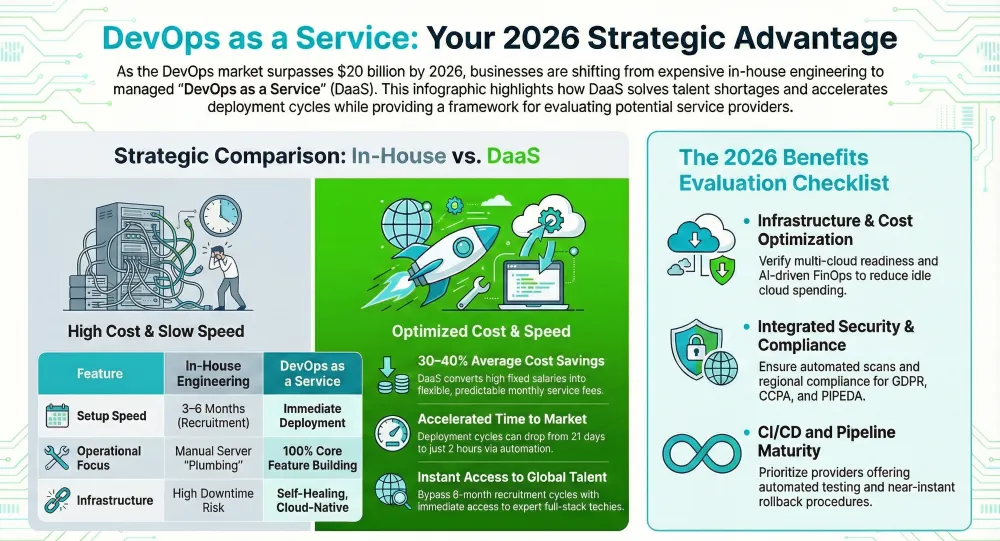
The Ultimate DevOps as a Service Benefits Evaluation Checklist
Use this detailed checklist to measure the potential value of a DaaS provider. Each point represents a critical area where your business can gain a competitive edge.
Checklist Point 1: Infrastructure Automation and Scalability
- Assess Infrastructure as Code (IaC): Does the provider use tools like Terraform or Ansible? This ensures your servers are “written” in code, making them easy to rebuild and scale.
- Evaluate Multi-Cloud Readiness: Can the service operate across AWS, Azure, and Google Cloud? This is vital for businesses in the USA and UK to avoid being locked into one vendor.
- Check Auto-Scaling Capabilities: Will the system automatically grow during high traffic (like Black Friday in the USA) and shrink during slow times?
Why this matters: Automation eliminates manual errors and ensures your app stays online even when millions of users join at once.
Get scalable, fast, and user-friendly DevOps solutions tailored to your needs.
Get Free ConsultationChecklist Point 2: Cost Optimization and FinOps
- Analyze the Pricing Model: Is it a predictable monthly fee or a pay-as-you-go model? Most businesses find that converting large fixed costs (salaries) into variable costs (service fees) improves their balance sheet.
- Review Cloud Spending Reports: Does the provider offer “FinOps” (Financial Operations)? They should actively look for idle servers and suggest ways to save money on cloud bills.
- Calculate ROI: Compare the cost of 5 full-time engineers (average $130,000 each in the USA) against the cost of a managed service.
Why this matters: In a tight economy, optimizing every dollar spent on the cloud is essential for maintaining high profit margins.
Expert Insight: When evaluating Checklist Point 2 (FinOps), look for providers who don’t just report costs but use AI-driven spot instance orchestration. In 2026, simply “turning off servers” isn’t enough; your provider should be automatically shifting workloads to the most carbon-efficient and cost-effective regions in real-time.
Checklist Point 3: Security and Compliance Integration
- Verify DevSecOps Practices: Security should not be an afterthought. Ensure the provider integrates security scans directly into the development process.
- Check Regional Compliance: Does the service handle GDPR for European users, CCPA for California, and PIPEDA for Canada?
- Audit Trail Availability: Can the provider produce reports for auditors at any time?
Why this matters: A single data breach can cost a company millions in fines and lost trust. Professional DaaS providers use full-stack techies who understand security at every layer of the application.
Checklist Point 4: CI/CD Pipeline Maturity
- Measure Deployment Frequency: Can the provider help you move from monthly releases to daily or even hourly releases?
- Evaluate Automated Testing: Are unit tests, integration tests, and UI tests automated? This prevents “buggy” code from reaching your customers.
- Review Rollback Procedures: If something goes wrong, can the system automatically “undo” the update in seconds?
Why this matters: Fast delivery is useless if the software is broken. A mature pipeline ensures both speed and quality.
Checklist Point 5: Team Collaboration and Culture
- Assess Communication Tools: Does the provider use Slack, Microsoft Teams, or Jira to stay in sync with your developers?
- Evaluate Knowledge Transfer: Will the service provider train your internal staff? You want a partner, not a “black box” that keeps all the secrets.
- Check for “Full-Stack” Expertise: Ensure the team has full-stack techies who understand how a change in the database affects the user experience.
Why this matters: DevOps is as much about culture as it is about tools. A good partner acts as an extension of your own team.
The Future of DevOps as a Service
Looking ahead to 2027 and beyond, several trends will shape the industry:
- AI and Machine Learning (AIOps): Systems will soon be able to fix themselves before a human even knows there is a problem. AI will predict outages by looking at patterns in data.
- Platform Engineering: Instead of just “doing DevOps,” companies will build internal platforms that allow developers to “self-serve” their own infrastructure.
- Sustainability and Green Ops: There is a growing focus in Europe on reducing the carbon footprint of data centers. Future DaaS providers will optimize code not just for speed, but for energy efficiency.
- Serverless Dominance: More businesses will move toward serverless computing, where you only pay for the exact millisecond your code runs.
Conclusion
Evaluating DevOps as a Service benefits is a vital step for any tech-forward company in 2026. Whether you are based in the USA, UK, Canada, or Europe, the ability to automate your infrastructure and secure your data is a major advantage.
By using the checklist provided, you can ensure that your chosen partner offers the scalability, cost-efficiency, and security your business needs. Remember that the goal is not just to save money, but to create a faster, more reliable way to deliver value to your customers.
Working with expert full-stack techies through a managed service model allows your business to stay lean while competing with global giants. It is time to move past manual processes and embrace the future of automated, cloud-native operations.
Also Read: The Ultimate Guide to AWS DevOps as a Service (2026 Edition)



