

DevSecOps vs DevOps (2026 Edition): Why Speed is Dead Without Security
DevSecOps vs DevOps is no longer a technical debate—it’s a strategic necessity in 2026. While DevOps prioritizes speed and automation, DevSecOps embeds security directly into CI/CD pipelines, cloud infrastructure, and application development.


Introduction: The Post-Speed Era of Software Engineering
Welcome to 2026. If you are still following the 2020 playbook of “moving fast and breaking things,” you are likely already falling behind. In today’s landscape, the cost of a single security breach has skyrocketed, and the sophistication of AI-powered cyberattacks means that “speed” is no longer the primary metric for success. Resilience is.
The debate of DevSecOps vs DevOps has moved past simple definitions. It is now about survival. In a world where Gartner predicts that 80% of software engineering organizations will have shifted to platform engineering by 2027, the role of the developer has transformed. We are no longer just writing code; we are orchestrating entire ecosystems.
This is where Full-Stack Techies come in. In 2026, a true full-stack development company isn’t just a team that knows React and Node.js. It’s a strategic technology partner that understands the entire pipeline—from architecture planning and the first line of code to secure, automated deployment across complex multi-cloud environments.
In this exhaustive 2026 guide, we will explore the difference between DevOps and DevSecOps, dive into the rise of secdevops vs devsecops, and explain why your choice of methodology will define your scalability in the coming years.
Quick Comparison: DevSecOps vs. DevOps in 2026
- DevOps focuses on the continuous integration and delivery (CI/CD) of software to maximize speed and efficiency.
- DevSecOps integrates automated security at every stage of the lifecycle, shifting security “left” to ensure resilience without sacrificing velocity.
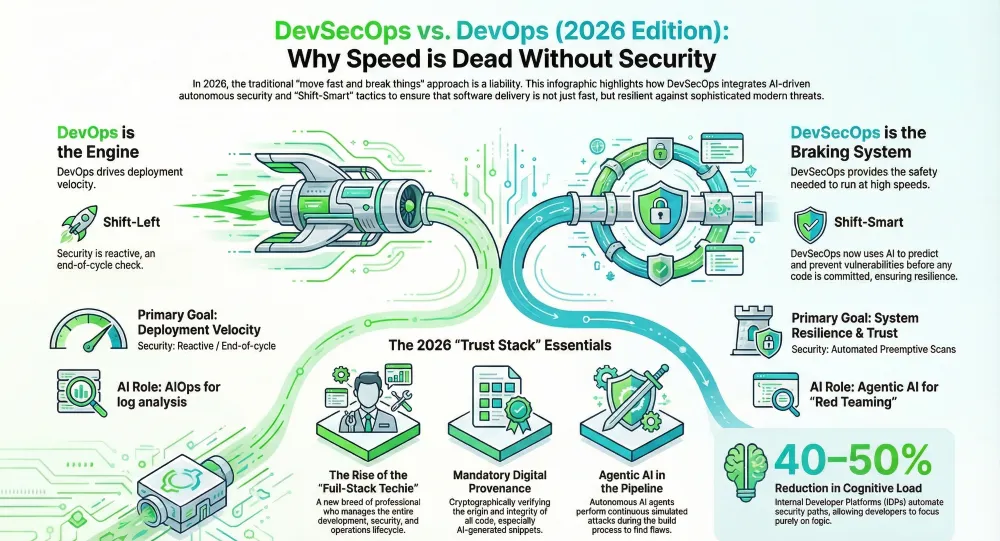
- The 2026 Verdict: While DevOps is the engine, DevSecOps is the braking system that allows the engine to run safely at high speeds in an AI-threat landscape.
Key Takeaways for “DevSecOps vs DevOps: The 2026 Edition”
- From “Shift-Left” to “Shift-Smart”: In 2026, simply doing security “early” isn’t enough. DevSecOps now utilizes AI-driven preemptive cybersecurity to predict vulnerabilities before a single line of code is committed, moving from manual scanning to autonomous risk prevention.
- The Rise of the “Advanced Techie”: The siloed DevOps Engineer is being replaced by the techie—a versatile professional who manages the entire “Trust Stack.” This role integrates development, security, and operations into a single, high-talent-density workflow.
- Platform Engineering is the New Foundation: Internal Developer Platforms (IDPs) are now the standard for scaling. They provide a “Golden Path” that embeds security and operations automatically, reducing developer cognitive load by 40–50%.
- Observability 2.0 & Self-Healing Systems: We have moved beyond reactive monitoring. 2026 is the era of AIOps, where systems use multi-agent AI to detect anomalies and self-remediate production issues in real-time, often before the Ops team is even alerted.
- Digital Provenance is Mandatory: With the explosion of AI-generated code, verifying the “ancestry” of your software is critical. DevSecOps now incorporates Digital Provenance and SBOMs (Software Bill of Materials) to cryptographically verify code integrity and origin.
- Agentic AI in the Pipeline: The 2026 CI/CD pipeline is no longer just a sequence of scripts; it’s an ecosystem of autonomous AI agents. These agents perform continuous “Red Teaming” (simulated attacks) to find and fix flaws during the build process.
- Sovereign Cloud (Geopatriation): Scalability in 2026 involves navigating geopolitical risks. Modern DevSecOps strategies prioritize Geopatriation, ensuring that data and operations can be shifted to regional or sovereign cloud providers to meet evolving global compliance laws.
- Speed is a Commodity; Resilience is the Moat: While DevOps mastered release velocity, DevSecOps provides business resilience. In 2026, companies aren’t judged by how fast they ship, but by how reliably their systems survive under constant, AI-powered threat landscapes.
What Are We Comparing? (The 2026 Context)
DevOps: The Engine of Automation
In 2026, DevOps remains the fundamental framework for breaking down silos between development and operations. Its goal is still the same: high-velocity delivery. However, DevOps in 2026 is heavily powered by AIOps (AI for IT Operations). It uses machine learning to analyze logs, predict failures, and automate the mundane parts of the CI/CD (Continuous Integration/Continuous Deployment) pipeline.
DevSecOps: The Shield of Intelligence
DevSecOps is the evolution that treats security as a living, breathing part of the development cycle. In 2026, this isn’t just about “shifting left.” It’s about “shifting smart.” It integrates AI-driven threat modeling and Preemptive Cybersecurity (a top Gartner trend for 2026) directly into the developer’s workflow. It ensures that security isn’t a bottleneck but a feature of the software itself.
The Detailed Breakdown: DevSecOps vs DevOps
1. Security: From “Afterthought” to “Ancestry.”
The most profound difference between DevOps and devsecops lies in the “ancestry” of the code.
- DevOps Approach: In a traditional DevOps environment, security is often handled by a separate team or performed at the end of the sprint. While automation makes this faster than the old “Waterfall” days, it still creates a “us vs. them” mentality.
- DevSecOps Approach: In 2026, DevSecOps uses Digital Provenance. This technology verifies the origin and integrity of every piece of code, including AI-generated snippets. Security is baked into the “ancestry” of the software. If a full-stack techie uses an AI agent to generate a function, a DevSecOps pipeline automatically scans it for “Prompt Injection” risks before it even reaches the repository.
2. Speed: The Myth of the DevSecOps Slowdown
There is a common misconception that adding “Sec” to “DevOps” slows everything down. In 2026, the opposite is true.
- The DevOps Speed Trap: Without integrated security, a team might deploy five times a day. However, if one of those deployments contains a critical vulnerability, the entire team must stop for a week to fix the “Production Fire.”
- The DevSecOps Velocity: By using Preemptive Cybersecurity, DevSecOps teams catch 90% of issues during the coding phase. Forbes recently noted that “Vibe Coding”—where developers rely on AI to generate code they don’t fully understand—is a major risk in 2026. DevSecOps mitigates this by providing automated guardrails, allowing teams to maintain a high release velocity without the fear of a catastrophic rollback.
3. Scalability: Handling the “AI Explosion”
As we look toward 2027, scalability is no longer just about server load; it’s about complexity management.
- DevOps Scalability: Relies on Kubernetes and Serverless architectures to handle millions of users. It focuses on infrastructure elasticity.
- DevSecOps Scalability: Relies on Confidential Computing and AI Security Platforms. It ensures that as you scale from 1,000 to 1,000,000 users, your data remains encrypted even while in use. For a full-stack techie, this means building systems that are “secure by design,” allowing the business to expand into highly regulated markets (like Healthcare or Finance) without re-architecting the entire stack.
2026 Comparison Table
| Feature | DevOps (2026 Standard) | DevSecOps (2026 Standard) |
|---|---|---|
| Primary Goal | Deployment Velocity & Automation | System Resilience & Trust |
| Security Integration | End-of-cycle audit or reactive | “Shift-Smart” automated preemptive scans |
| AI Role | AIOps for log analysis & failure prediction | Agentic AI for “Red Teaming” & threat modeling |
| Core Methodology | CI/CD Pipeline efficiency | Security-as-Code & Digital Provenance |
| Risk Mitigation | Focus on infrastructure elasticity | Protection against “Vibe Coding” & Prompt Injection |
| Developer Role | Specialized Operations/Dev roles | Full-Stack Techies owning the “Trust Stack” |
Get scalable, fast, and user-friendly DevOps solutions tailored to your needs.
Get Free ConsultationThe Nuance: SecDevOps vs DevSecOps
In your research, you may have come across the term SecDevOps. While they look similar, the priority shift is vital for high-stakes industries.
- DevSecOps: Security is a partner. The goal is to balance security with speed. This is the standard for 90% of SaaS companies.
- SecDevOps: Security is the leader. In this model, the security team defines the “Security as Code” parameters before a single line of application logic is written.
Expert Insight: “If you are building a social media app, use DevSecOps. If you are building a heart-rate monitor or a central bank digital currency (CBDC), you need SecDevOps.” — Industry Consensus, 2026.
Why the “Full-Stack Techies” is the Key to 2026
In the past, you had “Developers,” “Security Guys,” and “Ops Guys.” In 2026, those walls have crumbled. The industry is now dominated by full-stack techies.
Who is Full-Stack Techies?
Full-Stack Techies is an adaptive organization who views the SDLC (Software Development Life Cycle) as a single, unified organism. We don’t just “hand off” code; we own the outcome.
Why they prefer DevSecOps:
- Autonomy: They use tools like Internal Developer Platforms (IDPs) to provision their own secure environments.
- Efficiency: They appreciate automated security feedback because it prevents them from being paged at 3:00 AM for a breach.
- Career Growth: The demand for engineers who understand both AI-native development and preemptive security is at an all-time high.
Industry Updates: Insights from Forbes and Gartner
Gartner: The Rise of Multiagent Systems (MAS)
According to the Gartner Top Strategic Technology Trends for 2026, Multiagent Systems—collections of AI agents working together—will revolutionize DevSecOps. These agents will autonomously perform “Red Teaming” (simulating attacks) and “Blue Teaming” (defending) within your CI/CD pipeline, making the DevSecOps vs DevOps gap even wider.
Forbes: Redefining Risk in the AI Era
A recent Forbes Tech Council article highlighted that “Confidence is replacing comprehension” in modern development. With AI writing more code, the human element (the full-stack techie) must act as the “Orchestrator.” Forbes suggests that by late 2026, companies without a formal DevSecOps strategy will be uninsurable against cyber risks.
The 2026 Tooling Landscape
To implement these methodologies effectively, you need a modern stack. Here is what the leading full-stack techies are using this year:
The DevOps Stack (Efficiency Focused)
- Orchestration: Kubernetes v1.3x (with integrated AIOps).
- Infrastructure: Pulumi (for Cloud-as-Code) and Terraform.
- Deployment: ArgoCD (for GitOps-driven delivery).
- Experience: Backstage (for Internal Developer Portals).
The DevSecOps Stack (Resilience Focused)
- Security Scanning: Wiz and Snyk (AI-enhanced vulnerability detection).
- Identity: HashiCorp Vault (Zero Trust secret management).
- Runtime Protection: Aqua Security (for container and serverless defense).
- Observability: Honeycomb (Observability 2.0 for high-cardinality data).
Alternatives Section: Beyond the Traditional Models
While DevSecOps vs DevOps are the main players, 2026 has introduced specialized alternatives:
- Platform Engineering: Focusing on building a “golden path” for developers. It’s less about the process and more about the platform that enforces DevOps/Sec principles automatically.
- MLOps / LLMOps: Specifically for teams building AI models. It focuses on the data pipeline, model versioning, and “Prompt Security.”
- DataOps: A methodology centered around data quality and flow, essential for big-data enterprises.
- No-Ops: The futuristic goal where the cloud provider handles all operations, leaving the full-stack techie to focus purely on business logic.
Technical Insight: Platform Engineering in 2026 refers to the practice of building Internal Developer Platforms (IDPs) that provide “golden paths”—pre-configured, secure workflows—that allow developers to deploy code without needing to manually configure underlying Kubernetes security protocols.
Which Methodology Is Right for Your 2026 Strategy?
Match Your Persona
- The High-Growth Startup: You need DevSecOps. You cannot afford a breach that kills your reputation before you’ve even scaled. Your full-stack techies should be empowered with automated security tools from day one.
- The Legacy Enterprise: You are likely in a DevOps transition. Focus on “Modernizing” into DevSecOps by slowly introducing security automation into your existing pipelines.
- The AI Innovator: You need LLMOps + DevSecOps. Since you are dealing with generative AI, you must protect against data poisoning and model theft.
- The Government/Fintech Agency: SecDevOps is your only choice. The risk of failure is too high for anything less than a security-first architecture.
Conclusion: Designing for the 2027 Horizon
As we wrap up this 2026 comparison, one thing is clear: the difference between devops and devsecops is no longer just about tools; it’s about culture and talent density.
The “DevOps” of yesterday was about breaking down walls. The “DevSecOps” of tomorrow is about building a foundation of trust. By embracing the role of the full-stack techie and integrating AI-driven security at every level, you aren’t just shipping code faster—you are shipping code that lasts.
The future belongs to those who can balance the raw power of AI with the surgical precision of modern security. Whether you choose DevOps or DevSecOps, ensure your team is equipped for the Preemptive Cybersecurity era.
Why Trust This Comparison?
This article was constructed using the latest Q1 2026 reports from the Gartner IT Symposium/Xpo and Forbes Tech Council insights. Our methodology focuses on “Future-Proofing” your tech stack by analyzing the intersection of AI, Security, and Human Talent. We prioritize factual accuracy, technical depth, and the real-world experiences of full-stack techies in the field.



