

How to Hire a DevOps Engineer: Skills, Rates & Red Flags to Watch in 2026
Looking to Hire a DevOps Engineer in 2026? This guide covers essential skills, current market rates, and critical red flags to watch for. Learn how to identify the right talent to build scalable, efficient DevOps teams and accelerate your software delivery.


Introduction
If your team is struggling with slow deployments, fragile infrastructure, or endless “it works on my machine” debates, there’s a good chance you need to hire a DevOps engineer — and fast. In 2026, DevOps is no longer a nice-to-have; it is the backbone of modern software delivery.
But here’s the challenge: the demand for qualified DevOps professionals has outpaced supply for years. Knowing how to hire a DevOps engineer — what skills to look for, what fair rates look like, and which warning signs to avoid — is now a strategic advantage for any business.
This guide pulls together the latest industry data, real salary benchmarks, and practical interview tactics so you can hire dedicated DevOps engineers confidently, whether you’re a startup, a scale-up, or an enterprise team. We’ll also share how Full-Stack Techies can remove the friction from your entire hiring process.
Key Takeaways
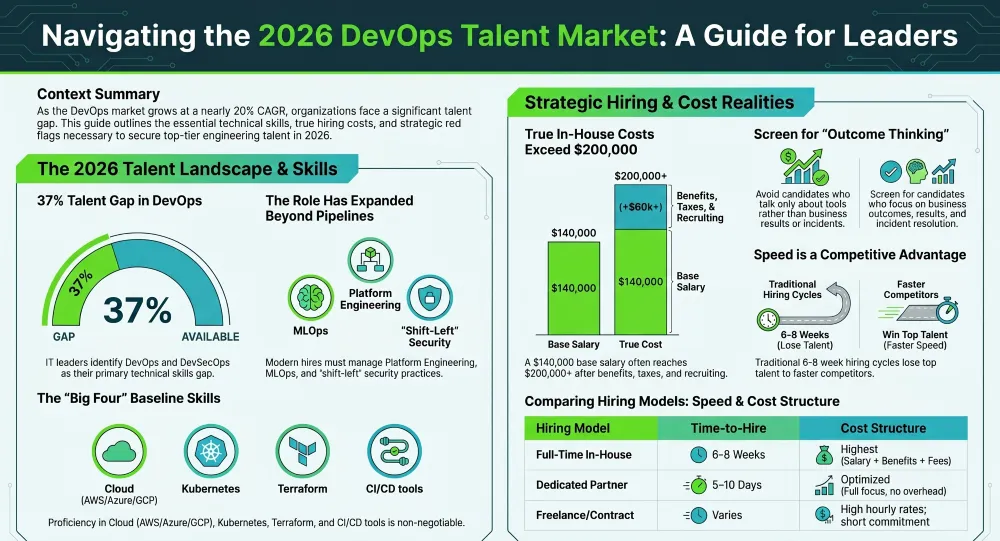
1. DevOps Hiring Is a Strategic Priority, Not an Option. The global DevOps market is growing at 19.7% CAGR and 37% of IT leaders already cite DevOps skills as their number one talent gap. Companies that delay hiring skilled DevOps engineers risk falling behind competitors who are shipping faster, deploying more reliably, and scaling infrastructure more efficiently.
2. The Role Has Expanded Beyond Pipelines. In 2026, a DevOps engineer is expected to handle far more than CI/CD automation. Platform Engineering, MLOps pipelines, DevSecOps practices, and Internal Developer Platforms are now core parts of the role — making it critical to define exactly what you need before you start the hiring process.
3. Technical Skills Must Be Backed by Practical Depth. Cloud platforms, Kubernetes, Terraform, Docker, and CI/CD tooling are the baseline. But the best candidates connect every technical decision to a business outcome. When you hire DevOps engineers, test for real-world problem-solving, not just tool familiarity or certification.
4. Know Your Hiring Model Before You Post the Job. Full-time, dedicated remote, freelance, and consulting team engagements all serve different needs and budgets. For most growing companies in 2026, hiring a dedicated DevOps engineer through a trusted partner like Full-Stack Techies delivers the best balance of quality, speed, and cost efficiency.
5. True Hiring Costs Are Often Underestimated. A $140,000 salary can easily become a $200,000+ first-year investment when you add benefits, payroll taxes, recruiting fees, and onboarding time. Understanding the full cost of direct hiring is essential before deciding whether to hire a DevOps engineer in-house or through a staffing partner.
6. Salary Benchmarks Vary Widely by Region and Seniority. US-based senior DevOps engineers command $145,000–$175,000 annually while comparable talent in Eastern Europe or South Asia can be hired at $45–$95 per hour on a contract basis. Knowing current market rates gives you a real negotiating advantage and helps you avoid overpaying or losing top candidates with low offers.
7. Speed Is a Competitive Advantage in Hiring. Top DevOps engineers receive multiple offers at the same time. The average direct hire takes 6–8 weeks — far too slow in today’s market. Partnering with Full-Stack Techies compresses that timeline to 5–10 business days with pre-vetted candidates ready to interview immediately.
8. Red Flags Are Just as Important as Green Flags. Candidates who only talk about tools, claim they’ve never faced a production incident, treat security as someone else’s job, or give vague answers about documentation are serious risks. A structured interview process that goes beyond the résumé is essential every time you look for a DevOps engineer for hire.
9. Security Is Now Inseparable from DevOps. DevSecOps is no longer a specialization — it is an expectation. Any DevOps engineer you hire in 2026 should demonstrate shift-left security thinking, familiarity with secrets management tools, and experience embedding vulnerability scanning directly into the pipeline.
10. The Right Partner Removes the Guesswork Entirely. Full-Stack Techies pre-vets every engineer with multi-stage technical assessments, matches candidates to your specific stack and culture, and delivers dedicated DevOps engineers ready to contribute from day one. Whether you need one engineer or an entire DevOps team, partnering with Full-Stack Techies is the most efficient and reliable path to hiring right in 2026.
Who Is This Guide For?
This guide is designed for decision-makers who need to bridge the gap between development and operations efficiently:
- CTOs and VPs of Engineering: Scaling your platform engineering teams and transitioning from traditional DevOps to AIOps and GitOps.
- Startup Founders & Small Business Owners: Looking to hire a dedicated DevOps engineer to set up scalable cloud architecture from day one.
- HR and Talent Acquisition Managers: Navigating the complex technical jargon to understand what separates a top-tier DevOps engineer for hire from an average applicant.
- Enterprise IT Leaders: Seeking to optimize cloud spend (FinOps) and implement secure-by-design (DevSecOps) compliance at scale.
Why 2026 Is A Critical Year To Hire A DevOps Engineer
The numbers tell a compelling story. The global DevOps market was valued at an estimated $10.4 billion in 2023 and is forecast to reach $25.5 billion by 2028, growing at a CAGR of 19.7%. That isn’t incremental growth — it’s a structural shift in how organizations build and ship software.
Key statistics shaping the market right now:
- 29% of IT teams recently hired a DevOps engineer — making it the number one recruited role in IT
- 37% of IT leaders cite DevOps/DevSecOps skills as their top technical skills gap
- 80% of software companies are expected to adopt Internal Developer Platforms by 2026, according to Gartner
- More than 85% of organizations have adopted a cloud computing strategy, tightly aligned with DevOps practices (Gartner)
Sources: Spacelift DevOps Statistics 2026; Brokee Hiring Report; Gartner Cloud Forecast; DEV Community 2026 Developer Predictions.
Gartner has projected that organizations investing in Developer Experience (DevEx) will achieve twice the developer retention rate by 2027 compared to those that don’t — and DevOps engineers sit at the center of that investment. Meanwhile, 27% of security engineers identify better integration of development workflows as their primary focus for 2026, fueling the DevSecOps surge.
According to Gartner, by 2027, 80% of organizations will incorporate a DevOps platform into their development toolchain — up from just 25% in 2023. That’s an enormous adoption curve, and every organization building toward that target needs skilled DevOps engineers to lead the way.
The bottom line: if you’re not actively working to hire DevOps engineers today, you’re likely already behind your competitors.
What Does A DevOps Engineer Actually Do?
Before you post a job listing, it’s essential to understand what you’re actually hiring for. A DevOps engineer sits at the intersection of software development and IT operations. Their primary mission is to shorten the development lifecycle, improve deployment frequency, and increase system reliability — all without sacrificing security or quality.
Core responsibilities typically include:
-
- Designing, building, and maintaining CI/CD pipelines (Continuous Integration / Continuous Deployment)
- Managing and automating cloud infrastructure on platforms like AWS, Azure, or GCP
- Containerization and orchestration using Docker and KubernetesTerraform, Ansible, or Pulumi
- Infrastructure as Code (IaC) using tools like
- Monitoring, observability, and incident response using tools like Datadog, Prometheus, and Grafana
- Embedding security into pipelines — increasingly called DevSecOps
- Collaborating with developers, QA, and product teams to reduce friction in delivery
- Cost optimization of cloud resources and infrastructure
In 2026, the DevOps role has evolved further. Engineers are now expected to understand Platform Engineering — building Internal Developer Platforms (IDPs) that other developers use to deploy and manage their own code. They’re also increasingly involved in MLOps pipelines as companies scale their AI and machine learning workloads.
Quick Distinction: A DevOps Engineer focuses on pipeline automation, infrastructure, and deployment. A Site Reliability Engineer (SRE) focuses more on uptime, SLAs, and system resilience. A Platform Engineer builds the internal developer tooling layer. In smaller teams, one person often covers all three — which is why dedicated DevOps engineers command a premium.
Must-Have Skills When You Hire DevOps Engineers
One of the most common hiring mistakes is writing a job description that either asks for too much or misses critical competencies entirely. Here is a structured breakdown of the skills to prioritize when you look for a DevOps engineer for hire.
Technical Skills
Cloud Platforms: Proficiency in at least one major cloud — AWS, Azure, or GCP. Multi-cloud experience is a growing premium in 2026. Candidates who can navigate hybrid and multi-cloud environments without vendor lock-in are especially valuable.
Containerization: Docker and Kubernetes (K8s) are table stakes in 2026. Helm charts, ArgoCD, and Flux are strong signals for senior candidates who manage complex microservices deployments.
CI/CD Tooling: Hands-on experience with Jenkins, GitHub Actions, GitLab CI, CircleCI, or similar pipeline tools. The ability to design pipelines from scratch — not just maintain inherited ones — is a key differentiator.
Infrastructure as Code (IaC): Terraform is the industry standard. Ansible, Pulumi, and CloudFormation round out a strong IaC toolkit. Look for candidates who write modular, reusable IaC code, not monolithic scripts.
Scripting and Programming: Python, Bash, Go, or Ruby for automation. Comfort reading and writing code is non-negotiable — DevOps is not a no-code role. Engineers who can build internal tooling in Python or Go are especially versatile.
DevSecOps and Security: Shift-left security practices, secrets management using tools like HashiCorp Vault or AWS Secrets Manager, and vulnerability scanning tools like Snyk or Trivy. Security is no longer separate from DevOps — it’s embedded in it.
Monitoring and Observability: Prometheus, Grafana, Datadog, ELK Stack, or similar tools for metrics, logs, and distributed tracing. The ability to build meaningful dashboards and set up actionable alerts is essential.
Networking and OS: Solid understanding of Linux, TCP/IP, DNS, load balancing, and service meshes like Istio or Linkerd for enterprise-level roles. Engineers who treat networking as a black box will struggle in complex distributed environments.
Soft Skills That Separate Good from Great
Technical proficiency is the baseline. What truly distinguishes an excellent dedicated DevOps engineer from an average one is mindset and communication:
- Systems thinking — the ability to see the whole pipeline, not just their slice of it
- Proactive communication — developers and ops teams speak different languages; a great DevOps engineer bridges both
- Ownership mentality — if a deployment breaks at 2 AM, they don’t wait to be paged; they’ve already set up the alert
- Documentation habits — runbooks, playbooks, and architecture diagrams that others can actually use
- Continuous learning — the DevOps toolchain evolves every six months; the best engineers embrace that
Certifications Worth Prioritizing in 2026
Certifications don’t replace experience, but they signal commitment and structured knowledge. The most valuable ones to look for when you want to hire a DevOps engineer include:
- AWS Certified DevOps Engineer – Professional
- Certified Kubernetes Administrator (CKA)
- Microsoft Azure DevOps Engineer Expert
- Google Professional DevOps Engineer
- HashiCorp Certified: Terraform Associate
Also Read: DevOps as a Service vs In-House DevOps: Which Model Wins in 2026?
Types Of DevOps Engineers You Can Hire
Not every company needs the same kind of DevOps hire. Understanding the different options helps you match your budget and needs when you look for a DevOps engineer for hire.
By Experience Level
Junior DevOps Engineer (0–2 years): Good for teams that already have a senior engineer who can mentor. They handle basic pipeline maintenance, monitoring setup, and scripted deployments under supervision.
Mid-Level DevOps Engineer (2–5 years): The sweet spot for most growing companies. Capable of independently designing CI/CD pipelines, managing cloud environments, and contributing to IaC frameworks.
Senior DevOps Engineer (5–8 years): Architects complex multi-cloud environments, leads platform engineering initiatives, mentors junior engineers, and interfaces with leadership on infrastructure strategy.
DevOps Architect (8+ years): Designs organization-wide DevOps strategy, evaluates toolchains, and bridges the gap between engineering leadership and hands-on implementation.
By Hiring Model
Full-Time In-House: Best for companies with ongoing, complex infrastructure needs. Provides deep institutional knowledge but comes at the highest total cost — salary, benefits, equity, and recruiting fees.
Dedicated Remote Engineer: Increasingly the model of choice in 2026. A dedicated DevOps engineer works exclusively on your project but is managed through a partner like Full-Stack Techies — giving you all the benefits of a full-time hire without the overhead of direct employment.
Freelance / Contract: Ideal for defined projects such as a one-time cloud migration, a CI/CD pipeline overhaul, or a security audit. Lower long-term commitment but higher hourly rates and ramp-up friction.
DevOps Consulting Team: For enterprises undertaking major transformations, a team of DevOps engineers provides end-to-end delivery with built-in redundancy and expertise across the full stack.
Also Read: 10 Types of DevOps as a Service Models Explained
Hiring Model Comparison at a Glance
| Feature | Full-Time In-House | Dedicated Remote Engineer (Partner Model) | Freelance / Contract | DevOps Consulting Team |
|---|---|---|---|---|
| Time-to-Hire | 6–8 weeks on average. | 5–10 business days. | Varies; often faster than in-house but involves ramp-up friction. | Varies based on project scope. |
| Cost Structure | Highest total cost; a $140k salary often exceeds $200k with benefits and taxes. | Optimized; full-time focus without the overhead of direct employment. | Higher hourly rates but lower long-term financial commitment. | Project-based or retainer; provides high expertise across the full stack. |
| Commitment | Deep institutional knowledge; permanent headcount. | Works exclusively on your project; integrates with your team. | Lower long-term commitment; ideal for defined tasks. | High-level delivery with built-in redundancy and expertise. |
| Scalability | Difficult; involves lengthy recruitment and offboarding cycles. | High flexibility; scale capacity up or down based on project phases. | Moderate; dependent on individual availability. | High; can handle massive transformations or greenfield projects. |
| Best Use Case | Ongoing, complex infrastructure needs requiring permanent staff. | Growing companies needing quality, speed, and cost efficiency. | Short-term migrations, one-time audits, or specific overhauls. | Enterprises undertaking major technical transformations. |
DevOps Engineer Rates & Salary Benchmarks For 2026
Understanding market rates is critical before you start negotiations. Here’s a comprehensive breakdown of what it costs to hire DevOps engineers across different models in 2026.
Annual Salaries — United States (Full-Time)
- Junior (0–2 years): $83,000 – $115,000 per year / ~$40–55 per hour
- Mid-Level (2–5 years): $115,000 – $145,000 per year / ~$55–70 per hour
- Senior (5–8 years): $145,000 – $175,000 per year / ~$70–86 per hour
- DevOps Architect (8+ years): $175,000 – $340,000+ per year / ~$85–165 per hour
Sources: Glassdoor (March 2026), Salary.com (January 2026), Robert Half 2026 Salary Guide.
Freelance / Contract Hourly Rates — Global
- North America — Junior: $40–65/hr | Mid: $65–100/hr | Senior: $100–150/hr | Architect: $150–200+/hr
- Western Europe — Junior: $35–55/hr | Mid: $55–85/hr | Senior: $85–130/hr | Architect: $130–180/hr
- Eastern Europe — Junior: $20–35/hr | Mid: $35–60/hr | Senior: $60–95/hr | Architect: $90–130/hr
- Latin America — Junior: $18–30/hr | Mid: $30–55/hr | Senior: $55–85/hr | Architect: $80–120/hr
- South/Southeast Asia — Junior: $15–25/hr | Mid: $25–45/hr | Senior: $45–75/hr | Architect: $70–110/hr
Sources: Abbacus Technologies 2026 Hourly Rate Guide; Arc.dev DevOps Hiring Data; ZipRecruiter 2026.
Skill Premiums in 2026: Candidates with multi-cloud certifications, DevSecOps expertise, Kubernetes administration credentials, or hands-on AI/MLOps experience command a 15–30% premium over standard market rates. Budget accordingly if these are core requirements.
The Hidden Costs of Hiring In-House
The sticker salary is just the start. When you factor in benefits, payroll taxes, recruiting fees (typically 15–20% of first-year salary), onboarding time, software licenses, and the productivity lag of a new hire, the true first-year cost of a $140,000 DevOps engineer often exceeds $200,000. This is why many companies choose to hire dedicated DevOps engineers through a trusted partner like Full-Stack Techies instead.
Get scalable, fast, and user-friendly DevOps solutions tailored to your needs
Get Free ConsultationWhere To Find A DevOps Engineer For Hire
Knowing where to look is half the battle. Here are the most effective channels for finding a quality DevOps engineer for hire in 2026:
Specialized Tech Staffing Firms: Companies like Full-Stack Techies pre-vet candidates with technical assessments, meaning you interview engineers who have already proven their skills — not just polished their résumés. This cuts your time-to-hire by weeks, not days.
LinkedIn Talent Solutions: Still the largest professional network for tech hiring. Use Boolean search strings combining skills like “Kubernetes + Terraform + AWS + CI/CD” and filter for candidates who have shipped real projects.
GitHub and GitLab Profiles: A DevOps engineer’s public repositories are worth more than any cover letter. Active contributors to open-source infrastructure tools, well-documented IaC repos, and clean commit histories are strong green flags.
Curated Talent Platforms: Platforms like Toptal, Arc.dev, and Gun.io offer engineers who have passed skills assessments. Higher hourly rates, but lower screening burden on your end.
DevOps and Cloud Communities: Communities on Slack (Hangops, CNCF Slack), Reddit (r/devops), Stack Overflow Careers, and conferences like KubeCon, HashiConf, and AWS re:Invent are great for finding engineers who are genuinely passionate about the craft.
Referrals: Still the highest signal-to-noise ratio. A recommendation from your existing engineering team carries enormous weight because engineers know what “good” actually looks like in this space.
How To Interview A DevOps Engineer
The interview process for a DevOps engineer should go beyond whiteboard algorithms. You need to test real-world infrastructure thinking, incident response instincts, and the ability to communicate across teams.
Stage 1: Technical Screening (30–45 minutes)
Cover the basics: Can they explain CI/CD, IaC, and containerization concepts clearly? Do they understand the difference between orchestration and configuration management? A quick take-home exercise — like reviewing a broken Dockerfile or a misconfigured Terraform plan — reveals practical skill quickly and honestly.
Stage 2: System Design Interview (60 minutes)
Give them a realistic scenario. Example: “Design the CI/CD pipeline and deployment architecture for a microservices application that needs to handle 10,000 requests per second with 99.9% uptime.” Listen for how they think about trade-offs, failure modes, observability, and rollback strategies — not just the happy path.
Stage 3: Behavioral and Cultural Interview (45 minutes)
Use the STAR method (Situation, Task, Action, Result) to explore how they’ve handled real production incidents, cross-functional friction, and evolving requirements under pressure.
Top Interview Questions When You Hire a DevOps Engineer
- “Walk me through the last major deployment pipeline you built from scratch.” — Tests depth and genuine ownership.
- “Describe a production outage you were responsible for. What happened, and what did you change afterward?” — Tests accountability and learning mindset.
- “How do you decide whether to use managed cloud services versus self-hosted infrastructure?” — Tests cost and complexity trade-off thinking.
- “How would you introduce DevSecOps practices to a team that currently has none?” — Tests cultural change skills, not just technical ability.
- “What’s your approach to infrastructure drift? How do you detect and remediate it?” — Tests IaC maturity and operational discipline.
- “How do you communicate an infrastructure decision to a developer who strongly disagrees with your approach?” — Tests collaboration and soft skills under pressure.
- “What’s your monitoring strategy for a distributed system across three cloud regions?” — Tests observability depth and system resilience thinking.
Red Flags To Watch Before You Hire
A polished résumé can hide a lot. Here are the warning signs to watch for during the process to hire DevOps engineers — signals that the candidate may not be the right fit despite looking good on paper.
They can only talk about tools, not outcomes. If every answer is “I implemented Kubernetes” without any discussion of what problem it solved, what trade-offs were made, or what the measurable result was — that’s a red flag. Great DevOps engineers tie technical decisions to business impact.
No public code, repos, or contributions. Not mandatory — but a senior candidate with zero public GitHub activity, no technical blog, and no community involvement should at minimum explain why. Ask to see private work samples with sensitive data redacted.
They claim they’ve “never had a production incident.” Every experienced engineer has dealt with incidents. Someone who claims otherwise either lacks experience, hasn’t worked in high-stakes environments, or isn’t being honest. You want someone who has made mistakes and learned from them.
Over-reliance on a single cloud or single tool. AWS-only tunnel vision, or a candidate who dismisses Kubernetes as “over-engineered” without nuance, signals inflexibility. In 2026, multi-cloud awareness and pragmatic tool selection are baseline expectations for senior roles.
Security is an afterthought. Any candidate who describes security as “handled by the security team” or “something we add at the end” is misaligned with modern DevSecOps expectations. Security is now a shared responsibility embedded in the pipeline from day one.
Vague answers about documentation and runbooks. If they can’t describe how they document their pipelines, incident response procedures, or infrastructure changes, your team will inherit a black box. Good DevOps practice is repeatable — and that requires clear, maintained documentation.
Poor communication with non-technical stakeholders. DevOps engineers work across product, engineering, QA, and leadership. If the candidate can’t explain a deployment risk in plain English during the interview, they won’t be able to do it in a board meeting either.
Certifications without practical depth. Certifications are positive signals, not proof of competence. If a candidate has an AWS DevOps Pro certification but can’t walk through a multi-region failover scenario, the cert is padding — not substance.
Why Full-Stack Techies Is Your Best Hiring Partner
Finding the right talent in a competitive market is time-consuming, expensive, and fraught with risk. That’s exactly why Full-Stack Techies exists — to take the complexity out of how to hire a DevOps engineer and give you access to pre-vetted, production-ready talent faster than any traditional hiring channel.
Whether you’re looking to hire dedicated DevOps engineers for a long-term embedded role, bring in a contract specialist for a cloud migration, or staff an entire DevOps team for a greenfield project, Full-Stack Techies delivers engineers who are matched to your stack, your culture, and your timeline.
What Sets Full-Stack Techies Apart
Technical pre-vetting: Every engineer in our talent network passes multi-stage assessments covering CI/CD design, cloud architecture, and real-world debugging scenarios before you ever see their profile. You’re not sorting through résumés — you’re evaluating proven candidates.
Dedicated engagement model: Our dedicated DevOps engineers work exclusively on your project, embed with your team, and operate in your time zone — not juggling five clients at once like a typical freelancer. You get the focus of a full-time hire with the flexibility of a partner model.
Full-stack coverage: Need a DevOps engineer who can also contribute to backend services or cloud-native application development? Our engineers are often T-shaped — deep in DevOps, broad across the modern stack — making them immediately useful across your engineering organization.
Fast time-to-hire: We typically match companies with qualified candidates within 5–10 business days, compared to the industry average of 6–8 weeks for direct hiring. In a market where top DevOps engineers receive multiple offers simultaneously, speed matters enormously.
Flexible scaling: Scale your DevOps capacity up or down based on project phases, sprint cycles, or product launches — without the overhead of permanent headcount changes. Hire one engineer today, scale to a team of five next quarter.
Transparent pricing: No hidden fees, no surprise markups. You know exactly what you’re paying and what you’re getting from day one.
If you’re serious about how to hire DevOps engineers who will actually move the needle — not just fill a seat — Full-Stack Techies is the partner built for exactly that.
Final Hiring Checklist
Before you make your hire, run through this checklist to make sure you’ve done your due diligence when deciding to hire a DevOps engineer for your team.
- Clearly defined job description with specific tools, platforms, and responsibilities — not a generic list of buzzwords
- Realistic salary range benchmarked to 2026 market data based on experience level and engagement model
- Technical assessment designed to test real-world problem-solving, not memorized trivia or textbook answers
- System design interview covering CI/CD pipeline design, cloud architecture, and failure handling scenarios
- Behavioral interview covering incident response, cross-functional collaboration, and documentation habits
- Reference checks with previous managers or tech leads — specifically asking about reliability under pressure
- Red flag review completed: no unexplained security blind spots, no tool-only thinking, no implausible “never had an incident” claims
- Clear alignment on engagement model: full-time, dedicated remote, or contract based on your actual project needs
- Onboarding plan ready before day one: environment access, runbook handoff, and first 30/60/90-day milestones defined
- Consider partnering with Full-Stack Techies to access pre-vetted talent and cut time-to-hire dramatically
Common Mistakes to Avoid
When trying to hire a DevOps engineer, avoid these costly pitfalls:
- Ignoring Security (DevSecOps): Treating security as an afterthought is the biggest risk in 2026. If a candidate cannot explain basic container hardening or IAM least-privilege principles, do not hire them.
- Hiring a “Resume Engineer”: Some candidates list 50 tools on their resume (Chef, Puppet, Ansible, Terraform, Kubernetes, Nomad, etc.). Usually, they only have surface-level knowledge. Look for deep mastery of a few modern tools rather than shallow knowledge of everything.
- Focusing on Uptime Over MTTR: While uptime is great, systems will fail. An excellent DevOps engineer optimizes for Mean Time To Recovery (MTTR) rather than chasing an impossible 100% uptime without failure planning.
- Not Partnering with Experts: Trying to vet highly technical cloud architecture skills without an internal expert can lead to disastrous hires. Utilizing services like Full-Stack Techies ensures the technical screening is handled by seasoned architects.
Bottom Line
The demand for skilled DevOps engineers will only intensify through 2026 and beyond as organizations race to adopt cloud-native infrastructure, Platform Engineering, and AI-integrated pipelines. Companies that move fast, hire smart, and partner with the right talent providers will pull ahead. Those that wait, over-screen, or underpay will keep losing candidates to competitors.
Full-Stack Techies is here to make sure you’re in the first camp — not the second. Reach out today to tell us about your project, your stack, and your timeline. We’ll match you with a pre-vetted DevOps engineer for hire — usually within a week.
Also Read: The Ultimate Guide to DevOps as a Service (DaaS) in 2026



