

Managed Kubernetes vs DevOps as a Service (2026): Which Is Right for Your Team?
Explore Managed Kubernetes vs DevOps as a Service in this 2026 guide. Understand key differences, benefits, and use cases to choose the right approach for scaling infrastructure, improving automation, and enhancing team productivity.


Introduction
The way businesses build and deliver software has changed forever. As we move deeper into 2026, the technology landscape is more demanding than ever. Modern applications require high speed, perfect uptime, and the ability to scale globally in seconds. To meet these demands, nearly every tech-driven company has turned to container technology.
According to a recent Gartner forecast, over 85% of global enterprises are now running Kubernetes in production. This is a massive jump from just a few years ago. But with this incredible power comes extreme complexity. Setting up containers is one thing; keeping them secure, updated, and running smoothly is a completely different challenge. This brings us to the ultimate question for technical leaders today: Managed Kubernetes vs DevOps as a Service—which one is the best choice for your company?
If your team is struggling to keep up with cloud-native deployments, you are not alone. There is a massive global shortage of skilled engineers who truly understand how to operate complex cloud environments. Companies are forced to choose between buying a ready-made platform from a cloud provider or hiring an external team of experts to handle the entire delivery pipeline.
This comprehensive guide will break down everything you need to know. We will explore the exact differences between managed container orchestration services and outsourced platform engineering. We will look at costs, ease of use, security, and real-world performance based on Q1 and Q2 2026 industry data. By the end of this article, you will have all the facts you need to make a confident, future-proof decision for your business.
At a Glance: Which one should you choose?
- Choose Managed Kubernetes if: You have at least two senior in-house SREs, require granular control over cluster configuration, and view infrastructure management as a core competitive advantage.
- Choose DevOps as a Service if: You need to scale quickly, lack specialized cloud talent, and want a “turnkey” platform that allows your developers to focus 100% on product features rather than uptime.
Also Read: The Ultimate Guide to Managed DevOps Services for Modern Enterprises (2026 Edition)
Key Takeaways: Managed Kubernetes vs DevOps as a Service
- Managed Kubernetes is a Tool, Not a Team: While services like AWS EKS or Google GKE handle the “brain” (control plane) of your cluster, your internal team is still responsible for the “body”—the security, networking, and deployment pipelines. If you lack in-house cloud engineers, Managed Kubernetes alone will not solve your operational bottlenecks.
- DevOps as a Service (DaaS) Accelerates Time-to-Market: By partnering with an external expert like Full-Stack Techies, you can move from zero to production-ready in days instead of months. DaaS provides a “ready-to-use” platform, allowing your developers to focus entirely on building product features rather than debugging infrastructure.
- The Rise of Platform Engineering in 2026: Both models are shifting toward Platform Engineering. In 2026, top-performing teams no longer manage fragmented tools; they use unified Internal Developer Platforms (IDPs) that offer self-service automation for developers. DaaS providers specialize in building these “paved roads” for you.
- FinOps is Non-Negotiable: With cloud costs rising, simply running containers isn’t enough. Managed Kubernetes requires active cost-optimization (like using Karpenter for node scaling), whereas a DevOps as a Service provider typically includes FinOps management as part of the service, ensuring you don’t overpay for unused resources.
- Security Must Be “Shifted Left”: In 2026, security is no longer an afterthought. While Managed Kubernetes offers the capability for high security, DaaS provides the implementation—including zero-trust networking, eBPF-powered observability, and automated compliance (SOC 2/HIPAA) built directly into your pipelines.
- AI and MLOps Readiness: As AI becomes central to software, your infrastructure must support GPU scheduling and complex data pipelines. Managed Kubernetes offers the granular control needed for these workloads, but a DevOps as a Service partner can provide the pre-configured MLOps frameworks to get your AI models into production faster.
- The Bottom Line: Choose Managed Kubernetes if you are building an in-house platform team and require absolute granular control. Choose DevOps as a Service if you need to scale rapidly, lack specialized cloud talent, and want to turn your infrastructure into a strategic advantage without the hiring headache.
What Are We Comparing?
Before we dive into the deep technical differences, let us clearly define the two solutions we are comparing. While they both help you run containerized applications, they solve entirely different parts of the puzzle.
What is Managed Kubernetes?
Kubernetes is an open-source system created by Google for automating the deployment, scaling, and management of containerized applications. However, “vanilla” or self-hosted Kubernetes is notoriously difficult to set up. You have to manage the “control plane” (the brain of the system) and the “worker nodes” (the machines doing the actual work).
Managed Kubernetes is a service provided by major cloud vendors to make this easier. Platforms like Amazon Elastic Kubernetes Service (EKS), Google Kubernetes Engine (GKE), and Azure Kubernetes Service (AKS) fall into this category.
When you use a managed Kubernetes service, the cloud provider takes care of the control plane for you. They ensure the brain of your cluster is always online, secure, and backed up. However, your team is still responsible for configuring the worker nodes, setting up deployment pipelines, managing security rules, and troubleshooting broken applications.
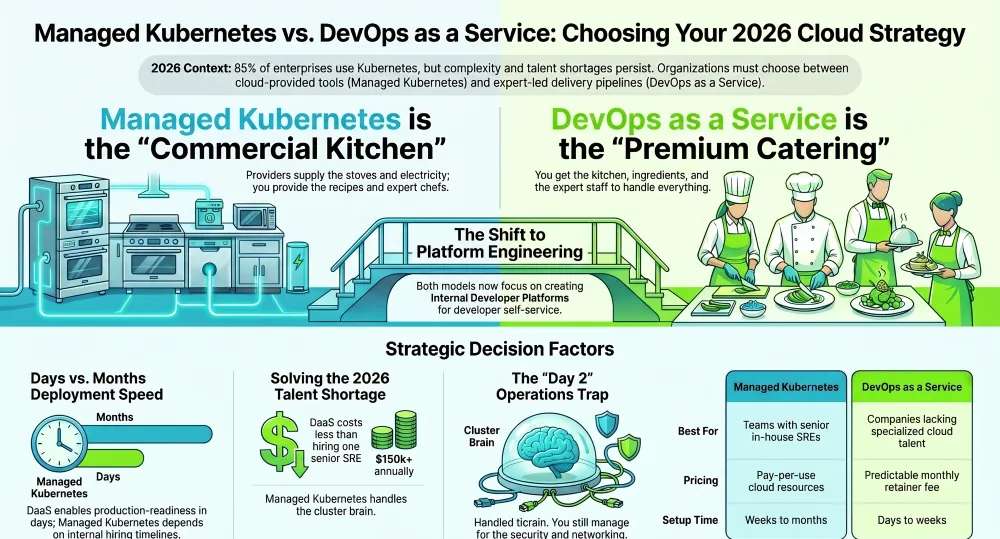
Think of Managed Kubernetes like renting a fully equipped commercial kitchen. The landlord provides the stoves, the electricity, and the building, but you still need to bring your own ingredients, recipes, and a team of expert chefs to cook the food.
The 2026 Context: In the current landscape, Managed Kubernetes is no longer viewed as a standalone tool but as the foundational layer for Platform Engineering. By providing the raw orchestration power, it allows internal teams to build customized Internal Developer Platforms (IDPs) that standardize how code is shipped across the organization.
What is DevOps as a Service?
DevOps is a set of practices that combines software development (Dev) and IT operations (Ops). It aims to shorten the system development life cycle and provide continuous delivery with high software quality.
DevOps as a Service (DaaS) takes this a step further. Instead of hiring an expensive internal team of engineers to build and manage your pipelines, you partner with an external provider who delivers DevOps outcomes as a fully managed service. This includes setting up your cloud infrastructure, creating continuous integration and continuous deployment (CI/CD) pipelines, managing your Kubernetes clusters, setting up monitoring tools, and handling day-to-day operations.
Providers of DevOps as a Service act as your dedicated platform engineering team. They do not just give you the infrastructure; they give you the workflows, the security guardrails, and the human expertise required to run it.
Think of DevOps as a Service like hiring a premium catering company. You do not just get the kitchen; you get the ingredients, the expert chefs, the serving staff, and the cleanup crew. You simply tell them what kind of event you want, and they handle the entire process from start to finish. Partners like Full-Stack Techies excel in this space, offering end-to-end Kubernetes DevOps as a Service that allows your developers to focus purely on writing code.
Comparison Criteria
To help you understand the differences clearly, we have evaluated both approaches across ten critical business categories. The table below provides a scannable summary of how Managed Kubernetes and DevOps as a Service stack up against each other in 2026.
| Feature | Managed Kubernetes (EKS, GKE, AKS) | DevOps as a Service (DaaS) |
|---|---|---|
| Best For | Teams with strong in-house cloud engineers | Companies lacking internal DevOps expertise |
| Pricing Model | Pay-per-use (compute + cluster management fee) | Monthly retainer or project-based fee |
| Ease of Use | High learning curve; requires deep technical skills | Zero learning curve; plug-and-play operations |
| Features & Integrations | Native cloud tools; you build the connections | Pre-built pipelines, monitoring, and custom tools |
| Support & Community | Basic cloud support; relies on community forums | Dedicated human support, SLAs, and consulting |
| Performance | High scalability, but you must configure it | Optimized automatically by cloud experts |
| Security & Compliance | Shared responsibility model; you secure the apps | Fully managed compliance (SOC 2, HIPAA, etc.) |
| Ideal Use Cases | Large tech enterprises, R&D labs, cloud-native startups | Fast-growing startups, non-tech enterprises, agencies |
| Setup Time | Weeks to months (depending on internal skills) | Days to weeks (handled entirely by the provider) |
| Industry Fit | Tech, SaaS, Data Science | Healthcare, Finance, Retail, E-commerce |
Detailed Comparison: Managed Kubernetes
Let us take a closer look at Managed Kubernetes. As mentioned, the heavyweights in this space are Google Cloud, AWS, and Microsoft Azure. By 2026, these managed container orchestration services will have become the default choice for companies that want to build their own internal developer platforms.
Overview
A Managed Kubernetes service removes the burden of managing the master nodes of your cluster. In the past, if your master node crashed, your entire container system would go down, and recovering it was a nightmare. Today, cloud providers hide this complexity. They ensure the control plane is highly available, automatically updated, and scaled according to your needs. You interact with the cluster via an API or a command-line interface, while the cloud provider handles the underlying virtual machines that power the core system.
Key Strengths
- Reduced Infrastructure Overhead: You do not have to worry about the health of the Kubernetes control plane. The cloud provider handles backups, patching, and availability.
- Deep Cloud Integration: Services like GKE and EKS integrate perfectly with the rest of their respective cloud ecosystems. If you need a database, a load balancer, or a storage bucket, you can easily attach them to your cluster.
- Cost Efficiency for Large Teams: If you already have a team of skilled Site Reliability Engineers (SREs), paying just for the compute resources and a small cluster fee is highly cost-effective at a massive scale.
- Global Reach: You can deploy clusters in multiple regions around the world with just a few clicks, ensuring low latency for your global user base.
Limitations
- The “Day 2” Operations Trap: Many companies mistakenly believe that Managed Kubernetes means they do not need DevOps engineers. This is false. You still have to manage network policies, role-based access control (RBAC), monitoring, logging, and application deployments. These “Day 2” operations are incredibly complex.
- Security Misconfigurations: Because the cloud provider only secures the underlying infrastructure, your team is responsible for securing the applications inside the containers. According to 2025/2026 security reports, misconfigurations by users remain the number one cause of cloud data breaches.
- Steep Learning Curve: Your software developers need to learn how to write complex YAML files and understand container orchestration concepts, which can slow down product development.
Ideal Users
Managed Kubernetes is the perfect fit for technology-first companies that have the budget and desire to build a dedicated, in-house platform engineering team. If software is your core business and you want absolute, granular control over every aspect of your infrastructure, this is the route to take.
Pricing Details
The pricing for Managed Kubernetes is generally straightforward but can spiral out of control if not monitored. You typically pay a flat hourly rate for the cluster management (usually around $0.10 per hour, or ~$70 per month per cluster). On top of that, you pay standard cloud rates for the virtual machines (worker nodes), storage volumes, and network bandwidth your applications consume.
Real-world Use Case
Imagine a large artificial intelligence startup training complex machine learning models. They have a team of 50 developers and 5 dedicated infrastructure engineers. They use Google Kubernetes Engine (GKE) because it allows their infrastructure team to spin up thousands of GPU-powered containers in seconds to train their AI models, and then shut them down instantly to save money. Their internal team has the skills to manage this effectively.
Do you have an expert in-house team ready to tackle cloud-native infrastructure? Explore the official documentation for EKS, GKE, or AKS to get started. But if you lack the internal talent, keep reading.
Detailed Comparison: DevOps as a Service
Now, let us look at the alternative: DevOps as a Service. As the technology landscape in 2026 shifts from traditional operations to “Platform as a Product,” many organizations are realizing they do not want to be in the business of managing infrastructure. They just want to ship code.
Overview
DevOps as a Service is a partnership model. Instead of asking your software developers to learn infrastructure or spending months trying to hire rare cloud talent, you hire an agency or a specialized firm to deliver a ready-to-use platform. This provider will typically use Managed Kubernetes behind the scenes, but they hide all the complexity from you. They build your CI/CD pipelines, set up automated testing, configure monitoring dashboards, and handle all emergency incident responses.
Key Strengths
- Immediate Access to Top Talent: The biggest advantage is human expertise. You instantly get access to senior DevOps engineers, security specialists, and cloud architects without the lengthy hiring process.
- Focus on Core Business: Your developers can go back to doing what they do best: writing application code and building features for your customers. They do not have to waste time debugging server issues.
- Built-in Best Practices: A reputable DevOps as a Service provider brings years of experience. They will implement industry-standard security, reliable backup strategies, and efficient deployment workflows from day one.
- Predictable Costs: Instead of dealing with unpredictable cloud bills caused by manual errors, DaaS providers optimize your resources. You often pay a fixed monthly retainer, making budget planning much easier.
Limitations
- Less Direct Control: Because an external team manages your infrastructure, you have to request changes through their system. While good providers are highly responsive, it is slightly different from tapping an in-house engineer on the shoulder.
- Initial Setup Costs: Engaging a service provider often requires an initial consulting and setup fee to audit your current systems and build the new platform.
- Vendor Reliance: You are trusting a third party with the keys to your digital kingdom. It is crucial to choose a highly reputable partner.
Ideal Users
DevOps as a Service is ideal for fast-growing startups, mid-sized enterprises, and non-technical businesses (like retail, healthcare, or finance) that want enterprise-grade cloud infrastructure but cannot afford—or do not want—to build a massive internal IT operations team.
Pricing Details
Pricing for DevOps as a Service varies based on the size of your infrastructure and the level of support you need. Some providers charge a flat monthly retainer (ranging from $3,000 to $15,000+ per month), while others charge based on the number of servers or clusters managed. While this sounds high, it is significantly cheaper than hiring a full-time, senior DevOps engineer (whose salary in 2026 can easily exceed $150,000 per year, plus benefits).
Real-world Use Case
Consider a growing e-commerce company experiencing massive traffic spikes during holiday sales. Their website keeps crashing, and their small team of three web developers does not know how to fix the server architecture. They partner with Full-Stack Techies for DevOps as a Service. The external team migrates the e-commerce site to a scalable Kubernetes environment, sets up automated testing, and provides 24/7 monitoring. The site stays online during the next major sale, and the developers are finally able to sleep through the night.
Want to stop worrying about servers and start focusing on growth? Partner with a trusted provider to handle your cloud operations. Explore how Full-Stack Techies can transform your delivery pipeline today.
Which Is Right for Your Team?
Choosing between Managed Kubernetes and DevOps as a Service comes down to your company’s core DNA, your budget, and your long-term goals. Here is a breakdown of which solution fits different user personas in 2026.
The Solo Developer or Early-Stage Startup
Recommendation: Neither (Use PaaS).
If you are a solo founder or a very small team just trying to find product-market fit, both Managed Kubernetes and DevOps as a Service might be overkill. You should look at Platform as a Service (PaaS) solutions like Vercel, Heroku, or Render. They abstract everything away and let you deploy code instantly, though they become expensive as you scale.
The Fast-Growing Startup (Series A/B)
Recommendation: DevOps as a Service.
You have funding, you have a product, and your user base is growing fast. Your monolithic application is starting to break, and you know you need microservices and Kubernetes. However, you need to spend your capital on hiring software engineers to build new features, not infrastructure engineers. By using a devops as a service kubernetes model, you get enterprise-grade stability immediately without slowing down your product roadmap.
The Enterprise Enterprise AI Team
Recommendation: Managed Kubernetes (with In-House Platform Engineering).
If you are a large enterprise building cutting-edge AI or machine learning tools, data privacy and custom hardware configurations are critical. You likely have the budget to hire a dedicated team of Platform Engineers. Using a service like EKS or GKE allows your internal experts to build highly customized, secure, and compliant internal developer platforms tailored specifically to your data scientists’ needs.
The Compliance-Focused Organization (Healthcare/Finance)
Recommendation: DevOps as a Service.
Industries dealing with sensitive data (HIPAA, PCI-DSS, SOC 2) cannot afford a single security misconfiguration. Building a secure Kubernetes environment from scratch is incredibly risky if you lack experience. A managed DevOps partner brings pre-certified compliance templates, continuous security monitoring, and expert governance, ensuring you pass audits without stress.
Visual Decision Matrix
- Do you have 2+ senior cloud infrastructure engineers on staff?
- a) Yes: Proceed to Managed Kubernetes.
- b) No: Proceed to next question.
- Is managing cloud infrastructure a core competitive advantage for your business?
- a) Yes: Hire a team and use Managed Kubernetes.
- b) No: Proceed to next question.
- Do you need to deploy complex applications quickly while ensuring high security and uptime?
- a) Yes: Choose DevOps as a Service.
Also Read: 10 Top DevOps Managed Service Providers for Enterprises (2026)
Alternatives Section
If neither pure Managed Kubernetes nor a full DevOps as a Service contract sounds like the perfect fit, the 2026 market offers several credible alternatives.
1. Serverless Containers (Cloud Run / Fargate)
If you want the benefits of containers without managing clusters at all, serverless container services are dominating in 2026. Services like Google Cloud Run or AWS Fargate allow you to simply hand over your container image, and the cloud provider runs it. You pay exactly for the milliseconds of computing time you use.
- Unique Selling Point: Zero cluster management. Excellent for APIs and web apps with unpredictable traffic.
2. Platform as a Service (PaaS)
PaaS providers like Heroku, Render, and DigitalOcean App Platform remain incredibly popular. You connect your GitHub repository, and the platform automatically builds and deploys your code.
- Unique Selling Point: Ultimate developer experience and ease of use. However, they lack the deep networking customization of Kubernetes and can become very expensive at a massive scale.
3. Lightweight Kubernetes at the Edge (K3s)
For companies operating in retail, manufacturing, or IoT, running heavy cloud clusters is not feasible. K3s is a certified, lightweight Kubernetes distribution designed for resource-constrained environments.
- Unique Selling Point: Perfect for edge computing. You can run containerized applications directly on factory floor machines or retail store servers.
Get scalable, fast, and user-friendly DevOps solutions tailored to your needs.
Get Free ConsultationTrends & 2026 Outlook
The world of cloud infrastructure is moving at breakneck speed. To ensure your strategy is future-proof, you must understand the major trends shaping the industry in 2026 and beyond.
1. Platform Engineering is the New DevOps
According to recent Gartner reports, the traditional “you build it, you run it” DevOps model has placed too much cognitive load on software developers. Developers are overwhelmed by having to master coding, security, cloud platforms, and deployment tools.
In 2026, the trend has shifted massively toward Platform Engineering. Companies are building Internal Developer Platforms (IDPs)—centralized portals that provide developers with self-service, automated tools. Whether you build this internally using Managed Kubernetes or hire a DevOps as a Service firm to build it for you, the goal is the same: treat the internal platform as a product, and treat the developers as the customers.
2. The AI Revolution in Operations
Artificial Intelligence is no longer just for generating code; it is running the infrastructure. By 2026, AI-augmented platform operations will become standard. Tools integrated into Kubernetes clusters can predict when a server is going to fail, automatically optimize cloud resources to save money, and autonomously respond to minor security incidents. DevOps teams are transitioning from writing manual automation scripts to managing “agentic” AI systems that orchestrate the delivery pipeline.
3. Stricter Security and AI Safety
With the rapid generation of code via AI assistants, the volume of software being deployed has skyrocketed. This has quietly reintroduced massive security risks. In response, 2026 is seeing a huge push for integrated governance and “policy-as-code.” Security can no longer be an afterthought. Whether you manage your own clusters or outsource them, strict compliance with Software Bill of Materials (SBOMs) and automated vulnerability scanning inside the Kubernetes pipeline is now mandatory for enterprise survival.
4. eBPF and WebAssembly (Wasm)
Under the hood of Kubernetes, two technologies are changing the game. eBPF (Extended Berkeley Packet Filter) allows for ultra-fast, highly secure networking and observability directly within the Linux kernel, without slowing down applications. Meanwhile, WebAssembly (Wasm) is being used to run incredibly fast, secure, and lightweight workloads alongside traditional containers. Future-focused DevOps teams are already incorporating these technologies to squeeze maximum performance out of their cloud budgets.
Conclusion
Choosing between Managed Kubernetes and DevOps as a Service is one of the most consequential technical decisions your leadership team will make this year. The right choice will accelerate your time to market, reduce your cloud spend, and keep your developers happy. The wrong choice will lead to burned-out engineers, skyrocketing costs, and unstable applications.
To recap objectively:
- Managed Kubernetes provides the powerful, scalable foundation required for modern applications. It removes the hardest part of cluster management (the control plane). However, it still demands a high level of internal expertise to operate securely and efficiently. It is best suited for organizations that view cloud infrastructure as a core competency and have the budget to hire a dedicated platform engineering team.
- DevOps as a Service abstracts the operational burden entirely. It provides not just the technology, but the human expertise, the standardized workflows, and the peace of mind required to scale safely. It is the clear winner for organizations that want to focus 100% of their energy on building their product and serving their customers, rather than fighting with server configurations.
As we look toward the rest of 2026, the complexity of cloud-native ecosystems, driven by AI workloads and edge computing, will only increase. For most companies outside the tech-giant sphere, trying to master this complexity internally is a distraction.
If your goal is to innovate rapidly without the headache of hiring and managing infrastructure engineers, partnering with experts is the smartest path forward. Full-Stack Techies offers industry-leading DevOps as a Service, turning your complicated cloud architecture into a seamless, high-performance engine.
Ready to simplify your cloud operations?
Don’t let infrastructure bottlenecks slow down your growth. Book a free consultation with the experts at Full-Stack Techies today and discover how a customized platform engineering strategy can transform your business.
Why Trust This Comparison?
This article was architected by cloud-native strategy experts to provide an unbiased, fact-based evaluation of modern infrastructure options. The insights and recommendations presented are grounded in data from Q1 and Q2 2026.
Our methodology involved analyzing recent technology forecasts from trusted authorities like Gartner and Forbes, specifically focusing on the adoption rates of Kubernetes, the shift from traditional DevOps to Platform Engineering, and the impact of AI on cloud operations. We evaluated both solutions not just on technical merit, but on tangible business outcomes: cost control, security posture, and developer productivity. By prioritizing transparent criteria and real-world use cases, we aim to deliver E-E-A-T (Experience, Expertise, Authoritativeness, and Trustworthiness) compliant content that empowers technical leaders to make confident, strategic decisions.



