

10 Best AI-Powered DevOps Tools to Watch in 2026
Explore the Best AI-Powered DevOps Tools to watch in 2026. This guide highlights cutting-edge tools that leverage AI to automate workflows, improve system reliability, and accelerate software delivery for modern engineering teams.


Introduction: Why AI-Powered DevOps Tools Are No Longer Optional in 2026
The DevOps landscape has crossed a critical inflection point. What began as incremental automation — smarter CI/CD pipelines, better monitoring dashboards — has transformed into something fundamentally different: software delivery powered end-to-end by artificial intelligence.
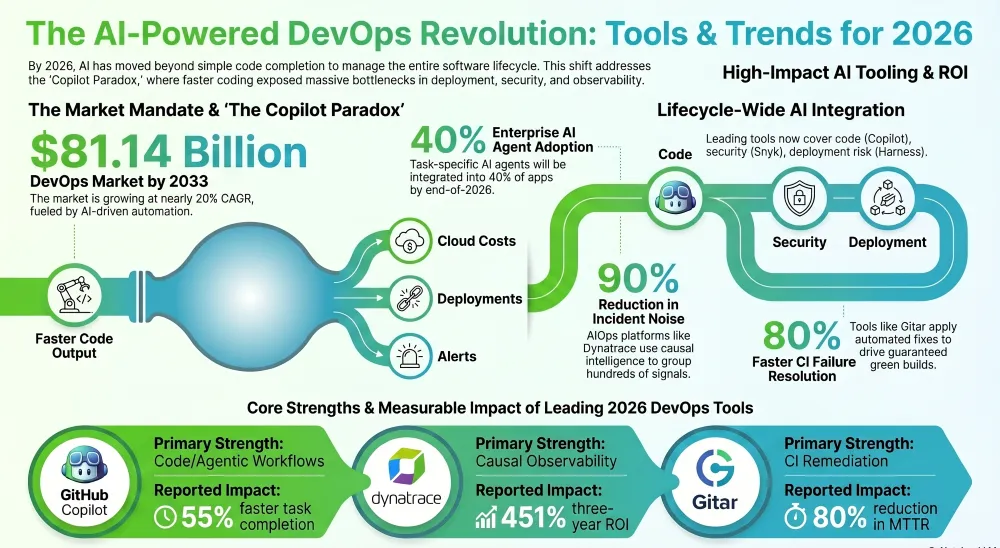
If your team adopted GitHub Copilot last year and celebrated faster code output, you may have also noticed something uncomfortable. The bottleneck didn’t disappear. It moved. Developers writing code faster only exposed every downstream constraint — slower deployments, noisier alerts, harder-to-debug failures, and cloud bills climbing 30% while traffic grew 10%. That’s what industry practitioners are calling the “Copilot Paradox,” and in 2026, solving it requires AI-driven DevOps across the entire software lifecycle — not just at the editor level.
The numbers confirm the urgency. The global DevOps market was valued at USD 13.16 billion in 2024 and is projected to reach USD 81.14 billion by 2033, growing at a CAGR of 19.95%. Within that, the global AIOps market was valued at $16.42 billion in 2025 and is expected to reach $36.6 billion by 2030. Meanwhile, Gartner predicts that 40% of enterprise applications will be integrated with task-specific AI agents by the end of 2026, up from less than 5% in 2025.
The message is clear: the teams winning in 2026 aren’t just using AI to write code faster. They’re deploying DevOps AI tools across infrastructure generation, deployment pipelines, observability, incident response, and security — so the entire system moves intelligently together.
At Full-Stack Techies, we’ve worked with engineering teams at various stages of this transition — from organizations just beginning to explore AI-assisted CI/CD to enterprises building mature AIOps as a Service environments. This guide is built on that hands-on experience, combined with the latest research, to help you make informed decisions about which tools deserve a place in your stack.
Key Takeaways: Best AI-Powered DevOps Tools in 2026
The DevOps bottleneck has shifted, not disappeared. Adopting a single AI coding tool like GitHub Copilot accelerates code output but exposes every downstream constraint — deployment pipelines, observability gaps, and incident response. Winning teams in 2026 deploy AI-driven DevOps across the entire software lifecycle, not just at the editor layer.
The market opportunity is massive and moving fast. The global DevOps market is projected to reach $81.14 billion by 2033, while the AIOps market alone is expected to hit $36.6 billion by 2030. Gartner confirms that 40% of enterprise applications will integrate task-specific AI agents by end of 2026 — up from less than 5% in 2025. Early movers have a compounding advantage.
No single tool covers everything — strategy matters more than individual product selection. The best AI-powered DevOps tools in 2026 are purpose-built for specific stages: code generation, deployment risk, observability, security, and incident response. A coherent AI-driven DevOps strategy requires aligning the right tools to your actual bottlenecks, not chasing feature lists.
AI-assisted security is no longer optional. With Forrester predicting that 40% of businesses will use AI to auto-remediate security flaws in code by 2026, DevSecOps AI tools like Snyk are transitioning from best practice to baseline expectation. Every modern AI-assisted CI/CD pipeline should include automated vulnerability scanning at every pull request.
Regulated industries have viable, compliant AI options. Privacy-first tools like Tabnine eliminate the barrier that compliance requirements once created for generative AI for DevOps adoption. Air-gapped deployments, on-premise model hosting, and data residency controls are now standard features — not future roadmap items — for enterprise-grade DevOps AI tools.
AIOps as a Service is transforming on-call culture. Intelligent alert correlation from platforms like Dynatrace and PagerDuty is reducing alert noise by grouping hundreds of signals into single actionable incidents. Teams report up to 90% reduction in mean time to identify incidents, 40% fewer critical outages annually, and measurable improvements in engineer retention — a direct result of reducing on-call burnout.
Free and low-cost tools can deliver enterprise-grade results. Budget is no longer a valid reason to delay AI-driven DevOps adoption. Gitar cuts CI failure resolution time by 80% at zero cost. GitHub Copilot starts at $4/user/month. Snyk offers a functional free tier for smaller teams. The ROI of even a single tool typically outpaces its cost within the first quarter of deployment.
Implementation quality determines outcomes, not tool selection alone. The organizations getting the most from best AI-powered DevOps tools are those that pair strong tooling with deliberate implementation — proper pipeline integration, team enablement, governance policies for AI-generated code, and continuous measurement of delivery metrics. That’s precisely the gap that Full-Stack Techies helps engineering teams close through its DevOps as a Service practice.
The shift from AI-augmented to AI-autonomous DevOps is already beginning. In 2026, the practical model is AI-augmented workflows with human oversight. By 2027–2028, agentic AI ecosystems will handle end-to-end pipeline decisions autonomously for routine deployments. Teams building the foundational skills and tooling now will be best positioned to operate in that environment. Those that wait will face a steeper climb with a more competitive talent market working against them.
Full-Stack Techies is your strategic partner for this transition. From tooling assessment and pipeline architecture to hands-on implementation and ongoing optimization, Full-Stack Techies brings the expertise to help organizations at every stage of AI-driven DevOps maturity — building environments where the entire software delivery system moves intelligently, not just the developer’s cursor.
What Makes a DevOps AI Tool Worth Watching in 2026?
Before we rank tools, it’s worth setting an honest evaluation framework. The best AI-powered DevOps tools in 2026 aren’t the ones with the most impressive demo videos. They’re the ones that move meaningful metrics: mean time to recovery (MTTR), deployment frequency, change failure rate, and developer time reclaimed from toil.
When evaluating tools for this list, we assessed each across five dimensions:
- Depth of AI integration — Is AI core to the product or bolted on as a marketing layer?
- Pipeline coverage — Does the tool touch one stage or multiple stages of the DevOps lifecycle?
- Enterprise readiness — Security controls, compliance, audit logging, and model governance.
- Integration surface — How well does it connect with GitHub, GitLab, Kubernetes, Terraform, Slack, and the tools teams already use?
- Measurable outcomes — Real, reported impact on delivery speed, incident resolution, and developer productivity.
With those criteria established, here are the 10 best AI-powered DevOps tools shaping the industry in 2026.
1. GitHub Copilot — The Foundation of AI-Assisted CI/CD
Category: AI Coding Assistant + Agentic Workflows
Best For: Engineering teams on GitHub wanting to accelerate developer velocity at the code layer
GitHub Copilot has achieved adoption across 90% of Fortune 100 companies, with teams completing coding tasks 55% faster and pull request turnaround time dropping from 9.6 days to 2.4 days.
But in 2026, Copilot has grown beyond inline code suggestions. Copilot Workspace now allows engineers to describe a feature in natural language and receive a full proposed implementation — planned changes, edited files, test runs, and open pull requests — without leaving the GitHub interface. GitHub leans hardest into AI as a coding agent: Copilot can plan changes, edit files, run tests, and open PRs, with deep ties to GitHub Advanced Security for scanning and fixing code, secrets, and dependencies.
For generative AI for DevOps use cases, Copilot also now supports agentic workflows that run inside GitHub Actions, enabling pipelines that can self-diagnose and — in early iterations — self-repair.
Where it falls short: Copilot excels at the code layer. It doesn’t directly address deployment risk, infrastructure provisioning, or observability. Think of it as the starting point of your AI-driven DevOps stack, not the complete solution.
Pricing: Free for individuals; team plans from $4 to $24 per user/month; Enterprise tier available.
2. GitLab Duo — Unified DevSecOps AI Across the Entire Lifecycle
Category: Full-Lifecycle DevSecOps AI Platform
Best For: Teams wanting a single platform for code, security, CI/CD, and deployment
GitLab Duo, one of the most actively shipped AI tools for DevOps in 2025-2026, analyzes failed job traces and associated code changes to identify root causes — whether a missing dependency, misconfigured environment variable, or flaky test — then delivers clear fixes directly inside the GitLab UI without engineers leaving the platform.
What separates Duo from point solutions is its lifecycle-wide coverage. GitLab positions Duo as an AI-native DevSecOps assistant, with AI woven through the entire lifecycle — plan, code, CI/CD, security, and monitoring — explaining and triaging vulnerabilities, failed pipelines, and value stream metrics.
The Duo Agent Platform, updated through GitLab 18.5 and 18.6, runs specialized agents including a Security Analyst Agent for DevSecOps AI triage and a Planner Agent for sprint coordination — all wired into CI/CD pipelines with admin-level model governance, so enterprises retain control over which LLM powers each workflow.
For teams building AI-assisted CI/CD pipelines without stitching together five different vendors, GitLab Duo is the most comprehensive single-platform answer available in 2026.
Key differentiator: The Fix Pipeline Flow feature, enabled by default in GitLab 18.5, goes beyond diagnosis — it automatically creates merge requests with the proposed fix when a pipeline fails.
3. Harness — AI-Driven DevOps for Deployment Risk Management
Category: AI-Powered CI/CD and Deployment Intelligence
Best For: Mid-to-large engineering organizations needing enterprise-grade CI/CD with deployment risk management
Deployment failures are expensive — not just in downtime, but in the senior engineering hours spent on rollback archaeology. Harness attacks that problem directly with its AI Development Assistant (AIDA). AIDA analyzes the specific code changes in a pull request to predict which tests are actually relevant — not running 400 tests when 30 matter — and identifies flaky tests that have been silently corrupting pipeline confidence for months.
More critically, Harness evaluates deployment risk in real time, recommending canary rollouts or triggering automatic rollbacks before a bad release reaches production users. This is predictive analytics DevOps applied at the deployment layer — not just after incidents occur.
Harness uses machine learning for automated deployment verification and test intelligence, reducing build times through smarter test selection.
For organizations operating DevOps as a Service environments where deployment failures cascade across multiple customer environments, Harness provides the risk-management layer that most CI/CD tools don’t natively offer.
4. Dynatrace — Enterprise AIOps as a Service with Causal Intelligence
Category: AI-Powered Observability and AIOps
Best For: Large enterprises with complex microservice topologies
Dynatrace Davis AI doesn’t just detect anomalies — it identifies causal relationships across thousands of microservice dependencies simultaneously. One customer reported a 90% reduction in mean time to identify incidents, with teams also recording a 451% three-year ROI and 40% fewer Sev1 and Sev2 outages annually.
The 2025 Hypermodal AI upgrade added Davis CoPilot, a generative AI layer that pairs causal analysis with natural language summaries, remediation steps, and LLM observability for teams running AI tools in production. Engineers can query the entire observability stack in plain English, which is meaningful when you’re managing a system too complex to navigate through dashboards during an active incident.
For teams building mature AIOps as a Service capabilities — where the goal is not just detecting problems but preventing them — Dynatrace represents the current ceiling of what enterprise-grade observability AI can deliver.
5. Datadog — AI-Driven DevOps Observability with Breadth
Category: Full-Stack Monitoring and AIOps
Best For: Teams needing visibility across applications, infrastructure, and security in a single platform
Datadog’s Watchdog continuously scans telemetry for anomalies and generates natural language incident summaries, giving on-call engineers a starting point instead of a blank screen at 3 AM. The Bits AI assistant lets teams query logs, traces, and dashboards in plain English — practical during active incidents when recalling PromQL syntax is the last thing engineers want to do.
Datadog’s Watchdog applies unsupervised ML to detect anomalies in real time across CI/CD pipelines, microservices, and cloud infrastructure, using two weeks of behavioral baseline data, growing more accurate over time.
Datadog’s strength in 2026 is breadth: if you need visibility across your entire stack — application performance, infrastructure health, security signals, and CI/CD pipeline events — in a single vendor relationship, it covers more ground than almost any other platform. Recent releases have added AI-generated runbook suggestions tied to active incidents, accelerating resolution for on-call teams.
For companies partnering with a DevOps as a Service provider like Full-Stack Techies, Datadog is a frequent anchor of the observability layer precisely because it connects so cleanly with the rest of a modern DevOps toolchain.
6. Snyk — Generative AI for DevOps Security
Category: AI-Powered DevSecOps
Best For: Engineering teams needing security embedded natively in CI/CD pipelines
Security that lives outside the pipeline is security that gets bypassed. Snyk is a DevSecOps AI platform that scans code, open source dependencies, containers, and infrastructure as code for vulnerabilities at every pipeline stage before anything reaches production — with Snyk Code’s AI-powered SAST engine running build-free scans in seconds and auto-fixing vulnerabilities with 80% accuracy through one-click Agent Fix.
Forrester predicts that by 2026, 40% of businesses will use AI to automatically remediate common security flaws in code, reducing critical security findings by 25% on average. Snyk is one of the primary tools being used to get there.
Snyk integrates directly into CI/CD pipelines via Jenkins, GitHub Actions, CircleCI, Azure Pipelines, GitLab, and Terraform, scanning every pull request automatically without disrupting deployment automation workflows.
For organizations where AI-assisted CI/CD and security governance must coexist — particularly in regulated industries like healthcare, financial services, and government — Snyk is the most mature DevOps AI tool available for shifting security genuinely left.
7. PagerDuty — Intelligent Incident Response for AI-Driven DevOps Teams
Category: AI-Powered Incident Management
Best For: On-call teams drowning in alert noise
Getting 400 alerts a day while only 10 are actionable isn’t a monitoring problem — it’s a signal-to-noise problem, and it trains teams to ignore alerts. That’s how the one alert that matters gets missed. PagerDuty’s Event Intelligence module uses ML to group related alerts into a single incident context, suppressing duplicates and noise so the right responder gets one page, not forty, then routes that page intelligently based on service ownership, schedule, and historical resolution patterns.
In 2026, PagerDuty has expanded its AI capabilities to include automated runbook execution, which allows certain categories of incidents to be resolved without waking anyone up at all. For mature AIOps as a Service implementations, this represents the practical endpoint of the incident response automation journey: fewer pages, faster resolution, and engineers who aren’t burning out on overnight on-call rotations.
8. Opsera — AI-Driven DevOps Orchestration for Enterprise Pipelines
Category: AI-Powered DevOps Orchestration Platform
Best For: Fortune 1000 companies needing unified DevOps intelligence across complex tool ecosystems
Opsera, described as a top AI-driven DevOps platform relied upon by Fortune 1000 firms, has expanded its collaboration with Databricks, introducing DevOps for DataOps capabilities that enable customers to manage data and AI pipelines with the same rigor as application pipelines.
Opsera’s core value proposition in 2026 is orchestration intelligence: the platform sits above individual DevOps tools, providing unified analytics, compliance reporting, and AI-driven optimization recommendations across an organization’s entire tool ecosystem. For enterprises running heterogeneous environments — multiple cloud providers, multiple CI/CD systems, multiple security scanners — Opsera provides the connective intelligence layer that makes everything coherent.
This is particularly relevant for organizations exploring DevOps as a Service models where a managed partner handles pipeline architecture and ongoing optimization. Full-Stack Techies has found Opsera especially effective as an observability and optimization layer for enterprises that have accumulated complex, multi-vendor DevOps toolchains over years of growth.
9. Tabnine — Privacy-First AI-Assisted CI/CD for Regulated Industries
Category: AI Code Completion with Enterprise Privacy Controls
Best For: Privacy-sensitive enterprises, regulated industries, and organizations requiring full control over AI systems
Not every organization can route its source code through a third-party cloud API. Tabnine is an AI-powered code completion platform that emphasizes privacy-first AI by training on permissive open-source code and enabling teams to leverage private repositories without exposing sensitive data externally.
For industries where data residency, air-gapped environments, and compliance with regulations like HIPAA, SOC 2, or GDPR make cloud-based generative AI for DevOps tools impractical, Tabnine provides a compliant path to AI-assisted development. Teams can deploy Tabnine on their own infrastructure, maintain full control over training data, and still benefit from context-aware code completion that meaningfully accelerates developer productivity.
In 2026, as enterprises in financial services, healthcare, and government mature their AI-driven DevOps strategies, privacy-controlled AI tooling has moved from a niche requirement to a mainstream concern. Tabnine is the most mature answer to that requirement in the code assistance category.
10. Gitar — Free AIOps for CI Failure Resolution
Category: AI-Powered Code Review and CI Failure Remediation
Best For: DevOps teams needing automated CI repair without an enterprise budget
Gitar delivers free AI code review and auto-fix for CI failures, cutting MTTR by 80% and saving approximately $375K per year for a team of 20 developers.
What makes Gitar notable in 2026 is its distinction between suggesting a fix and applying one. Platforms like CodeRabbit provide suggestions but still require manual fixes, while Gitar applies solutions directly and drives guaranteed green builds.
Gitar uses a zero-configuration approach — teams install the GitHub app and start receiving automated code review immediately, with hierarchical memory at the line, pull request, and repository levels supporting context-aware improvements over time. Enterprise validation includes production deployments across more than 50 million lines of code at scale, which establishes its reliability beyond demo environments.
For teams whose organizations can’t yet invest in enterprise-tier devops ai tools but need real automation improvement in their pipelines, Gitar represents the best free entry point available.
Quick Reference: Top AI DevOps Tools Comparison 2026
| Tool | Primary Category | Core Strength | Best For |
|---|---|---|---|
| GitHub Copilot | AI Coding Agent | Natural language to code | GitHub-centric teams |
| GitLab Duo | DevSecOps Platform | End-to-end lifecycle AI | Unified platform users |
| Harness | Deployment Intel | Predicting deployment risk | Large-scale CI/CD |
| Dynatrace | AIOps/Observability | Causal root-cause analysis | Complex microservices |
| Snyk | DevSecOps AI | Auto-remediation of flaws | Security-first pipelines |
| Tabnine | Private AI Coding | Data residency & privacy | Regulated industries |
| Gitar | CI Remediation | Auto-fixing build failures | High-velocity startups |
Get scalable, fast, and user-friendly DevOps solutions tailored to your needs.
Get Free ConsultationIndustry Signals: What the Research Is Telling Us About AI-Driven DevOps in 2026
The quantitative backdrop for this transformation is substantial and worth understanding before your organization makes tooling investments.
Global IT spending is predicted to reach $5.44 trillion in 2025, an 8.3% rise year over year, driven by investments in AI-powered development and DevOps toolchains.
Gartner’s best-case scenario projects that agentic AI could drive approximately 30% of enterprise application software revenue by 2035, surpassing $450 billion, up from 2% in 2025.
Integration of Generative AI tools in DevOps enhances platforms by improving anomaly detection, enabling predictive analytics, automating testing, and enabling remediation without human intervention.
The integration of security and DevOps is expected to deepen in 2026, with 27.27% of security engineers citing better integration of development workflows as a primary focus.
These aren’t projections from technology optimists. They represent consensus findings from Gartner, Forrester, and IDC — the primary research institutions that enterprise technology leaders use to validate investment decisions. The direction is unambiguous: AI-powered DevOps tools are transitioning from competitive advantage to operational necessity.
The Governance Guardrail: Managing AI Risks in DevOps
While AI significantly accelerates delivery, expert teams at Full-Stack Techies emphasize that 2026 is the year of “Human-in-the-Loop” orchestration. To maintain high EEAT standards, organizations must address:
- Hallucination Management: AI-generated infrastructure code (Terraform/K8s) must be validated by senior engineers to prevent “ghost” resources that cause cloud waste.
- Model Drift: AIOps tools like Dynatrace require periodic baseline resets to ensure “normal” behavior hasn’t shifted due to legitimate architectural changes.
- Security Verification: Even with Snyk’s 80% auto-fix accuracy, critical paths still require manual security audits to catch logic-based vulnerabilities that LLMs might overlook.
How to Choose the Right Best AI-Powered DevOps Tools for Your Organization
Given the breadth of tools above, the right selection depends on where your current bottlenecks actually live. Here’s a practical decision framework:
If your bottleneck is developer velocity, start with GitHub Copilot or GitLab Duo — these deliver the fastest measurable impact on code output and pull request cycle times.
If your bottleneck is deployment reliability, Harness is the most targeted solution for deployment risk management and intelligent test selection.
If your bottleneck is incident response and alert fatigue, PagerDuty’s Event Intelligence and Dynatrace’s Davis AI address signal-to-noise problems at scale.
If your bottleneck is security and compliance in CI/CD, Snyk provides the most mature AI-assisted CI/CD security layer available.
If you operate in a regulated industry with strict data residency requirements, Tabnine provides a compliant path to generative AI for DevOps without exposing proprietary code externally.
If you need enterprise-wide orchestration across a complex multi-tool environment, Opsera provides the observability and optimization intelligence layer that makes heterogeneous toolchains coherent.
Also Read: The Ultimate Guide to DevOps as a Service (DaaS) in 2026
How Full-Stack Techies Helps Teams Navigate AI-Driven DevOps
Selecting the right tools is only half the challenge. The other half is implementation — integrating these platforms with your existing infrastructure, training teams on new workflows, establishing governance policies for AI-generated code and AI-driven deployments, and continuously measuring outcomes against real business metrics.
Full-Stack Techies specializes in exactly that: helping engineering organizations design, implement, and optimize AI-driven DevOps environments that deliver measurable results. Our DevOps as a Service practice covers the full spectrum — from initial pipeline assessment and tooling selection through hands-on implementation, ongoing optimization, and team enablement.
We’ve guided teams through migrations from legacy Jenkins environments to modern AI-assisted CI/CD pipelines, built AIOps as a Service observability layers for enterprises running complex microservice architectures, and helped regulated-industry clients implement privacy-compliant generative AI for DevOps workflows using tools like Tabnine and Snyk.
What distinguishes our approach is that we don’t recommend tools in isolation. A GitHub Copilot deployment that doesn’t account for downstream deployment pipeline capacity will create a bottleneck, not solve one. Every engagement we run starts with understanding where your organization’s real constraints live before prescribing any technology.
If your team is ready to move beyond point-solution AI tools and toward a coherent AI-driven DevOps strategy, Full-Stack Techies is built to be that partner.
Conclusion: Building a Coherent AI-Driven DevOps Strategy in 2026
The best AI-powered DevOps tools in 2026 are not individual products. They’re components of a coherent strategy that applies intelligence across every stage of software delivery — from the moment a developer begins writing code to the moment an on-call engineer closes an incident ticket.
The organizations pulling ahead aren’t the ones with the biggest AI budgets. They’re the ones that identified their actual bottlenecks, selected tools aligned with those specific constraints, and implemented them with enough rigor to measure real outcomes.
As Gartner observed, AI agents will evolve rapidly, progressing from task and application-specific agents to agentic ecosystems — transforming enterprise applications from tools supporting individual productivity into platforms enabling seamless autonomous collaboration and dynamic workflow orchestration.
That transformation is already underway. The question for every engineering organization in 2026 is not whether to adopt AI-driven DevOps — it’s how quickly and how intelligently to do so.
Full-Stack Techies is ready to help you answer that question with precision. Whether you’re just beginning your devops ai tools evaluation or ready to build an enterprise-grade AIOps as a Service environment, our team brings the experience to accelerate the journey without the costly missteps.
Frequently Asked Questions About Best AI-Powered DevOps Tools
Q1. What is the difference between AIOps and AI-powered DevOps tools?
AIOps (Artificial Intelligence for IT Operations) specifically refers to applying AI and ML to IT operations tasks u2014 primarily monitoring, event correlation, anomaly detection, and incident response. AI-powered DevOps tools is a broader category that includes AIOps but also covers AI-assisted coding, AI-assisted CI/CD, deployment intelligence, security automation, and infrastructure management. Most leading platforms in 2026 blend both.
Q2. What does DevOps as a Service mean in the context of AI?
DevOps as a Service refers to outsourcing DevOps capability u2014 pipeline design, toolchain management, monitoring, and optimization u2014 to a managed service provider. When AI is integrated, this means the service provider manages not just the tooling but also the intelligent automation layer: AI-driven deployment pipelines, predictive analytics, and continuous optimization. Partners like Full-Stack Techies deliver this as a managed service.
Q3. Is generative AI for DevOps mature enough for enterprise production use?
Yes, for most use cases. Generative AI for DevOps is most mature in code assistance, code review, pipeline failure analysis, and natural language querying of observability data. Fully autonomous deployment decision-making is still in early stages and requires human oversight in most enterprise environments. The practical approach in 2026 is AI-augmented workflows, not fully autonomous ones.
Q4. How do AI-powered DevOps tools affect developer job security?
The evidence in 2026 consistently shows that devops ai tools shift developer work rather than eliminate it. Developers spend less time on repetitive tasks u2014 writing boilerplate, debugging build failures, triaging alerts u2014 and more time on architecture, design, and complex problem-solving. AI assistants embedded in development tools have reduced average time to resolution for everyday support tickets by 30% and produced a 109% productivity increase. Demand for skilled developers continues to grow as organizations build more software faster.
Q5. What are the top benefits of using AI-powered DevOps tools in 2026?
The top benefits of using best AI-powered DevOps tools include faster deployment cycles, reduced mean time to recovery (MTTR), automated security scanning in pipelines, smarter test selection, and lower operational overhead. Teams using AI-driven DevOps consistently report 30u201355% improvements in developer productivity and significantly fewer Sev1 and Sev2 incidents annually.
Q6. What is AI-assisted CI/CD and how does it differ from traditional CI/CD?
Traditional CI/CD automates build, test, and deployment steps based on fixed rules. AI-assisted CI/CD goes further u2014 it predicts deployment risk, selects only the relevant tests, auto-diagnoses pipeline failures, and recommends or applies fixes without manual intervention. The result is faster pipelines, fewer false failures, and deployments that are smarter, not just faster.
Q7. Which industries benefit most from AI-driven DevOps tools?
AI-driven DevOps delivers the highest ROI in industries with high deployment frequency and strict reliability requirements u2014 including FinTech, healthcare IT, e-commerce, enterprise SaaS, and telecommunications. Regulated industries also benefit significantly from AI-assisted CI/CD security tools like Snyk, which embed compliance checks directly into every pipeline run.
Q8. What is AIOps and why does it matter for DevOps teams in 2026?
AIOps applies machine learning to IT operations u2014 correlating alerts, detecting anomalies, and identifying root causes across complex infrastructure automatically. For DevOps teams managing distributed microservices, AIOps as a Service replaces reactive, threshold-based monitoring with intelligent, predictive operations u2014 dramatically cutting alert noise and accelerating incident resolution without scaling headcount.
Q9. How do AI-powered DevOps tools integrate with existing pipelines?
Most leading devops ai tools in 2026 are designed for low-friction integration. Platforms like Snyk, Harness, and Datadog connect natively with GitHub Actions, GitLab CI, Jenkins, CircleCI, Terraform, and Kubernetes. Tools like Gitar require zero configuration u2014 simply install the app and AI capabilities activate immediately. Integration complexity scales with enterprise requirements like SSO, audit logging, and custom model governance.
Q10. Can small and mid-sized teams afford AI-powered DevOps tools?
Absolutely. The best AI-powered DevOps tools ecosystem in 2026 covers every budget tier. GitHub Copilot starts at $4/user/month, Snyk offers generous free tiers, and Gitar delivers enterprise-grade CI failure automation at no cost. For teams that need broader pipeline strategy without the overhead of building it in-house, DevOps as a Service partners like Full-Stack Techies offer scalable engagement models that match team size and budget.



