

CI/CD Pipeline Audit Checklist: 20 Things to Review Before Your Next Release
Ensure your releases run smoothly with this comprehensive CI/CD Pipeline Audit Checklist. Covering 20 critical checkpoints, this 2026 guide helps teams improve pipeline performance, strengthen security, and eliminate bottlenecks before deployment.


Introduction: Why a CI/CD Pipeline Audit Is No Longer Optional
Every development team dreams of the perfect release: zero downtime, zero rollbacks, zero 3 AM incident calls. But in reality, the gap between “we pushed the code” and “the feature works in production” is filled with potential failures, security gaps, and environment inconsistencies that only a rigorous pre-release review can catch.
That’s where a structured CI/CD Pipeline Audit Checklist becomes your single most valuable DevOps asset.
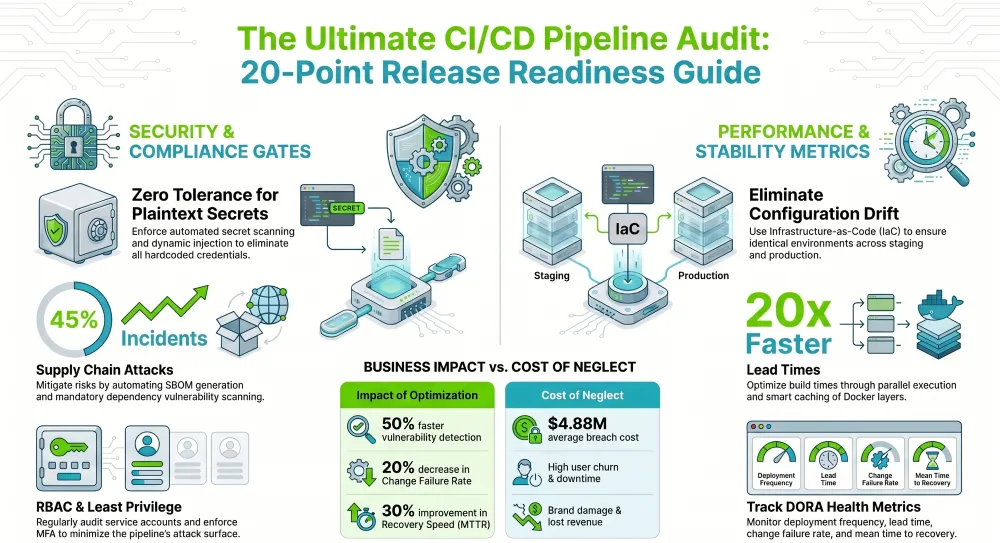
The numbers tell a sobering story. A study by Forrester found that 57% of organizations confirmed they experienced a security incident related to exposed secrets due to insecure DevOps processes in the last two years. At the same time, Gartner predicts that by 2025, 70% of organizations will require robust supply chain security as a critical component of their DevOps workflows to mitigate increasing threats. And on the performance side, according to Forbes, lead times for changes reduce by 20x with DevOps practices, while Gartner data shows change failure rates decrease by 20% with automated testing and mean time to recovery improves by 30% with real-time monitoring.
These aren’t abstract metrics. They translate directly to user trust, revenue, and your team’s ability to ship with confidence.
At Full-Stack Techies, we work with engineering teams across industries to design, audit, and optimize their continuous deployment management workflows. Over time, we’ve distilled the most critical inspection points into this actionable CI/CD Pipeline Audit Checklist — 20 things every team should review before the next release goes live.
Whether you’re running a startup pipeline or managing enterprise-grade infrastructure, this guide is designed to give you complete visibility and control over your software delivery process.
At a Glance: What is a CI/CD Pipeline Audit?
A CI/CD Pipeline Audit is a systematic technical review of the automated workflows used to build, test, and deploy software. It ensures that security gates (SAST/DAST), secrets management, and environment consistency are verified before code reaches production to prevent breaches and downtime.
Top 3 Audit Priorities for 2026:
- Secrets Management: 100% removal of plaintext credentials.
- Supply Chain Security: Automated SBOM generation and dependency scanning.
- Environment Parity: Using Infrastructure-as-Code (IaC) to eliminate configuration drift.
Also Read: 10 Best CI/CD Tools for Managed DevOps Services in 2026
Key Takeaways: CI/CD Pipeline Audit Checklist
1. A CI/CD Pipeline Audit Is a Pre-Release Non-Negotiable. Running a structured CI/CD Pipeline Audit Checklist before every major release is not optional — it is the difference between shipping with confidence and shipping and hoping. Audits catch security gaps, configuration drift, and test failures before they reach production users.
2. Secrets Management Is Your Highest-Priority Security Control. Exposed API keys, hardcoded tokens, and unencrypted credentials in YAML files remain the leading cause of CI/CD security incidents. Every secure CI/CD pipeline must enforce automated secret scanning on every commit, dynamic secret injection at runtime, and automated rotation policies — with zero tolerance for plaintext credentials anywhere in the pipeline.
3. Supply Chain Security Is Now a Business-Critical Risk. With Gartner estimating that 45% of organizations faced software supply chain attacks by the end of 2025, dependency scanning, SBOM generation, and artifact signing are no longer advanced practices — they are baseline requirements for any production-grade CI/CD Pipeline Optimization program.
4. Environment Consistency Automation Eliminates the Staging-to-Production Gap. The most preventable class of production failures comes from environmental differences. Environment consistency automation through IaC, GitOps, identical container image promotion, and automated drift detection ensures that what passes in staging is exactly what runs in production — every single time.
5. Pipeline Observability Turns Reactive Teams Into Proactive Ones. You cannot optimize what you cannot measure. Strong pipeline observability — encompassing structured logging, real-time alerting, deployment health dashboards, and DORA metric tracking — gives your team the visibility to detect problems early, recover faster, and make data-driven decisions about continuous deployment management improvements.
6. DORA Metrics Are the Scorecard for CI/CD Health. Deployment Frequency, Lead Time for Changes, Change Failure Rate, and Mean Time to Restore are the four metrics every engineering team must track consistently. These are not vanity numbers — they directly connect your CI/CD Pipeline Audit findings to measurable business outcomes, including uptime, developer productivity, and release velocity.
7. Security Must Be Embedded, Not Bolted On. Integrating SAST, DAST, container scanning, and IaC security checks directly into pipeline gates — rather than running them as separate post-release activities — is the defining principle of a mature DevSecOps culture. Automated security gates block vulnerable code from progressing through the pipeline before it ever reaches production.
8. Access Controls and RBAC Are Foundational, Not Afterthoughts. Overly permissive service accounts, shared credentials, and missing MFA enforcement are silent risks that accumulate quietly over time. Every CI/CD Pipeline Audit Checklist must include a full RBAC review, enforcing the principle of least privilege across every role, service identity, and third-party tool integration in your pipeline.
9. DevOps as a Service Accelerates Pipeline Maturity. For teams without deep in-house DevOps expertise, partnering with a trusted DevOps as a Service provider like Full-Stack Techies delivers faster access to pipeline best practices, independent audit perspectives, and continuous optimization — without the time and cost of building a full internal DevOps function from scratch.
10. The Goal Is Confident, Frequent, and Secure Deployments. Every item in this CI/CD Pipeline Audit Checklist — from secrets management and dependency scanning to rollback planning and compliance automation — serves one overarching objective: enabling your team to deploy software frequently, securely, and with complete confidence in what you’re shipping. That is the true measure of CI/CD Pipeline Optimization done right.
What Is a CI/CD Pipeline Audit and Who Should Conduct One?
A CI/CD Pipeline Audit is a systematic review of your continuous integration and continuous deployment (CI/CD) workflows, configurations, security controls, test coverage, observability tools, and environment setups. The goal is to identify weaknesses — technical, operational, or security-related — before they manifest as production incidents.
Audits should be conducted:
- Before every major release or product milestone
- After significant infrastructure changes
- Quarterly as part of a broader CI/CD Pipeline Optimization cycle
- After onboarding new team members or integrating third-party tools
- In response to a security incident or compliance requirement
The audit should involve your DevOps engineers, security team, QA leads, and ideally an independent perspective — either internal or from a trusted DevOps as a Service partner like Full-Stack Techies who can bring an objective lens to your pipeline’s blind spots.
Why is a CI/CD Pipeline Audit Important?
You might wonder why you need to spend time checking your pipeline. The answer is simple: skipping checks costs a lot of money.
Recent data from 2025 and 2026 shows that fixing a data breach costs companies over 4.88 million dollars on average. Also, experts say global cyber crime will cost over 13 trillion dollars by 2028. You do not want to be part of those numbers.
Here are the main reasons why this audit is so important:
- It Stops Hackers Early: If your pipeline has weak spots, hackers can put bad code into your app. An audit finds these weak spots before hackers do.
- It Saves Time: Full-stack techies hate waiting. A bad pipeline slows everyone down. An audit finds ways to make things run faster.
- It Keeps Customers Happy: If your app breaks during an update, users get angry. Good checks mean smooth updates with zero downtime.
- It Meets Strict Local Laws: Different parts of the world have strict rules about user data. If you have clients in the USA, UK, Canada, or Europe, you must follow their rules. For example, Europe has GDPR. The USA has SOC 2 laws for cloud data. If you sell the best tech services in London or offer top software in New York, your clients will ask for proof that your pipeline is safe.
Get scalable, fast, and user-friendly DevOps solutions tailored to your needs.
Get Free Consultation
Start Building With Full-Stack Techies Today
Part 1: Security & Access Controls (Checklist Items 1–6)
Security is where most pipelines quietly fail. It’s not always dramatic — it’s an API key committed to a YAML file, an overly permissive service account, or a dependency that hasn’t been updated in eight months. The foundation of secure CI/CD pipelines starts here.
1. Review Secrets Management Practices
Secrets management is perhaps the single most critical item in any CI/CD Pipeline Audit Checklist. Secrets management tools like HashiCorp Vault or AWS Secrets Manager provide features like dynamic secrets, secret revocation, and detailed audit logs that enhance your organization’s security posture. Additionally, pre-commit hooks and secret scanning tools enforce coding standards and prevent hardcoding of secrets in your codebase.
Your audit should confirm that:
- No API keys, tokens, SSH credentials, or database passwords are stored in plain text in YAML files, environment variables, or source code
- Secrets are pulled dynamically from a vault at runtime — not baked into container images
- Rotation policies are automated and regularly enforced
- Secret scanning tools run on every commit and block merges when credentials are detected
Credential leaks in CI/CD often come from exposed API keys, SSH keys, tokens, and cloud secrets in workflows and configuration files. Once attackers obtain these secrets, they can access cloud accounts, data stores, and APIs without noisy intrusion attempts.
At Full-Stack Techies, we’ve encountered pipelines where production database credentials were visible in CI logs for months before anyone noticed. A proper audit catches this before an attacker does.
2. Audit Role-Based Access Controls (RBAC)
Not everyone on your team needs access to everything in your pipeline. Role-Based Access Control (RBAC) assigns roles based on the principle of least privilege, ensuring developers only have access to the components necessary for their work. Multi-factor authentication (MFA) adds an extra layer of security for accessing CI/CD tools and infrastructure. Comprehensive audit logs track who accessed the system, what changes were made, and when, helping to identify unauthorized access or changes.
During your audit, verify that:
- Service accounts follow the principle of least privilege
- MFA is enforced for all users with pipeline access
- Unused accounts and service identities have been removed
- Permissions are reviewed on a scheduled basis and after any team changes
3. Inspect Branch Protection Rules and Code Review Requirements
Your codebase is the foundation of everything your pipeline builds. Branch protection rules enforce policies that prevent direct commits to critical branches, such as the main or master branch. Without these gates, a single unreviewed commit can introduce breaking changes or malicious code into your release.
Your audit should confirm that:
- The main/master branch requires at least one peer-reviewed pull request approval before merging
- Status checks (build passing, tests green, security scans clean) are mandatory before merge
- Force-push is disabled on protected branches
- Pipeline definition files (e.g., .github/workflows/*.yml) are version-controlled and reviewed before merging
4. Run a Dependency Vulnerability Scan
Third-party dependencies are one of the most overlooked attack surfaces in modern software. According to the 2024 Sonatype State of the Software Supply Chain report, 12% of open-source components downloaded contained known vulnerabilities, highlighting the risks posed by weak supply chain security.
Your CI/CD Pipeline Audit Checklist must include a full dependency audit using tools like Snyk, OWASP Dependency-Check, or Dependabot. Confirm that:
- All third-party libraries are scanned automatically on every build
- Critical and high-severity vulnerabilities block the pipeline from progressing
- Lock files are used to pin dependency versions for reproducible builds
- Actively unmaintained packages are identified and replaced
5. Verify SAST, DAST, and Container Security Scans Are Integrated
Automated security testing should not be a post-release activity — it must be embedded throughout the pipeline. Static Application Security Testing (SAST) scans source code and binaries for vulnerabilities such as cross-site scripting (XSS) and SQL injection. When integrated directly into the CI/CD pipeline, SAST enables early detection and prioritization.
For secure CI/CD pipelines, your audit should confirm:
- SAST tools (e.g., SonarQube, Semgrep, Checkmarx) are running on every commit
- DAST tools are triggered during staging deployments
- Container images are scanned for vulnerabilities before pushing to production registries
- Infrastructure-as-Code (IaC) configurations are scanned with tools like Checkov or tfsec
- All security scan results are logged and stored for compliance and audit purposes
6. Audit Third-Party Tool Integrations and Their Permissions
Integrations add power to your pipeline — but also risk. While integrations with third-party tools improve functionality within CI/CD pipelines, they can extensively increase the attack surface if left unmanaged. These integrations should be audited and restricted to what is necessary and given minimal required privileges, and such integrations along with their permissions should be audited on a recurring basis.
Review every connected tool — Slack bots, analytics plugins, cloud provider integrations, artifact registries — and confirm that each has only the minimum permissions required.
Part 2: Build & Test Integrity (Checklist Items 7–11)
Security protects your pipeline, but build and test integrity determines whether what you’re shipping actually works. This section focuses on the mechanics of CI/CD Pipeline Optimization at the code and artifact level.
7. Validate Test Coverage Thresholds
Before any release, confirm that your automated test suite is actually covering the code being shipped. Many teams set test coverage minimums once and forget them — allowing coverage to erode silently over months of feature development.
During your audit:
- Review current code coverage percentage against the agreed baseline (e.g., 80% or higher for critical services)
- Identify untested modules, especially those modified in recent commits
- Confirm that unit tests, integration tests, and end-to-end tests are all represented
- Ensure the pipeline fails the build if coverage drops below defined thresholds
Developer productivity improves by 28% with CI/CD pipelines, and consistent automated checks reduce errors measurably. But that improvement only materializes when the tests being run are actually meaningful.
8. Check Build Reproducibility and Artifact Integrity
Can you rebuild your release from scratch and get an identical result? If not, your pipeline has a reproducibility problem that will cause inconsistencies between environments. Pinning dependencies and using lock files ensures builds stay reproducible while remaining auditable. Running builds on ephemeral runners that are destroyed after each job reduces the persistence of malicious changes and protects against poisoned pipeline execution attacks.
Audit checklist items include:
- Dependency versions are pinned using lock files (package-lock.json, Pipfile.lock, go.sum)
- Build runners are ephemeral and not shared between jobs
- Artifacts are signed and their integrity verified before deployment
- Build outputs are stored in a secure, access-controlled artifact registry
9. Review the Software Bill of Materials (SBOM) Strategy
The SBOM has gone from a nice-to-have to a compliance requirement for many industries. Most teams still don’t generate a proper Software Bill of Materials (SBOM), or worse, they rely on automated SCA tools but never review the output. The fix is to adopt SBOM tools like BlackDuck, Syft, or CycloneDX and automate export in your build.
Your CI/CD Pipeline Audit Checklist should verify that:
- An SBOM is generated automatically on every build
- The SBOM output is reviewed — not just generated and ignored
- SBOMs are stored alongside release artifacts for traceability
- Your SBOM strategy aligns with any applicable regulatory frameworks (e.g., NIST, EU CRA)
10. Confirm Flaky Test Identification and Handling
Flaky tests — tests that pass or fail unpredictably without code changes — erode trust in your entire CI/CD process. Engineers start ignoring test failures, pipelines get forced through manually, and eventually a real bug gets merged because “it was probably just flaky.”
Before your release, audit:
- How many tests in your suite are currently flagged as flaky
- Whether flaky tests are quarantined or immediately retried without investigation
- Whether your team has a documented process for investigating and eliminating flakiness
- Whether recent flaky test activity has increased (a signal of infrastructure or test design problems)
11. Audit Pipeline Efficiency and Build Times
CI/CD Pipeline Optimization is not just about security — it’s also about speed. Slow pipelines create developer frustration, encourage manual bypasses, and delay feedback loops. DevOps teams experience a 5x lower failure rate for deployments through collaboration and testing improvements, and operational costs decrease by 22% with optimized DevOps processes.
During your audit, measure and review:
- Average build time across the last 30 days
- Stages consuming disproportionate time (often integration tests or heavy container builds)
- Caching strategies for dependencies, Docker layers, and build artifacts
- Whether parallel job execution is configured where possible
- Whether unnecessary steps are running on every commit versus only on relevant branches
At Full-Stack Techies, our pipeline optimization engagements regularly uncover 40–60% build time reductions by simply restructuring job ordering and implementing smarter caching. Faster builds mean faster feedback, which means fewer bugs reaching production.
Part 3: Environment Consistency & Configuration (Checklist Items 12–15)
The phrase “but it works on my machine” has a CI/CD equivalent: “it passed in staging but broke in production.” Environment consistency automation is the discipline that eliminates this class of failure.
12. Review Infrastructure-as-Code (IaC) Configurations for Drift
Environment consistency automation depends on IaC being the authoritative source of truth for all environments. Drift — where the actual state of an environment diverges from what the IaC declares — is one of the most common causes of staging-to-production discrepancies.
Your audit should confirm:
- All environments (dev, staging, production) are provisioned using IaC tools like Terraform, Pulumi, or AWS CDK
- Drift detection is automated and alerts are generated when environments diverge
- No manual infrastructure changes are made directly in production consoles without corresponding IaC updates
- IaC code is version-controlled and subject to the same review process as application code
GitOps practices ensure that all infrastructure modifications undergo proper security review, and regular drift detection helps identify unauthorized changes.
13. Validate Environment Variable and Configuration Parity
Environment-specific configuration differences are a hidden source of production failures. Your audit should systematically compare:
- All environment variables used in staging versus production (names, formats, absence of any production-only variables not mirrored in staging)
- Feature flag states across environments
- Connection strings and endpoint configurations
- Timeout values, rate limits, and retry policies that differ by environment
A configuration management audit catches these before they cause an incident. Tools like Doppler, AWS Parameter Store, or Consul can help enforce consistency across environments as part of your environment consistency automation strategy.
14. Inspect Container Image Consistency and Registry Hygiene
Docker adoption grows by 28% annually, and containerization ensures consistent environments across development and deployment. But container consistency only works if your image management is disciplined.
Before release, audit:
- Whether the exact same container image (same tag, same digest) is promoted through dev → staging → production (never rebuilding per environment)
- Whether outdated or vulnerable base images are identified and updated
- Whether the container registry enforces image signing
- Whether unused images are regularly purged to reduce storage costs and attack surface
15. Confirm Database Migration Safety and Rollback Plan
Database migrations are one of the most risky elements of any release. A failed migration that can’t be rolled back is a production-down scenario. Your CI/CD Pipeline Audit Checklist must include:
- All pending database migrations reviewed and approved before release
- Backward-compatible migration patterns (e.g., expand-contract) are used to support blue-green or canary deployments
- A tested rollback script exists for every forward migration
- Migrations are applied atomically within the pipeline, not manually by engineers during deployment windows
Part 4: Pipeline Observability & Monitoring (Checklist Items 16–18)
You can’t fix what you can’t see. Pipeline observability — the ability to understand the internal state of your CI/CD system through its outputs — is what separates reactive teams from proactive ones.
16. Review Pipeline Logging, Alerting, and Dashboards
Pipeline observability requires that every stage of your CI/CD workflow generates structured, searchable logs and that meaningful alerts are configured for failure conditions.
Your audit should verify:
- Build failures, test failures, and deployment failures all trigger immediate alerts to the responsible team (via Slack, PagerDuty, or equivalent)
- Logs are stored in a centralized, searchable system (e.g., ELK Stack, Datadog, Google Cloud Logging) with sufficient retention
- A pipeline health dashboard exists showing build success rate, average build time, and deployment frequency trends
- Alerts are tuned to avoid alert fatigue — only actionable conditions should page engineers
Monitoring and observability tools monitor application performance and help calculate MTTR and change failure rates. Without these in place, you’re flying blind after every release.
17. Evaluate Deployment Monitoring and Automatic Rollback Capabilities
Deploying code is only half the job. Monitoring the deployment and being able to reverse it instantly is what gives teams confidence to ship frequently. Audit your current setup for:
- Canary deployment or blue-green deployment strategies with automated health checks
- Automatic rollback triggers when error rate or latency thresholds are breached post-deployment
- Smoke tests that run immediately after deployment to verify critical user paths are functional
- Clear runbooks defining who owns a rollback decision and what the rollback procedure is
Teams with mature pipelines and automated testing achieve measurable gains in both speed and stability. Automatic rollback is a cornerstone of that maturity.
18. Audit DORA Metrics Tracking
The DORA framework remains the industry gold standard for measuring CI/CD health. The four DORA metrics — lead time for changes, deployment frequency, change failure rate, and time to restore service — together measure how efficiently and reliably your teams deliver software.
Before your next release, confirm that your team is actively tracking:
- Deployment Frequency — how often you’re shipping to production
- Lead Time for Changes — time from commit to production
- Change Failure Rate — what percentage of deployments cause incidents
- Mean Time to Restore (MTTR) — how quickly you recover when things go wrong
If these numbers are not tracked, you cannot make data-driven decisions about continuous deployment management. Full-Stack Techies helps teams instrument these metrics from day one, building dashboards that connect pipeline performance directly to business outcomes.
Part 5: Compliance, Governance & Release Readiness (Checklist Items 19–20)
The final layer of a thorough CI/CD Pipeline Audit connects your technical controls to governance, compliance, and organizational readiness for release.
19. Review Compliance Automation and Audit Trail Completeness
Regulatory compliance — whether you’re dealing with SOC 2, GDPR, HIPAA, PCI-DSS, or industry-specific frameworks — increasingly intersects with your CI/CD processes. Automated audits using pre-configured rules help ensure compliance with regulations such as GDPR or SOC 2. Secrets management detects hard-coded credentials in code or logs, and enforces rotation policies to maintain good security practice.
Your pre-release compliance audit should confirm:
- All pipeline activities are logged with timestamps, actor identity, and action details — creating a complete audit trail
- Policy gates automatically block non-compliant builds from progressing
- Security scan results are archived in a format accessible to compliance auditors
- Your SBOM, dependency scan results, and test coverage reports are stored alongside release artifacts
Regular security audits of the CI/CD pipeline need to consider everything from the overall security posture of an organization, including vulnerability management, access control, and configuration settings, right up to code repositories. Documentation of findings must be followed by the actual implementation of recommended improvements.
20. Conduct a Pre-Release Deployment Readiness Review
The final checkpoint before release is a holistic readiness review — a structured conversation between engineering, QA, security, and operations to confirm the release is ready to go live.
This review should cover:
- All items in this CI/CD Pipeline Audit Checklist have been reviewed and any critical issues resolved
- Release notes are complete and accurate
- On-call rotation is confirmed and briefed on the release scope
- Rollback plan is documented, tested, and understood by all stakeholders
- Customer-facing communications (if any) are prepared and ready
- Deployment window is scheduled to minimize user impact
Full-Stack Techies conducts these readiness reviews as part of our DevOps as a Service engagements, ensuring that every release is backed by documented evidence of pipeline health — not just team confidence.
Industry Trends Shaping the Future of CI/CD Pipeline Audits
Understanding the context around your pipeline decisions helps you prioritize the right investments. Here’s what the industry data tells us about where CI/CD Pipeline Optimization is heading:
- AI-Powered Security is Accelerating. Gartner predicts that by 2025, organizations using AI-based security tools will reduce the time to detect vulnerabilities by 50%. AI is increasingly being embedded directly into CI/CD pipelines to flag anomalies, predict failure-prone commits, and auto-remediate low-severity issues — reducing the burden on human reviewers.
- Supply Chain Attacks Are Intensifying. Gartner estimated that 45% of organizations would face software supply chain attacks by the end of 2025. These campaigns target dependencies, build tools, and package registries that CI/CD systems trust by default. This makes dependency auditing and SBOM governance non-negotiable elements of any serious CI/CD Pipeline Audit Checklist.
- Zero Trust is Becoming the Default Architecture. Zero Trust means implementing strict verification of identities for every access request from internal or external sources. This approach reduces risks related to implicit trust assumptions and enforces authentication for every access attempt, improving security within CI/CD by detecting unauthorized attempts and minimizing lateral movement within the pipeline.
- DevSecOps Adoption is Surging. DevSecOps is a top initiative for 56% of teams according to the DevOps Institute, and DevOps teams using microservices deploy 46x more often and fix issues 96x faster. The convergence of development, security, and operations into a unified culture is accelerating — and your pipeline must reflect that integration.
- The DevOps Market is Growing Rapidly. The global DevOps market is expected to reach $25.5 billion by 2028, growing at a CAGR of 19.7%. This growth signals a maturing ecosystem where best practices, tooling, and expectations are rising across the board.
CI/CD Pipeline Audit Checklist: Quick Reference Summary
Here’s your complete pre-release checklist at a glance:
Security & Access Controls
- Secrets management practices reviewed and enforced
- RBAC and MFA verified across all pipeline access points
- Branch protection rules and code review requirements confirmed
- Dependency vulnerability scan completed with no critical open issues
- SAST, DAST, and container security scans integrated and passing
- Third-party tool integrations audited for permission creep
Build & Test Integrity
- Test coverage thresholds validated against baseline
- Build reproducibility and artifact integrity confirmed
- SBOM generated, reviewed, and stored
- Flaky tests identified, quarantined, or eliminated
- Pipeline efficiency reviewed and build times optimized
Environment Consistency & Configuration
- IaC configurations reviewed for environment drift
- Environment variable and configuration parity validated
- Container image consistency and registry hygiene confirmed
- Database migration safety and rollback plan verified
Pipeline Observability & Monitoring
- Logging, alerting, and dashboard coverage reviewed
- Deployment monitoring and automatic rollback capabilities confirmed
- DORA metrics actively tracked and within acceptable ranges
Compliance, Governance & Release Readiness
- Compliance automation and audit trail completeness verified
- Pre-release deployment readiness review conducted
Also Read: CI/CD vs DevOps (2025–2026): Which Delivers More Value?
How Full-Stack Techies Can Help You Build a Release-Ready Pipeline
Running through a CI/CD Pipeline Audit Checklist is valuable — but building a culture and infrastructure where your pipeline passes that checklist every single time requires dedicated expertise.
Full-Stack Techies offers comprehensive DevOps as a Service solutions that help engineering teams of all sizes design, secure, and continuously optimize their CI/CD workflows. Our services include:
- Pipeline Architecture & Design — Building secure CI/CD pipelines from scratch or refactoring existing ones with modern best practices baked in from day one
- Pipeline Observability Implementation — Instrumenting your pipeline with full pipeline observability tooling including logging, alerting, DORA metric dashboards, and deployment health monitoring
- Security & Compliance Audits — Conducting thorough, independent audits of your CI/CD security posture, secrets management, access controls, and compliance readiness
- Environment Consistency Automation — Eliminating the “works in staging, breaks in production” problem through disciplined IaC, GitOps, and configuration management practices
- Ongoing CI/CD Pipeline Optimization — Continuous improvement programs that track build performance, test reliability, and deployment confidence over time
Our team works as an extension of your engineering organization — embedded, accountable, and focused on outcomes, not just recommendations.
If your team is preparing for a major release, scaling your deployment infrastructure, or simply tired of firefighting production incidents, we’d love to talk. Full-Stack Techies brings the expertise to make confident, frequent, and secure deployments your team’s normal — not your exception.
Conclusion
A CI/CD Pipeline Audit Checklist is not a bureaucratic formality. It is a structured discipline that separates engineering teams who ship with confidence from those who ship and hope.
The 20 items in this guide cover the full spectrum of what it takes to release software safely: from secure CI/CD pipelines and pipeline observability, to environment consistency automation and continuous deployment management. Each item represents a real category of failure that real teams experience — and that a thorough audit prevents.
The best time to conduct your next CI/CD pipeline audit was before your last release. The second-best time is right now, before your next one.
Full-Stack Techies is here to help you every step of the way — from the first audit to building a self-reinforcing culture of pipeline excellence that scales with your team.
Frequently Asked Questions: CI/CD Pipeline Audit Checklist
Q1. What is a CI/CD Pipeline Audit Checklist and why does my team need one?
A CI/CD Pipeline Audit Checklist is a structured review framework that evaluates your continuous integration and deployment workflows for security gaps, configuration issues, test coverage failures, and release readiness. Your team needs one because even well-functioning pipelines accumulate blind spots over time u2014 and a single overlooked vulnerability or environment inconsistency can turn a routine release into a production incident.
Q2. How often should we conduct a CI/CD pipeline audit?
You should conduct a CI/CD pipeline audit before every major release, after significant infrastructure changes, and at minimum once per quarter as part of a broader CI/CD Pipeline Optimization cycle. If your team ships frequently, lightweight checklist reviews should happen before every deployment, with comprehensive audits scheduled quarterly.
Q3. What are the most critical security risks in a CI/CD pipeline?
The most critical risks in secure CI/CD pipelines include exposed secrets and hardcoded credentials in code or YAML files, overly permissive RBAC roles, unscanned third-party dependencies, missing SAST/DAST integration, and insecure third-party tool integrations. Supply chain attacks targeting build tools and package registries are also a rapidly growing threat in 2025 and 2026.
Q4. What tools should we use to automate CI/CD pipeline security scanning?
For secure CI/CD pipelines, the most widely used tools include SonarQube and Semgrep for SAST, OWASP Dependency-Check or Snyk for dependency scanning, Trivy or Grype for container image scanning, HashiCorp Vault or AWS Secrets Manager for secrets management, and Checkov or tfsec for Infrastructure-as-Code scanning. The right stack depends on your environment, but all of these should integrate natively into your pipeline as automated gates.
Q5. What is pipeline observability and why does it matter for releases?
Pipeline observability is the ability to understand the internal health of your CI/CD system through structured logs, real-time alerts, and dashboards. It matters because without full visibility into build performance, deployment success rates, and failure patterns, your team is reacting to production incidents instead of preventing them. Strong pipeline observability enables faster debugging, confident releases, and data-driven CI/CD Pipeline Optimization.
Q6. How do we ensure environment consistency between staging and production?
Environment consistency automation requires using Infrastructure-as-Code (IaC) tools like Terraform or Pulumi to provision all environments from the same source of truth, promoting identical container image digests across environments rather than rebuilding per stage, automating drift detection, and enforcing configuration parity for environment variables, feature flags, and connection settings. GitOps practices further ensure all infrastructure changes are version-controlled and reviewed.
Q7. What DORA metrics should we track as part of a CI/CD pipeline audit?
The four core DORA metrics every team should track as part of continuous deployment management are Deployment Frequency, Lead Time for Changes, Change Failure Rate, and Mean Time to Restore (MTTR). Together they give a balanced view of both delivery speed and pipeline reliability. High-performing teams deploy multiple times daily, maintain a change failure rate below 15%, and recover from incidents in under one hour.
Q8. What is a Software Bill of Materials (SBOM) and is it required for CI/CD compliance?
An SBOM is a complete, structured inventory of every component, library, and dependency included in your software build. It is increasingly required for regulatory compliance in industries such as healthcare, finance, and government contracting, and is becoming a baseline expectation across enterprise software supply chains. Your CI/CD Pipeline Audit Checklist should confirm that an SBOM is automatically generated on every build using tools like Syft or CycloneDX and stored alongside release artifacts.
Q9. What is DevOps as a Service and how can it help with CI/CD pipeline audits?
DevOps as a Service is an engagement model where an external expert team u2014 like Full-Stack Techies u2014 designs, implements, audits, and continuously optimizes your CI/CD infrastructure on your behalf. It is particularly valuable for teams that lack in-house DevOps depth, need an independent audit perspective, or want to accelerate their pipeline maturity without hiring a full internal team. It covers everything from secure CI/CD pipelines and pipeline observability to compliance automation and release governance.
Q10. How do we reduce deployment failures using a CI/CD pipeline audit?
Reducing deployment failures starts with the systematic review that a CI/CD Pipeline Audit Checklist provides u2014 covering test coverage validation, dependency scanning, environment consistency checks, database migration safety reviews, and deployment monitoring with automatic rollback capabilities. Combined with consistent DORA metric tracking and automated security gates, teams that conduct regular audits experience measurably lower change failure rates, faster recovery times, and more predictable release outcomes.



