

DevOps Outsourcing Checklist: 15 Questions to Ask Before Signing a Contract
Choosing the right DevOps partner is critical. This DevOps Outsourcing Checklist outlines 15 essential questions to ask before signing a contract, helping you evaluate vendors, reduce risks, and ensure long-term success in your DevOps strategy.


Introduction: Why Most Companies Get DevOps Outsourcing Wrong
Signing a DevOps outsourcing contract without asking the right questions is one of the costliest mistakes a technology leader can make. You might onboard a vendor that looks impressive on paper, only to discover six months later that their SLAs are paper-thin, their security practices are misaligned with your compliance requirements, and your internal team has no idea how to take back control if the relationship ends.
The good news? These failures are almost entirely preventable — with the right DevOps outsourcing checklist in hand before you sign anything.
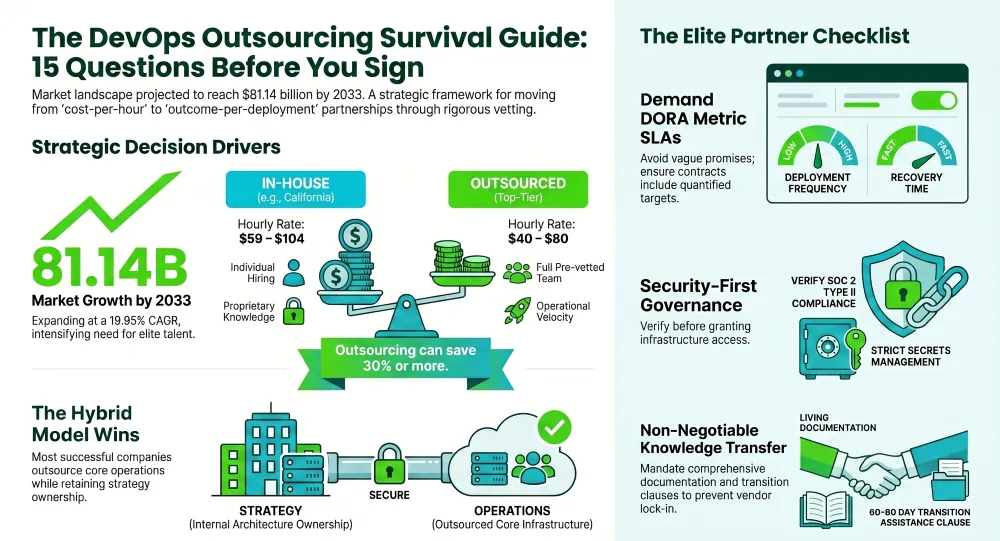
The global DevOps market was valued at USD 13.16 billion in 2024 and is projected to reach USD 81.14 billion by 2033, growing at a CAGR of 19.95%. As the market explodes, so does the number of DevOps outsourcing companies competing for your budget — ranging from elite managed specialists to generalist shops that slap “DevOps” on their service page. Knowing how to separate the two is no longer optional; it is a core business competency.
By 2027, Gartner estimates that 80% of organizations will incorporate a DevOps platform into their development toolchains, up from just 25% in 2023. That dramatic shift means the demand for outsourced DevOps talent will continue to intensify — and so will the vendor landscape you need to navigate.
This guide gives you 15 essential questions that every CTO, VP of Engineering, or IT decision-maker must ask any prospective DevOps outsourcing services provider before a single contract clause is agreed to. We’ve also included guidance on when to outsource DevOps vs hire in-house, when to migrate to managed DevOps, and what DevOps as a Service really means for your organization’s long-term health.
Executive Summary: How to Choose a DevOps Partner
Selecting a DevOps outsourcing provider requires a shift from evaluating “cost-per-hour” to “outcome-per-deployment.” A successful partnership hinges on five critical pillars: technical stack alignment, quantified SLAs (DORA metrics), security-first governance (DevSecOps), comprehensive knowledge transfer, and clear exit strategies. Use this checklist to filter for “elite” providers who operate as an embedded extension of your team rather than a distant vendor.
Key Takeaways: DevOps Outsourcing Checklist
- The DevOps outsourcing market is growing fast — and so is the risk of choosing the wrong vendor. The global DevOps market is projected to reach USD 81.14 billion by 2033. As the number of DevOps outsourcing companies multiplies, the gap between elite providers and average ones widens. A structured DevOps outsourcing checklist is your most reliable tool for telling them apart before you sign anything.
- Most DevOps outsourcing failures are contractual, not technical. The leading cause of failed outsourced DevOps engagements is unclear expectations — vague SLAs, undefined scope, poor documentation practices, and missing exit clauses. These are entirely preventable with the right questions asked upfront.
- SLAs must be quantified, not aspirational. Any DevOps outsourcing services provider that cannot give you specific, measurable SLA commitments — with defined remedies for missing them — is not operationally mature enough to manage your infrastructure. Look for DORA metrics: deployment frequency, lead time for changes, change failure rate, and mean time to recovery.
- Documentation and knowledge transfer are non-negotiable. Vendor dependency is one of the most underestimated risks in DevOps outsourcing. Your contract must mandate living documentation, architecture diagrams, runbooks, and a 60–90 day transition assistance clause — so you can always take back control cleanly if the relationship ends.
- Security must be embedded, not bolted on. Outsourced DevOps teams have privileged access to your most sensitive systems. Vet every vendor’s DevSecOps practices rigorously — secrets management, access controls, vulnerability scanning, compliance alignment, and offboarding procedures all matter before a single line of infrastructure code is touched.
- The outsource DevOps vs hire in-house decision is not binary. For most growth-stage and mid-market companies, the optimal model is hybrid — outsource infrastructure operations to a specialist while retaining internal ownership of architecture strategy. This delivers the best balance of speed, cost efficiency, and institutional knowledge.
- DevOps as a Service is an operational model, not just a label. True DevOps as a Service means your provider functions as an embedded extension of your engineering team — not a distant vendor sending monthly reports. Expect real-time dashboards, active participation in your engineering ceremonies, and outcome-aligned performance metrics.
- Migrating to managed DevOps makes sense when internal DevOps is costing more than it delivers. Clear signals include deployment frequency below weekly, MTTR above two hours, developers spending more than 20% of their time on infrastructure toil, or an approaching scaling event your current infrastructure is not ready for.
- Always validate vendor claims with references and real metrics. Every DevOps outsourcing company will claim excellence. References from comparable clients — combined with anonymized performance data showing deployment frequency, uptime, and MTTR — are the only reliable way to verify those claims before committing.
- The right vendor answers all 15 checklist questions with evidence, not promises. Vendors who hesitate, deflect, or respond vaguely to the questions in this DevOps outsourcing checklist are revealing exactly how they will behave once the contract is signed. Use the checklist as a filter — the best providers will welcome every question on it.
What is DevOps Outsourcing?
DevOps outsourcing means hiring an external company to manage your software development and IT operations. Instead of building a team inside your own office, you use experts from an outside firm. These experts handle tasks like writing code, testing software, managing cloud servers, and fixing technical problems.
When you use DevOps outsourcing services, you get a full team of professionals who already know how to work together. This is different from the traditional model of hiring individual employees one by one. Many companies use DevOps as a Service to get fast access to top tools and skills without paying for full-time salaries and benefits.
This model is very popular across the globe. Companies in the USA, Canada, UK, and Europe use these services to stay competitive. It allows businesses to focus on their main goals, like selling products or serving customers, while the technical experts handle the complex computer systems.
The State of DevOps Outsourcing in 2026: Industry Context You Need to Know
Before diving into the checklist, it’s important to understand the market reality shaping vendor behavior today.
77% of businesses that outsource do so for IT functions, and organizations have historically spent an average of 8.1% of their budget on IT outsourcing services. DevOps is one of the fastest-growing segments within the IT outsourcing spend.
Businesses are increasingly adopting cloud-first strategies and DevOps outsourcing to enhance scalability, agility, and operational efficiency. As cloud computing becomes the backbone of modern IT infrastructure, organizations prioritize outsourcing cloud and DevOps services to accelerate deployments, reduce costs, and improve system reliability.
At the same time, 83% of CIOs feel pressured to deliver more with less in 2024, making smart budgeting a top priority. When accounting for overheads and benefits, a DevOps engineer in California might cost from $59 to $104 per hour, while rates for DevOps outsourcing companies vary between $40–$80 per hour for top-tier engineers, depending on geography.
The pressure to cut costs without cutting corners is real. That pressure is exactly why having a structured DevOps outsourcing checklist is not a nice-to-have — it is your primary defense against expensive misalignments.
Outsource DevOps vs Hire In-House: Setting the Context
Before you can use this checklist effectively, you need to be clear-eyed about why you are outsourcing in the first place. The outsource DevOps vs hire in-house debate does not have a universal answer, but there are clear signals pointing toward each path.
Signs you should outsource DevOps:
- You need specialized skills (Kubernetes, IaC, CI/CD automation, observability platforms) faster than your recruiting pipeline can deliver
- Your software delivery cycles are too slow and you lack the internal expertise to diagnose why
- You are scaling rapidly and need infrastructure support that keeps pace with product growth
- You want to migrate to managed DevOps to reduce the operational burden on your development team
Signs you may need an in-house team instead:
- Your DevOps workflows are deeply integrated with proprietary or regulated systems
- You require 24/7 on-site support that a remote vendor structurally cannot provide
- Your leadership philosophy prioritizes building internal institutional knowledge above all else
For most growth-stage startups and mid-market companies, a hybrid model — using DevOps as a Service for core infrastructure operations while maintaining internal ownership of architecture decisions — delivers the best balance of speed, cost, and control.
This is the model that Full-Stack Techies recommends for most clients who come to us asking whether to outsource DevOps or hire in-house. The answer is almost always: outsource the operations, own the architecture.
Start Building With Full-Stack Techies Today
The Complete DevOps Outsourcing Checklist: 15 Questions to Ask Before Signing
Question 1: What Is Your Specific Experience With Our Technology Stack?
Generic DevOps experience and stack-specific expertise are two very different things. A vendor that is excellent with AWS, Terraform, and GitHub Actions may struggle badly with a GCP-native environment using Pulumi and GitLab CI.
Ask your prospective DevOps outsourcing services provider to name specific projects they have delivered on your exact stack. Request architecture diagrams (with sensitive details redacted), client references, and case studies. Outsourced DevOps developers typically work in companies that specialize in DevOps culture. Such teams are more productive and experienced with cross-functional Agile teams, able to shorten development cycles and speed up recovery from failure.
The key is verifying this is true for your stack, not just DevOps in general.
What to look for in the answer: Specific tool names, cloud platforms, container orchestration systems (Kubernetes, ECS), IaC frameworks (Terraform, Pulumi, CDK), CI/CD platforms, and monitoring stacks (Prometheus, Datadog, Grafana). Vague answers are a red flag.
Question 2: How Do You Define and Measure SLAs — And What Happens When You Miss Them?
This is arguably the most important question on the entire DevOps outsourcing checklist. A service-level agreement is only as valuable as its enforcement mechanism.
Establish measurable SLAs that set targets for deployment frequency, lead time for changes, mean time to recovery, and change failure rate. Define consequences for missing those targets.
Push your vendor to articulate specific SLA numbers: What is the guaranteed uptime? What is the maximum incident response time? What is the mean time to resolution (MTTR) for P1 incidents? What financial remedies or service credits apply when SLAs are breached?
SLAs should specify the consequences of not meeting target performance standards. Typically, a provider may extend a service credit in return — such as a discount or extended service periods — to compensate for below-target performance.
What to look for in the answer: Quantified commitments (e.g., 99.9% uptime, 15-minute P1 response time), a defined remediation process, and a history of SLA reporting transparency with past clients. Avoid vendors who can only offer vague assurances of “best effort.”
At Full-Stack Techies, every managed engagement is backed by documented SLA thresholds tied directly to DORA metrics — the industry gold standard for measuring DevOps outsourcing performance.
Question 3: What Does Your Security and Compliance Framework Look Like?
Outsourced DevOps teams have elevated access to your most sensitive infrastructure. They can touch your CI/CD pipelines, your cloud environments, your secrets management systems, and your production databases. That level of access demands an exceptionally mature security posture.
Outsourcing expands your attack surface and introduces new security variables. Vendors might have different security maturity levels or less familiarity with your specific regulatory landscape, such as HIPAA or PCI DSS. Enterprises must rigorously vet security practices and ensure continuous compliance audits are part of the partnership.
Ask specifically: Do they follow SOC 2 Type II practices? Are their engineers trained in secrets management and least-privilege access? How do they handle offboarding — do they revoke access immediately when an engagement ends or an engineer rotates off? Do they have experience with your specific compliance framework (GDPR, HIPAA, ISO 27001, FedRAMP)?
What to look for in the answer: Documented security policies, certifications, a formal access control policy, and references from clients in regulated industries. If a vendor cannot produce a clear answer to this question, stop the evaluation immediately.
Question 4: How Do You Handle Knowledge Transfer and Documentation?
One of the most underappreciated risks in DevOps outsourcing is organizational dependency. If your entire infrastructure knowledge lives inside the heads of your vendor’s engineers, you are in a dangerous position. What happens when the engagement ends, the team rotates, or you want to bring operations in-house?
Require comprehensive documentation, including architecture diagrams, runbooks, configuration documentation, and access procedures. Schedule quarterly knowledge transfer sessions and include transition assistance provisions in the contract requiring 60–90 days of knowledge transfer support if the DevOps outsourcing relationship ends.
This is non-negotiable. Your contract should mandate living documentation in a format your internal team can access, understand, and use independently.
What to look for in the answer: A specific documentation framework (Confluence, Notion, internal wikis), scheduled knowledge transfer sessions built into the engagement model, and a clear exit clause that protects your operational continuity.
Question 5: What Is Your Team Structure — And Who Will Actually Work on Our Account?
The team you meet during the sales process is rarely the team that manages your infrastructure day-to-day. This is one of the oldest tricks in the DevOps outsourcing companies’ playbook: senior engineers close the deal, junior engineers run the engagement.
Ask directly: Who are the specific engineers assigned to our account? What are their individual credentials and years of experience? What is the team’s bench depth — who covers during holidays, illness, or sudden attrition? How much of the work is done by the firm’s employees vs. subcontractors?
What to look for in the answer: Named individuals with verifiable LinkedIn profiles and certifications (AWS Certified DevOps Engineer, CKA for Kubernetes, HashiCorp Terraform Associate). Clear answers about subcontracting. A dedicated point of contact who understands your systems deeply.
Full-Stack Techies maintains fully transparent team assignments for every client engagement — you know exactly who is touching your infrastructure, their certification level, and their experience with your technology stack before the contract is signed.
Question 6: How Do You Approach CI/CD Pipeline Design and Automation?
The core of any DevOps-as-a-Service engagement is the ability to design, build, and continuously improve CI/CD pipelines that accelerate your software delivery without sacrificing stability. Not all vendors approach this with the same philosophy.
Ask: Do they favor build-it-right-once versus iterate quickly? How do they handle rollbacks? What is their strategy for zero-downtime deployments? How do they integrate automated testing into the pipeline? Do they support feature flags and progressive delivery?
Tasks you should expect from a competent outsourced DevOps team include automating CI/CD pipelines, implementing microservices and container orchestration, and creating Infrastructure as Code.
What to look for in the answer: Philosophy alignment with your team’s engineering culture, specific tooling choices with rationale (not just following trends), and documented examples of pipelines they have built and the outcomes achieved.
Question 7: What Is Your Incident Response Process?
How a DevOps outsourcing services provider responds to production incidents reveals more about their operational maturity than almost any other signal. A structured, well-rehearsed incident response process is the hallmark of a professional team. An ad-hoc, reactive “we’ll figure it out” attitude is a warning sign.
Ask: Do you have a documented incident response runbook? What are your escalation paths? How do you communicate during an incident — and how frequently? Do you conduct post-mortems after every P1/P2 incident? Do you share those post-mortems with clients?
The advantages of DevOps outsourcing include 24/7 coverage models with follow-the-sun support. Organizations with outsourced SRE functions have achieved 99.99% uptime SLAs thanks to proactive monitoring, instant alerting, and automated rollback strategies.
What to look for in the answer: A documented, tiered severity classification (P1 through P4), defined response and resolution time targets for each tier, a blameless post-mortem culture, and transparent communication protocols.
Question 8: How Do You Handle Infrastructure as Code (IaC) Governance?
Infrastructure as Code is the backbone of modern DevOps outsourcing. But IaC managed poorly is worse than no IaC at all — it creates brittle, undocumented infrastructure that becomes impossible to modify safely.
Ask: What IaC framework do you use and why (Terraform, Pulumi, AWS CDK, Ansible)? How do you version-control infrastructure? What is your code review process for infrastructure changes? How do you manage state files? How do you test infrastructure changes before applying them to production?
What to look for in the answer: A mature IaC governance model that mirrors software engineering best practices — version control, code review, automated testing (Terratest, Checkov), and a clear promotion process from dev to staging to production.
Question 9: What Monitoring and Observability Stack Do You Recommend — and Why?
A DevOps outsourcing partner who cannot tell you why they chose a particular monitoring stack is flying blind. Monitoring and observability are the nervous system of your infrastructure. Your vendor needs a clear, defensible philosophy around metrics, logs, and traces.
Ask: What observability stack do you typically recommend for environments like ours? How do you structure alerting to minimize noise while ensuring critical issues surface immediately? How do you approach on-call rotations? Do you provide dashboards that your internal team can access and understand?
According to Gartner’s forecast, organizations that focus on improving developer experience through better platforms and workflows are expected to achieve twice the developer retention rate by 2027 compared to those that do not invest similarly. Observability is central to that developer experience.
What to look for in the answer: Specific tooling recommendations with clear reasoning (e.g., “We use Prometheus and Grafana for open-source flexibility” or “We recommend Datadog for your multi-cloud environment because…”), a structured alerting philosophy, and client-accessible dashboards with real-time visibility.
Question 10: What Are Your Contract Terms for Exit, Termination, and Transition?
During vendor due diligence, you should check contract clauses for renewal, termination, and penalties, and verify how intellectual property will be handled.
Most companies focus on onboarding when evaluating DevOps outsourcing companies and give almost no thought to offboarding. This is a serious mistake. Your ability to exit a relationship cleanly — without operational disruption — depends entirely on clauses negotiated before the contract is signed.
Ask: What notice period is required for termination? Is there a minimum contract term? What transition support is provided if you choose to move to another vendor or bring operations in-house? Who owns the infrastructure, code, and documentation created during the engagement?
Contracts should include termination assistance provisions requiring 60–90 days of knowledge transfer, documentation handoff, and operational continuity support if the DevOps outsourcing relationship ends.
What to look for in the answer: Client-friendly exit provisions, clear IP ownership language (everything created during the engagement belongs to you), and a structured transition plan that can be invoked at any time.
Question 11: How Do You Integrate With Our Existing Engineering Team?
Outsourced DevOps that operates in a silo disconnected from your development team is not DevOps — it is traditional ops with a new label. True DevOps culture requires tight integration between infrastructure operations and application development.
Ask: How do you embed with our team’s Agile or Scrum processes? Do your engineers join our standups and sprint planning sessions? How do you handle communication across time zones? What collaboration tools do you use and how do you align with our existing toolchain?
External DevOps teams need to mesh with your existing IT, development, and security groups. This integration can be complex if your enterprise runs on legacy systems, customized platforms, or siloed tools. The solution is to carefully onboard and share documentation to maintain seamless operations.
What to look for in the answer: Willingness to participate in your team’s ceremonies, use of your communication platforms (Slack, Teams, Jira), and a proactive collaboration model — not a “we’ll send you a monthly report” approach.
Question 12: How Do You Price Your Services — And What’s Not Included?
Hidden costs are one of the most common sources of conflict in DevOps outsourcing relationships. A low headline price often conceals charges for overtime, on-call support, emergency response, tool licensing, or scope expansion.
Under fixed-price contracts, potential risks of missing deadlines, releasing a flawed product, and customer issues are high. Time and Materials (T&M) contracts restructure the development process between the client and the service provider, making the DevOps outsourcing arrangement value-driven.
Ask: Is your pricing Time & Materials, fixed-scope, or outcome-based? What triggers a change order? Is 24/7 on-call included or billed separately? What happens when urgent work falls outside the defined scope? Are tool and infrastructure costs included or passed through?
What to look for in the answer: Complete transparency on what is and is not included, a clearly defined change management process, and pricing that aligns incentives — the vendor should be rewarded for outcomes, not for billing more hours.
Question 13: Can You Provide References From Similar Clients — and Can We See Real Metrics?
Every DevOps outsourcing services vendor will tell you they are excellent. References from clients with comparable technology complexity and scale tell you whether that claim holds up in practice.
Ask for three to five references from clients with similar: company size, technology stack, industry vertical (especially if you are in a regulated industry), and stage of DevOps maturity. Then ask those references the hard questions: Did the vendor meet their SLAs consistently? How did they handle major incidents? Would you sign the contract again?
Additionally, ask the vendor to share anonymized performance metrics from current engagements — deployment frequency, change failure rates, MTTR, and uptime percentages. Mature DevOps outsourcing companies measure these systematically and are proud to share them.
What to look for in the answer: References who respond enthusiastically (not grudgingly), specific metrics that demonstrate outcomes, and honest acknowledgment of challenges encountered and how they were resolved.
Question 14: What Is Your Approach to DevSecOps and Ongoing Security Hardening?
Security cannot be bolted on at the end of a DevOps pipeline — it must be embedded throughout the software delivery lifecycle. This practice, known as DevSecOps, is increasingly a baseline expectation rather than an advanced capability.
With nearly 34% of organizations embracing DevSecOps practices, the landscape for adoption continues to grow. Security integration within development and operations workflows is becoming standard practice.
Ask: How do you integrate security scanning into the CI/CD pipeline (SAST, DAST, dependency scanning)? How do you manage secrets (Vault, AWS Secrets Manager, Azure Key Vault)? How do you handle container image vulnerability scanning? How do you conduct regular penetration testing and security audits?
What to look for in the answer: Security integrated at every stage of the pipeline — shift-left security practices, automated vulnerability scanning, secrets rotation policies, and a clear escalation path for security incidents.
Full-Stack Techies builds DevSecOps practices into every engagement from day one — not as an add-on, but as a foundational layer of our DevOps as a Service delivery model.
Question 15: What Does Success Look Like at 30, 90, and 180 Days?
Any serious DevOps outsourcing partner should be able to give you a concrete answer to this question before you sign a contract. If they cannot articulate what success looks like in your first six months, they have not thought seriously about your specific needs.
Ask: What will be delivered in the first 30 days? What milestones should we expect at 90 days? What does a fully mature, optimized state look like at 180 days? How will progress be measured and reported?
Successful DevOps outsourcing requires ongoing governance and relationship management beyond initial setup. Starting with limited scope to prove execution quality before expanding responsibilities is the right approach. Successful pilots lasting 3–6 months validate fit for broader DevOps outsourcing expansion.
What to look for in the answer: A phased roadmap with specific, measurable deliverables at each milestone. The 30-day plan should address immediate infrastructure assessment and quick wins. The 90-day plan should cover pipeline optimization and SLA baseline establishment. The 180-day plan should articulate a mature, continuously improving operational state.
Also Read: The Ultimate Guide to DevOps as a Service (DaaS) in 2026
When to Consider Migrating to Managed DevOps
If your internal DevOps function is consuming more engineering hours than it is saving, or if deployment failures are becoming a recurring source of revenue risk, it may be time to seriously evaluate the decision to migrate to managed DevOps.
Signs that this transition makes sense for your organization:
Your deployment frequency is lower than weekly. Your mean time to recovery from production incidents exceeds two hours. Your development team is spending more than 20% of their time on infrastructure tasks rather than product development. You have experienced a security incident related to infrastructure misconfiguration. You are approaching a major scaling event (fundraise, product launch, geographic expansion) and your current infrastructure is not ready.
Full-Stack Techies specializes in helping organizations migrate to managed DevOps — starting with a no-obligation infrastructure audit that identifies the highest-impact improvements available, then building a phased transition plan that minimizes disruption and maximizes velocity from day one.
DevOps as a Service: What It Really Means for Your Business
DevOps as a Service (DaaS) is not simply outsourcing your infrastructure management. It is a comprehensive operational model in which a specialized partner takes ownership of your CI/CD pipelines, cloud infrastructure, monitoring, incident response, and security posture — operating as an embedded extension of your engineering organization rather than an external vendor.
Done well, DevOps as a Service delivers:
Faster deployment cycles — teams that previously shipped weekly move to daily or multiple deploys per day. Reduced operational burden — your internal engineers focus on product features, not infrastructure toil. Improved reliability — professional-grade monitoring, alerting, and on-call coverage that most internal teams cannot sustainably maintain. Cost efficiency — the fully loaded cost of a managed DevOps as a Service engagement is typically significantly lower than hiring and retaining a senior in-house DevOps team, especially when accounting for benefits, training, tooling, and turnover.
Gartner expects that in most industries, 50% more will be spent on external IT services than on in-house staff by 2027, as digital transformations continue and competition for tech talent becomes increasingly intense.
Red Flags to Watch for With DevOps Outsourcing Companies
As you apply this DevOps outsourcing checklist, watch for these warning signs that should prompt you to pause or end an evaluation:
The vendor cannot name specific tools they use for your stack. Their SLAs are defined in vague or aspirational language rather than quantified commitments. They resist including strong exit and transition provisions in the contract. They cannot provide references from comparable clients on request. They have no formal documentation or knowledge transfer process. Their pricing includes significant ambiguity about what triggers extra charges. They propose a fixed-price contract for an inherently iterative DevOps engagement. They cannot demonstrate a formal security and compliance framework.
Any one of these signals warrants a hard follow-up questio
The Future of DevOps Outsourcing
n. Multiple signals together should end the evaluation.
As we look at the data for 2026, the world of DevOps is changing rapidly. Artificial Intelligence (AI) is now a major part of software development. The best devops outsourcing companies are using AI to write basic code, find security bugs, and predict server crashes before they happen.
We are also seeing a rise in Edge Computing in the USA and Europe. This means processing data closer to where the user is located, rather than in a distant central server. This makes websites and apps much faster. An updated outsourced team will know how to manage these new, complex edge networks.
Another big trend is Green IT. Companies in the UK and Canada are facing strict rules about their carbon footprint. Top outsourcing partners are now expected to optimize cloud servers so they use less electricity, helping businesses meet their environmental goals while saving money.
To stay ahead, businesses must regularly review their partnerships. Technology does not stand still, and your outsourced team must be proactive in bringing these new 2026 innovations to your company.
How Full-Stack Techies Approach DevOps Outsourcing
At Full-Stack Techies, we built our DevOps outsourcing services practice on a single foundational belief: the best vendor relationship is one where the client gains operational capability, not dependency.
That means every engagement we run is built around three principles.
Transparency first. You always know which engineers are working on your infrastructure, what they are doing, and how your systems are performing — through real-time dashboards, weekly reporting, and direct access to your team’s Slack channels.
Documentation as a deliverable. Architecture diagrams, runbooks, and operational playbooks are not internal documents that disappear when the engagement ends. They belong to you from day one.
Outcome-aligned incentives. Our success metrics are your success metrics — deployment frequency, uptime, MTTR, and infrastructure cost efficiency. We measure them transparently and report against them in every quarterly business review.
Whether you are looking to migrate to managed DevOps, build out a full DevOps as a Service model, or simply answer the outsource DevOps vs hire in-house question with real data rather than gut feel, we are here to help you make that decision well before you sign anything.
Conclusion: The Right Checklist Changes the Conversation
The DevOps outsourcing checklist in this guide does more than help you avoid bad vendors — it changes the nature of every conversation you have with prospective partners. Vendors who cannot answer these 15 questions clearly and confidently are telling you something important about how they will operate once the contract is signed.
Most DevOps outsourcing failures stem from unclear expectations rather than technical inability. That insight is worth repeating: the failures are almost never technical. They are contractual, communicative, and structural. The right checklist closes those gaps before they become problems.
If you are evaluating your DevOps outsourcing options and want a partner who will answer every one of these 15 questions with documented evidence rather than polished sales answers, Full-Stack Techies is ready to start that conversation.
Reach out for a free infrastructure consultation — we will walk you through exactly how our DevOps as a Service model answers each question on this checklist, and help you determine whether outsourcing, hiring in-house, or a hybrid model is right for your organization’s current stage.
Frequently Asked Questions About the DevOps Outsourcing Checklist
Q1. What is a DevOps outsourcing checklist?
A DevOps outsourcing checklist is a structured set of questions and evaluation criteria used to assess the competency, reliability, security posture, and contractual terms of a prospective DevOps outsourcing services provider. It helps organizations avoid costly misalignments before signing a contract.
Q2. What are the biggest risks of DevOps outsourcing?
The biggest risks include vendor lock-in through poor documentation practices, security exposure from misconfigured access controls, SLA misalignment where commitments are vague or unenforceable, hidden costs from poorly defined scope, and operational disruption when an engagement ends without a structured transition plan.
Q3. How do I choose between outsource DevOps vs hire in-house?
The decision depends on your current DevOps maturity, speed of scaling, budget constraints, and the availability of talent in your local market. For most growth-stage and mid-market companies, outsourcing operations to a specialized partner while retaining internal ownership of architecture strategy delivers the best results.
Q4. What does migrate to managed DevOps involve?
Migrating to managed DevOps typically involves an infrastructure audit, a phased handover of CI/CD pipelines and cloud operations, establishment of SLAs and monitoring baselines, and ongoing governance through regular reporting and review cadences.
Q5. What is DevOps as a Service?
DevOps as a Service is a managed operational model where a specialized provider takes end-to-end ownership of your infrastructure operations u2014 including CI/CD, cloud management, monitoring, incident response, and security u2014 operating as an embedded extension of your engineering team.
Q6. What questions should I ask a DevOps outsourcing company before signing a contract?
Before signing with any DevOps outsourcing provider, ask about their specific experience with your tech stack, how they define and enforce SLAs, what their incident response process looks like, how they handle documentation and knowledge transfer, and what exit and transition terms are included in the contract. These five areas cover the highest-risk failure points in most DevOps outsourcing relationships.
Q7. How much does DevOps outsourcing typically cost?
DevOps outsourcing costs vary by geography and engagement model. Rates for DevOps outsourcing companies typically range from $40 to $80 per hour for senior engineers in top outsourcing destinations, compared to $59 to $104 per hour for equivalent in-house talent in the US when benefits and overhead are factored in. Full managed DevOps as a Service engagements are usually priced as a monthly retainer and are almost always more cost-effective than building an equivalent in-house team from scratch.
Q8. What is the difference between DevOps outsourcing and DevOps as a Service?
DevOps outsourcing is a broad term referring to any arrangement where an external team handles DevOps functions on your behalf. DevOps as a Service is a specific managed delivery model where a provider takes comprehensive, ongoing ownership of your CI/CD pipelines, cloud infrastructure, monitoring, security, and incident response u2014 operating as an embedded part of your engineering organization rather than a project-based external contractor.
Q9. What SLA metrics should be included in a DevOps outsourcing contract?
A well-structured DevOps outsourcing contract should include quantified SLA targets for four core DORA metrics: deployment frequency, lead time for changes, change failure rate, and mean time to recovery (MTTR). It should also specify system uptime guarantees (typically 99.9% or higher), incident response time by severity tier (P1 through P4), and defined remedies such as service credits when SLA targets are not met.
Q10. Is DevOps outsourcing suitable for startups or only for large enterprises?
DevOps outsourcing is well-suited for startups and mid-market companies, often more so than for large enterprises. Early-stage and growth-stage companies rarely have the budget to hire a full in-house DevOps team, yet need professional-grade infrastructure from day one. Outsourced DevOps gives startups immediate access to senior expertise, established tooling, and scalable operations u2014 without the time and cost of recruiting, onboarding, and retaining specialized engineers in a highly competitive talent market.



